

What you’ll have achieved, time required, and skill level
By the end of this guide you will have a fully actionable diet to get fit and lean: a calculated daily calorie target, precise macronutrient breakdowns in grams, a 7-day sample workout diet plan with measured portions, a grocery and meal-prep schedule, and rules to adjust over 4–12 weeks. Expect to spend one focused 90–150 minute planning session up front, plus 2–4 hours per week on grocery shopping and batch cooking. This guide assumes an intermediate skill level: you can read nutrition labels, use a kitchen scale, and follow recipes; beginners can still apply the steps but should allow an extra 1–2 weeks to practice tracking and cooking.
Before you start
- Digital kitchen scale (precision to 1 g) and measuring cups/spoons.
- Food tracking app account (MyFitnessPal, Cronometer, or a spreadsheet).
- Basic cookware: 12″ skillet, 1 large roasting pan, 1 saucepot, 6 meal containers (900–1,200 mL each).
- Reliable bathroom scale and a measuring tape (waist, hips, chest).
- Timer or phone for workout and cook timings.
- Access to tested recipes or a simple recipe book (you will follow exact grams and minutes below).
- Medical clearance if you have chronic conditions, are pregnant, or on medication (see the “when to call a professional” section).
Quick principles that guide every decision
To get fit and lean you must place slow, consistent pressure on energy balance and prioritize protein and strength work. Use a 10–20% calorie deficit for fat loss while maintaining 1.6–2.4 g protein per kg bodyweight to preserve lean mass. Match carbohydrates to training intensity: 3–6 g/kg on heavy training days, 2–3 g/kg on light days. Keep dietary fat at 20–30% of total calories. Hydrate + get 7–8 hours sleep nightly. These are the numeric anchors you will use in the steps below.
Step-by-step: Build and follow your diet to get fit and lean
-
Calculate your daily calorie needs precisely
We use Mifflin–St Jeor to estimate resting metabolic rate (RMR), then an activity factor. Formula (men): RMR = 10 × kg + 6.25 × cm − 5 × age + 5. (women): RMR = 10 × kg + 6.25 × cm − 5 × age − 161. Example A: a 30-year-old male, 80 kg, 180 cm:
RMR = (10×80) + (6.25×180) − (5×30) + 5 = 800 + 1125 − 150 + 5 = 1,780 kcal.
Now apply an activity factor (choose one):
- 1.35 — sedentary (desk job, very little exercise)
- 1.45 — light activity (2–3 workouts/wk)
- 1.55 — moderate (3–5 workouts/wk)
- 1.70 — high (6–7 workouts/wk)
- 1.90 — very high (daily double sessions)
Using 1.55 (moderate): Total Energy Expenditure (TDEE) = 1,780 × 1.55 = 2,759 kcal/day. To aim to get lean, use a 15% deficit: target = 2,759 × 0.85 = 2,345 kcal/day. Record this as your starting daily calorie target.
Example B: a 35-year-old female, 65 kg, 165 cm, activity 1.45:
RMR = 10×65 + 6.25×165 − 5×35 − 161 = 650 + 1,031.25 − 175 − 161 = 1,345 kcal. TDEE = 1,345 × 1.45 = 1,950 kcal. At 15% deficit: 1,658 kcal/day.
Notes: If your body fat is over 30% or under 12% (men) / 22% (women), consider a smaller deficit (10%) or slower rate; if you must lose weight faster for a short window, never exceed 1,000 kcal/day deficit and monitor energy and strength closely.
-
Set macronutrients in grams, then convert to meals
Macro rules we use for a diet to get fit and lean:
- Protein: 1.6–2.4 g per kg bodyweight. Use 2.0 g/kg as the default for active strength trainees.
- Fat: 20–30% of calories. Use 25% default.
- Carbohydrates: remaining calories (kcal) after protein and fat allocations.
Working example for the 80 kg male on 2,345 kcal:
Protein: 2.0 g/kg × 80 kg = 160 g → 160 g × 4 kcal/g = 640 kcal.
Fat: 25% × 2,345 kcal = 586 kcal → 586 kcal ÷ 9 kcal/g = 65 g fat (rounded).
Carbs: Remaining kcal = 2,345 − 640 − 586 = 1,119 kcal → 1,119 ÷ 4 = 280 g carbs.
Summary target: 2,345 kcal — Protein 160 g; Carbs 280 g; Fat 65 g.
For the female example (1,658 kcal, 65 kg): Protein 2.0 × 65 = 130 g (520 kcal); Fat 25% = 414.5 kcal → 46 g; Carbs = (1,658 − 520 − 414.5) = 723.5 kcal → 181 g carbs.
Round macros sensibly: protein to nearest 5 g, fat to nearest 2–3 g, carbs to nearest 5 g.
-
Assign macros to meal slots and workout timing
Decide how many meals you prefer: 3 main meals + 2 snacks is common and practical for meal prep. Here’s a distribution for a training day (change low-intensity days as noted):
- Breakfast — 25% of daily calories (split higher carbs if morning workout): 586 kcal.
- Pre-workout snack (60–90 minutes before) — 10%: 235 kcal.
- Post-workout meal — 30%: 704 kcal (prioritize carbs + protein within 30–60 minutes).
- Dinner — 25%: 586 kcal.
- Optional evening snack — 10%: 235 kcal.
Convert to grams using your macro targets. For the 80 kg male (2,345 kcal): breakfast would contain ~40 g protein, 70 g carbs, 16 g fat (calculate each meal with your app). On light, non-training days shift 15–30% of carbs from daily total into fibrous veg and slightly higher fat (add 5–10 g) to keep satiety.
Example explicit meal distribution for the 80 kg male (targets: P160/C280/F65):
- Breakfast (25%): P40 / C70 / F16 — kcal ≈ 586
- Pre-workout (10%): P16 / C28 / F4 — kcal ≈ 235
- Post-workout (30%): P48 / C84 / F20 — kcal ≈ 704
- Dinner (25%): P40 / C70 / F16 — kcal ≈ 586
- Snack (10%): P16 / C28 / F4 — kcal ≈ 235
Adjust for meal frequency: if you prefer 3 meals, combine snack macros into nearest meal and ensure protein remains spread across meals (aim for 30–40 g protein per meal).
-
Choose foods and portion sizes with precise weights
Pick nutrient-dense, minimally processed foods and record exact portions. Below I list common choices with the gram portions that meet meal macros. Use a kitchen scale and track in your app.
High-quality protein sources (cooked weights):
- Chicken breast (cooked): 100 g ≈ 31 g protein, 3.6 g fat, 165 kcal.
- Salmon (cooked): 100 g ≈ 25 g protein, 13 g fat, 208 kcal.
- Eggs: 1 large ≈ 6 g protein, 5 g fat, 70 kcal.
- Greek yogurt (0%): 150 g ≈ 15 g protein, 0 g fat, 80–90 kcal.
- Tofu (firm, cooked): 100 g ≈ 8 g protein, 4 g fat, 76 kcal.
Carb sources (cooked weights):
- Cooked white rice: 100 g ≈ 28 g carbs, 130 kcal.
- Cooked quinoa: 100 g ≈ 21 g carbs, 120 kcal.
- Oats (dry): 50 g ≈ 31 g carbs, 190 kcal.
- Sweet potato (baked, flesh): 150 g ≈ 30 g carbs, 135 kcal.
Vegetables and fiber (raw or cooked): target 400–600 g/day across meals.
Fats: 1 tbsp olive oil ≈ 14 g fat ≈ 126 kcal; 30 g almonds ≈ 16 g fat, 174 kcal; 1/2 avocado ≈ 12 g fat, 120–140 kcal.
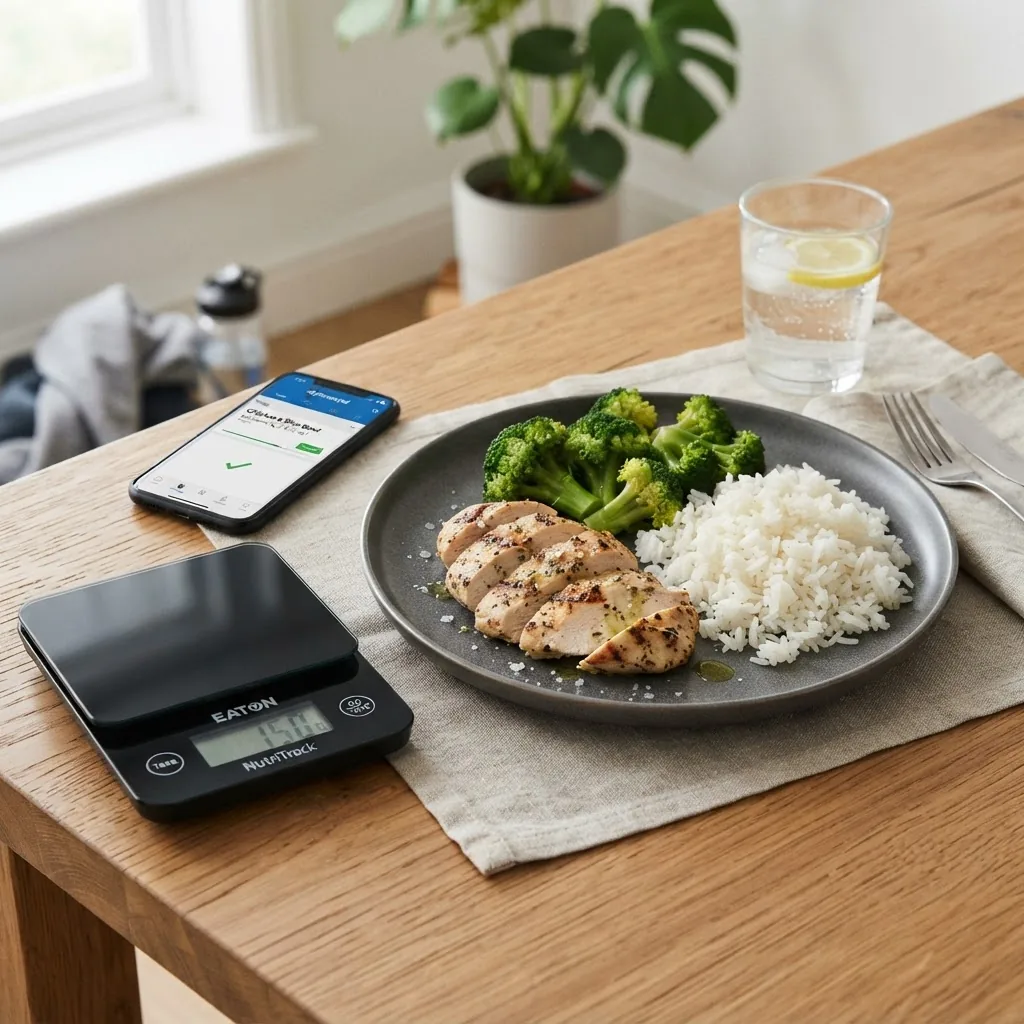
Concrete plate example for a post-workout meal (target P48/C84/F20):
- Cooked chicken breast 200 g = 62 g protein, 7.2 g fat (reduce to 150 g if protein overshoot) — aim 150 g = 46.5 g protein.
- Cooked white rice 300 g = 84 g carbs.
- 1 tsp olive oil (5 mL) on veggies = 4.5 g fat.
- Steamed broccoli 150 g for fiber and micronutrients.
Use the above measures to hit target macros within ±5 g protein and ±10 g carbs. If protein goes slightly over, prioritize hitting carb target precisely on heavy workout days.
-
Create a 7-day sample workout diet plan with exact meals
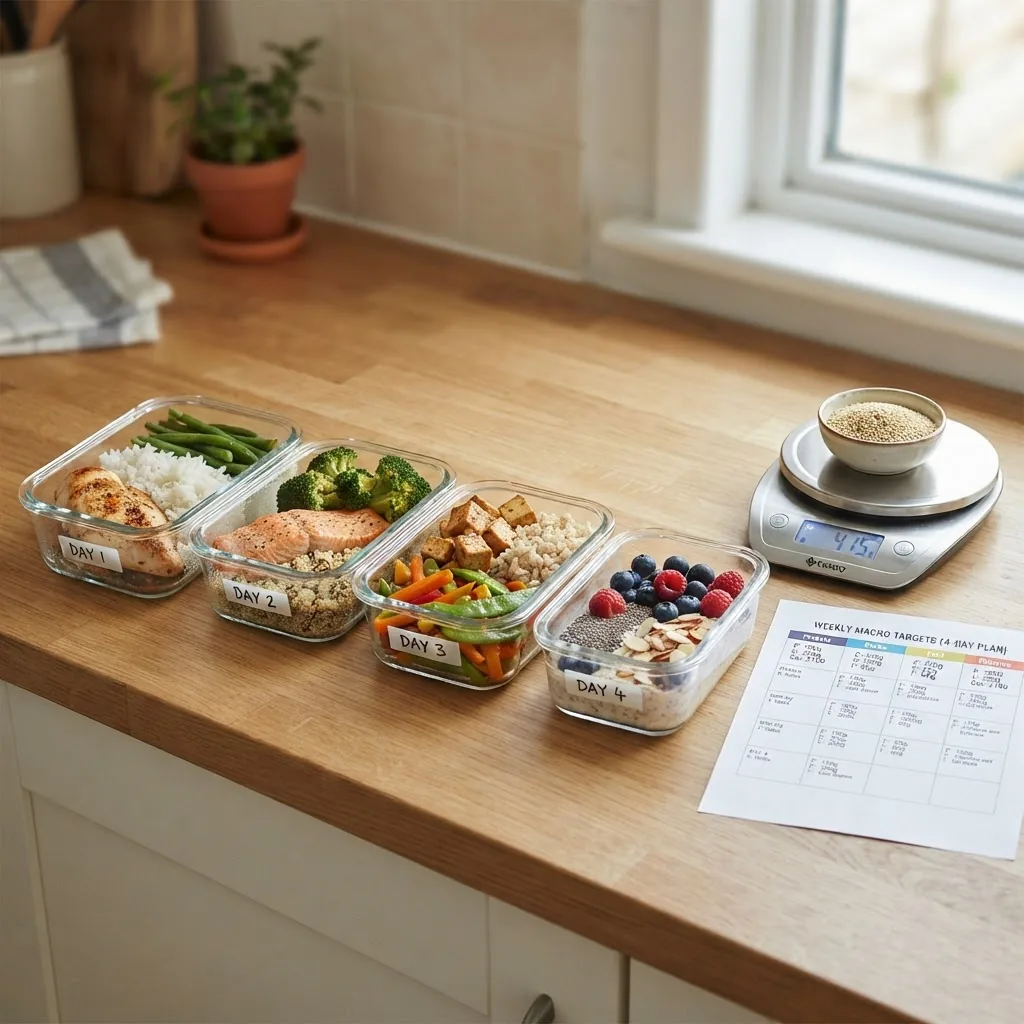
Below is a practical week you can follow exactly. Each day lists meals with weights (cooked where specified). Swap similar items but keep grams consistent.
Day 1 — Heavy lower-body strength (training at 6 pm)
- Breakfast (07:30): 60 g dry oats (190 kcal), 250 mL skim milk (90 kcal), 1 medium banana (120 kcal), 1 scoop whey (30 g protein) mixed — weigh oats dry and milk.
- Pre-workout (16:00): 1 rice cake (10 g carbs) + 120 g Greek yogurt (12 g protein) + 20 g honey (16 g carbs).
- Post-workout dinner (19:30): 180 g cooked chicken breast (≈56 g protein), 250 g cooked white rice (≈70 g carbs), 150 g mixed vegetables, 1 tbsp olive oil (14 g fat).
- Evening snack (21:30): 200 g cottage cheese (≈24 g protein) + 15 g almonds (8 g fat).
Day 2 — Low-intensity cardio
- Breakfast: 3 eggs scrambled (18 g protein), 2 slices whole-grain toast (30 g carbs), 50 g avocado (6 g fat).
- Lunch: 150 g cooked salmon salad (≈37 g protein, 12 g fat), 100 g cooked quinoa (≈21 g carbs), leafy greens 200 g.
- Snack: Protein shake 1 scoop + 1 apple (20–25 g carbs).
- Dinner: Stir-fry tofu 200 g (16 g protein), 200 g mixed veg, 150 g cooked brown rice (≈42 g carbs), 1 tbsp sesame oil (14 g fat).
(Continue Days 3–7 with similar structure: alternate heavy strength days with low-intensity or rest days, shifting carbs higher on heavy days and lower on rest days; keep protein steady.)
Keep total day macros within ±5 g protein and ±10–15 g carbs of your target. For female targets use adjusted portion weights (e.g., 120 g cooked chicken instead of 180 g).
-
Grocery list and batch-cooking schedule with timings
Buy quantities that match your weekly plan. Example for one person for 7 days (based on the sample above):
- Chicken breast (raw): 1,400–1,600 g (plan 150–230 g cooked per meal; raw to cooked shrinkage ≈ 20–25%).
- Salmon fillets: 600 g.
- Tofu firm: 600 g.
- White rice (dry): 700 g (yields ≈ 2,000 g cooked).
- Quinoa (dry): 200 g.
- Oats (dry): 350 g.
- Eggs: 12–18 large.
- Greek yogurt: 1.5–2 kg tub.
- Frozen mixed vegetables: 1.5–2 kg.
- Fresh produce: bananas 7, apples 5, broccoli 1.5 kg, mixed salad greens 600 g, sweet potatoes 1.2 kg.
- Olive oil 250 mL, almonds 200 g, cottage cheese 500 g.
Batch cooking schedule (Sunday, ~2 hours):
- Start rice: 40 minutes (for 700 g dry; use rice cooker 5–7 cups cooked; cook once).
- Roast chicken: preheat oven 200°C (392°F). Season and roast raw chicken breasts 25–35 minutes depending on size; rest 5 minutes then slice. (Total time 35–45 minutes.)
- Bake sweet potatoes: 45–60 minutes at 200°C (392°F) until tender.
- Steam/roast vegetables: 20–30 minutes.
- Cook quinoa: 15 minutes.
- Divide into 6 meal containers: weigh each portion to match macros and label with meal and day.
Reheating notes: store dressings separately; reheat proteins no more than once and never leave at room temperature >2 hours. Use meal containers rated for microwave use if reheating at work.
-
Pre- and post-workout nutrition: timing and exact portions
Timing and amounts matter more when training intensity is high. Use these guidelines:
- Pre-workout (60–90 min before): 20–30 g protein + 30–40 g carbs. Example: 120 g Greek yogurt + 1 small banana = ~20 g protein and 30 g carbs.
- During workout (over 90 minutes high-intensity): sip water with 30–60 g carbs/hour as a 6–8% carbohydrate electrolyte drink (e.g., 60 g maltodextrin in 1 L water for a long training session).
- Post-workout (within 30–60 min): 0.3–0.5 g/kg protein and 0.8–1.2 g/kg carbs. For 80 kg male: protein 24–40 g; carbs 64–96 g. Example: 150 g cooked chicken (≈46 g protein) + 250–300 g cooked rice (≈70–84 g carbs).
If training fasted in the morning, prioritize a higher-carb breakfast post-workout and keep pre-workout to a 10–15 g protein small snack if needed.
See /nutrition-tips/eat-before-or-after-workout-guide-for-optimal-nutrition-timing/ for detailed timing options and variations.
-
Hydration, micronutrients, and sensible supplementation
Hydration and micronutrients support performance and recovery. Concrete guidelines:
- Daily water: 35–45 mL per kg bodyweight. For 80 kg = 2.8–3.6 L/day. Add 300–700 mL per hour of heavy training in heat (Texas summers require the higher end).
- Electrolytes: include 300–500 mg sodium/day beyond normal food on heavy sweat days; consider a sports drink while training >60 minutes.
- Micronutrients: aim for 2–3 cups leafy greens/day, 2 servings of fruit/day, 3+ colors of vegetables across meals to hit vitamin and mineral targets.
Evidence-based supplements to consider (optional, with dosages):
- Creatine monohydrate: 3–5 g/day to support strength and lean-mass retention.
- Whey protein: 20–30 g post-workout to hit protein targets when meals are impractical.
- Vitamin D3: 1,000–2,000 IU/day if you live in low sun or have lab-confirmed insufficiency; test first if possible.
Always prefer whole foods; use supplements to fill gaps or convenience. Consult a clinician before starting medications or high-dose vitamins.
External reference for nutrient guidance: USDA ChooseMyPlate resources can help visualize plate composition: https://www.choosemyplate.gov/.
-
Track progress: metrics, frequencies, and practical thresholds
Use multiple metrics rather than scale-only. Track:
- Body weight: daily first thing, then weekly average. Expect 0.25–0.75% bodyweight loss per week for lean, sustainable results. For an 80 kg person, that’s 0.2–0.6 kg/week.
- Strength: log sets, reps, and weight each workout. If strength falls >10% across two weeks, increase calories by 5–10%.
- Measurements: waist, hips, chest, and thighs every two weeks. Look for reduced waist circumference as the primary body composition indicator.
- Photos: consistent lighting and poses every two weeks for visual comparison.
Adjustment rules:
- After 3 weeks, if weight/waist hasn’t changed and strength is stable, drop calories by 5% or increase weekly cardio by 75 minutes.
- If energy or workouts suffer (chronic fatigue, dropping strength), raise calories by 5–10% or increase carbs on training days.
-
Introduce periodic refeed and diet breaks correctly
Long-term dieting benefits from planned higher-carb refeed days and short diet breaks to protect hormones and performance.
- Refeed day: once every 10–14 days, increase calories to maintenance for 24 hours, primarily via carbohydrates (add 50–100 g carbs depending on size). Example: for the 80 kg male, add 500–800 kcal as carbs to raise day to 3,000–3,600 kcal.
- Diet break: after 8–12 weeks of continuous deficit, take a 7–14 day diet break at maintenance calories (no bingeing) to restore energy and mental adherence.
Use refeeds strategically before a big training session or event; monitor scale and waist next day to differentiate glycogen-related weight from fat regain.
-
Plan workouts to complement the diet: strength priority with progressive overload
Your diet will do most of the fat-loss work; strength training preserves muscle. Practical weekly split:
- 3 strength sessions/week (compound-focused): 45–60 minutes each, progressive load (2–5% increase every 1–2 weeks when reps allow).
- 1–2 moderate cardio sessions (30–45 minutes steady state) or 1 HIIT session (10–20 minutes) depending on preference.
- 2 rest/active recovery days with light mobility work.
Nutrition notes: schedule heavier carbs on strength days (increase 20–30% carbs) and lower carbs on rest days (drop 10–25% carbs but keep protein constant).
Small example strength workout (A): Squat 5×5, Bench 5×5, Romanian deadlift 3×8, Pull-ups 3×6. Keep rest 2–3 minutes between heavy sets; total session time ≈ 45–60 minutes.
-
Make data-driven adjustments: a three-week decision flow
Follow this simple three-week cycle to decide whether to change calories:
- Week 0 — baseline: record TDEE-derived target and start tracking.
- Week 1–2 — observe: track weight daily and weekly average; track workouts and energy.
- End of Week 3 — decision:
Decision thresholds:
- If weekly average weight dropped by 0.25–0.75% and strength stable: maintain current plan.
- If no change and energy is normal: reduce calories by 5% or add 75 minutes of low-intensity cardio per week.
- If weight dropped >1%/week or strength declines: increase calories by 5–10% to avoid excessive lean mass loss.
Document changes and reevaluate after three more weeks. Make only one variable change at a time (calories, cardio, or sleep) to know what worked.
-
Fine-tune personalization: food preferences, blood glucose, and digestive tolerance
People respond differently to fiber, dairy, and FODMAPs. Practical rules I use with clients in Texas climates:
- If you experience bloating or GI distress, test reducing high-FODMAP foods (onions, garlic, apples) for 7 days and replace with tolerated foods while keeping macros stable.
- If blood glucose swings impair training, split larger carb meals into two smaller doses around workouts (e.g., 40 g carbs 90 min pre + 30 g carbs 15 min pre).
- If you do shift work or late training, move the largest meal to post-workout and keep evening protein high with lower carbs to preserve sleep quality.
Record subjective metrics (hunger, sleep, GI comfort) every day; if a pattern of poor sleep or high hunger appears for >7 days, increase calories by 5–10% or improve meal timing and protein distribution.
-
Maintain adherence: practical habits and contingency plans
Adherence is the primary predictor of success. Implement these concrete habits:
- Prepare and portion at least 5 meals on Sunday; commit to 2 “free but measured” meals/week where you log but don’t weigh (must still stay within weekly calorie band ±5%).
- When eating out: choose grilled proteins 150–200 g, ask for sauces on the side, choose 1 cup rice or 1 medium potato, and estimate serving sizes with your palm and cupped hand—then log conservatively (+10%).
- If you miss a meal, replace it with a quick shake: 30 g whey (24 g protein) + 50 g oats (31 g carbs) + water — a 350–420 kcal meal replacement matching macros roughly.
Accountability tip: log every meal for at least 21 days to build the tracking habit; remove the phone’s “auto-complete” for entries for more accurate logging initially (this reduces sloppy entries).
Worked examples: two full daily meal plans with weights and macros
Complete day for the 80 kg male (target 2,345 kcal / P160 / C280 / F65):
| Meal | Food (weights) | Macros (P/C/F) & kcal |
|---|---|---|
| Breakfast | 50 g oats (dry), 250 mL skim milk, 1 scoop whey (30 g), 1 medium banana | P:40 g / C:72 g / F:9 g — 590 kcal |
| Pre-workout | 120 g Greek yogurt, 1 small apple | P:18 g / C:30 g / F:1 g — 220 kcal |
| Post-workout / Lunch | 150 g cooked chicken, 300 g cooked rice, 150 g broccoli, 1 tsp olive oil | P:48 g / C:84 g / F:10 g — 700 kcal |
| Dinner | 130 g cooked salmon, 200 g sweet potato, mixed salad 200 g, 1 tbsp olive oil | P:36 g / C:52 g / F:22 g — 610 kcal |
| Snack | 200 g cottage cheese, 15 g almonds | P:18 g / C:12 g / F:13 g — 225 kcal |
Totals approximate: P=160 g, C=250–280 g, F=65 g, kcal ≈ 2,345. Adjust rice portion +25–50 g cooked to hit final carb target if necessary.
Common mistakes and how to avoid them (practitioner notes)
I once had a client who kept increasing cardio every week while keeping the same large calorie deficit; within three weeks they lost weight but strength collapsed and they felt chronically tired. I corrected this by raising calories 7%, reducing cardio, and prioritizing protein. Strength recovered in 10 days.
I also commonly see people underestimate portions—especially oil and restaurant dressings. I watched a person log “grilled chicken salad” without measuring and underestimate 400 kcal/day from dressing, which stalled fat loss. My fix: measure or request dressings on the side and add a conservative 20% to logged restaurant meals.
Another repeated error: dropping protein to hit calorie goals. I had a client who cut protein to 0.8 g/kg; over four weeks lean mass decreased. I recommend keeping protein 1.6–2.4 g/kg and reducing carbs or fat instead.
Compact checklist to verify your work
- Daily calorie target calculated using Mifflin–St Jeor and appropriate activity factor.
- Macronutrients set in grams: protein 1.6–2.4 g/kg, fat 20–30% of calories, carbs as remainder.
- Meal macro distribution logged (3 meals + snacks) and within ±5 g protein per day.
- One week of meal prep containers labeled with weighed portions completed.
- Pre/post-workout meals timed (pre 60–90 min, post within 30–60 min) and match guidelines.
- Hydration goal set (mL/day) and electrolytes planned for heavy sweat days.
- Tracking system in place for weight, strength, measurements, and photos weekly.
When to call in a professional
Contact a registered dietitian or physician if you have type 1 or type 2 diabetes, a recent cardiovascular event, kidney disease, pregnancy, or if you’re losing >1.0% bodyweight/week and experiencing persistent fatigue, bradycardia, or amenorrhea. If you need a very precise competition cut (bodyfat within the single digits) or have complex food allergies, hire a sports dietitian for tailored periodization and lab monitoring.
Additional resources and internal links
Use the pillar guide on balanced meals for nutrient completeness: Nutritionally Complete Meal Guide. If you want a ready 7-day menu you can plug into the macro targets here, see /nutrition-tips/7-day-diet-menu-to-lose-weight-with-meal-planning-guide/. For timing around workouts, read /nutrition-tips/eat-before-or-after-workout-guide-for-optimal-nutrition-timing/.
Troubleshooting quick reference
If you plateau for three weeks and your strength is intact, reduce daily calories by 5% and add 2×20 minute brisk walks per week. If energy drops and sleep worsens, increase calories by 5% and prioritize evening protein. If GI issues appear after adding more fiber, lower high-FODMAP items and reintroduce one at a time after two weeks.
Frequently Asked Questions
What is the best diet to get fit and lean?
The best diet prioritizes a modest calorie deficit (10–20%), high protein (1.6–2.4 g/kg), moderate carbs timed around workouts, and fats at 20–30% of calories. Focus on whole foods, consistent tracking for three weeks, strength training, and periodic refeeds to protect performance and adherence.
How many calories should I eat to get lean?
Calculate your RMR with Mifflin–St Jeor, multiply by an activity factor (1.35–1.70), then reduce by 10–20% as your starting deficit. Example: a moderately active 80 kg male with TDEE 2,759 kcal would start around 2,345 kcal (15% deficit).
Should I eat before or after workouts to lose fat and keep muscle?
Eat a small pre-workout with 20–30 g protein and 30–40 g carbs 60–90 minutes before training for performance, and prioritize a post-workout meal within 30–60 minutes containing 0.3–0.5 g/kg protein and 0.8–1.2 g/kg carbs to support recovery and muscle retention.
Can I lose fat and build muscle at the same time?
Yes, but it’s most likely for beginners, those returning from a layoff, or when prioritizing a small calorie deficit with high protein and progressive strength training. Expect slower visible changes; monitor strength and circumference rather than scale alone.
How long until I see results from this workout diet plan?
Expect measurable changes in body weight or waist circumference within 2–4 weeks; significant body composition shifts take 8–12 weeks. Strength improvements can appear in 2–6 weeks if you follow progressive overload and keep protein sufficient.