What you’ll finish with, time required, and assumed skill level
By the end of this guide you will have a finished, one-week healthy grocery list tailored for one adult (with clear scaling instructions for 2 or 4 people), a prioritized shopping route, an organized pantry audit, and a meal-pairing plan that covers breakfast, lunch, dinner and two snacks per day. You will also have explicit quantities (ounces, cups, cans), storage and shelf-life targets, and a simple weekly prep schedule so nothing spoils before you use it.
Expect to spend 60–120 minutes on planning and pantry audit at home, 45–75 minutes in the store for a full weekly shop, and 2–4 hours for batch meal prep once a week. This guide assumes beginner-to-intermediate kitchen skills: you can chop vegetables, roast a sheet pan, simmer a pot of beans, and follow a simple oven temperature and timing instruction.
Before you start
- Grocery list template (paper, phone notes app, or a printable sheet)
- Kitchen scale (0.1–5,000 g capacity) or measuring cups and spoons
- Pen and highlighter for pantry audit
- Reusable grocery bags and insulated cooler bag for cold items
- Phone or camera to photograph expiration dates (optional)
- Access to one nutrition reference: USDA MyPlate (https://www.choosemyplate.gov/) for portion benchmarks
- Calculator or phone calculator for simple quantity math
Core steps: build and use a practical healthy grocery list
-
Decide your dietary goals and energy target
Action first: write down your primary goal for this shopping trip — weight maintenance, weight loss (mild deficit), muscle gain, or improved variety for general health. Then convert that goal into a daily calorie target.
Quick method (for a realistic start): use the Mifflin-St Jeor estimate as a baseline, then adjust by activity level.
Example calculation for a 35-year-old woman, 5’6″ (167 cm), 150 lbs (68 kg), moderately active:
- Basal metabolic rate (Mifflin-St Jeor): 10 × 68 + 6.25 × 167 − 5 × 35 − 161 = 680 + 1,044 − 175 − 161 = 1,388 kcal/day
- Multiply by activity factor (1.55 moderate activity): 1,388 × 1.55 ≈ 2,151 kcal/day
- If the goal is mild weight loss, subtract 300–500 kcal → target 1,650–1,850 kcal/day
Record the final target prominently on your planning page. It will determine quantities on your healthy grocery list — for example, protein targets of 20–30% of calories (82–138 g/day at 1,650–1,850 kcal) shape how much meat, dairy, legumes, and nuts you buy.
-
Audit your pantry and fridge right now
Action first: empty the front shelf of your pantry and the top of your fridge and sort items into three piles: keep (use within 7 days), toss (expired or freezer-burned), and relocate (stored incorrectly).
Check these specifics:
- Dry goods: unopened grains/pasta are safe for 12–18 months; opened grains stored in airtight containers are best used within 3 months for fresh flavor.
- Oils: olive oil is best used within 6 months after opening; if it smells rancid, discard.
- Canned goods: if dented on the seam or bulging, discard. Otherwise, canned vegetables and beans keep 2–5 years; note the date opened and use within 3–4 days refrigerated.
- Fresh produce: use leafy greens within 5–7 days once opened; apples last 4–6 weeks in the fridge; berries 3–5 days refrigerated.

Take one photo of any confusing expiry dates or packaging claims so you can reference them while building the list. Replace duplicates: if you have an opened bag of rice and a new unopened bag, use the older one first and note “use within 3 months.” Mark items on your list to avoid accidental repurchase.
-
Create a one-week meal template
Action first: sketch weekdays (Mon–Sun) in a three-meal-plus-2-snack format. Assign protein, carbohydrate, vegetable, fruit, and healthy fat targets for each meal using portion benchmarks.
Portion benchmarks (single adult, adjust linearly):
- Breakfast: 20–30 g protein, 30–45 g carbohydrates, 1 cup fruit or vegetables, 1 tbsp healthy fat.
- Lunch: 25–40 g protein, 30–50 g carbohydrates, 1–2 cups vegetables, 1 tbsp healthy fat.
- Dinner: 25–40 g protein, 30–50 g carbohydrates, 1–2 cups vegetables, 1 tbsp healthy fat.
- Snacks (two per day): 10–15 g protein or 150–250 kcal each; examples: 6–8 almonds + 1 small apple, or 1 cup Greek yogurt (6 oz) with 1 tbsp flaxseed.
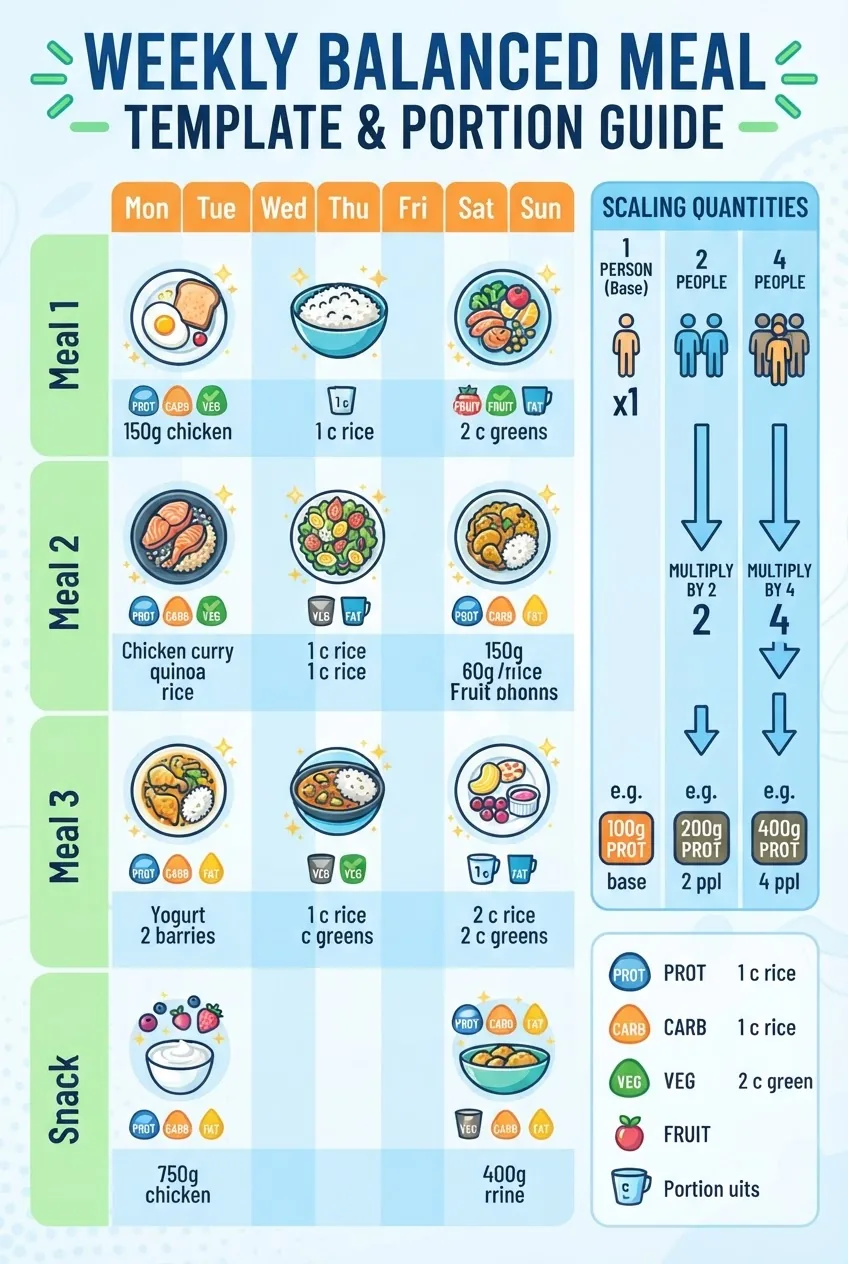
Fill the template with three simple recipes repeated across the week to reduce shopping variety and food waste. Example: Baked chicken, roasted veggies, and brown rice (Mon/Tue); vegetarian chili with beans and corn (Wed/Thu); salmon, sweet potato, and greens (Fri/Sat); brunch-style omelet with spinach (Sun).
-
Build your category-by-category healthy grocery list
Action first: use the meal template to convert portions into quantities. Below is a ready-made, one-week healthy grocery list sized for one adult. Scale by 1.8× for two adults who both eat the same, or 3.6× for four adults; round to whole items when necessary.
One-week shopping list for one adult (exact quantities):
Category Item Quantity (1 week) Notes Produce Spinach, bagged 10 oz (1 bag) Use for salads & omelets; buy pre-washed Produce Broccoli crowns 2 crowns (~20 oz total) Roast two sheet pans Produce Berries (strawberries or blueberries) 12 oz total Breakfast and snacks; buy frozen if price high Produce Bananas 7 medium 1 per day snack or smoothie Protein Boneless, skinless chicken breasts 32 oz (2 lb) Cook 16 oz for 2 dinners, freeze remainder Protein Canned beans (black/chickpeas) 3 cans (15 oz each) Choose low-sodium (<140 mg/srv) when possible Dairy & Alternatives Greek yogurt, plain 32 oz tub Protein-rich snack; 6 oz per snack Grains Brown rice, dry 16 oz (1 lb) Cook 1 cup dry = 2–3 meals Grains Old-fashioned oats 18 oz container Breakfast staples Fats & Seeds Extra-virgin olive oil 16 fl oz bottle Use 1 tbsp/day for cooking/dressing Nuts Almonds, raw 8 oz bag Snack portions: 1 oz (23 almonds) Freezer Frozen mixed vegetables 16 oz bag Backup veg for busy nights Pantry staples Canned tuna in water 2 cans (5 oz each) Quick protein for salads Herbs & Spices Garlic (fresh) 2 bulbs Use 1–2 cloves per savory meal Beverages Sparkling water / green tea 6-pack or 16 tea bags Hydration & variety Scale rule examples: for two adults, buy 3.6 lb chicken breast (round to 4 lb) rather than 2 lb; for four adults multiply quantities by 3.6 again and adjust to full-package sizes (e.g., buy two 5 lb rice bags instead of one).
Internal links for more meal templates and portion guidance: see the Nutritionally Complete Meal Guide and the 7-day plan at 7 Day Diet Menu.
-
Choose packaged foods with a rules-based label scan
Action first: for any packaged item allocate 30–60 seconds to check three things: serving size, added sugar, sodium, and fiber. Use these thresholds to decide purchase:
- Added sugar: aim for <8 g per serving for breakfast foods and snacks; cereals should be <8 g sugar/serving.
- Fiber: seek ≥3 g fiber per serving for cereal/bread; ≥5 g for legumes and whole-grain snacks is better.
- Sodium: for canned soups, broths, or prepared sauces choose options labeled low-sodium (≤140 mg per serving) or rinse canned beans to remove ~40% of sodium.
- Saturated fat: keep saturated fat <3 g per typical serving for snack items; dairy and meat portions fit within daily limits if total saturated fat stays below 10% of calories (~18–20 g saturated fat on a 1,800–2,000 kcal diet).
Example: If a whole-grain cereal lists 12 g sugar per serving and only 2 g fiber, swap it for one with 6 g sugar and 4 g fiber. For peanut butter, prefer ingredients that list only peanuts (and salt optional); avoid varieties with sugar and hydrogenated oils listed high up in ingredients.
For more label-reading depth, cross-check the step with our sibling article Food Labels Guide.
-
Prioritize fresh vs frozen vs canned by item and shelf life
Action first: mark items on your list as Fresh (use in 3–7 days), Frozen (keeps 3–12 months), or Canned/Dry (keeps 6–24 months unopened). This reduces waste and clarifies shopping frequency.
Rules of thumb with numbers:
- Fresh leafy greens: buy 1 bag (8–10 oz) per 2–3 days. If you shop weekly, choose half fresh (for early-week use) and half frozen or pre-washed spinach for later in the week.
- Fresh fish/shellfish: buy only for 1–2 days of meals unless frozen; otherwise purchase frozen fillets and plan to thaw 24 hours in the fridge.
- Root vegetables (potatoes, carrots, beets): buy 2–4 lb for a week for one adult.
- Frozen vegetables: buy 1–2 16 oz bags as backup; they retain nutrients and reduce spoilage.
-
Plan the shopping trip route and timing
Action first: choose your store and time using these Texas-friendly tips: shop weekday mornings 8:00–10:00 AM to avoid crowds, or weekday evenings 7:30–9:00 PM if you work. Weekend early mornings (7:00–8:30 AM) are second-best.
Route strategy (for a typical full-service supermarket):
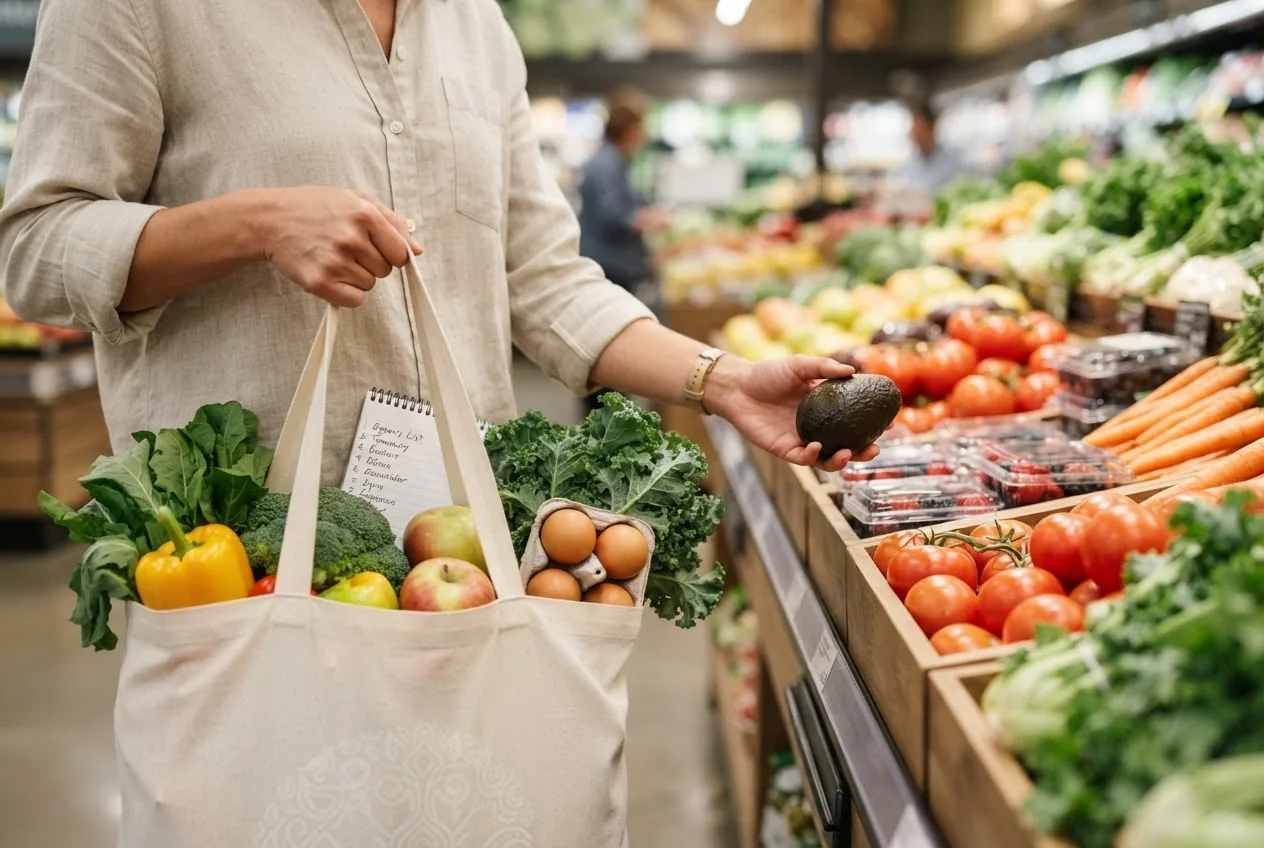
- Start in produce to pick the freshest items first and place them on top in your cart.
- Proceed to meat/seafood last to keep cold chain intact; pick frozen items immediately afterwards.
- Finish with pantry staples and dry goods; do canned/boxed items before bakery to avoid crushing fresh bread.
Use refrigerated cooler bag for the final 20–30 minutes of the trip if you have a long drive home, and get ice packs for hot Texas summers if greater than 30 minutes from store to home.
-
Shop with a “first-to-expire” mindset and check dates in-store
Action first: when picking perishable items in-store, consistently take the package with the furthest-away “best by” date only when you’re willing to use or freeze it within its shelf life. For meat, choose packages with an uncooked use-by date at least 3 days in the future; if shorter, plan to freeze immediately.
Example timing actions:
- Fresh chicken: buy packages with a use-by date ≥3 days ahead or freeze on day of purchase at 0°F. Thaw in the fridge 24 hours before cooking.
- Salad greens: pick bunches with crisp leaf edges, not wilting; shelf life 5–7 days refrigerated.
- Yogurt tubs: check production and best-by; unopened yogurt usually lasts 1–3 weeks unopened and 5–7 days after opening.
-
Handle checkout and cold-chain preservation
Action first: at the register separate cold items into the insulated bag and keep dry goods together. Do not leave groceries in a hot car longer than 20 minutes when outside temperatures exceed 85°F. If your trip includes a coffee stop or errands, place perishable items last in the car and out of direct sun.
Cold chain rules:
- Fridge target: keep at 35–38°F (2–3°C).
- Freezer target: 0°F (−18°C) or lower.
- Transfer meats and fish to the coldest part of your fridge immediately; store raw meat on the lowest shelf in a tray to catch drips.
-
Do an efficient weekly prep session (2–4 hours)
Action first: set aside 2–4 hours on one chosen day (Sunday or a weekday evening). Follow this order to maximize oven and burner use:
- Preheat oven to 400°F (204°C). Season and bake 2 lb chicken breasts for 18–22 minutes (internal temp 165°F / 74°C). Let rest 5 min; slice for salads and dinners.
- Roast 2 crowns broccoli and 2 medium sweet potatoes on sheet pans at 400°F: broccoli 18–22 minutes; sweet potatoes 40–45 minutes (cut to 1-inch cubes to reduce time to 25–30 minutes).
- Cook 1.5 cups dry brown rice (yields ~4–5 cups cooked): bring to boil, cover, simmer 35–40 minutes, then rest 10 minutes.
- Simmer one pot of vegetarian chili: sauté onion/garlic 5 minutes, add canned beans (drained), 2 cups crushed tomatoes, 1 cup broth, simmer 25–30 minutes.
- Portion meals into 5–7 ready-made containers: each container with 4–6 oz cooked protein, 1 cup vegetables, ½–1 cup grains/starch. Label with date.
Cooling guideline: cool hot foods to below 41°F within 4 hours. Divide large pots into shallow containers to speed cooling.
-
Store groceries to maximize freshness and reduce waste
Action first: immediately repackage bulk items into airtight containers and label with the date opened. Use clear containers for visibility and stackability.
Storage specifics:
- Refrigerated cooked meals: use within 3–4 days or freeze portions (freeze up to 3 months for best quality).
- Leafy greens: wrap washed, dried greens in paper towels inside a sealed container—use within 5–7 days.
- Berries: do not wash until ready to eat; spread on a paper-towel-lined tray and refrigerate; use within 3–5 days.
- Whole grains in pantry: transfer to airtight container and date; use within 6 months for best flavor.
-
Track consumption and adjust quantities weekly
Action first: at the end of each week record what you used and what you didn’t. Keep a one-line log: “Protein used 24/32 oz; berries 6 oz leftover; spinach 75% used.” Over two shopping cycles you will identify consistent overbuying items to cut by 25–50% and underbuying items to increase 25–50%.
Example adjustment: if you consistently have 8–10 oz leftover chicken after a week (from a 32 oz buy), reduce next week to 24 oz or freeze half immediately after purchase.
-
Use cost-saving swaps and budget targets
Action first: set a weekly grocery budget target (Texas average for one adult on a moderate healthy diet: $55–$85/week depending on region). Use these swaps if you breach the budget:
- Swap fresh berries for 16 oz frozen bag when price exceeds $3.50 per 6 oz equivalent.
- Buy whole chickens instead of breasts when price per pound is ≥20% lower; roast and portion yields more cooked weight per dollar.
- Buy dried beans (1 lb dry = ~6 cups cooked) instead of canned when cost per cooked cup is lower; soak 8–12 hours and simmer 60–90 minutes (pressure cook 25–30 minutes).
Clip coupons, use store loyalty prices, and check unit prices on shelf tags — they tell you cost per ounce or per count and help you pick the better value.
-
Plan for dietary restrictions and special conditions
Action first: add three alternative items per common restriction so you can substitute without extra shopping:
- Vegetarian: extra firm tofu (14 oz block), package tempeh (8 oz), extra canned lentils (2 cans).
- Low-sodium: choose no-salt-added canned tomatoes and beans; buy low-sodium broth (≤140 mg/srv) 32 oz cartons.
- Diabetes-friendly: prioritize non-starchy vegetables and whole grains; swap white rice for ¾ cup cooked quinoa or ½ cup cooked barley per meal.
When in doubt about a clinical condition, see the “When to call a professional” section below.
-
Finalize and digitize the healthy grocery list
Action first: convert your paper list into one of these three practical formats and pick the workflow you will actually use:
- Phone note app with bold headers per category and checkboxes; keep one master template and duplicate it weekly.
- Printable checklist with quantities written and a column for “already have” from your pantry audit.
- Grocery app that supports shared lists if shopping with family, with item quantities set and store aisle notes.
Example final checklist line: “Chicken breasts — 32 oz (2 lb) — buy fresh if plan to freeze; use-by ≥3 days from purchase.” Keep the list accessible on your phone and print a copy to attach to your fridge for family visibility.
Common mistakes and how to avoid them
I once bought a 5 lb bag of spinach because it looked like a deal, only to have it wilt within four days—wasted money and time. Now I buy a 10 oz pre-washed bag and a 16 oz frozen bag so I use fresh early in the week and frozen later.
I have also mistakenly assumed “reduced fat” meant low calorie; I learned to compare calories and sugar per serving. Reduced-fat flavored yogurts often add sugar; I now prefer plain Greek yogurt and portion fruit for sweetness.
Another repeated failure: buying several new recipes’ ingredients in one week. The result was unused specialty items. My rule now: test one new recipe per week; stick to repeats otherwise. If a recipe calls for an expensive herb used only once, substitute dried or skip it until you know you’ll reuse it.
Compact checklist to verify your work
- Meal template completed with daily calorie and protein targets recorded.
- Pantry/fridge audit done, duplicates noted, expired items removed.
- One-week healthy grocery list created with category quantities for one adult.
- Packaged foods checked using label thresholds: sugar ≤8 g, fiber ≥3 g, sodium ≤140 mg for low-sodium options.
- Shopping time and route planned; insulated bag ready for cold foods.
- Weekly prep session scheduled with cooking order and times (ovens, simmering, rice).
- Storage approach set: date-marked containers, fridge <38°F, freezer 0°F, cooked meals labelled.
- Budget checked and cost-saving swaps identified.
When to call in a professional
Call a registered dietitian or physician if you have diabetes, kidney disease, a recent cardiac event, pregnancy, breastfeeding with special dietary needs, or multiple food allergies. Also consult a dietitian if you need a medically-tailored plan (e.g., phosphorus or potassium limits). If you simply want personalized macronutrient targets beyond a general healthy grocery list — especially for athletics or recovery — a credentialed sports dietitian can create exact gram targets and timing.
Appendix: Worked examples and scaling math
Scaling the one-week list for two adults who eat similarly
Rule: multiply per-person quantities by 1.8 (not exactly 2) because some items scale non-linearly (e.g., spices, oils). Example: 32 oz chicken for one adult × 1.8 = 57.6 oz → round to 58–60 oz (3.6 lb). If standard package sizes are 2.5 lb or 5 lb, choose the one closest that avoids waste: pick 5 lb only if you plan to freeze half immediately.
Meal packing example for Monday
Target for Monday (1,800 kcal example):
- Breakfast: 1 cup cooked oats (150 g), 6 oz Greek yogurt, ½ cup berries. Prep: combine overnight or heat oats 3–4 minutes.
- Lunch: 5 oz sliced baked chicken, 1 cup brown rice cooked (200 g cooked), 1 cup steamed broccoli, 1 tbsp olive oil dressing.
- Dinner: Vegetarian chili 1.5 cups, side salad 2 cups spinach, 1 tbsp olive oil vinaigrette.
- Snacks: 1 medium banana; 1 oz almonds.
Convert to grocery quantities: breakfast oats for 7 days ≈ 7 cups dry (~600 g). Greek yogurt 6 oz × 7 = 42 oz → buy 48 oz tub to allow margin. Chicken 5 oz × 3 dinners = 15 oz + 1 dinner portion extra = 32 oz total as listed earlier.
Replacing luxury items with budget-friendly alternatives
Example: swapping almond butter for peanut butter saves ~25–40% on cost per ounce. If almond butter recipe calls for 2 tbsp/day and price is $0.80 per tbsp vs $0.50 for peanut butter, swap or reduce almond butter to one 2-tablespoon serving twice a week rather than daily to save without losing variety.
Frequently Asked Questions
What is a healthy grocery list for beginners?
A healthy grocery list for beginners includes a balance of lean proteins, whole grains, fruits, vegetables, healthy fats, and pantry staples. Start with precise quantities for one week: e.g., 32 oz chicken, 16 oz brown rice, 10 oz spinach, 12 oz berries, three 15 oz canned beans, 32 oz Greek yogurt.
How much should I buy per week for one adult?
For one adult on a balanced 1,600–1,900 kcal plan, buy roughly 2–3 lb protein (e.g., 32–48 oz cooked weight), 12–16 cups cooked grains/starches (1–2 lb dry), 1.5–2 lb fresh vegetables per week plus 12–16 oz frozen or canned backups, and 1–2 lb fruit.
Should I choose frozen or fresh vegetables?
Choose fresh for early-week meals and frozen as a backup. Frozen vegetables are nutritionally comparable, cost-effective, and last 6–12 months in the freezer; buy at least one 16 oz frozen bag per week to prevent waste and ensure cooked veg availability.
How do I read labels to pick the healthiest packaged foods?
Check serving size, sugar, sodium and fiber. Prefer cereals and snacks with ≤8 g added sugar and ≥3 g fiber per serving. For canned products, pick low-sodium options (≤140 mg per serving) or plan to rinse canned beans to remove roughly 30–40% of sodium.
How often should I shop to minimize waste?
Weekly shopping is a practical cadence for most people, supplemented by a mid-week quick trip for fresh produce if needed. Buying frozen backups and planning early-week fresh items reduces spoilage and maintains variety without excess waste.
What is a realistic budget for a healthy grocery shopping list in Texas?
Expect $55–$85 per week for one adult on a moderate healthy diet in many Texas regions. Costs vary with protein choices and organic produce; use value swaps like dried beans, whole chickens, and seasonal produce to stay near the lower end.