What you will achieve, time required, and skill level
By the end of this guide you will have a ready-to-follow, evidence-informed proper diet to lose weight and gain muscle: a calculated daily calorie target, specific macronutrient targets (grams of protein, carbs and fat), three 1-week sample menus, a 2-hour shopping and meal-prep workflow, and a 12-week monitoring and adjustment plan. Expect to spend 3–4 hours upfront to set targets and prep week 1, then 3–6 hours per week for cooking and tracking. This guide assumes an intermediate beginner skill level: you can read nutrition labels, use a kitchen scale, and complete basic resistance training 3×/week.
Before you start
- Kitchen scale (digital, 0–5,000 g, accurate to 1 g)
- Food tracking app (MyFitnessPal, Cronometer, or equivalent)
- Basic cooking tools: skillet, oven, saucepot, measuring cups/spoons
- Protein source options: 2–3 packs of chicken breast (1 kg), 700 g lean ground turkey, 6 cans of tuna, or 1.5 kg firm tofu
- Whole grains & starches: brown rice (1.5 kg), rolled oats (1 kg), whole wheat bread (1 loaf)
- Healthy fats: olive oil (250 mL), mixed nuts (400 g), peanut butter (350 g)
- Fresh vegetables: mixed salad greens (2 bags), broccoli (1.2 kg), bell peppers (6)
- Supplements (optional): whey protein (one 900 g tub), vitamin D if deficient
- Body scale and a soft tape measure
Overview: the method in brief
This approach uses a controlled calorie deficit of 10–20% while prioritizing high protein (1.6–2.2 g/kg bodyweight) and resistance training to preserve and build muscle. Carbohydrate and fat are adjusted to meet calorie targets and personal preference. You will: (1) calculate maintenance calories, (2) set a deficit and protein target, (3) distribute macros per meal, (4) design daily menus with protein at each meal, (5) prepare food in 2-hour blocks, and (6) track progress and adjust every two weeks.
Step-by-step implementation
-
Calculate your starting calorie target and weekly weight goals
Step 1 is arithmetic and reality-checking. Use this two-stage process:
- Estimate maintenance calories: multiply bodyweight (kg) by activity factor. If you know your weight in pounds, divide by 2.2 to convert.
- Sedentary (desk job, minimal exercise): 28 kcal/kg
- Lightly active (1–3 workouts/wk): 33 kcal/kg
- Moderately active (3–5 workouts/wk): 36 kcal/kg
- Very active (daily training): 40 kcal/kg
Example: a 80 kg person, training 3×/week (moderately active) → 80 × 36 = 2,880 kcal maintenance.
- Set a deficit: subtract 10–20% depending on how aggressive you want to be.
- Conservative loss (preserve performance): −10% → 2,592 kcal/day
- Balanced (typical): −15% → 2,448 kcal/day
- Faster loss (only if experienced): −20% → 2,304 kcal/day
For most readers seeking to lose fat and gain muscle at the same time, choose −10% to −15% to enable muscle gain. Unless you are lean already (<12% body fat men, <22% women), pick −10%.
Record this target in your tracking app and set a practical weekly weight goal: 0.25–0.5% bodyweight/week (e.g., 0.2–0.4 kg/week for 80 kg). Faster weekly losses increase the risk of muscle loss.
- Estimate maintenance calories: multiply bodyweight (kg) by activity factor. If you know your weight in pounds, divide by 2.2 to convert.
-
Set a protein target in grams and per meal
Protein is the anchor for a diet to build muscle and lose fat. Aim for 1.6–2.2 g/kg bodyweight per day. Use higher values if you are in a larger calorie deficit or older than 40.
Examples:
- 80 kg male: 1.8 g/kg → 144 g protein/day
- 65 kg female: 1.8 g/kg → 117 g protein/day
Distribute protein evenly across 3–4 meals to maximize muscle protein synthesis. If you eat 4 meals: 80 kg example → 144 g ÷ 4 = 36 g protein/meal. Use the kitchen scale to measure cooked weights (e.g., 100 g cooked chicken breast ≈ 31 g protein).
Quick reference cooked-protein yields:
- Chicken breast, cooked: 31 g protein per 100 g
- Lean ground turkey, cooked: 27 g per 100 g
- Firm tofu, cooked: 12 g per 100 g
- Eggs: 6 g per large egg
- Whey isolate: 24 g per 30 g scoop
-
Allocate remaining calories to carbs and fats
With your protein target set, convert protein grams to calories (1 g protein = 4 kcal). Subtract that from your daily calorie target to get remaining calories for carbs and fats.
Example: 2,448 kcal target, 144 g protein → 576 kcal from protein. Remaining = 1,872 kcal.
Choose fat at 20–30% of total calories for hormonal health and satiety. Practical default: 25% of calories from fat.
- Fat calories = Total kcal × 0.25 (e.g., 2,448 × 0.25 = 612 kcal). At 9 kcal/g → 68 g fat/day.
- Remaining calories become carbs: 1,872 − 612 = 1,260 kcal → carbs at 4 kcal/g = 315 g/day.
Adjust within ranges: fat 55–85 g/day for most adults; carbs 150–400 g/day depending on training volume. If you train high-volume HIIT or long cardio, increase carbs toward the upper range.
-
Create a meal structure and sample day
Design 3–4 meals and 0–1 snacks so each meal has protein target met. Example structure for an 80 kg person, target 144 g protein, 2,448 kcal:
- Meal 1 (breakfast): 36 g protein, 60 g carbs, 15 g fat
- Meal 2 (lunch): 36 g protein, 80 g carbs, 20 g fat
- Meal 3 (post-workout): 36 g protein, 90 g carbs, 8 g fat
- Meal 4 (dinner): 36 g protein, 85 g carbs, 25 g fat
Sample day (quantities shown):
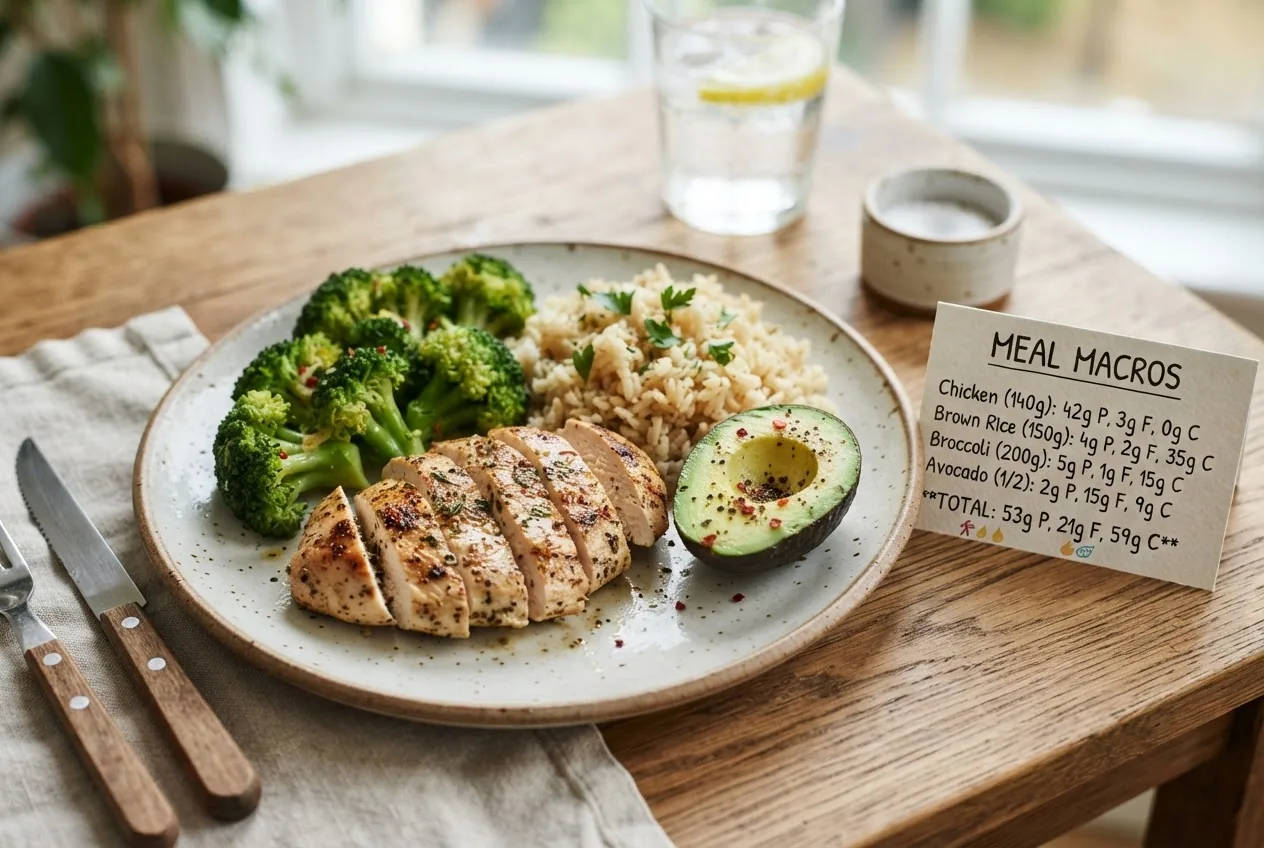
Meal Food Portion Protein / Carbs / Fat (g) Breakfast Rolled oats + whey + blueberries 60 g oats, 30 g whey, 150 g berries 36 / 60 / 15 Lunch Grilled chicken, brown rice, broccoli 140 g cooked chicken, 150 g cooked rice, 200 g broccoli 36 / 80 / 20 Post-workout Tuna wrap, banana 1 can tuna (140 g drained), whole wheat wrap, 1 banana 36 / 90 / 8 Dinner Salmon, sweet potato, salad 140 g cooked salmon, 250 g sweet potato, salad 36 / 85 / 25 Tweak carb timing around workouts: place 40–70% of daily carbs in the 3 hours around training if you do heavy resistance sessions, which supports performance and recovery.
-
Plan two practical 1-week menus (including swap lists)
Construct two interchangeable weeks so you can rotate variety and keep grocery shopping simple. Each weekday should target your daily macros within ±5% and protein to ±5 g.
Week A (high-carb training days): Monday, Wednesday, Friday are higher-carb training days; Tuesday/Thursday lighter days lower carbs by 30%. Week B flips the pattern or places carbs on weekends if you train then.
Example breakfasts (choose one each day):
- Oat bowl: 60 g oats, 30 g whey, 150 g mixed berries, 10 g almond butter (36 g protein)
- Egg sandwich: 4 egg whites + 1 whole egg, 1 slice whole wheat bread, 30 g avocado (32 g protein)
- Greek yogurt bowl: 300 g 0% Greek yogurt + 40 g granola + 20 g honey (34 g protein)
Swap list (use these to keep macros stable):
- Chicken breast 100 g cooked ↔ turkey breast 110 g cooked
- Brown rice 150 g cooked ↔ quinoa 140 g cooked
- Salmon 140 g cooked ↔ steak 120 g cooked (lean cut)
- Tofu 200 g cooked ↔ tempeh 140 g
Keep a table in your tracking app for portion-to-macro conversions. That speeds future meal logging to less than 2 minutes per meal.
-
Grocery list and 2-hour weekly meal-prep workflow
Use a single shopping trip and a 2-hour cooking block to prepare proteins, one grain, and two vegetable sides that you will mix across meals.
Grocery list for one person, 7 days (quantities approximate):
- Chicken breast, raw: 2.5 kg
- Salmon fillets: 800 g
- Canned tuna: 6 cans (140 g drained each)
- Rolled oats: 700 g
- Brown rice: 1.5 kg
- Sweet potatoes: 3 kg
- Frozen mixed vegetables: 1 kg
- Fresh salad greens: 3 bags
- Bananas: 12
- Mixed berries (frozen): 1 kg
- Olive oil: 250 mL
- Mixed nuts: 400 g
- Eggs: 18
- Whey protein: 900 g (optional)
2-hour prep workflow (timed):
- 0:00–0:10 — Preheat oven to 200°C (400°F). Line two sheet pans.
- 0:10–0:30 — Rinse rice and set 1.5 kg brown rice to cooker (use 1:2.5 rice:water ratio by weight for firm cooked rice). Start rice.
- 0:30–0:50 — Season 2.5 kg chicken with salt, pepper, 15 mL olive oil, 10 g garlic powder. Place on sheet pans. Roast 22–26 minutes until internal temp 74°C (165°F) for breasts.
- 0:50–1:10 — Roast 3 kg sweet potatoes diced (25–30 minutes) on separate pan with 10 mL olive oil and 8 g smoked paprika.
- 1:10–1:25 — Sear salmon fillets in skillet 2.5–3 minutes per side (medium-high) then finish in oven 6–8 minutes to 50–55°C internal for medium.
- 1:25–1:45 — Steam broccoli and mixed veg for 5–7 minutes until crisp-tender. Cool quickly under cold water to preserve color.
- 1:45–2:00 — Portion into containers: weigh protein servings (120–160 g cooked meat per serving), rice 150 g cooked per portion, vegetables 150–200 g. Label containers with macros.
Store 4–5 meals refrigerated for 4 days, remainder frozen for up to 8 weeks. Reheat in microwave 90–120 seconds or in oven at 175°C (350°F) for 8–10 minutes.
-
Implement resistance training and coordinate nutrition timing
Nutrition alone won’t build muscle; pair the diet with structured resistance training. If you train 3×/week, use full-body sessions; 4–5×/week can use upper/lower splits.
Macro timing rules that matter:
- Eat 20–40 g protein within 2 hours post-workout if training fasted. Otherwise, consume your next planned meal.
- Place 40–70% of daily carbs in the 3 hours before and after your heavy sessions on high-volume days.
- Spread protein evenly across meals; aim for 30–40 g per meal.
Sample 3×/week training week for hypertrophy:
- Monday — Full-body (squats 4×6–10, bench press 4×6–10, rows 3×8–12)
- Wednesday — Full-body (deadlift 3×5, overhead press 4×6–10, lunges 3×10)
- Friday — Full-body (leg press 3×10, pull-ups 3×AMRAP, incline press 3×8–12)
Adjust calories on non-training days by reducing 10–15% of carbs if you want automatic caloric balancing without changing protein or fat.
If you are following endurance training, raise carbs: add 0.3–0.6 g/kg per hour of training longer than 60 minutes.
-
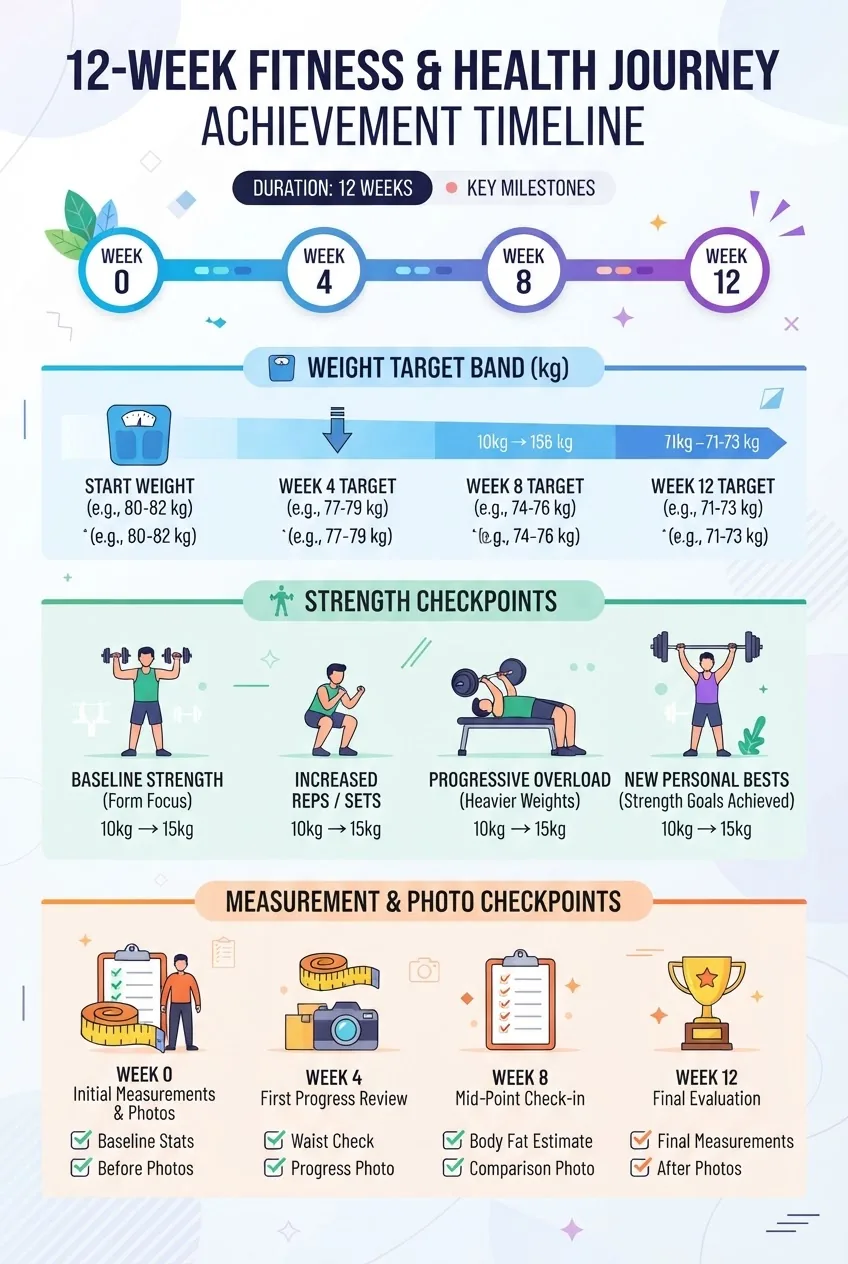
Track progress with numbers and photos for 12 weeks
Tracking is the difference between progress and guesswork. Use these metrics:
- Scale weight: daily mornings, after voiding, averaged weekly (record each day and compute 7-day average).
- Three-point circumference: waist (at navel), hip (widest), upper arm relaxed — measure every 2 weeks.
- Strength logs: track major lifts (squat, deadlift, bench), record reps and load each session.
- Progress photos: standardized (same clothes, lighting, 3 poses) every 2 weeks.
Adjustment rules every 14 days:
- If weekly average weight change is within your goal range (±0.25–0.5% bodyweight/week), keep calories.
- If loss is slower than target for two consecutive weeks, reduce calories by 150–250 kcal/day or increase weekly cardio by 150–300 kcal burn.
- If strength drops rapidly and you are losing >0.8% bodyweight/week, increase calories by 100–200 kcal and ensure protein is at least 1.8 g/kg.
Keep a single spreadsheet or tracking note summarizing calories, protein, bodyweight average, and key lifts to make decisions evidence-based.
-
Use evidence-based supplements only where helpful
Supplements are conveniences, not replacements. Recommended options with dose guidelines:
- Whey protein isolate: 20–30 g per shake to reach protein targets when whole-foods are impractical.
- Creatine monohydrate: 5 g/day (no loading required) — supports strength and muscle mass gains.
- Omega-3 (EPA+DHA): 1 g/day if fish intake is <2 servings/week.
- Vitamin D3: 1,000–2,000 IU/day if deficient; test before high-dose supplementation.
Avoid fat burners, high-dose stimulants, and thermogenic products — they have limited benefit and can interfere with training and sleep.
-
Manage hunger, satiety, and adherence strategies
Sustained adherence matters more than any micro-optimization. Practical tactics I use with clients:
- Prioritize high-volume, low-calorie foods — vegetables, broth-based soups, and salads to increase meal size for fewer calories.
- Include 20–30 g of slow-digesting carbs or fiber per meal: oats, legumes, and vegetables reduce hunger spikes.
- Use a mid-afternoon protein snack (e.g., 150 g Greek yogurt with 10 g nuts) if hunger otherwise causes overeating at dinner.
Set a weekly “flex meal” (one meal where you eat freely within reason) to improve long-term adherence — limit to one meal per week initially.
-
Fine-tune for special situations: vegetarian, time-restricted eating, or travel
Vegetarian/vegan: raise total protein target to 1.8–2.2 g/kg to compensate for lower per-meal leucine; prioritize soy, seitan, lentils and use protein powders. Example: 70 kg vegan → 126–154 g protein/d; aim for 30–40 g protein per meal with tofu/tempeh, seitan, or concentrated plant protein.
Time-restricted eating (TRE): if following 8–10 hour feeding window, keep protein per meal high and increase meal frequency to 3 within the window. For example, with 3 meals in 8 hours, target 40–50 g protein/meal.
Travel: pack whey, single-serve tuna packets, nuts, and instant oats. Choose grilled proteins and steamed veg; prioritize protein at airport and hotel meals.
-
Eating out and social events without derailing progress
When dining out follow a simple decision tree I use: 1) pick a protein (grilled, roasted, or broiled), 2) swap fries for vegetables or a side salad, 3) order sauces on the side — aim to estimate portions using hand-size cues: palm = 90–120 g cooked protein, cupped hand = 150 g carbs, fist = 150–200 g vegetables.
If you expect alcohol, plan 150–200 kcal room by lowering carbs earlier in the day and choose lower-calorie drinks (12 oz light beer ≈ 100–150 kcal; 4 oz wine ≈ 85–120 kcal). Avoid cocktails that add 200–400 kcal from mixers.
-
When to test a refeed or diet break
Use short refeeds (1–2 days) or a 7–14 day diet break when rate of progress stalls and you’re experiencing persistent fatigue, sleep disruption, or performance loss. A refeed increases carbs to maintenance or +10–15% above maintenance for 24–48 hours; a diet break returns you to maintenance calories for 7–14 days. Monitor weight and training; resume deficit after recovery. This helps restore leptin and training quality and reduces muscle breakdown risk.
Common mistakes and how to avoid them
I once reduced calories by 30% to speed results and lost strength and motivation within two weeks. That taught me to always cap deficits at 20% and prefer 10–15% for simultaneous fat loss and muscle gain.
I’ve also seen people set protein targets too low — often 0.8 g/kg — and then wonder why they lose muscle. Increasing to at least 1.6 g/kg stabilized their strength and preserved lean mass.
Another repeated issue: not weighing food. I speak from experience: guessing portions led to 300–600 kcal daily overestimates. A kitchen scale fixed that within a week.
Compact verification checklist
- Daily calories set and logged in an app (±5% tolerance)
- Protein target calculated at 1.6–2.2 g/kg and distributed evenly across 3–4 meals
- Fat at 20–30% of calories; carbs fill remainder (check grams)
- At least three ready-to-eat protein portions prepped and labeled
- Resistance training plan logged for the next 4 weeks
- Baseline photos, three-point measurements, and weekly weighing scheduled
- Two-week check-in set with clear adjustment rules
When to call in a professional
Hire a registered dietitian or sports nutritionist if you have any of the following: active medical conditions (diabetes, thyroid disease), are pregnant or breastfeeding, are an athlete with weight-class requirements, or have complex dietary restrictions. Seek medical clearance and a tailored plan if you have a history of disordered eating. For performance-specific programming or precise body composition contests, consult a coach who will provide individualized periodization and monitoring.
Worked examples (realistic scenarios)
Example A — 78 kg male, office job, trains 4×/week
78 kg × 36 kcal/kg (moderately active) = 2,808 kcal maintenance. Select a −12% deficit → 2,472 kcal/day. Protein at 1.8 g/kg = 140 g (560 kcal). Fat at 25% = 618 kcal → 69 g fat. Remaining carbs = 2,472 − (560 + 618) = 1,294 kcal → 324 g carbs. Spread across 4 meals = 35 g protein/meal and ~80 g carbs per main meal with one smaller snack.
Example B — 62 kg female, trains 3×/week, vegetarian
62 kg × 33 kcal/kg = 2,046 kcal maintenance. Choose −10% → 1,841 kcal/day. For vegetarian focus on 1.9 g/kg protein = 118 g (472 kcal). Fat 25% = 460 kcal → 51 g fat. Carbs = 1,841 − (472 + 460) = 909 kcal → 227 g carbs. Meals: three meals + snack → aim for 30–35 g protein per meal using tofu, tempeh, dairy/Greek yogurt, or concentrated plant protein.
Food selection specifics: best foods for losing weight and building muscle
Choose nutrient-dense, minimally processed foods that provide protein, fiber, micronutrients, and healthy fats. Specific recommendations I use with clients in Texas and similar climates:
- Proteins: chicken breast, salmon, lean beef, canned tuna, Greek yogurt, cottage cheese, eggs, tofu, tempeh, seitan.
- Carbs: rolled oats, brown rice, sweet potato, quinoa, whole wheat pasta, beans and lentils.
- Vegetables: broccoli, spinach, kale, bell peppers, tomatoes, zucchini.
- Fats: olive oil, avocado, mixed nuts, natural peanut or almond butter.
- Snacks: Greek yogurt + berries, apple + 20 g almond butter, 30 g mixed nuts.
Prioritize whole-food sources of protein and carbohydrates; use whey or plant powder for convenience or to hit protein grams on busy days.
Sample 7-day menu (compact, macros included per day)
This is a balanced, realistic 7-day outline that you can rotate. Each day aims to hit 1.6–1.9 g/kg protein, fats 22–28% of calories, and similar calories to your target depending on body size (example target 2,200–2,600 kcal).
Day 1 (training): Breakfast — oats + whey; Lunch — chicken rice salad; Snack — Greek yogurt; Dinner — salmon sweet potato salad. Day 2 (light): Breakfast — eggs & toast; Lunch — tuna wrap; Snack — apple+peanut butter; Dinner — turkey chili. Day 3 (training): Breakfast — smoothie (whey, banana, oats); Lunch — steak & quinoa; Snack — cottage cheese; Dinner — chicken stir-fry. Day 4 (rest): Breakfast — yogurt bowl; Lunch — bean salad; Snack — nuts; Dinner — baked tofu & veg. Day 5 (training): Breakfast — pancakes (oat-based with whey); Lunch — salmon bowl; Snack — protein bar; Dinner — lean beef & sweet potato. Day 6 (active rest): Breakfast — omelette; Lunch — quinoa salad; Snack — berries + almonds; Dinner — shrimp pasta with whole wheat. Day 7 (flex): Brunch — eggs & pancakes; Dinner — your social meal (calorie planned in advance).
When you adopt these menus, weigh and log each portion for your first week to build accurate personal conversions.
Cooking tips to preserve protein and flavor while minimizing added calories
- Cook proteins at moderate temperatures to prevent dryness: chicken breasts at 200°C (400°F) for 22–26 minutes, resting 5 minutes before slicing.
- Use herbs, citrus, and vinegars instead of sugary sauces. A marinade of 15 mL olive oil, 10 g mustard, 10 mL lemon, and 8 g smoked paprika adds flavor with controlled calories.
- Measure oil: 1 teaspoon = 5 mL ≈ 40–45 kcal. For a 25 g fat allocation, that’s ~5–6 teaspoons across the day.
- Prefer steaming, boiling, or oven-roasting over deep frying. When pan-frying, use a non-stick pan and limit oil to 10–15 mL per meal.
Troubleshooting common plateaus
If you plateau for 3–4 weeks—no weight change, stalled strength—perform a 7-day log of calories and activity. Look for hidden calories: drinks, condiments, nuts. If logged calories match planned calories and you still stall, decrease calories by 5–7% or add two 20–30 minute moderate cardio sessions per week. Reassess protein intake; if below 1.6 g/kg, raise to 1.8 g/kg for 2 weeks.
Behavioral nudges to maintain progress
Small changes I recommend that have large effects:
- Automate: schedule grocery delivery for two items every week (protein and veggies) so you never run out.
- Pre-log meals: enter planned meals into your tracking app before you eat to commit and avoid impulse choices.
- Use a “decision sandwich”: if unsure what to eat, list 3 acceptable meals in order and pick the top one; this reduces choice fatigue.
Safety and medical considerations
Always consult a provider if you have chronic disease. If you experience extreme fatigue, palpitations, dizziness, or syncope after changing diet or exercise, stop the program and seek immediate medical advice. For most adults in Texas without medical contraindications, the macronutrient ranges and resistance training described are safe, but personalized medical oversight is recommended when in doubt.
Resources and internal reading to continue
For a deeper dive into balanced meals and nutrient timing see the pillar resource on complete meals: Nutritionally Complete Meal Guide with Balanced Diet Advice. For practical 7-day templates and grocery lists consult our 7-day menu: 7 Day Diet Menu to Lose Weight with Meal Planning Guide and for cutting-phase meal planning see Cutting Diet Plan Guide.
Frequently Asked Questions
What is a proper diet to lose weight and gain muscle?
A proper diet to lose weight and gain muscle provides a moderate calorie deficit (10–15%), high protein (1.6–2.2 g/kg/day), adequate fats (20–30% of calories), and carbs timed around training. Pair this with regular resistance training and track progress every two weeks.
How many calories should I eat to lose fat and build muscle at the same time?
Estimate maintenance calories by bodyweight × activity factor (28–40 kcal/kg), then reduce by 10–15% for most people. Example: 80 kg moderately active person: ~2,880 kcal maintenance → 2,448 kcal target at −15%.
Which foods are best for losing weight and building muscle?
Prioritize high-protein whole foods: chicken, fish, lean beef, eggs, Greek yogurt, tofu and legumes; pair with whole grains (oats, brown rice), vegetables and healthy fats (olive oil, avocado). Aim for protein each meal and fiber-rich vegetables to control hunger.
Can I be vegetarian and still lose fat and gain muscle?
Yes. Vegetarians should set protein at 1.8–2.2 g/kg and choose concentrated plant proteins like soy, seitan, lentils, dairy or protein powders to meet per-meal targets of 30–40 g protein and maintain energy for training.
How long before I see visible muscle gain while losing fat?
Visible changes vary, but with consistent diet and training expect measurable strength or composition changes in 6–12 weeks; significant visible muscle definition often appears after 12 weeks alongside fat loss and strength gains.