
What you’ll achieve, time required, and assumed skill level
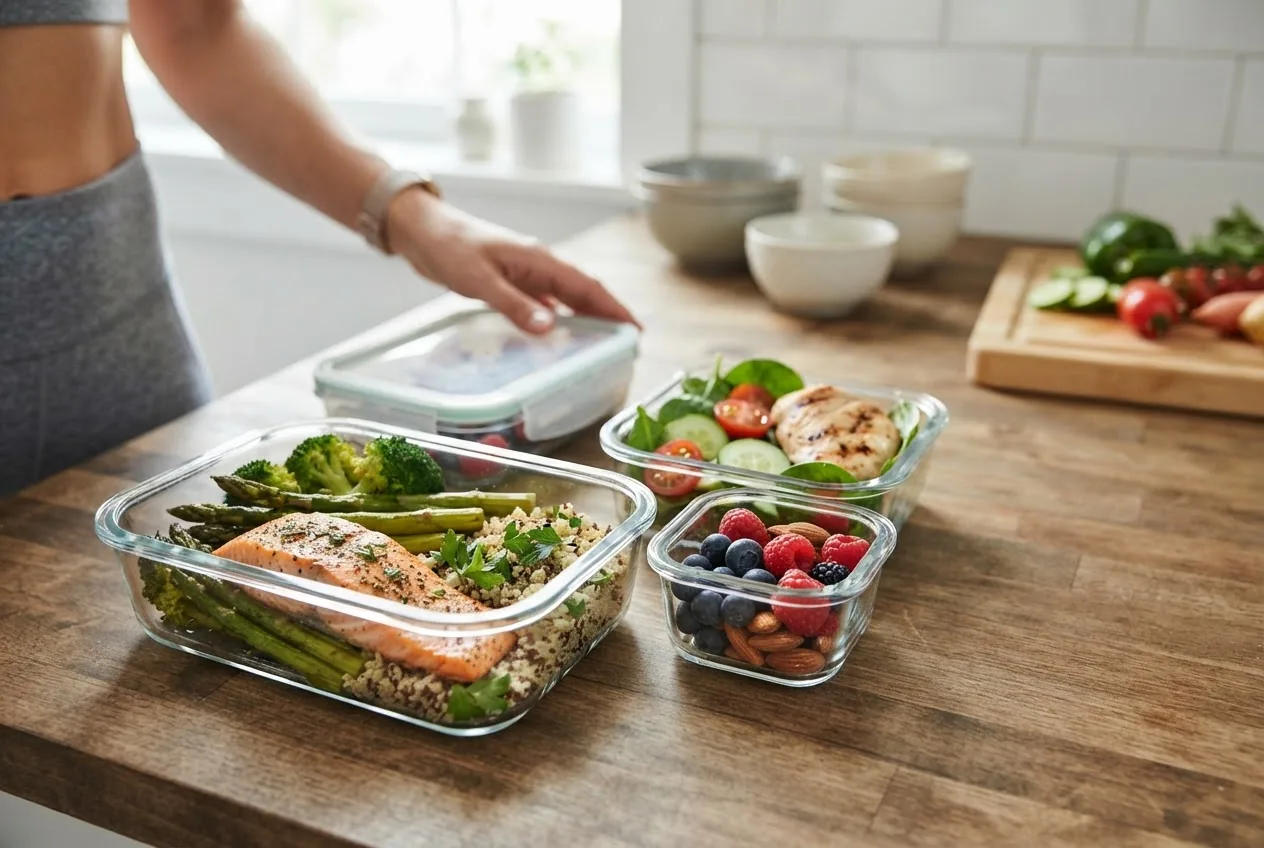
By the end of this guide you’ll have a complete, personalized cutting diet plan you can use for 8–12 weeks: an exact daily calorie target, macronutrient split, a one-week sample diet chart for cutting (with portions and recipes), a grocery list for seven days, a 2-hour weekly meal-prep schedule, and clear rules for measuring progress and adjusting the plan. Expect to read and set up the plan in 90–150 minutes; executing meal prep takes about 2–3 hours weekly. This guide assumes intermediate kitchen skills (can roast, grill, simmer), basic math comfort (percentages and multiplication), and a goal to lose 0.5–1.0% body weight per week.
Before you start
- Scale (bathroom) and tape measure for weekly tracking
- Kitchen scale accurate to ±1 g, measuring cups and spoons
- Food tracking app or spreadsheet (MyFitnessPal, Cronometer, or Google Sheet)
- Basic meal-prep kit: sheet pans, 2.5–4 L slow cooker or Instant Pot, 2 non-stick skillets, airtight containers (7×800–1,200 ml)
- Protein source choices for the week: 2.5–3 kg chicken breast, 700 g lean beef, 1.2 kg tofu/tempeh or canned fish (as alternatives)
- Weekly grocery budget plan: $60–$120 depending on protein choices and Texas local prices
Core step-by-step plan
-
Calculate your starting calorie target
We use a two-step approach: estimate Total Daily Energy Expenditure (TDEE) then subtract a safe deficit. Use Mifflin–St Jeor for men: BMR = 10×weight(kg) + 6.25×height(cm) − 5×age + 5. Multiply BMR by activity factor: 1.2 (sedentary), 1.375 (light), 1.55 (moderate; 3–5 workouts/week), 1.725 (very active).
Worked example: 35-year-old man, 82 kg (180 lb), 178 cm (5′10″), moderate activity (1.55).
- BMR = 10×82 + 6.25×178 − 5×35 + 5 = 820 + 1112.5 − 175 + 5 = 1762.5 kcal
- TDEE = 1762.5 × 1.55 = 2732 kcal/day (rounded)
- Safe deficit = 15–20% for men prioritizing muscle retention. At 20%: 2732 × 0.80 = 2186 kcal/day.
Set initial daily target: 2,100–2,250 kcal depending on aggressiveness and starting body fat. If body fat >25% use 20% deficit; if ≤12% use 10–12% to prevent muscle loss. Track for 2 weeks before changing.
-
Set protein, fat, and carbohydrate targets
For a cutting diet plan focused on muscle retention and performance for men, use these targets:
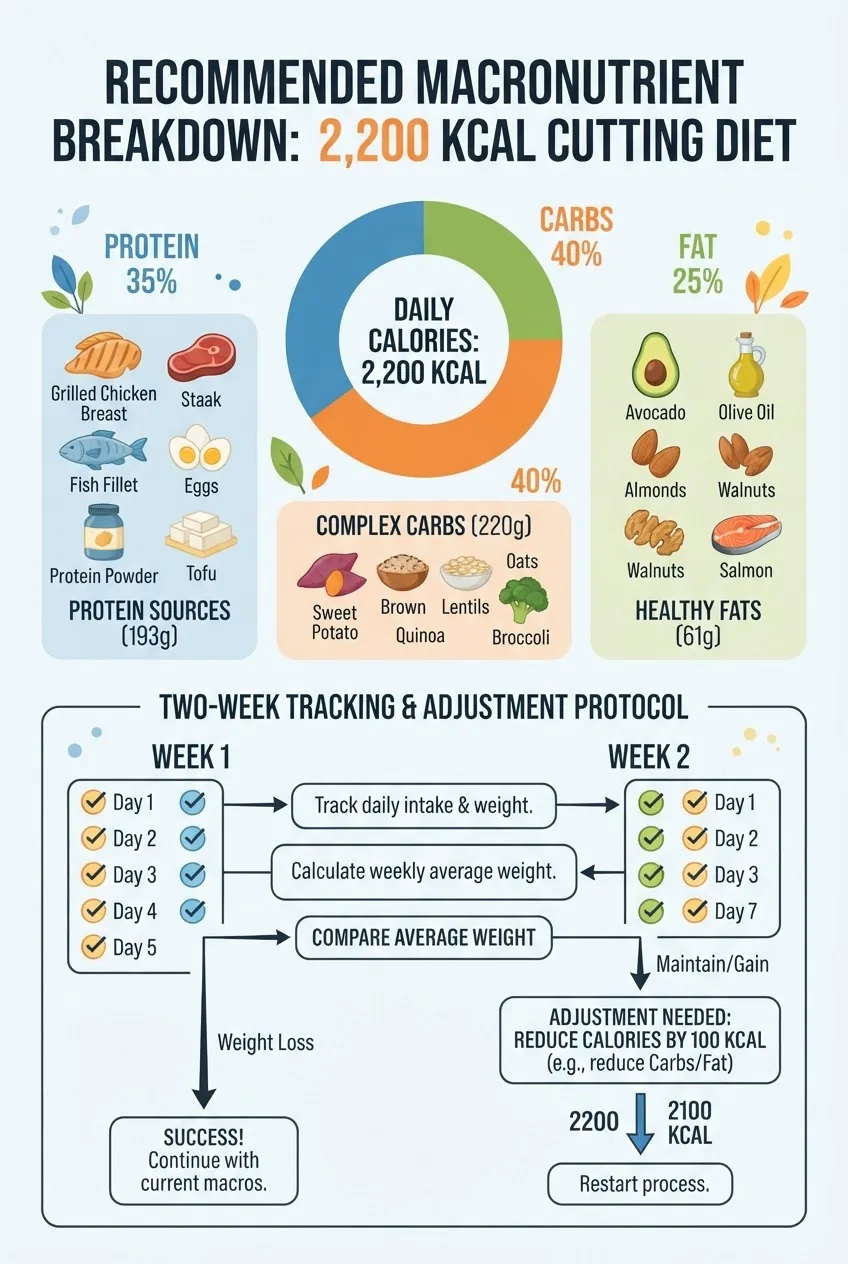
- Protein: 2.2–2.8 g/kg bodyweight per day (0.99–1.27 g/lb). For our 82 kg example aim 2.4 g/kg = 197 g protein/day.
- Fat: 22–30% of total calories. With a 2,200 kcal target, 25% fat = 550 kcal = 61 g fat/day.
- Carbohydrates: remaining calories. Carbs = (2,200 − protein kcal − fat kcal) / 4. Example protein kcal = 197×4 = 788; fat kcal = 61×9 = 549; carbs kcal = 2,200 − 788 − 549 = 863 kcal → 216 g carbs/day.
Round protein to nearest 5 g, fat to nearest 2 g. Use these practical ranges: protein 180–210 g, fat 55–70 g, carbs 180–240 g for the example man.
-
Choose nutrient-dense foods and build your food list
Prioritize whole foods that match targets and fit local Texas availability: lean proteins, fibrous vegetables, whole grains, legumes, healthy fats, and low-sugar dairy. Sample weekly grocery quantities for one man (7 days):
- Chicken breast: 2.5 kg (divided across 10–12 meals)
- Lean beef / turkey: 700 g
- Eggs: 18 large
- Greek yogurt (0%–2%): 1.2 kg
- Oats: 700 g
- Brown rice/quinoa: 1.5 kg cooked weight ≈ 600 g dry
- Sweet potatoes: 2.5 kg
- Broccoli, spinach, mixed salad greens: total ~3 kg
- Olive oil: 250 ml
- Nuts (almonds/walnuts): 350 g
- Fruits (apples/berries/bananas): ~2 kg
That list supplies 21–28 meals with ~25–40 g protein each plus 3–4 snacks. Swap equivalent plant proteins (tofu, tempeh, lentils) maintaining grams of protein.
-
Design a one-week sample meal plan (with portions)
Below is a practical 2,200 kcal day sample and an alternate vegetarian day. Use the exact portions listed; they match the macros shown above for the example man.
Meal Portion Calories • Protein • Carb • Fat Breakfast — Oat bowl 80 g rolled oats, 250 ml skim milk, 30 g whey, 100 g berries, 10 g almond butter 520 kcal • 42 g P • 58 g C • 13 g F Snack 1 200 g 0% Greek yogurt, 20 g walnuts 320 kcal • 30 g P • 12 g C • 18 g F Lunch — Grilled chicken bowl 150 g cooked chicken breast, 150 g cooked brown rice, 200 g mixed veggies, 1 tbsp olive oil 560 kcal • 52 g P • 56 g C • 16 g F Pre-workout snack 1 medium banana, 20 g peanut butter 230 kcal • 6 g P • 32 g C • 9 g F Dinner — Salmon & sweet potato 150 g salmon, 250 g baked sweet potato, 150 g spinach, 1 tsp olive oil 480 kcal • 44 g P • 46 g C • 18 g F Evening snack (optional) 30 g casein or cottage cheese (150 g cottage) 90 kcal • 13 g P • 2 g C • 2 g F Totals ~2,200 kcal • 187 g protein • 206 g carbs • 76 g fat. Adjust portions to hit your personal totals: add 25 g carbs (≈100 kcal) at any meal to raise calories by 100.
-
Create a fitness food schedule — meal timing and training nutrition
For fat loss and performance, prioritize protein distribution and peri-workout carbs:
- Protein: 30–45 g every 3–4 hours. Aim for 3–5 protein feedings daily.
- Pre-workout: 30–60 minutes before training consume 20–40 g carbs + 10–20 g protein (e.g., banana + 20 g whey).
- Post-workout: within 45 minutes intake 25–40 g protein + 30–60 g carbs if training is high intensity. For strength training use the higher end; for low-intensity cardio reduce carbs to 20–30 g.
- Breakfast calories: 20–30% of daily calories if training in morning; otherwise 15–25%.
Example schedule (training at 6:30 pm): Breakfast 7:30 (30% protein early), Lunch 12:30, Pre-workout 6:00, Post-workout 7:45, Dinner 8:30, Optional casein 10:30.
-
Plan and execute a 2-hour weekly meal-prep session
Use this timed sequence on Sunday to prepare 5–7 lunches and dinners plus grab-and-go breakfasts and snacks.
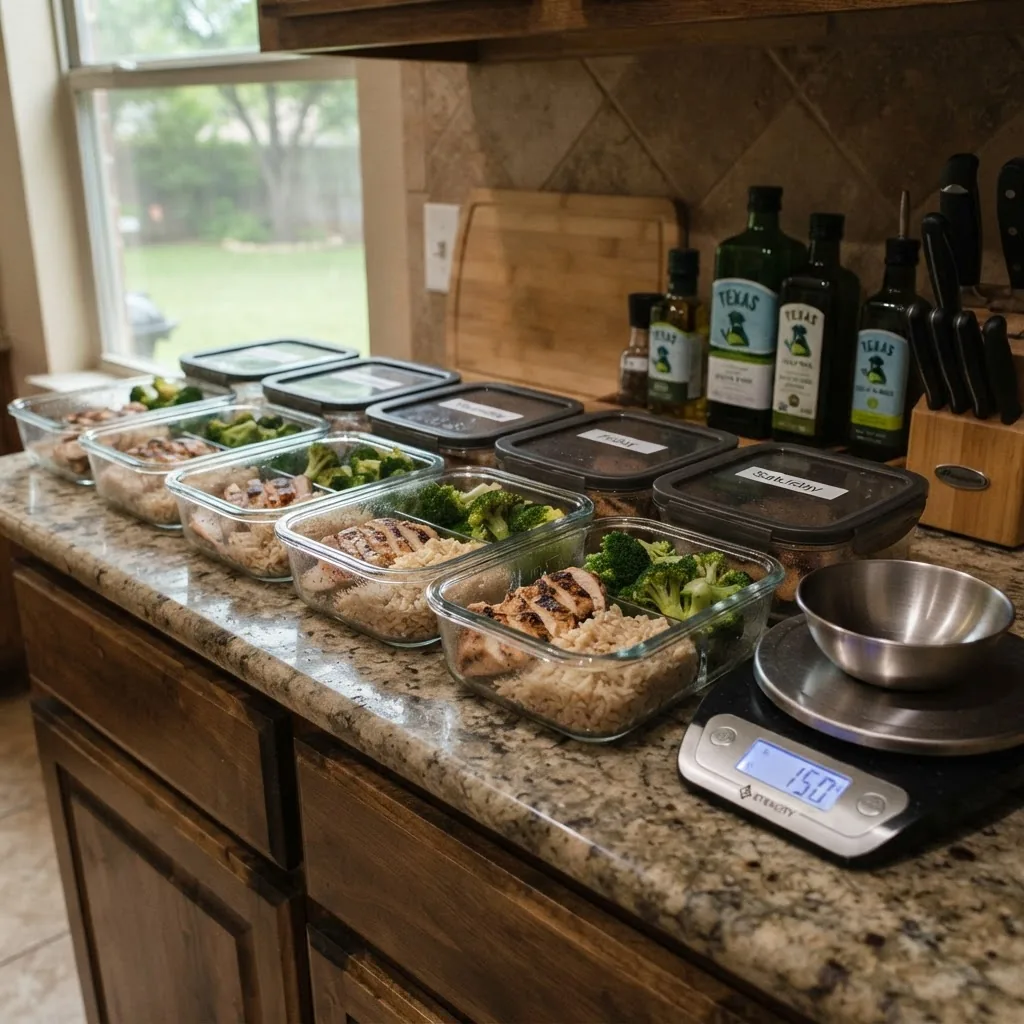
- 30 minutes: shopping unpack & mise en place. Preheat oven to 200°C (400°F). Thaw frozen proteins in cold water if needed.
- 40 minutes: bulk-cook proteins. Roast 2.5 kg chicken breasts on sheet pans for 18–22 minutes at 200°C until internal temp 74°C (165°F); or grill/pan-sear in batches. For salmon: 12–14 minutes at 200°C to 63°C (145°F).
- 25 minutes: cook carbs and vegetables. Bake 2–3 large sweet potatoes (45–60 minutes total but mostly hands-off) or pressure-cook 600 g dry brown rice (25 min). Steam 1.5 kg broccoli for 6–8 minutes.
- 15 minutes: portioning and packaging. Weigh each cooked protein serving to 150 g (approx 45 g raw yields 150 g cooked? — weigh cooked for accuracy). Place in 800–1,200 ml containers with measured carbs and vegetables. Label weekday name and date.
- 10 minutes: prepare quick snacks. Portion 20 g nuts into 7 bags, divide Greek yogurt into single-serve containers, pre-mix overnight oats if desired.
-
Track intake and weekly progress with precise measurements
Track daily calories and macros in an app; weigh real food servings on a kitchen scale — do not estimate by eye. Take these measurements weekly:
- Body weight: same scale, same time (first thing, after voiding, before food) on Mondays.
- Waist circumference: measure at the top of the hip bones or at the navel — record three readings and use the median.
- Progress photos: front, side and back, same lighting, same clothing, every 2 weeks.
Adjustment rules after two weeks:
- If weight loss <0.25% bodyweight/week → reduce calories by 100–150 kcal/day.
- If weight loss 0.5–1.0% per week → maintain the current calories.
- If weight loss >1.5% per week or energy crash occurs → add 100–150 kcal/day and re-evaluate training intensity.
-
Address cravings and adherence with structured swaps
When a craving hits, you can swap rather than cheat. Keep a 250–300 kcal “flex” slot 2× weekly for social meals. Practical swaps that preserve macros:
- Swap 150 g roasted potatoes (≈150 kcal) for 50 g oats (≈190 kcal) and reduce later carbs by 40 g.
- Swap a 200 kcal candy bar by adding 200 g Greek yogurt and 50 g fruit (keeps protein higher).
- If you want alcohol: 1 standard drink (≈140 kcal) counts as 140 kcal; reduce carbs by 35 g that day to keep total consistent.
-
Design a vegetarian cutting day (example)
Vegetarian men can hit high protein using dairy, eggs, and legume/soy mixes. Example 2,200 kcal vegetarian day:
- Breakfast: 80 g oats + 250 g 2% Greek yogurt + 30 g whey isolate (if lacto) + 100 g berries — 520 kcal, 50 g P.
- Snack: 150 g cottage cheese + 20 g almonds — 300 kcal, 28 g P.
- Lunch: 200 g tempeh (cooked) + 150 g cooked quinoa + 200 g greens + 1 tbsp olive oil — 620 kcal, 48 g P.
- Pre-workout: 1 apple + 20 g peanut butter — 240 kcal, 6 g P.
- Dinner: Lentil stew 250 g cooked lentils + 150 g sweet potato + side salad — 420 kcal, 30 g P.
Totals ~2,100–2,250 kcal, protein 160–170 g; add 20–40 g protein powder if you need to reach higher protein targets.
-
Use supplements sensibly
Supplements aren’t required but can help adherence and recovery. Use only what’s cost-effective and evidence-backed:
- Whey isolate or concentrate: 20–30 g post-workout or to increase daily protein. Cost: $0.80–$1.20 per serving depending on brand.
- Creatine monohydrate: 5 g daily — supports strength retention during a cut.
- Vitamin D3: 1,000–2,000 IU/day if blood level low (check labs).
- Fish oil: 1,000 mg EPA+DHA daily if you don’t eat fatty fish 2× weekly.
Track supplement costs into your weekly budget. Avoid proprietary fat-burner blends; they are not necessary and often expensive.
-
Plan for plateaus and physiological adaptation
When weight loss stalls for 2–3 weeks despite adherence, follow this systematic protocol:
- Confirm accurate tracking and no under-reporting (weigh cooked food; re-check entries in app).
- Reduce calories by 100 kcal and prioritize increasing daily NEAT (add 20 extra minutes walking to increase TDEE by ~100–150 kcal).
- Recalculate macros after a 5–6% weight loss: protein per kg should be recalculated to current weight; maintain 2.2–2.6 g/kg.
- If plateau persists after these two changes for another 2 weeks, schedule a 7–10 day diet break: eat at maintenance (TDEE) to restore hormones and motivation.
-
Fine-tune sodium, fiber and hydration for performance and scale consistency
Practical thresholds:
- Daily sodium: 1,500–3,000 mg/day. Keep consistent sodium day-to-day to avoid water-weight swings before weigh-ins.
- Fiber: 25–40 g/day from vegetables, oats, beans. If >40 g and you have GI issues, reduce to 30 g and add soluble fiber slowly.
- Hydration: 35–45 ml/kg bodyweight per day. For 82 kg man that’s 2.9–3.7 L/day. Increase by 500–1,000 ml on training days.
Keep sodium and water stable before weekly weigh-ins — that gives a truer reflection of fat loss versus temporary water shifts.
-
Create a scalable template for different calorie targets
If you need a higher or lower calorie target, scale per-meal portions proportionally. Example multipliers vs base 2,200 kcal:
- For 1,800 kcal target multiply each portion by 0.82 (1,800/2,200).
- For 2,500 kcal target multiply each portion by 1.136 (2,500/2,200).
But do not scale protein below 1.8–2.2 g/kg. If scaling down to 1,800 kcal keep protein grams constant and reduce carbs and fats first.
-
Integrate with other resources and long-term planning
For broader nutritional education and variety, consult the pillar resources on balanced meals and related meal plans. Useful internal reads:
- Nutritionally Complete Meal Guide — for micronutrient balancing and long-term diet structure.
- Cutting Meal Plan for Weight Loss — alternate sample menus and recipes.
- Meal Plan for Weight Loss Guide — broader weight-loss meal scheduling and behavior change tactics.
Recipes and quick preparation notes (quantities and timings)
Sheet-pan chicken, rice and broccoli (makes 5 portions)
Ingredients: 2.5 kg chicken breast, 750 g dry brown rice (yields ~1.9 kg cooked), 1.5 kg broccoli, 30 ml olive oil, salt 6 g, black pepper 3 g, garlic powder 6 g.
Method and timings: Preheat oven 200°C. Season chicken, roast 18–22 minutes to 74°C. Cook rice in covered pot: 1 part rice to 2.5 parts water, bring to boil, simmer 25–30 minutes. Steam broccoli 6–8 minutes. Portion 150 g cooked chicken, 150 g cooked rice, 200 g broccoli per lunch container. Cool containers for 20 minutes before sealing.
Simple lentil stew for 4 portions
Ingredients: 400 g dried brown lentils, 1 L low-sodium vegetable stock, 400 g canned tomatoes, 200 g chopped carrots, 150 g onion, 10 ml olive oil, 5 g cumin, 5 g paprika.
Method: Sauté onion and carrots 6–8 minutes in 10 ml oil, add spices 1 minute, add lentils, tomatoes and stock, simmer 25–30 minutes until lentils tender. Per portion: ~300 kcal, 20–22 g protein. Store in fridge 4–5 days.
Monitoring, troubleshooting, and the first 12 weeks
Expect the fastest visible changes in weeks 1–4 due to glycogen and water losses; meaningful fat loss and visual change usually appear weeks 4–12. Follow this timeline:
- Week 0–2: Set baseline, confirm adherence; first 0.5–2.0 kg loss typical.
- Week 3–6: Steady fat loss at 0.5–1.0% bodyweight/week if calorie deficit accurate and training maintained.
- Week 7–12: Slower losses, re-evaluate training load, increase protein if strength drops, consider brief diet break if weight loss stalls for 3+ weeks.
If you experience persistent fatigue, dropping strength, sleep disruption, or mood changes across 3–4 weeks, increase calories by 100–200 kcal and reassess. Consider bloodwork for ferritin, TSH, testosterone, and vitamin D if symptoms persist despite dietary adjustments (find a local Texas clinic for testing).
Common mistakes and how to avoid them (from my practice)
I speak from years of coaching: the following are mistakes I regularly see and the exact fixes I used to get clients back on track.
- Underestimating portions: I once assumed a client’s “hand-sized” chicken was 120 g; weighed it and it was 70 g cooked. The fix: weigh everything for one week — it reveals hidden calorie gaps.
- Cutting calories too aggressively: I had an athlete lose 6% bodyweight in two weeks and then lose strength. The fix: switch to 10–15% deficit and increase protein to 2.6 g/kg — strength returns and fat loss continues sustainably.
- Ignoring fiber and hydration: I advised a client to hit 50 g fiber without increasing water; they had GI complaints. The fix: target 30–35 g fiber and drink 500 ml extra per 10 g fiber increase.
- Chasing scale daily: I watched clients get demotivated by water-weight. The fix: weigh weekly under standard conditions and use waist measures and photos for context.
- Over-relying on “low-fat” packaged foods: I observed stalls when clients replaced whole foods with processed low-fat bars; these raised hunger. The fix: prioritize whole foods with 25–35 g fiber and slow-digesting carbs to improve satiety.
Seven-day grocery list and prep quantities (printable)
Quantities below match the sample menus and assume one man cutting at ~2,200 kcal/day. Adjust proportionally for different calorie goals or additional household members.
- Chicken breast: 2.5 kg
- Salmon or lean beef: 700 g
- Eggs: 18 large
- Greek yogurt: 1.2 kg
- Cottage cheese: 700 g
- Rolled oats: 700 g
- Brown rice or quinoa dry: 600 g
- Sweet potatoes: 2.5 kg
- Broccoli: 1.5 kg; spinach/greens: 1 kg; mixed salad: 500 g
- Bananas/apples/berries: 2 kg total
- Olive oil: 250 ml; peanut/almond butter: 200 g
- Nuts: 350 g
- Tempeh/tofu or canned beans: 1.2 kg (if vegetarian)
Checklist before you start a cutting cycle (verify these)
- Daily calorie target calculated and logged in tracking app.
- Protein goal set and matches 2.2–2.8 g/kg (or at least 1.8 g/kg minimum).
- One-week meal plan written with exact portion sizes and recipes.
- Grocery list and budget prepared; meal-prep containers ready.
- Two-week measurement plan scheduled (weigh-in day/time, waist, photos).
- Supplements decided and purchased (creatine, whey if used).
- Emergency flex meals allocated: 2 social meals per week ≤300 kcal each beyond the plan.
When to call in a professional
Call a registered dietitian, physician, or certified strength coach if any of the following apply:
- Unexplained >10% weight change in less than 3 months outside of planned cut.
- Persistent weakness, palpitations, or fainting spells.
- Suspected eating disorder or obsessive behaviors around food.
- Complex health conditions (type 1 diabetes, advanced kidney disease, hormonal disorders) that require medically supervised nutrition.
- If you want a fully personalized plan with body composition testing (DEXA) and periodic lab work; this level of service is best handled by a registered dietitian or sports nutritionist.
Additional tips for Texas readers
Buy proteins from local grocers and markets to save money; in Texas, bulk chicken and eggs can often be purchased for lower cost. When fresh produce prices rise in summer heat, use frozen vegetables — they retain nutrients and save money. For outdoor activity increase water by 500–1,000 ml and add 300–500 mg sodium during long (>60 minutes) heavy sweat sessions.
Maintenance and transitioning off a cut
After you meet your target or finish 8–12 weeks, transition gradually: raise calories by 5–10% (100–200 kcal) each week until you reach maintenance (previous TDEE recalculated for new weight). Expect a small rebound in weight (0.5–1.5 kg) largely water and glycogen. Keep protein high during reverse dieting to protect lean mass.
Useful rules-of-thumb and quick reference numbers
- Protein: 2.2–2.8 g/kg (men prioritizing muscle retention)
- Fat: 22–30% of calories; minimum 0.6 g/kg to maintain hormones
- Carbs: remainder of calories; higher on heavy training days
- Weight-loss target: 0.5–1.0% bodyweight per week
- Adjust calories by 100–150 kcal steps based on 2-week results
- Hydration: 35–45 ml/kg/day (≈3.0–3.7 L/day for 82 kg man)
Frequently Asked Questions
What is a cutting diet plan and how does it differ from a regular diet?
A cutting diet plan is a short-term, calorie-restricted eating plan designed to reduce body fat while preserving muscle. It differs from a maintenance diet by using a planned calorie deficit (usually 10–20%), higher protein (2.2–2.8 g/kg), and targeted timing of carbs around workouts to support performance.
How many calories should a man eat to cut weight safely?
Calculate Total Daily Energy Expenditure (TDEE) via Mifflin–St Jeor and subtract 10–20% depending on body fat. For many men that yields 1,800–2,400 kcal/day. Start with 15–20% deficit if body fat is over 18%; use 10–12% if leaner to protect muscle.
Can I keep muscle while on a cutting meal plan?
Yes—if you prioritize high protein (2.2–2.8 g/kg), resistance training 3–5× per week, and avoid aggressive deficits below 10% of TDEE. Adding creatine 5 g/day and keeping progressive overload in training reduces muscle loss risk significantly.
How long should a cutting phase last?
Most effective cuts run 8–12 weeks. Shorter cuts (4–6 weeks) yield modest fat loss; longer cuts beyond 12 weeks often require planned diet breaks (7–10 days at maintenance) to restore hormones, energy and adherence.
What common errors cause stalled progress on a cutting diet plan?
Common errors include underestimating portions, dropping calories too low, inconsistent tracking, large day-to-day sodium swings, and skipping resistance training. Correct these by weighing food, increasing protein, tracking for two full weeks, and stabilizing sodium and hydration before weigh-ins.