
What you’ll have done by the end, time required, and required skill level
By the end of this guide you’ll have built and implemented a practical cutting meal plan: a 30-day calorie-deficit eating schedule with daily menus, portioned recipes, a shopping list, macro targets, and simple meal-prep instructions you can repeat weekly. Realistic time: planning and first-week prep will take about 3–5 hours (1.5–2 hours to calculate and plan, 1.5–3 hours for grocery shopping and two batch-cook sessions). Skill level: basic cooking and simple math — if you can use a kitchen scale, a blender, and an oven, you’re ready.
Before you start
- Scale or phone app that tracks weight (we recommend weekly weigh-ins, same day/time).
- Kitchen scale accurate to 1 g, measuring cups/spoons, and food thermometer.
- Access to calorie tracking app or spreadsheet (MyFitnessPal, Cronometer, or Google Sheets).
- Basic cookware: 1 sheet pan, 1 large pot, 1 nonstick skillet, 2 airtight containers per day for meal prep.
- Staple pantry items: olive oil (2 tbsp/day max), sea salt, black pepper, dried herbs, canned beans (2 cans), rolled oats (1 kg), brown rice (2 kg).
- Protein sources: chicken breast (600–900 g/week), canned tuna (4 cans/week), eggs (12/week), Greek yogurt (1.5 kg/week).
- Produce: mixed greens (2–3 bags/week), 8 apples, 8 bananas, 4 avocados, 1 kg carrots, 1 kg broccoli.
- Calculator and timer (phone works).
- Medical clearance if you have a chronic condition (diabetes, kidney disease) or are on medication.
How this guide uses the phrase “cutting meal plan”
In this article “cutting meal plan” means a structured eating program that creates a calorie deficit to reduce body fat while preserving lean mass via adequate protein and resistance-based exercise. It includes a 30-day sample plan and modifications for women over 40 and 50, low-calorie options, and an exercise food plan for training days.
Core steps — build and run your cutting meal plan
-
Calculate your baseline calories and target deficit
Step time: 20–30 minutes. Action: determine your Total Daily Energy Expenditure (TDEE) and subtract a safe deficit.
How to calculate: 1) Find your Resting Metabolic Rate (RMR) using Mifflin-St Jeor:
Women: RMR = 10 × weight(kg) + 6.25 × height(cm) − 5 × age(years) − 161
Example: 40-year-old woman, 72 kg, 165 cm → RMR = 10×72 + 6.25×165 − 5×40 − 161 = 720 + 1031.25 − 200 − 161 = 1390 kcal.
2) Multiply RMR by an activity factor to get TDEE:
- Sedentary (desk job): ×1.2
- Light active (3x/week light cardio): ×1.375
- Moderately active (3–5x/week mixed training): ×1.55
- Very active (daily training or heavy labor): ×1.725
Using the example above and moderate activity: TDEE = 1390 × 1.55 ≈ 2155 kcal/day.
3) Choose a deficit: 300–500 kcal/day for steady fat loss (0.5–1 lb/week). For faster but riskier results, up to 750 kcal but not recommended without supervision. Example target: 2155 − 500 = 1655 kcal/day.
Notes: never go below 1,200 kcal/day for women without medical supervision. For women over 50, use a smaller deficit initially (300 kcal) to protect bone and hormonal health.
-
Set concrete macro targets
Step time: 10–15 minutes. Action: translate total calories into protein, fat, and carbohydrate grams.
Rules I follow for cutting while preserving muscle:
- Protein: 0.8–1.0 g per pound bodyweight (1.8–2.2 g/kg). For our 72 kg example, aim 130–160 g/day. I use 1.0 g/lb → 160 g/day.
- Fat: 22–30% of total calories. I recommend 25% for hormonal balance. Example: 1655 kcal × 0.25 = 414 kcal from fat → 46 g fat/day (1 g fat = 9 kcal).
- Carbs: remaining calories to fill target. Example: calories from protein = 160 g × 4 kcal = 640 kcal; from fat = 414 kcal; total = 1054 kcal → carbs = 1655 − 1054 = 601 kcal → 150 g carbs/day (1 g carbohydrate = 4 kcal).
Round macros to practical numbers: protein 150–160 g, carbs 140–160 g, fat 45–50 g per day.
Tip: track grams, not percentage for consistency. If weight loss stalls for two weeks, reduce carbs by 20–30 g/day or lower calories by 100–150 kcal, not both at once.
-
Design a daily template you can repeat
Step time: 30–45 minutes. Action: create an easy-to-follow daily meal template with meal timing, calories and macro targets per meal.
Most people do best with 3 main meals plus 1–2 snacks. Example template for a 1655 kcal target:
- Breakfast: 350 kcal → 30 g protein / 35 g carbs / 10 g fat
- Lunch: 450 kcal → 40 g protein / 45 g carbs / 12 g fat
- Pre/post-workout snack: 150 kcal → 15 g protein / 18 g carbs / 3 g fat
- Dinner: 500–550 kcal → 60–70 g protein / 50–55 g carbs / 18–20 g fat
- Total ≈ 1655 kcal → protein ~145–160 g, carbs ~148–153 g, fat ~45–50 g
Write these targets on your meal planner and label containers with intended macros so you can weigh and adjust over the first week.
-
Create a 7-day rotating menu and scale to 30 days
Step time: 60–90 minutes to plan; 2–3 hours to batch-cook initial week.
Action: build a 7-day menu that repeats with minor swaps to cover 30 days. Use the following sample daily menus that hit the template numbers. Each recipe lists portions, kcal and macros (rounded).
Sample Day A — Training day (approx. 1655 kcal)
Breakfast — Greek yogurt bowl (350 kcal): 200 g 2% Greek yogurt (140 kcal, 20 g protein), 40 g rolled oats (150 kcal, 5 g protein), 60 g blueberries (35 kcal), 10 g almond butter (25 kcal). Macros: 30 g protein / 35 g carbs / 10 g fat.
Lunch — Chicken, brown rice, greens (450 kcal)
150 g cooked skinless chicken breast (165 kcal, 33 g protein), 120 g cooked brown rice (150 kcal, 3 g protein), 100 g steamed broccoli (35 kcal), 1 tbsp olive oil for dressing (100 kcal). Macros: 40 g protein / 45 g carbs / 12 g fat.
Pre-workout snack (150 kcal)
1 medium banana (100 kcal) + 12 g whey protein isolate mixed with water (50 kcal, 12 g protein). Macros: 12 g protein / 18 g carbs / 0.5 g fat.
Dinner — Tuna salad bowl (550 kcal)
1 can tuna in water drained (165 kcal, 36 g protein), 120 g cooked quinoa (180 kcal, 6 g protein), 50 g mixed greens (10 kcal), ½ avocado (120 g, 190 kcal but limit to 100 g/half → 160 kcal), 1 tsp olive oil (40 kcal). Adjust portion of quinoa to 90 g cooked if calories exceed target. Macros: ~65 g protein / 50 g carbs / 20 g fat.
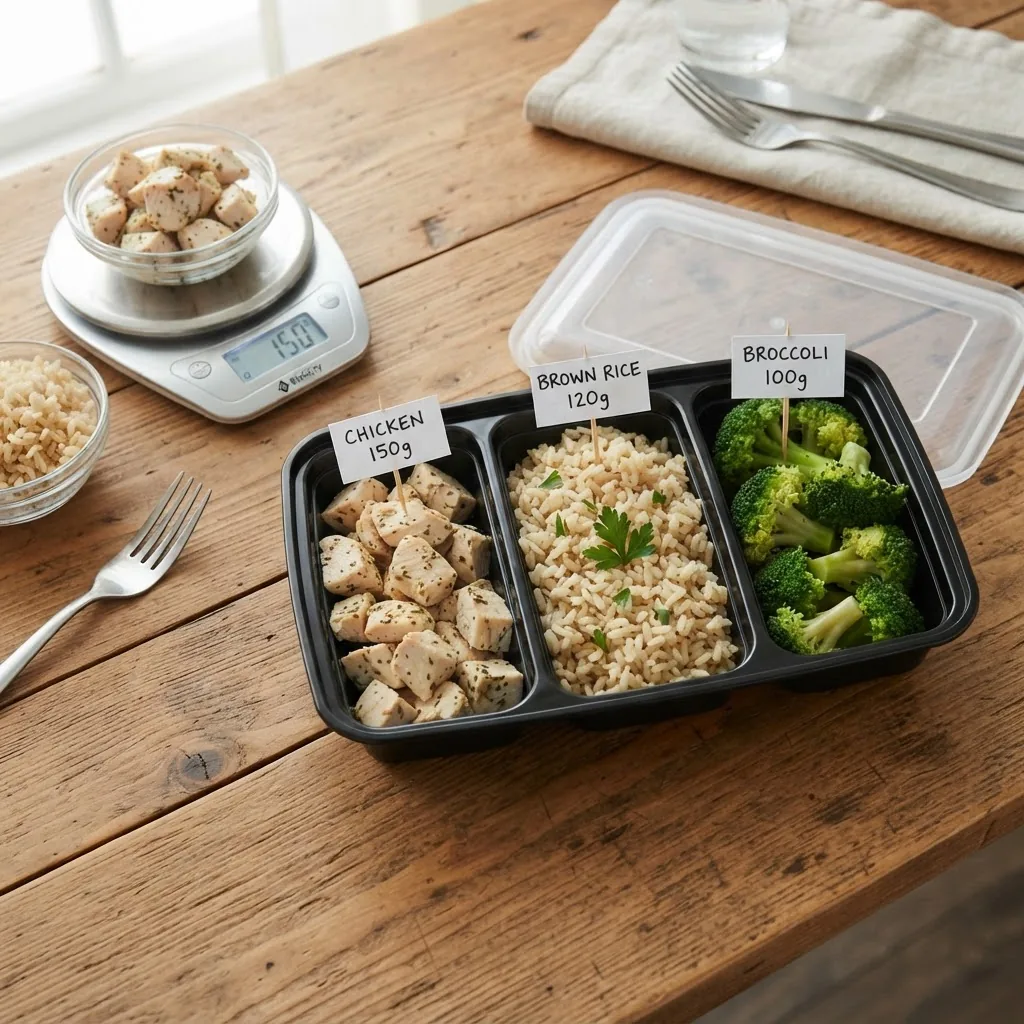
Repeat this pattern across 7 days with swaps: replace chicken with salmon (150 g cooked salmon = 280 kcal, 34 g protein, 12 g fat) two nights per week, swap quinoa for sweet potato (100 g cooked sweet potato = 90 kcal, 2 g protein), and include one vegetarian day with 200 g cooked lentils (230 kcal, 18 g protein).
-
Write a 30-day calendar and batch-cook schedule
Step time: 30–45 minutes to write; 2–4 hours to batch cook weekly meals. Action: assign the 7-day menus to a 30-day calendar and schedule two meal-prep sessions per week.
My recommended cadence:
- Sunday (2-hour session): cook proteins for 3–4 days, roast vegetables, cook grains; portion into 3–4 airtight containers.
- Wednesday evening (60–90 minutes): top-up proteins, fresh salads, cook grains for remainder of week.
Label containers with date and macros (protein/carbs/fat). Keep refrigerated meals ≤4 days; freeze any extra beyond 4 days and thaw overnight. Use airtight containers rated for freezer if freezing.
-
Create a precise grocery list with quantities
Step time: 15–30 minutes. Action: create one-week and four-week shopping lists with exact quantities so you avoid impulse buys and keep calories controlled.
Example one-week list for one person following the sample menus:
- Chicken breast: 1.2–1.4 kg
- Salmon fillets: 600 g (2 portions)
- Canned tuna in water: 4 cans (120 g drained each)
- Eggs: 12
- Greek yogurt 2%: 1.5 kg
- Rolled oats: 500 g
- Brown rice (uncooked): 700 g
- Quinoa (uncooked): 300 g
- Sweet potatoes: 1.2 kg
- Mixed greens (bags): 3 bags (approx. 300 g)
- Broccoli: 1.2 kg
- Blueberries: 400 g
- Apples/bananas: 7 each
- Avocados: 3
- Olive oil: 250 mL (use 1 tbsp/day max)
- Whey protein isolate: 500 g (use 12–24 g/day)
Tip: buy bulk grains and freeze proteins in portioned vacuum bags. In Texas, choose local seasonal produce like strawberries in spring and peaches in summer for variety and cost savings.
-
Prep, portion, and label meals with exact weights
Step time: 2–3 hours the first batch-cook. Action: follow strict weighing and portioning during meal prep so each container matches daily macros.
Procedure:
- Cook proteins separately and let rest 5–10 minutes before slicing.
- Weigh cooked servings — use cooked grams because weight changes during cooking. Example: 150 g cooked chicken ≈ 165 kcal.
- Weigh cooked rice/quinoa/sweet potato per serving (120 g cooked rice ≈ 150 kcal; 100 g cooked sweet potato ≈ 90 kcal).
- Pack proteins and carbs in separate compartments; add vegetables to fill without many calories (100–200 g steamed greens ≈ 25–60 kcal).
- Label each container with date and macros: e.g., “Mon A — 450 kcal: P 40/C 45/F 12”.
Storage safety: refrigerate at ≤4°C and consume within 4 days; freeze extras. Reheat to 74°C (165°F) in center for food safety.
-
Track progress and adjust weekly
Step time: 10–15 minutes weekly. Action: weigh-in, measure key metrics, and adjust calories or macros based on rate of weight loss.
What to track:
- Body weight: weekly, first thing in the morning after using the bathroom, before food and coffee.
- Body measurements: waist, hips, chest, thigh, once every two weeks.
- Training performance: ability to sustain resistance training sets and weights.
Adjustment rules I use:
- If weight loss is 0.5–1.0 lb/week: keep current plan.
- If loss is >1.5 lb/week or energy is poor: add 100–150 kcal/day back (usually via carbs or fat).
- If no weight loss in two weeks and activity is unchanged: reduce calories by 100–150 kcal or increase daily steps by 1,500–2,500. Prefer adding activity before cutting calories again if already under 1,500 kcal/day.
-
Pair your cutting meal plan with an exercise food plan
Step time: 20–30 minutes to align meals with training. Action: schedule higher-carb meals around workouts and ensure protein is evenly distributed.
Principles:
- Pre-workout (60–90 minutes before): 20–30 g carbs + 10–15 g protein (e.g., a banana + 12 g whey).
- Post-workout (within 60 minutes): 20–40 g protein + 20–40 g carbs (e.g., 150 g Greek yogurt + 60 g oats or a small rice bowl).
- On rest days: lower carbs by 10–30 g and keep protein steady.
Example weekly exercise schedule and food pattern:
- Mon: Strength lower body — higher carbs pre/post.
- Tue: Light cardio — normal carbs.
- Wed: Strength upper body — higher carbs pre/post.
- Thu: Active recovery — lower carbs.
- Fri: Full-body strength or conditioning — higher carbs pre/post.
- Sat: HIIT or long walk — moderate carbs.
- Sun: Rest — lowest carbs.
Note: keep protein distribution even — aim for 30–40 g protein at main meals and ~15 g at snacks.
-
Implement low-calorie meal swaps and treats so the plan is sustainable
Step time: 15–20 minutes planning. Action: plan low-calorie substitutions and schedule two weekly controlled treats (150–250 kcal) to prevent bingeing.
Low-calorie swap examples:
- Swap 60 g cooked rice (80 kcal) for 150 g roasted cauliflower rice (35 kcal).
- Replace 1 tbsp mayo (90 kcal) with 1 tbsp plain Greek yogurt (15 kcal) mixed with mustard and lemon.
- Use 1 tsp olive oil (40 kcal) for dressings instead of 1 tbsp (120 kcal).
Planned treat rules I use: allocate two 200 kcal treats per week (e.g., a small slice of pie or 2 scoops premium ice cream). Track these as part of weekly calorie budget — do not “go over and then restrict” the next day.
-
Adjust the plan for women over 40 and over 50
Step time: 15–20 minutes personalization. Action: make small, evidence-backed adjustments for hormonal changes, lower resting metabolic rate, and bone health.
Key modifications I apply:
- Use a smaller calorie deficit: −300 kcal/day rather than −500 kcal if aged 40+. Example: TDEE 2000 → target 1700 kcal/day.
- Increase protein to 1.0 g/lb to preserve lean mass and offset sarcopenia risk.
- Raise calcium (1,000–1,200 mg/day) and vitamin D intake (600–800 IU/day) via foods and/or supplements; consult your provider.
- Include at least 2 resistance sessions/week focused on progressive overload and 1–2 bone-strengthening activities (jumping, lunges) if medically approved.
For women over 50, monitor sodium and kidney function if lifting protein to upper ranges; get a baseline blood test if you plan a major diet change.
-
Plan for dining out and social situations
Step time: 10–15 minutes to prepare each outing. Action: use simple rules to approximate portions and preserve the calorie deficit without obsessive counting at restaurants.
Dining rules I use and teach clients:
- Aim for protein ~30–40 g (6–8 oz cooked portion) and a vegetable or salad that occupies half the plate.
- Ask for dressings/sauces on the side; use 1 tbsp of dressing (approx. 80–100 kcal) and avoid heavy cream sauces.
- For steak/fish: order 4–6 oz (115–170 g) and add a side salad and steamed veg instead of fries.
- When unsure, subtract 200–300 kcal from the rest of the day (reduce carbs or snacks) to account for higher restaurant calories.
Practical tip: when you must indulge, choose an item you truly enjoy and plan for it so you avoid feeling deprived.
-
Use basic meal timing to control hunger and maintain energy
Step time: none — habit to build. Action: spread protein across meals and include a moderate carb at breakfast and post-workout to prevent energy dips.
Timing I recommend:
- Breakfast within 60–90 minutes of waking (if hungry) — 25–35 g protein, 30–40 g carbs.
- Regular meals every 3.5–4.5 hours to prevent blood sugar dips and overeating later.
- Evening meal 2–3 hours before bed — avoid heavy late-night snacks; if needed, 100–150 kcal slow-protein snack (cottage cheese or Greek yogurt).
Intermittent fasting can work if it suits you, but do not use fasting to justify under-eating on training days — prioritize protein and recovery.

-
Evaluate results at 30 days and plan the next block
Step time: 30–45 minutes to analyze. Action: review weight, measurements, training performance, and adherence at 30 days to decide next steps.
Decision rules I follow:
- If weight loss averaged 0.5–1.0 lb/week and strength is steady: continue the plan and repeat for another 30 days.
- If weight loss is rapid (>1.5 lb/week) or energy and training decline: increase calories by 100–200 kcal/day and retest for two weeks.
- If no change: check tracking accuracy (weigh cooked food, confirm app settings), then reduce calories by 100–150 kcal or add non-exercise activity like daily 30-minute walk.
After 30 days you should also reassess body composition — progress may show in measurements and how clothes fit even if weight loss is modest.
30-Day example: how to scale the week-by-week plan
Use the 7-day menu described in Step 4 and rotate it four times with small changes to keep micronutrients varied. Example month plan:
- Week 1: Base menu (Chicken/Rice/Greens, Tuna bowls, Greek yogurt breakfasts).
- Week 2: Swap 2 lunches for salmon, add one vegetarian lentil dinner, increase berries for snacks.
- Week 3: Replace 2 rice portions with sweet potato; add one legume-based soup for dinner.
- Week 4: Repeat Week 1 menu but reduce carbs by 10–20 g on rest days if weight loss slowed.
Rotate sauces (tomato salsa, lemon-herb vinaigrette) but cap added oils to 1 tsp–1 tbsp per serving. Keep variety with seasonal produce to cover vitamins and minerals.
Practical recipes with quantities and times
1. Sheet-pan lemon-herb chicken and broccoli (4 portions)
Ingredients: 800 g skinless chicken breast (200 g/portion), 800 g broccoli florets (200 g/portion), 2 tbsp olive oil total (30 mL), 2 cloves garlic minced, juice of 1 lemon, salt, pepper, dried oregano.
Method: Preheat oven to 200°C (400°F). Toss chicken and broccoli with olive oil, lemon, garlic, salt & pepper. Place on sheet pan; roast 18–22 minutes until chicken reaches 74°C (165°F) internal temp. Let rest 5 minutes. Portion: each serving ≈ 350 kcal (P 33 g / C 10 g / F 12 g).
2. Overnight oats (5 servings; 1 serving = breakfast)
Ingredients per serving: 40 g rolled oats, 150 g 2% Greek yogurt, 100 mL unsweetened almond milk, 60 g mixed berries, 10 g almond butter. Prep time: 5 minutes; rest overnight.
Macros per serving ≈ 350 kcal, 30 g protein, 40 g carbs, 12 g fat. Store in fridge up to 4 days.
3. Lentil and vegetable soup (6 portions)
Ingredients: 400 g dried red lentils (2400 g cooked approx), 1.2 L low-sodium vegetable broth, 400 g diced tomatoes, 300 g carrots, 300 g celery, 1 onion, 2 tsp cumin, salt & pepper. Simmer 25–30 minutes. Per portion (1 bowl): ~230 kcal, 18 g protein, 35 g carbs, 2 g fat.
Food shopping and budget tips for Texas readers
Buy seasonal produce at farmers markets for lower prices in peak months — peaches and tomatoes in summer, leafy greens in winter. Shop bulk for rice and oats; purchase frozen vegetables and fruit (no added sugar) to save money and reduce waste. In grocery chains common in Texas (H-E-B, Kroger), look for 2–3 weekly promotions and use store apps to stack discounts on lean proteins.
Diet modifications and substitution table
Below are direct swaps with calorie and macro differences so you can tailor meals quickly.
| Swap | Use instead | Calories (approx) | Notes |
|---|---|---|---|
| White rice (1 cup cooked) | Brown rice (1 cup cooked) | 216 → 215 kcal | Brown rice adds fiber; keep same calories by weight. |
| 1 tbsp mayo | 1 tbsp plain Greek yogurt | 94 → 15 kcal | Saves ~80 kcal per swap. |
| 8 oz steak | 6 oz salmon + salad | 600 → 420 kcal | Good for lower saturated fat and added omega-3s. |
Common mistakes and how to avoid them (from my practice)
I often watched clients undercount protein and overcount “healthy fats” because they assumed a tablespoon equals a serving. One client told me they were “eating healthy” but showed only 800 kcal of logged protein for the week — a clear preservation problem. I corrected this by instructing them to weigh cooked protein and aim for 30–40 g per main meal. After three weeks they stopped losing muscle and regained strength.
Another recurring error I saw: people using raw weights from package labels but eating cooked portions. Raw 120 g chicken becomes about 90–100 g cooked; that difference cost clients 150–200 kcal/day and stalled weight loss. I now insist clients weigh food cooked when logging.
Finally, I’ve seen strict calorie cutting without resistance training. A client lost weight quickly but lost strength and motivation. We reintroduced 2–3 resistance sessions per week and increased protein to 1.0 g/lb, which preserved lean mass and improved adherence.
Quick verification checklist
- Target calories set with RMR and activity factor and a 300–500 kcal deficit.
- Daily protein goal calculated and met (0.8–1.0 g per lb bodyweight).
- Three main meals plus planned snacks laid out with macro splits per meal.
- Grocery list created with exact weekly quantities; week 1 batch-cook scheduled.
- Containers labeled with date and macros; cooked weights recorded.
- Training-food alignment: higher carbs on training days; protein at each meal.
- Weekly tracking plan set: weigh-in day/time, measurements and strength log.
- Have rule for restaurant days and two planned treats per week.
When to call a professional
Call a registered dietitian or physician before starting if you have diabetes, kidney disease, eating disorder history, or take medications that influence appetite or blood sugar. If you hit a sustained energy drop, menstrual irregularity, dizziness, or heart palpitations within the first two weeks, stop the deficit and consult your provider. For personalized meal prescription, a dietitian can supply blood-informed recommendations and micronutrient testing. For strength programming beyond basic guidance, hire a certified strength coach.
Useful internal resources
For a deeper look at balanced nutrition and meal completeness, see our pillar page on a nutritionally complete meal guide. If you want a compact 7-day menu to start faster, check our 7 Day Diet Menu to Lose Weight. For more cutting-specific planning tips, read the Cutting Diet Plan Guide.
External reference
For authoritative guidance on calories and food groups, consult USDA MyPlate recommendations for fruit, vegetable, grain, protein and dairy categories: https://www.choosemyplate.gov/
Frequently Asked Questions
What is a cutting meal plan and how is it different from dieting?
A cutting meal plan is a structured calorie-deficit program focused on fat loss while preserving muscle through higher protein and resistance training. It differs from generic dieting by using precise macro targets, meal timing around workouts, and planned weekly progression to protect lean mass.
How many calories should a woman eat on a cutting meal plan?
Calculate RMR with Mifflin-St Jeor, multiply by activity (1.2–1.55), then subtract 300–500 kcal. Do not go below 1,200 kcal/day without medical supervision; for women over 40 start with a 300 kcal deficit to preserve hormones and muscle.
Can I follow this cutting meal plan if I’m over 40 or over 50?
Yes, with adjustments: use a smaller deficit (−300 kcal), increase protein to ~1.0 g/lb, prioritize resistance training twice weekly, and ensure calcium (1,000–1,200 mg/day) and vitamin D intake; consult a provider for medical conditions.
What are good low-calorie snacks that fit a cutting meal plan?
Good snacks: Greek yogurt (150 g) with berries (100 kcal), a medium apple with 12 g whey (150 kcal), 100 g carrot sticks with 2 tbsp hummus (120–150 kcal). Aim for 10–20 g protein at snacks to support muscle maintenance.
How long before I see weight loss on a 30 day calorie deficit diet plan?
Expect 0.5–1.0 lb per week on a 300–500 kcal deficit; visible changes in clothes and measurements may appear within 2–4 weeks. If no change after two weeks, verify tracking and adjust calories by 100–150 kcal or increase activity.