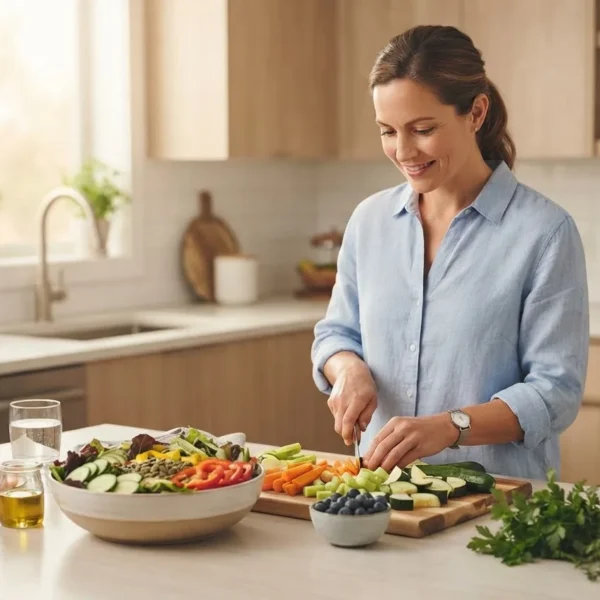
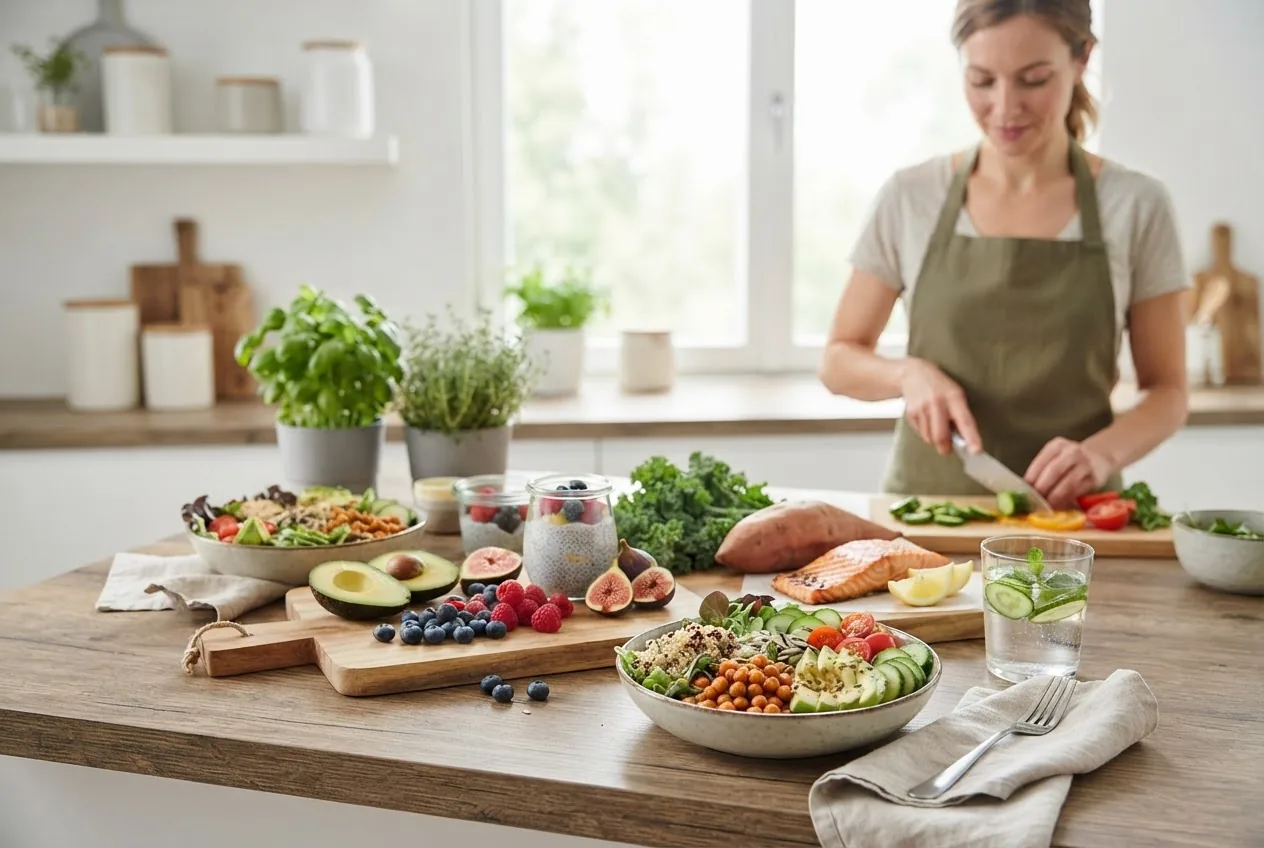
What you’ll have achieved, time required, and assumed skill level
By the time you finish this guide you will have: a personalized starting calorie target, a practical daily macro split (grams), three simple breakfast/lunch/dinner recipes with quantities, a shopping list for two weeks, and a 7-day example menu you can follow immediately. Realistic time to complete the setup: 90–150 minutes (assessment + shopping list + one batch-cook session). Skill level assumed: complete beginner to intermediate home cook — you need only basic chopping and stovetop skills.
Before you start
- Scale or food scale (digital, accurate to ±1 g)
- Measuring cups and spoons (1 cup, 1/2 cup, 1/4 cup, tablespoons)
- Notebook or habit-tracking app and a free calorie-tracking app (e.g., MyFitnessPal)
- Basic pantry: olive oil, salt, black pepper, canned beans (15 oz), rolled oats, brown rice, eggs (dozen)
- Thermometer for meat (optional) and a 30–60 minute block for meal prep
- Availability of local grocery stores in Texas (H-E-B, Kroger, or Whole Foods) or farmers market access for seasonal produce
Step-by-step plan: core actions for the best diet for beginners
-
Determine your daily calorie target
Action: calculate a starting daily calorie target using a quick formula and adjust for goals.
How: use the Mifflin-St Jeor equation for accuracy, then multiply by your activity factor.
Formulas (men): 10 × weight(kg) + 6.25 × height(cm) − 5 × age + 5. For women: 10 × weight(kg) + 6.25 × height(cm) − 5 × age − 161. Convert pounds to kg by dividing by 2.205; inches to cm by multiplying by 2.54.
Activity multipliers: sedentary 1.2, lightly active (light exercise 1–3×/wk) 1.375, moderately active (3–5×/wk) 1.55, very active 1.725.
Example: 35-year-old woman, 160 lb (72.6 kg), 5’6″ (167.6 cm): BMR = 10×72.6 + 6.25×167.6 − 5×35 −161 = 726 + 1047.5 −175 −161 = 1437.5 kcal. Multiply by 1.375 (light activity) = 1977 kcal/day. For weight loss reduce by 10–20% (200–400 kcal) — so target 1,580–1,780 kcal/day. For a beginner aiming to lose 0.5 lb/week choose 350–400 kcal deficit.
Action checklist: calculate BMR, pick activity multiplier, set initial target. Record exact kcal — don’t round to nearest 500.
-
Pick a clear macronutrient split
Action: select a starting macro ratio and convert to grams so you can track portions.
Concrete, beginner-friendly split options:
- Balanced: 40% carbs / 30% protein / 30% fat — good for steady energy and muscle retention.
- Moderate carb, higher protein: 35% carbs / 35% protein / 30% fat — better for satiety and weight loss.
- Higher carb (active people): 50% carbs / 25% protein / 25% fat — for frequent exercisers.
How to convert to grams (use target 1,600 kcal example): protein and carbs = 4 kcal/g, fat = 9 kcal/g.
Example (1,600 kcal, 40/30/30): carbs = 0.40×1600=640 kcal → 160 g; protein = 0.30×1600=480 kcal → 120 g; fat = 0.30×1600=480 kcal → 53 g.
Beginner rule-of-thumb minimums: protein at least 0.7 g/lb (1.5 g/kg) of bodyweight for those active or losing weight; fat at least 20% of calories (never below 20% long-term).
-
Assess your current diet for 3 days
Action: log everything you eat and drink for three full days (two weekdays + one weekend day) in a tracking app using exact portions.
Procedure: weigh portions on a food scale where possible; if not, use measuring cups. Enter brands and cooking methods into the app to capture calories and macros accurately.
What to look for after logging: average daily calories, protein intake (grams), and vegetable servings. Flag if protein < target by >15%, or vegetables <3 cups/day.
-
Create a simple weekly meal framework
Action: design a repeatable daily framework that hits your calorie and macro targets with minimal decisions.
Framework example for a 1,600 kcal/day balanced plan (40C/30P/30F = 160g C / 120g P / 53g F):
- Breakfast: 350 kcal — 40 g carbs, 25 g protein, 10 g fat
- Lunch: 450 kcal — 50 g carbs, 35 g protein, 12 g fat
- Snack: 150 kcal — 15–20 g carbs, 10 g protein, 6 g fat
- Dinner: 650 kcal — 55 g carbs, 50 g protein, 25 g fat
Actionable tip: plan two breakfasts, three lunches, and three dinners to rotate across the week to reduce prep time and keep variation.
-
Build a two-week shopping list with quantities
Action: convert your weekly meal framework into a concrete shopping list that covers 14 days (two cycles) and reduce decision fatigue.
Example list (quantities for 2 weeks, single person):
- Rolled oats: 3 cups (approx. 720 g)
- Eggs: 2 dozen
- Chicken breast: 3.5 lb (1.6 kg)
- Canned tuna in water: 4 × 5 oz cans (140 g each)
- Brown rice: 4 cups dry (approx. 760 g)
- Black beans (canned): 4 × 15 oz cans
- Frozen mixed vegetables: 2 × 16 oz bags
- Fresh spinach: 2 × 8 oz bags
- Greek yogurt plain: 32 oz (900 g)
- Bananas: 10 medium
- Apples: 8 medium
- Olive oil: 8 fl oz
- Nuts (almonds): 12 oz
- Whole wheat bread: 1 loaf
Tip for Texas buyers: buy seasonal produce at local farmers markets in spring/fall for better price and flavor; H-E-B often has two-for deals on proteins.
-
Prep and batch-cook for 60–120 minutes
Action: choose one 60–120 minute session each week to cook staples: grains, roasted vegetables, and at least one protein source.
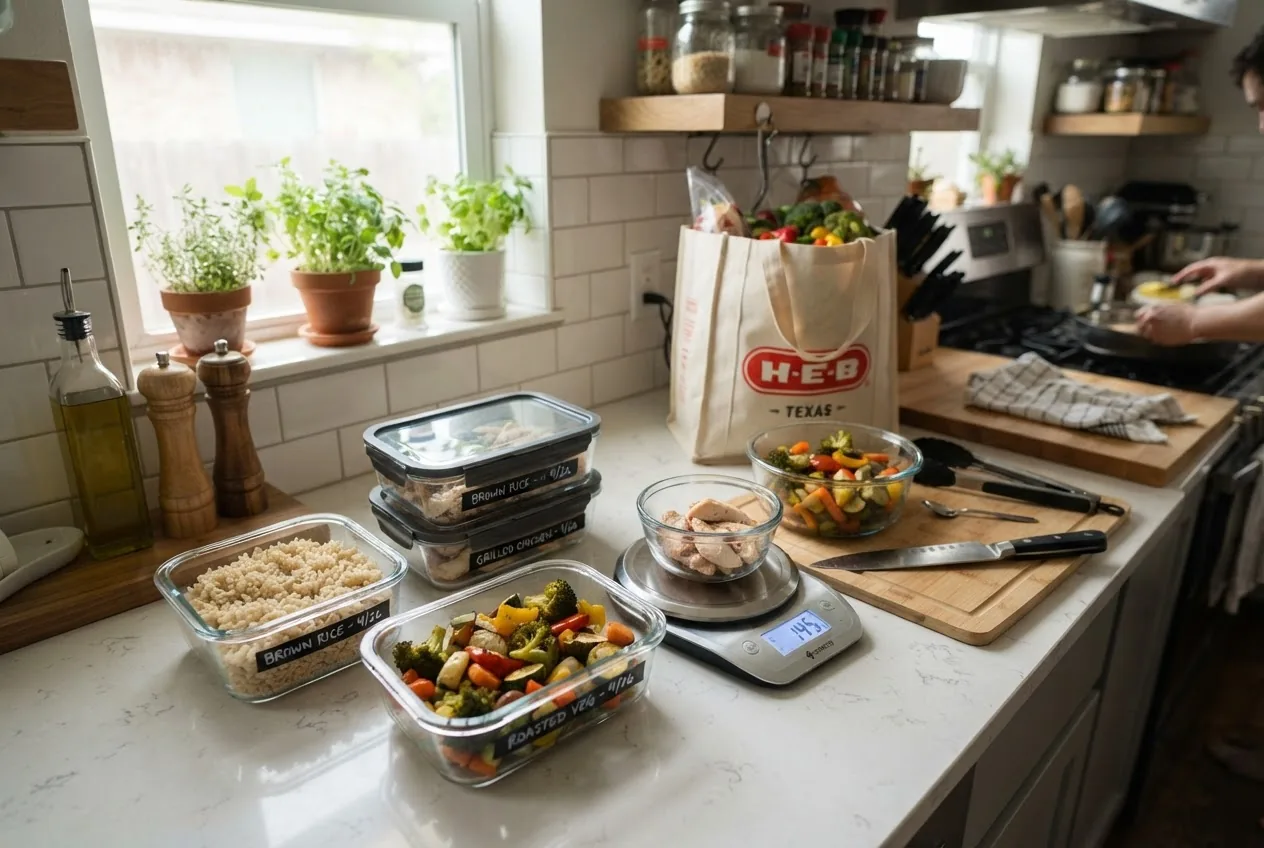
Batch-cook timeline (example 90 minutes):
- 0–10 min: Preheat oven to 425°F (220°C). Rinse rice and set to cook (brown rice 45 minutes simmer time).
- 10–30 min: Chop 1.5 lb of vegetables (bell pepper, zucchini, onion); toss with 1 tbsp olive oil and 1/2 tsp salt; roast 25–30 minutes.
- 30–45 min: Season 3.5 lb chicken breasts with 1 tsp smoked paprika, 1 tsp salt, 1/2 tsp pepper; sear 2–3 min/side then finish in oven 12–14 minutes until internal temp 165°F (74°C).
- 45–60 min: Portion cooked rice into 6 containers (3/4 cup cooked ≈ 150 g each), add 4 oz cooked chicken per container, and 1 cup roasted vegetables.
- 60–90 min: Cool containers 10–15 minutes then refrigerate; label with date. Use within 4 days or freeze up to 3 months.
Actionable safety threshold: do not leave cooked food at room temperature for more than 2 hours; cool to refrigerator temp within 90 minutes if possible.
-
Track intake precisely for the first two weeks
Action: weigh and log every serving for 14 consecutive days and compare averages to targets every 3 days.
Tracking routine: weigh breakfast items, enter exact grams; for mixed meals, create a recipe entry in the app with weights. Aim to log within 10 minutes of eating to maintain accuracy.
Evaluation thresholds: if average daily calories are >5% off target for three consecutive days, troubleshoot portions; if protein is >10% below target, add a 20–30 g protein snack (e.g., 1 scoop whey or 6 oz Greek yogurt).
-
Use portion tools and plate method for untracked meals
Action: when you cannot weigh food (eating out), use a visual plate method and hand-size portions to stay within macros.
Plate method for most lunches/dinners:
- Protein = palm-sized portion ≈ 3–4 oz cooked (20–30 g protein)
- Carbs = cupped hand or 1 fist ≈ 1 cup cooked rice/pasta (40–50 g carbs)
- Vegetables = 2 cupped hands ≈ 2 cups raw (low calories, high fiber)
- Fat = thumb size (1 tbsp olive oil or 1/4 avocado ≈ 10–12 g fat)
Example: at a Texas cafeteria, choose grilled chicken (palm), a medium baked sweet potato (1 cup), and a side salad with 1 tbsp dressing.
-
Read labels and pick whole-food options
Action: when choosing packaged foods, prioritize items with 3–5 ingredients, <20% daily value for saturated fat per serving, and <8 g added sugar per serving.
Concrete rules: pick canned beans with only water and salt; yogurt with <8 g sugar per 6 oz if plain or sweetened; bread with at least 3 g fiber per slice.
Label reading example: a granola bar with 220 kcal, 8 g protein, 26 g carbs (12 g sugar), 10 g fat — avoid for regular use; prefer 150 kcal Greek yogurt + 1/4 cup oats instead.
-
Schedule meals and hydration
Action: set consistent meal times and a hydration target for daily rhythm and appetite control.
Concrete timing: breakfast within 60 minutes of waking, lunch 4–5 hours later, snack 2–3 hours after lunch if needed, dinner 3–4 hours before bedtime. Example schedule: 7:30 am breakfast, 12:30 pm lunch, 3:30 pm snack, 7:00 pm dinner.
Hydration: aim for 0.5–1 oz of water per lb bodyweight per day. Example: 160 lb person = 80–160 oz/day (2.4–4.7 L). Practical target for most adults: 100 oz (3 L) per day; increase during heat or exercise.
-
Include 2–3 strength sessions weekly to preserve muscle
Action: add resistance training twice a week for 20–40 minutes to support protein needs and metabolic rate.
Sample beginner routine (2×/week):
- Warm-up 5 minutes brisk walk or dynamic mobility
- Squat (bodyweight or goblet) 3 sets × 8–12 reps
- Push-ups (knee or full) 3 sets × 8–12 reps
- One-arm dumbbell row 3 sets × 8–12 reps per side
- Plank 3 × 30–60 seconds
Progression target: add 5–10% load or 1–2 reps per week. If new to exercise, consult a trainer for form first session.
-
Adjust after two weeks using objective measures
Action: evaluate body weight, waist measurement, energy, and strength, then adjust calories by 100–200 kcal increments.
Concrete measurement protocol: weigh in the morning after voiding and before eating, twice weekly on same scale; measure waist at the iliac crest with tape, once weekly.
Adjustment rules:
- If losing 0.25–0.75 lb/week and energy is good → keep the plan.
- If losing <0.25 lb/week after 3 weeks → lower calories by 100–150 kcal/day or increase weekly activity by one 30-minute brisk walk.
- If losing >1 lb/week or energy/focus declines → add 150–200 kcal/day and slightly increase carbs or fat for satiety.
-
Make meals resilient: swap lists and quick fixes
Action: compile two swap lists so you can stay on plan without strict recipes.
Swap list examples (choose one from each column):
Protein Chicken breast 4 oz / canned tuna 3.5 oz / tofu 4 oz / 2 eggs Carb 1 cup cooked rice / 2 slices whole wheat bread / 1 medium baked potato Vegetable 2 cups salad greens / 1 cup steamed broccoli / 1 cup mixed veggies Fat 1 tbsp olive oil / 1/4 avocado / 12 almonds Use one-protein + one-carb + one-vegetable + one-fat to compose a meal quickly. This reduces decision fatigue and keeps calories predictable.
-
Plan for eating out and social events
Action: prepare strategies for typical restaurant scenarios common in Texas (BBQ, Tex-Mex).
Restaurant rules:
- BBQ: order 4–6 oz lean brisket or smoked turkey, skip sugary sauces or ask for sauce on side (1 tbsp ≈ 45 kcal).
- Tex-Mex: choose fajitas with 3 oz protein, 1 tortilla (or 2 small corn tortillas), extra vegetables, and salsa instead of queso (1 tbsp sour cream ≈ 23 kcal).
- When unsure, use plate method and estimate portions; ask kitchen for steamed vegetables in place of fries.
Actionable threshold: if a meal exceeds your daily calories by >20%, consider splitting it across two meals or increasing activity the following day.
-
Address micronutrients and simple supplements
Action: ensure basic micronutrient coverage through food first; consider a daily multivitamin and vitamin D if risk factors exist.
Concrete guidance: aim for 2 cups of fruit and 3–4 cups of vegetables daily for vitamins and fiber. If you live in Texas and have limited sun exposure, test 25(OH)D levels and supplement with 1,000–2,000 IU vitamin D3/day only if levels are low or per provider.
Protein supplement use: 1 scoop whey (~24 g protein) post-workout or as snack replacement if daily protein target is hard to meet; limit to 1 scoop/day for beginners.
External authority: for official dietary guidelines consult the USDA resources for nutrient recommendations USDA.
-
Make long-term behavior changes with measurable habits
Action: pick three sustainable habits to maintain for 8 weeks and measure adherence weekly.
Suggested habit set for beginners:
- Log food accurately for 14 of 14 days each week (or 10/14 minimum).
- Cook at home 5 nights per week.
- Do two strength workouts weekly and one 30-minute walk.
Tracking rule: score 1 point per habit per day; aim for weekly score ≥85% to continue the habit into the next month. If below 70%, reduce to one habit and rebuild.
Worked examples and concrete meal ideas
Example 1: 1,600 kcal day (40/30/30) — explicit meals
Breakfast (350 kcal): 1/2 cup rolled oats (40 g dry = 150 kcal), 1 scoop whey (24 g protein = 120 kcal), 1 small banana (100 kcal). Macros ≈ 45 g carbs / 28 g protein / 6 g fat.
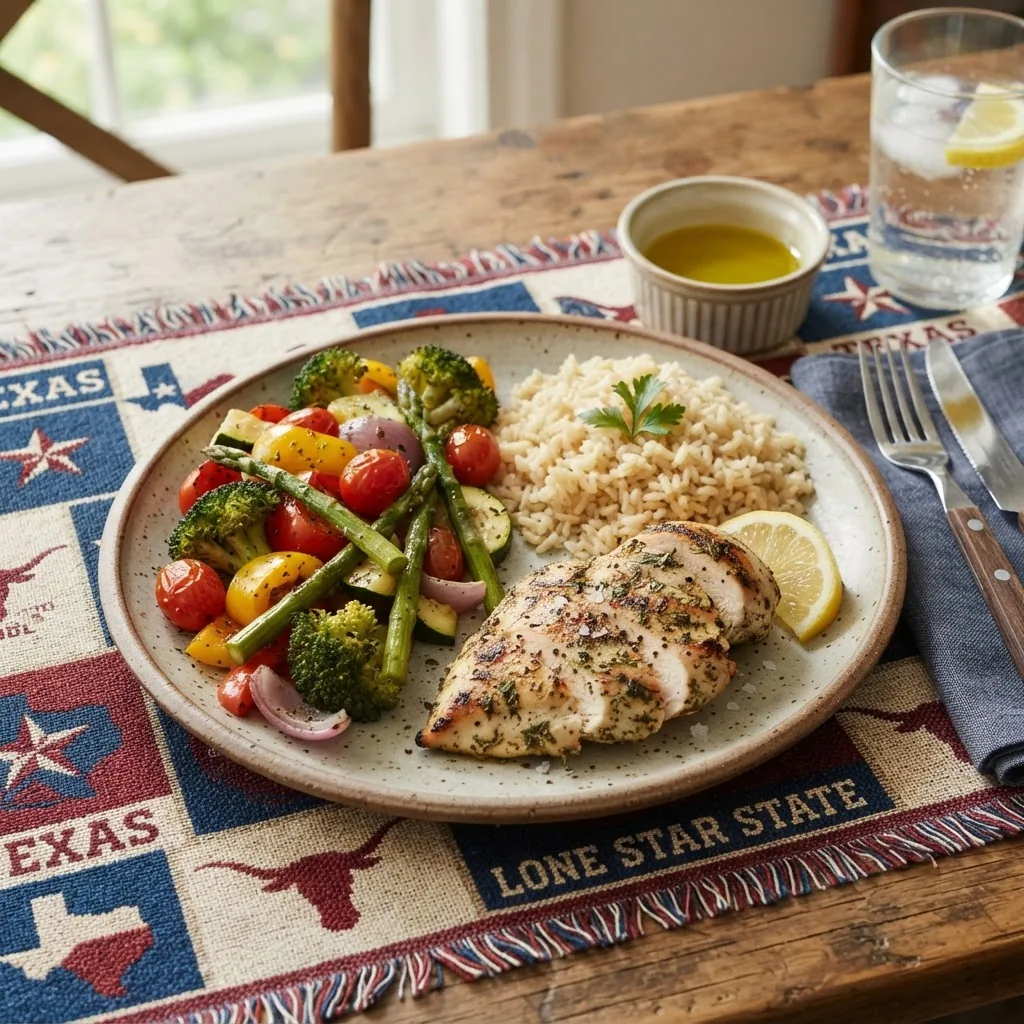
Lunch (450 kcal): 4 oz grilled chicken (120 g cooked = 35 g protein, 165 kcal), 1 cup cooked brown rice (195 g = 45 g carbs, 215 kcal), 1 cup steamed broccoli (55 g = 25 kcal). Macros ≈ 50 g carbs / 35 g protein / 6 g fat.
Snack (150 kcal): 6 oz plain Greek yogurt (100 kcal) + 12 almonds (50 kcal). Macros ≈ 10 g carbs / 12 g protein / 8 g fat.
Dinner (650 kcal): 6 oz salmon (170 g cooked = 36 g protein, 300 kcal), 1 cup quinoa cooked (185 g = 40 g carbs, 220 kcal), 1 cup mixed salad greens + 1 tbsp olive oil dressing (130 kcal). Macros ≈ 65 g carbs / 50 g protein / 33 g fat.
Example 2: Quick vegetarian day (1,800 kcal)
Breakfast: Smoothie — 1 cup spinach, 1 cup almond milk, 1/2 cup oats, 1 scoop plant protein, 1 cup frozen berries. (Approx. 420 kcal)
Lunch: Lentil salad — 1 cup cooked lentils (18 g protein), mixed vegetables, 1 tbsp olive oil, 1/2 cup cooked quinoa. (Approx. 520 kcal)
Snack: Apple + 2 tbsp peanut butter (Approx. 260 kcal)
Dinner: Stir-fry tofu 6 oz + 2 cups mixed vegetables + 1 cup brown rice. (Approx. 600 kcal)
How to customize for common goals
To lose weight (steady):
Start with a 10–20% calorie deficit relative to your maintenance. Target weekly loss: 0.25–0.75 lb. Keep protein at 0.7–0.9 g/lb bodyweight and include resistance training 2×/week. Reduce carbs by 50–100 kcal first, then fats if necessary. Example: 1,800 kcal maintenance → start 1,440–1,620 kcal.
To gain lean mass:
Add 150–300 kcal above maintenance, keep protein high (0.8–1.0 g/lb), and complete 3–4 strength sessions weekly focused on progressive overload. Aim for 0.25–0.5 lb gain/week to prioritize lean mass.
For improved energy and blood sugar control:
Distribute carbohydrates evenly across meals (no more than 45–60 g per meal for many beginners). Include 20–30 g protein at each meal and 3–4 cups of vegetables daily to stabilize glucose swings.
Tools, apps and simple trackers I recommend (and how to use them)
- Food tracking: MyFitnessPal or Cronometer — create custom recipes and save portions. Enter all weights in grams for accuracy.
- Habit tracking: tick off the three habits daily in a minimalist app or a paper notebook.
- Scale: a small digital scale — place washed and dried containers on the scale, tare, and add food to measure grams.
- Thermometer: use instant-read thermometer for meats; target 165°F (74°C) for chicken, 145°F (63°C) for fish with a 3-minute rest.
Common mistakes and how to avoid them
I write these from direct experience working with beginners.
- I under-logged liquids and condiments. I once tracked only meals and found my calories were 300 kcal higher because I didn’t weigh salad dressing and coffee creamer. Fix: weigh dressings (1 tbsp olive oil = 14 g ≈ 120 kcal) and set a rule to log drinks immediately after pouring.
- I trusted restaurant portions. I assumed a “grilled chicken plate” was 6 oz; it was 10 oz with buttery sauce. Fix: use the plate method and estimate protein as 3–4 oz palm-size; ask for sauces on the side.
- I skipped strength training. I focused only on cardio and lost muscle mass. Fix: add two short strength sessions per week; it’s essential to hit protein targets to preserve lean tissue.
- I made too many changes at once. I tried a new diet, new workouts, and cut sleep — unsustainable. Fix: choose 1–2 evidence-based habits (tracking + simple batch cooking) and maintain them for 8 weeks before adding more.
- I ignored micronutrients. I cut calories and ate only protein bars for convenience and developed low energy. Fix: include vegetables at every meal and consider a multivitamin if your intake of fruits/veggies is <5 servings/day.
Compact checklist to verify your work
- I calculated my BMR and set a specific daily calorie target (exact number logged).
- I converted my macro split to grams and recorded daily protein, carbs, and fat targets.
- I logged at least 3 baseline days and have average calorie/macros recorded.
- I completed a two-week shopping list with quantities and scheduled one batch-cook session.
- I tracked food accurately for 14 days and evaluated the averages against targets.
- I added two strength sessions weekly or scheduled them for the next two weeks.
- I measured weight and waist consistently and set thresholds for adjustment.
- I have swap lists for quick meals and strategies for eating out.
When to call in a professional
Call a registered dietitian or physician if you have any of the following: diagnosed medical conditions that affect metabolism (type 1 diabetes, uncontrolled type 2 diabetes), kidney disease, liver disease, history of disordered eating, pregnancy, or if you are taking medication that affects appetite/weight. If weight changes exceed 5% in a month unintentionally, seek medical review. For individualized performance or medical nutrition therapy, book a registered dietitian for a 60–90 minute consult.
Related reading and further steps
For guidance on creating fully balanced meals use the pillar guide on a nutritionally complete meal: Nutritionally Complete Meal Guide with Balanced Diet Advice. If you want a quick 7-day menu to put this plan into practice immediately, see the 7-day example here: 7 Day Diet Menu to Lose Weight with Meal Planning Guide. For smart shopping lists to accompany this plan, check Healthy Grocery List Guide for Smart and Nutritious Shopping.
Frequently Asked Questions
What is the best diet for beginners to start with?
The best diet for beginners emphasizes whole foods, a clear calorie target, and a simple macro split you can track. Start with a balanced 40% carbs / 30% protein / 30% fat plan, calculate your calories via Mifflin-St Jeor, and log food for two weeks to confirm and adjust.
How quickly will I see results on a beginner diet plan?
Expect measurable changes in two to four weeks: energy and appetite regulation first, modest weight change of 0.25–0.75 lb/week, and improved strength within 3–6 weeks if doing resistance training. Use objective measures (scale and waist) to track progress.
Can I follow this plan on a tight budget in Texas?
Yes. Prioritize cheaper proteins (eggs, canned tuna, beans), seasonal produce from Texas farmers markets, and bulk grains. Buy frozen vegetables and shop sales at H-E-B or Kroger; a two-week shop as listed typically costs $60–$120 depending on store and protein choices.
How do I adjust the plan if I don’t like counting calories?
If counting is not for you, use the plate method (palm-sized protein, fist-sized carbs, two cupped hands vegetables, thumb-sized fats) and a consistent meal framework. Track weight and measurements weekly to ensure progress and adjust portions from the swap lists.
What should I do if I hit a plateau after a month?
First, verify tracking accuracy for 7 days. If accurate, change one variable: reduce calories by 100–150 kcal/day or increase weekly activity by one 30–45 minute brisk walk. Reassess in two weeks and adjust again if needed.