

Answer: Low carb grains are whole or minimally processed grains and grain-like seeds that deliver fiber and micronutrients with fewer digestible carbohydrates per serving; top choices include quinoa, bulgur, barley (in controlled portions), buckwheat, and low-starch barley alternatives like barley groats — use portion control and net-carb math to keep totals low.
What exactly are low carb grains and how do they differ from regular grains?
Answer: Low carb grains are grains or grain-like seeds that provide lower available carbohydrates per typical serving while retaining fiber, protein, or micronutrients compared with standard high-carb grains like white rice or refined wheat.
Whole grain: a grain that contains the bran, germ, and endosperm in its original proportions, preserving fiber and nutrients.
Explanation: The primary difference is digestible carbohydrate content per serving and the grain’s fiber fraction; whole grains often have lower effective carbs than refined forms because fiber reduces net digestible carbohydrates and slows glucose absorption.
Key factors that make a grain “low carb” in practice:
- Higher fiber-to-carbohydrate ratio, reducing net carbs.
- Smaller common portion sizes or denser structure (seeds/pseudo-grains).
- Cooking and processing that do not concentrate starch (avoid flours and refined products).
How do I calculate net carbs for grains?
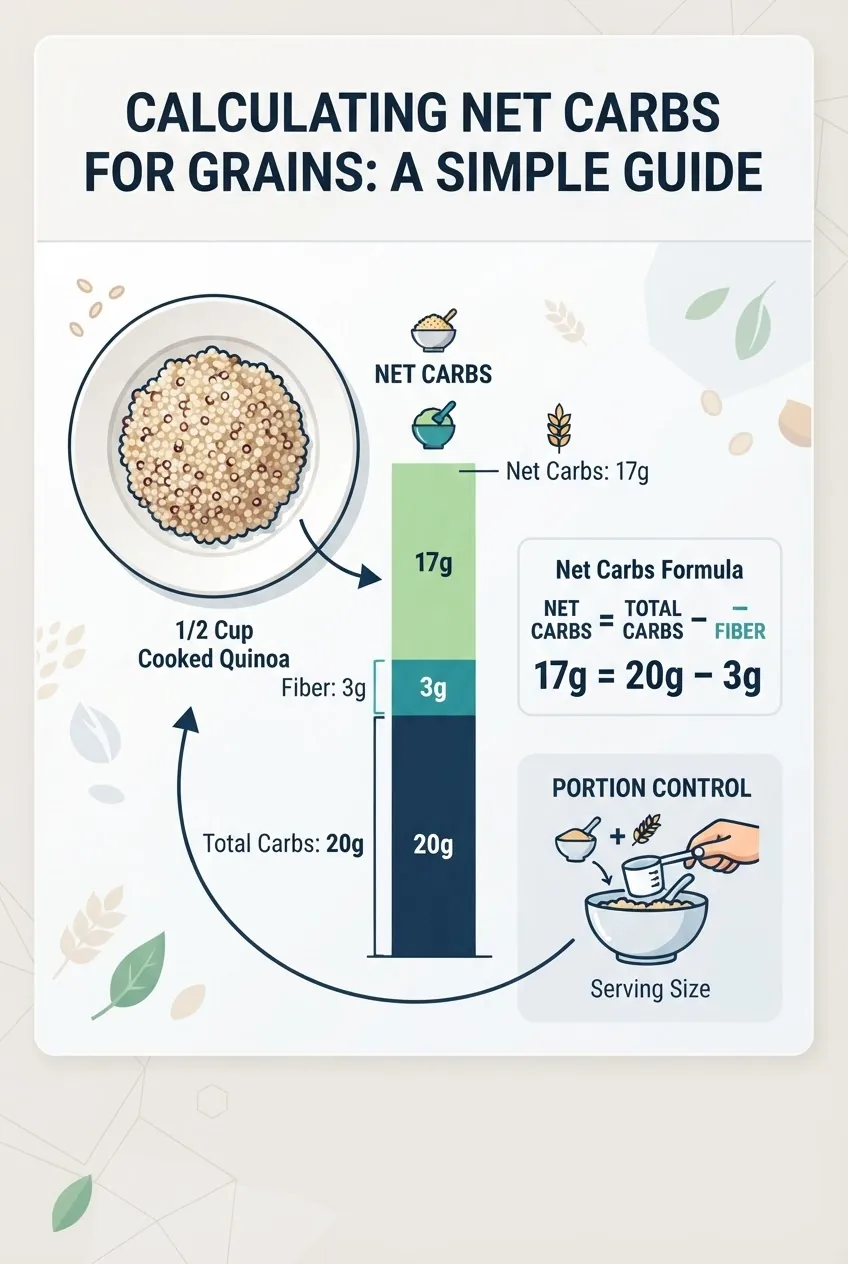
Answer: Calculate net carbs by subtracting fiber (and sugar alcohols, if present) from total carbohydrates per serving: Net carbs = Total carbs − Fiber − Sugar alcohols.
Net carbs: the digestible carbohydrate amount that raises blood glucose, computed as total carbs minus fiber and non-glycemic sugar substitutes.
Expanded method and working examples:
- Read the nutrition label or use a reliable database for “total carbohydrates” and “dietary fiber” per stated serving.
- Subtract fiber grams from total carbohydrate grams; if sugar alcohols are listed and are non-glycemic (e.g., erythritol), subtract them as well.
- Example: 1/2 cup cooked quinoa = 20 g total carbs − 3 g fiber = 17 g net carbs.
Which grains have the least carbohydrates per standard serving?
Answer: Per common cooked servings, the lowest-carb whole grains and grain-like options typically are bulgur, barley (moderate), quinoa, buckwheat, and millet; seeds like hemp and chia appear in grain roles but differ nutritionally and often have lower net carbs.
Pseudo-grain: a seed from a non-grass plant used and cooked like a grain (examples: quinoa, buckwheat).
Comparison table: cooked values per 1/2 cup (approximate)
| Grain | Total carbs (g) | Fiber (g) | Net carbs (g) | Typical calories |
|---|---|---|---|---|
| Bulgur (cooked) | 17 | 4 | 13 | 75 |
| Quinoa (cooked) | 20 | 3 | 17 | 111 |
| Barley, hulled (cooked) | 22 | 6 | 16 | 97 |
| Buckwheat groats (cooked) | 18 | 3 | 15 | 92 |
| Millet (cooked) | 20 | 2 | 18 | 110 |
| Cauliflower rice (1/2 cup, vegetable substitute) | 2 | 1 | 1 | 12 |
Notes: Values vary by brand and cooking method; cauliflower rice is a vegetable replacement with far fewer carbs and can be used to lower total meal carbs.
Is barley a carb and can it fit a low-carb plan?
Answer: Yes, barley is a carbohydrate source but hulled barley contains substantial fiber that lowers net carbs per serving, so moderate portions of whole (hulled) barley can fit into a reduced-carbs diet when portioned and paired with protein and vegetables.
Hulled barley: barley processed to remove only the outer hull while preserving the bran and germ, retaining fiber and nutrients.
Guidance:
- Hulled barley has higher fiber and lower net carbs than pearl barley or barley flour; choose hulled barley when aiming to preserve fiber.
- Limit portion to 1/4–1/2 cup cooked depending on your daily carb target; 1/2 cup cooked hulled barley typically yields ~16 g net carbs.
How should I choose grains with less carbohydrates for different diets (keto, low-carb, diabetic)?
Answer: Choose grains based on your daily net-carb budget: for strict ketogenic diets prefer non-grain vegetables and seed substitutes; for moderate low-carb or diabetic plans use small servings of quinoa, bulgur, buckwheat, or barley while prioritizing whole-grain forms and fiber.
Glycemic index (GI): a relative scale (0–100) measuring how quickly a carbohydrate-containing food raises blood glucose compared with pure glucose.
Practical selection rules by diet:
- Keto (typically ≤20–50 g net carbs/day): avoid most grains, use seed-based alternatives like flaxmeal, hemp seeds, or small amounts of chia for texture.
- Moderate low-carb (50–100 g net carbs/day): include 1/4–1/2 cup servings of quinoa, bulgur, or barley, timed with protein and healthy fats to lower glucose response.
- Diabetes management: prefer whole grains with lower GI (bulgur, barley, steel-cut oats) and monitor portions; distribute carbs across meals and pair with fiber/protein.
Tip: Use the pillar resource for whole-grain fiber benefits: Foods High in Whole Grains and Fiber.
What are the best low-carb grain substitutes that retain whole-grain benefits?
Answer: Best substitutes are pseudo-grains and seeds that behave like grains but have higher protein and fiber: quinoa, buckwheat, amaranth, hemp, chia, and cauliflower rice; they retain micronutrients and texture with fewer net carbs than refined grains.
Amaranth: a pseudo-grain seed high in protein and minerals, cooked like a grain.
Substitute ideas and use cases:
- Quinoa — as a rice or couscous replacement with balanced protein.
- Buckwheat — in salads and pilafs; gluten-free option with low net carbs relative to white rice.
- Cauliflower rice — vegetable stand-in for rice with minimal carbs.
- Chia or hemp — to thicken porridges and add fiber while keeping net carbs low.
How much of each low carb grain should I eat per meal to meet a reduced-carb goal?
Answer: Portion sizes depend on daily net-carb targets; common sensible portions are 1/4 cup cooked for strict low-carb, 1/2 cup for moderate low-carb, and up to 3/4 cup if balancing other low-carb foods across the day.
Portion planning examples (net-carb counts approximate):
- Strict low-carb (~20–30 g net/day): avoid grains or use ≤1/4 cup cooked cauliflower rice (net 1–2 g) or 1–4 tablespoons cooked quinoa as a treat (net ~4–8 g).
- Moderate low-carb (~50–100 g net/day): 1/2 cup cooked quinoa (17 g net) plus vegetables and lean protein keeps a meal balanced.
- Diabetic/maintenance (~100–150 g net/day): 1/2–3/4 cup cooked whole-grain like barley or bulgur (16–24 g net) depending on meal timing and medication.
Always measure cooked servings; volume varies substantially with cooking water and grain type.
How does processing (refining, flaking, milling) change a grain’s carbohydrate impact?
Answer: Processing that removes the bran and germ (refining) reduces fiber and increases digestible carbohydrates and glycemic impact, while minimal processing (cracking, rolling whole grains) preserves fiber and lowers net carb impact.
Refined grain: a grain that has had the bran and germ removed, leaving mostly endosperm and fewer nutrients.
Effects of common processes:
- Milling to white flour increases digestible starch and raises blood-glucose response.
- Pearling (as with pearl barley) removes bran and reduces fiber versus hulled barley.
- Cracked, steel-cut, or hulled forms keep more fiber and slower digestion.
Which low carb grains provide the most fiber and protein per serving?
Answer: Quinoa, buckwheat, hulled barley, and amaranth offer the strongest combined fiber and protein profiles among grains; pseudo-grains often rank high in both metrics compared with common refined grains.
Representative values per 1/2 cup cooked:
| Grain | Fiber (g) | Protein (g) |
|---|---|---|
| Quinoa | 3 | 4 |
| Buckwheat | 3 | 3.5 |
| Hulled barley | 6 | 3 |
| Amaranth | 2.5 | 4.5 |
Practical note: High-fiber grains reduce net carbs and increase satiety, which can help with appetite control on reduced-carbohydrate plans.
What are practical meal swaps to reduce carbs while keeping whole-grain benefits?
Answer: Swap refined rice or pasta with cauliflower rice, spiralized vegetables, cauliflower-couscous, or small portions of quinoa/bulgur; use barley or buckwheat in salads and reduce serving sizes to lower net carbs.
Examples of direct swaps:
- White rice (1 cup) → 1/2 cup cooked quinoa + steamed greens (saves ~30 g net carbs).
- Pasta (1 cup) → 1 cup zucchini noodles + 1/4 cup buckwheat (saves ~20–30 g net carbs).
- Breakfast cereal → overnight chia pudding with a tablespoon of hemp seeds (saves ~15–25 g net carbs).
How do I read labels and databases to find grains with less carbohydrates?
Answer: Read serving size, total carbohydrates, and dietary fiber on the label; use net carbs (total − fiber) and match serving sizes to your meal plan, confirming with USDA or manufacturer data for cooked weights when necessary.
Steps for accuracy:
- Confirm whether the nutrition facts refer to cooked or dry weight; many labels show dry weight, which multiplies cooked carbs.
- Use trusted databases (USDA FoodData Central) when label data is missing.
- Adjust for portion size: weigh or measure cooked servings to match the nutrition data you used for planning.
Can whole-grain barley, oats, or rice be part of a blood-sugar friendly low-carb plan?
Answer: Yes, whole-grain forms of barley and oats can fit a blood-sugar friendly plan when portioned, paired with protein and fats, and selected over refined rice or instant oats; control serving sizes to limit total meal net carbs.
Practical pairing rules:
- Always combine grain servings with lean protein and healthy fats to blunt post-meal glucose spikes.
- Use smaller portions of higher-fiber grains (e.g., 1/4–1/2 cup cooked) and increase non-starchy vegetables to fill the plate.
For broader context on whole-grain benefits and fiber, see Foods High in Whole Grains and Fiber.
What are low-carb grain cooking and preparation tips to preserve fiber and lower glycemic impact?
Answer: Cook grains al dente, rinse where recommended, avoid overcooking and pureeing, and combine with acidic ingredients, protein, and fat to slow digestion and lower glycemic response.
Techniques:
- Use less water and shorter cook times when appropriate (e.g., al dente quinoa) to reduce starch gelatinization.
- Cool cooked grains and reheat to raise resistant starch content slightly (beneficial for glycemic control).
- Add vinegar or lemon to salads with grains; acidity modestly reduces gastric emptying and glycemic response.
How does resistant starch affect the carb count and why might it matter?
Answer: Resistant starch is a type of carbohydrate that resists digestion in the small intestine and behaves like fiber, thereby lowering available net carbs and improving metabolic responses when present in cooked-and-cooled grains.
Resistant starch: starch that is not digested in the small intestine and ferments in the colon, acting like dietary fiber and producing short-chain fatty acids.
Practical application:
- Cooling cooked rice, barley, or potatoes increases resistant starch; reheating does not entirely reverse the effect.
- Using cooled-and-reheated whole grains in salads or cold bowls can reduce net digestible carbs and improve hunger control.
Which whole-grain products should I avoid if I want lower carbs?
Answer: Avoid refined grains and grain-based products with added sugars and flours — white rice, pearl barley, most breads and pastas made with refined flour, granola with sugar, and large servings of cooked grains unless portion-controlled.
Common high-carb pitfalls:
- Packaged cereals and granola with added sugars and large serving sizes.
- Refined flour products marketed as ‘whole’ without whole-kernel ingredients.
- Bread made from enriched white flour or commercial bagels — swap for smaller, 100% whole-grain slices when needed.
How much will substituting low carb grains save me in carbohydrate grams per week?
Answer: Substituting one large serving (1 cup) of white rice with 1/2 cup cooked quinoa or cauliflower rice saves approximately 30–45 g of net carbs per meal; across five meals per week this becomes a 150–225 g weekly reduction.
Worked example for weekly savings:
- Replace lunch white rice (1 cup cooked, ~45 g net) with 1/2 cup quinoa (~17 g net) = 28 g saved per meal.
- Five work lunches per week → 28 g × 5 = 140 g net carbs saved weekly.
- Switching dinner pasta twice weekly similarly compounds savings; two swaps saving 30 g each = 60 g additional weekly.
Interpretation: Small, consistent swaps add up quickly and can move you from a high-carb to a moderate- or low-carb weekly intake without fully eliminating grains.
Are there cost differences between low carb whole grains and common grains?
Answer: Some low-carb-friendly whole grains (e.g., quinoa, buckwheat) cost more per pound than commodity grains (rice, corn), but bulk buying, buying in-season, and using smaller portions reduce cost per meal; barley and bulgur are typically budget-friendly low-carb options.
Cost comparison (approximate per pound, USD, retail ranges):
| Grain | Typical retail $/lb | Cost per 1/2 cup cooked |
|---|---|---|
| White rice | $0.80–$1.50 | $0.05–$0.12 |
| Quinoa | $3.50–$6.00 | $0.40–$0.70 |
| Bulgur | $1.20–$2.50 | $0.10–$0.25 |
| Barley (hulled) | $1.00–$2.00 | $0.08–$0.18 |
Money-saving tips:
- Buy bulk or store-brand quinoa and bulgur from bulk bins.
- Use smaller grain portions as flavor components rather than main volume fillers.
- Blend expensive grains with lower-cost bulgur or cauliflower rice to lower cost and carbs simultaneously.
How should Texas shoppers and cooks source low-carb grains locally?
Answer: Texas shoppers can source low-carb whole grains at major grocery chains, health-food stores, farmer markets, and bulk stores; consider co-ops or online bulk suppliers for better pricing and check product labels for ‘whole’ and ‘hulled’ designations.
Practical local steps:
- Visit the bulk aisle at national grocers or specialty stores for quinoa, buckwheat, and barley.
- Compare unit prices and inspect packaging for whole-kernel terms: “hulled,” “whole,” or “groats.”
- Buy frozen cauliflower rice for convenience and cost-savings when substituting rice.
How do low carb grains affect digestion, fiber goals, and gut health?
Answer: Low carb whole grains with higher fiber (barley, bulgur, quinoa) support digestion and gut health by increasing fermentable fiber and resistant starch, feeding beneficial bacteria and improving regularity and satiety when introduced gradually.
Fiber introduction guidance:
- Increase fiber slowly over 1–2 weeks to avoid gas and bloating.
- Drink adequate water with higher-fiber grains to assist transit and reduce constipation risk.
- Pair grains with probiotic foods (yogurt, kefir, fermented vegetables) for synergistic gut benefits.
For more on fiber sources and how they support health, see the related article on Fibre Content of Quinoa.
What sample 7-day meal plan uses low carb grains without exceeding moderate carb targets?
Answer: A balanced 7-day plan uses small portions (1/4–1/2 cup cooked) of quinoa, bulgur, barley, and cauliflower rice across meals to keep daily net carbs around 50–80 g while maximizing fiber and protein.
Sample plan highlights (daily summary):
- Day 1: Breakfast chia pudding; lunch quinoa salad (1/2 cup cooked); dinner grilled fish with 1/2 cup barley and roasted veggies.
- Day 2: Omelet with 1/4 cup buckwheat porridge; lunch cauliflower rice stir-fry; dinner chicken with 1/2 cup bulgur tabbouleh.
- Day 3–7: Rotate small portions of quinoa, buckwheat, hulled barley, and cauliflower rice; emphasize non-starchy vegetables and lean proteins.
Portion-control spreadsheet method:
- Set daily net-carb cap (e.g., 60 g).
- Allocate carbs across three meals (e.g., 20 g each) and snacks if used.
- Use net-carb values from our comparison table to plan exact portions and swap components as needed.
How do low-carb grains fit into special diets: gluten-free, vegan, and paleo considerations?
Answer: Gluten-free diets can include quinoa, buckwheat, and millet; vegan diets benefit from protein-rich pseudo-grains; paleo diets typically avoid most grains, preferring seeds and vegetable substitutes instead.
Diet-specific notes:
- Gluten-free: choose quinoa, buckwheat, amaranth, and millet; avoid barley and wheat unless certified gluten-free alternatives are specified.
- Vegan: quinoa and amaranth supply complete amino acid profiles useful for plant-based protein needs.
- Paleo: most grains are excluded; use cauliflower rice, nuts, and seeds as grain alternatives.
What are common cooking times and tips for low-carb whole grains?
Answer: Cook times vary: quinoa 12–15 minutes; buckwheat groats 10–12 minutes; hulled barley 25–40 minutes; bulgur quick-cooks in 12–15 minutes for fine bulgur and 20–25 for coarse.
Quick-cook tips:
- Rinse quinoa to remove coating bitterness unless pre-rinsed by brand.
- Soak barley overnight to reduce cooking time and improve digestibility.
- Toast buckwheat briefly to enhance flavor before simmering.
How do I troubleshoot GI spikes or digestive issues when adding low carb grains?
Answer: If blood glucose rises or digestion is uncomfortable, reduce portion size, increase fiber (vegetables) in the meal, add healthy fat/protein, and consider switching to grains with lower GI or to vegetable substitutes like cauliflower rice.
Stepwise troubleshooting:
- Reduce grain portion by half and retest your glucose response or symptoms.
- Swap to a higher-fiber grain (hulled barley) or a pseudo-grain (quinoa).
- Increase non-starchy vegetables and add a fat source (olive oil, avocado) to slow absorption.
- If digestive symptoms persist, reintroduce fiber slowly and consult a healthcare professional.
What labeling and product words guarantee lower carbohydrate grains?
Answer: Look for “whole,” “hulled,” “groats,” “steel-cut,” and “whole kernel” on packaging; avoid “pearled,” “refined,” “enriched,” “instant,” and products with added sugars — these often indicate higher available carbs.
Labeling checklist:
- Prefer: “hulled barley,” “steel-cut oats,” “whole-grain buckwheat,” “whole quinoa.”
- Avoid: “pearled barley,” “instant oats,” “enriched flour,” and “multi-grain” without whole-grain percentages.
How do grain-based foods like bread and pasta compare when choosing lower-carb options?
Answer: Bread and pasta made from refined flours have higher net carbs than small portions of whole grains; choose 100% whole-grain breads with intact kernels, legume-based pastas, or reduce serving sizes to cut carbs effectively.
Comparison examples per typical serving:
- White bread slice ≈ 12–15 g net carbs; whole-grain slice may be similar unless very high in fiber.
- Legume pasta (e.g., chickpea) often has more protein and fiber and can have net carbs comparable to whole-grain pasta but greater satiety.
- Using 1/2 cup cooked barley instead of 1 cup cooked pasta reduces net carbs and increases fiber.
See also: Bread Health Guide for bread-specific choices and nutrition.
Which grains are most and least likely to cause weight gain when included in a reduced-carb diet?
Answer: Weight outcomes depend on total calorie and carb balance; dense, high-fiber grains (barley, bulgur, quinoa) are less likely to promote weight gain at controlled portions because of satiety, while refined grains and large portions of rice or pasta increase caloric and carb load and therefore weight risk.
Practical guidance:
- Prioritize high-fiber whole grains to increase fullness per calorie.
- Measure portions to avoid passive overconsumption; visual cues (1/2 cup cooked) help volume control.
- Combine grains with protein and vegetables to reduce total calorie intake across the meal.
How can I plan grocery lists and batch-cook low-carb grains for the week?
Answer: Build a list focused on 2–3 grain choices (quinoa, bulgur, hulled barley), bulk-buy for savings, and batch-cook measured portions into airtight containers for 3–5 days to streamline meals and control portions.
Batch-cooking workflow:
- Decide weekly net-carb target and allocate grams to meals.
- Cook bulk portions using measured dry:water ratios and cool to store in measured 1/2-cup containers.
- Label containers with net-carb values per portion to simplify tracking.
How do cultural and regional grain dishes adapt when choosing lower-carb options?
Answer: Traditional dishes can be adapted by substituting portion-controlled whole grains or vegetable bases: use cauliflower rice in Mexican or Asian rice dishes, bulgur or barley in Mediterranean salads, and buckwheat for Eastern European recipes that call for buckwheat specifically.
Adaptation examples:
- Tex-Mex: swap rice in burrito bowls for 1/2 cup quinoa plus extra lettuce and salsa.
- Mediterranean: use bulgur tabbouleh with extra parsley and vegetables while reducing bulgur to 1/3 cup.
- Asian: replace rice with cauliflower rice in stir-fries, keeping soy and sesame for flavor.
What testing and monitoring should I do when introducing low-carb grains if I have diabetes?
Answer: Monitor fasting and postprandial blood glucose after introducing or adjusting grain portions, keeping a food-and-glucose log for 1–2 weeks, and consult your healthcare team before changing medication or insulin dosing based on changed carbohydrate intake.
Monitoring protocol:
- Check blood glucose before a meal and 1–2 hours after the meal when testing a new grain or portion.
- Record food details, portion size, and exercise to correlate with readings.
- Contact your provider if consistent postprandial spikes occur for medication adjustment guidance.
What are common misconceptions about low carb grains I should avoid?
Answer: Misconceptions include assuming all whole grains are high-carb regardless of portion, that “gluten-free” equals low-carb, or that portion size doesn’t matter; fiber content and serving size drive the real carb impact.
Clarifications:
- Gluten-free foods can be high in starch and net carbs (e.g., rice or corn products).
- Whole-grain status often improves nutrient profile and reduces net carbs per satiety, but large servings still add significant digestible carbs.
- Processing level matters more than the label term alone — “whole” should mean whole-kernel when possible.
Which reliable resources should I use to verify grain nutrition data?
Answer: Use reputable databases such as USDA FoodData Central for standardized nutrient values and manufacturer nutrition panels for brand-specific products; consult registered dietitians for personalized carb targets and medical guidance.
Authoritative references:
- USDA FoodData Central — search cooked and dry weights for accurate net-carb math (use for cross-checking labels).
- Manufacturer nutrition facts panels — needed when buying packaged or fortified grain products.
External link example: USDA FoodData Central is a primary resource for food composition data.
How do I balance taste, convenience, and carb goals when selecting grains?
Answer: Balance by selecting one convenient low-carb substitute (e.g., cauliflower rice or pre-cooked quinoa), rotating with high-fiber whole grains for variety, and using flavor-enhancing techniques (toasting, herbs, acids) so smaller portions feel satisfying.
Taste and convenience tactics:
- Toast grains briefly before cooking to add depth, so smaller portions feel more flavorful.
- Use pre-cooked or frozen cauliflower rice for time savings.
- Mix small amounts of higher-cost pseudo-grains with bulgur to stretch flavor and nutrients affordably.
Frequently Asked Questions
Are any whole grains truly carbohydrate-free?
No. All true grains and pseudo-grains contain carbohydrates; carbohydrate-free alternatives are vegetables (cauliflower, zucchini) or fats and proteins — grains only vary in the amount of digestible carbs and fiber per serving.
Which low carb grain is best for someone managing blood sugar spikes?
Choose higher-fiber, lower-GI grains like hulled barley, bulgur, and steel-cut oats, and use small portions combined with protein and healthy fats to blunt spikes while providing whole-grain benefits.
How can I make my favorite rice dish lower in carbs without changing flavor much?
Use a mix of 50% cauliflower rice and 50% rice or substitute 1/2 the rice with cooked quinoa; add aromatic spices, herbs, and a splash of acid to preserve familiar flavors while cutting net carbs.
Is quinoa lower in carbs than white rice per serving?
Per typical cooked servings, quinoa has slightly fewer net carbs than white rice and offers more protein and micronutrients, making it a better choice for reduced-carb, nutrient-dense meals.
Can I still eat barley on a low-carb diet?
Yes—choose hulled barley and control portions (1/4–1/2 cup cooked), pair with protein and non-starchy vegetables, and count net carbs toward your daily target to include barley safely.
How quickly will swapping grains lower my weekly carbohydrate total?
Substituting one high-carb grain meal per day with a lower-carb alternative can save 20–45 g net carbs per meal, adding up to a 140–315 g weekly reduction depending on frequency, which significantly lowers weekly carb intake.
Are pseudo-grains like buckwheat and amaranth good low-carb choices?
Pseudo-grains typically have fewer digestible carbs than refined grains and offer better protein and fiber; they are good choices for moderate low-carb plans when portioned appropriately.
What should I do if I get digestive discomfort after increasing whole-grain intake?
Introduce fiber gradually over 1–2 weeks, drink more water, reduce portion sizes temporarily, and consider switching to soaked or sprouted grains which can be gentler on digestion.