

By the end of this hands-on guide you’ll have a practical weekly plan, clear rules for daily vs rest-day choices, and a step-by-step method to avoid overtraining — expect to spend about 90 minutes reading and applying this; the guide assumes basic fitness literacy. This article answers should you exercise every day with evidence-based recommendations tailored for varied fitness levels and Texas climate realities.
Before you start
- Medical clearance if you have chronic conditions, are pregnant, or are over 65 (ask your primary care provider).
- Tools: stopwatch or phone timer, notebook or tracking app, water bottle (≥24 oz/700 ml per session in heat), sunscreen (SPF 30+), hat for outdoor sessions.
- Basic equipment (optional): resistance bands, pair of adjustable dumbbells (5–30 lb depending on strength), a yoga mat.
- Time budget: plan blocks of 10–60 minutes per session; collect at least 150 minutes moderate or 75 minutes vigorous activity weekly.
Understanding Exercise Frequency: Should You Exercise Every Day?
The short answer is nuanced: many people can benefit from daily movement (light-to-moderate activity), but structured high-intensity or heavy-strength sessions should be spaced to allow recovery. This section discusses the debate on daily exercise benefits, myths, and a balanced approach you can follow.

Daily activity improves cardiovascular health, mood, and consistency, but “exercise every day” is often misunderstood as needing intense training daily. Think of daily movement as a spectrum: easy walks, mobility or yoga, and active recovery can happen every day; intense aerobic sessions and heavy resistance lifts should be cycled. The phrase daily physical activity myths often fuels either unnecessary rest or excessive training.
Physiologically, muscles and the nervous system need time to repair after high-intensity or eccentric-loaded sessions — that’s why rest is integral. Behaviorally, short daily sessions boost adherence: 10–20 minutes daily is easier to sustain than sporadic 90-minute sessions. Use perceived exertion (RPE 1–10) and heart rate zones to guide intensity, and record sessions to spot trends toward overtraining.
Official Exercise Recommendations: How Much Exercise Per Week and Per Day?
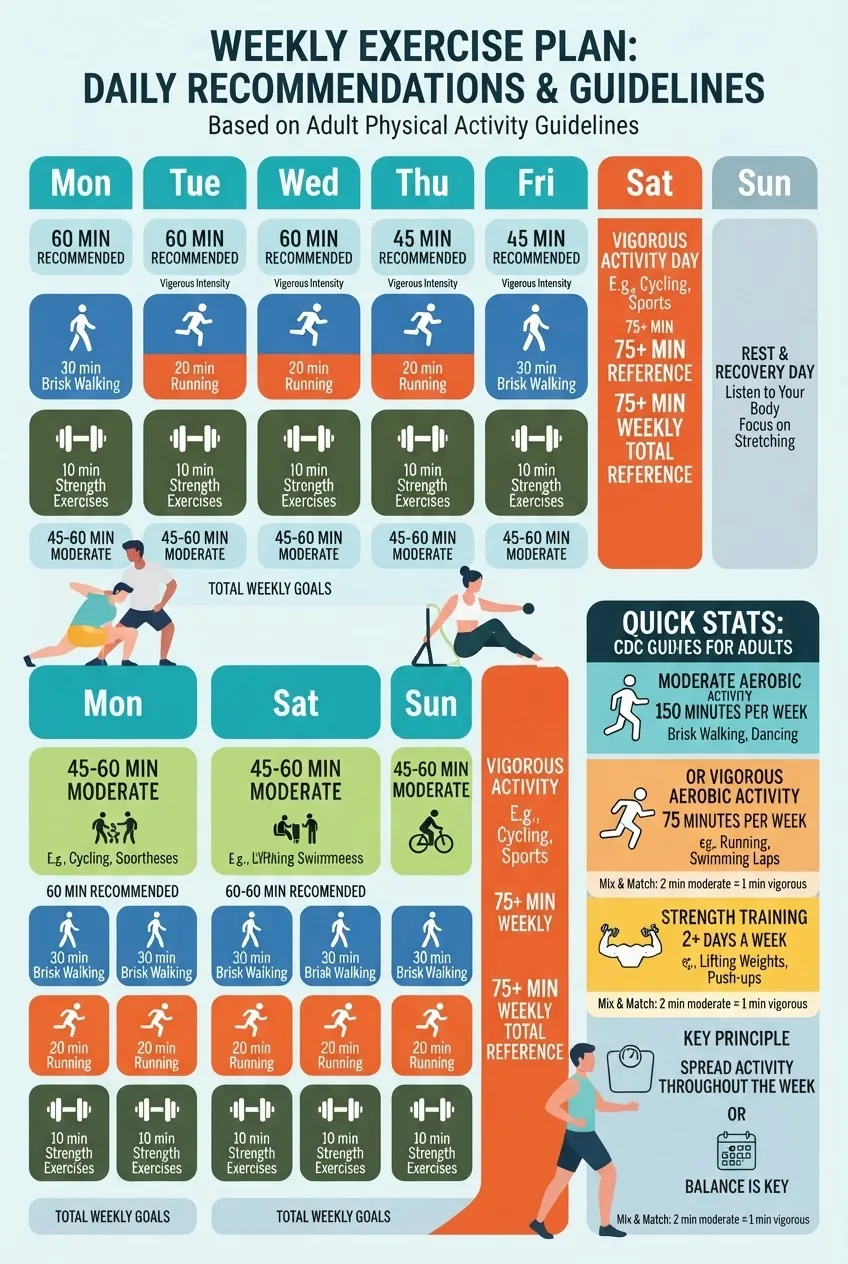
Below are authoritative targets used to build your weekly plan and daily minutes. All items include the source type and year so you can verify current guidance.
- Adults — aerobic minimum: 150–300 minutes of moderate-intensity aerobic activity per week, or 75–150 minutes of vigorous-intensity activity, or an equivalent mix. (According to a 2024 CDC guideline — government health agency.)
- Muscle strengthening: At least two days per week of muscle-strengthening activities involving all major muscle groups. (According to a 2024 CDC guideline — government health agency.)
- Daily activity baseline: Aim for at least 10 minutes of moderate movement if sedentary; accumulate activity throughout the day to reach weekly targets. (According to a 2023 WHO summary — international health organization.)
- Vigorous vs moderate guidance: Moderate = brisk walking, gentle cycling (RPE 4–6). Vigorous = running, heavy cycling, competitive sports (RPE 7–9). Use heart-rate zones: moderate ≈ 50–70% HRmax, vigorous ≈ 70–85% HRmax. (According to a 2023 American Heart Association resource — medical research institution.)
Translate weekly targets into minutes per day by dividing targets across 3–7 days. For example, 150 minutes moderate = 30 minutes on 5 days or 20–25 minutes daily across 6–7 days. Keep at least two non-consecutive days for strength training or distribute lighter resistance sessions across the week.
For more detailed guidelines from authoritative sources, see:
CDC physical activity basics,
American Heart Association exercise guidance, and
ACSM resources — all cited to support exercise frequency and intensity planning.
Benefits of Exercising Every Day vs Taking Rest Days
The trade-offs between daily movement and scheduled rest influence recovery, progression, and injury risk. Below is a direct comparison of common outcomes to help you decide what balance fits your goals.
| Outcome | Daily Light/Moderate Activity | Structured Training with Rest Days |
|---|---|---|
| Cardiovascular benefit | Improves baseline endurance; lowers blood pressure when accumulated (10–30 min/day). | Greater aerobic adaptations if including interval or longer steady-state sessions. |
| Strength & hypertrophy | Maintains general strength with bodyweight and short resistance sessions. | Superior gains when sessions are intense and spaced for recovery (48–72 hrs for muscle groups). |
| Mental health | Daily movement reduces stress and improves mood quickly (5–20 min effect). | Structured routine provides confidence and goal progress, also improving well-being. |
| Injury & overtraining risk | Lower if intensity remains light–moderate; risk rises if daily intensity is high without recovery. | Lower if rest days are observed; risk increases with insufficient sleep, nutrition, or volume spikes. |
Recent position statements show that consistent moderate activity reduces cardiovascular risk factors, while high-frequency intense work without adequate recovery leads to overtraining symptoms such as persistent fatigue, performance drop, and mood disturbances (According to a 2022–2024 review in exercise science literature — sports medicine journals). Use scheduled deload weeks (reduce volume by 30–50% every 4–8 weeks) when training intensely.
How Often Should You Exercise for Optimal Health?
Deciding how often should you exercise depends on goals: general health, fat loss, strength, or performance. Below is a step-by-step actionable approach to personalize frequency and intensity.
If you want broader habit frameworks that support exercise, read effective daily activities and habits.
-
Identify your primary goal in one sentence.
Write a specific outcome: “Improve cardiovascular fitness to run a 10K in 12 weeks,” or “Lose 10 lb of fat while preserving strength.” Clear goals determine frequency: health maintenance needs 30–45 min, 5 days/week; sport prep may require 6 days with planned intensity variation.
-
Calculate a weekly target from official guidelines.
Choose the weekly target (use CDC numbers): 150–300 min moderate or 75–150 min vigorous. Example: for 200 min moderate/week, schedule 20–40 minutes across 5–10 sessions. Log current activity for 7 days to know your baseline.
-
Assign intensity zones to session types.
Label sessions as “light” (RPE 1–3), “moderate” (RPE 4–6), or “vigorous” (RPE 7–9). Beginners: 80% moderate, 20% light. Advanced: include 1–3 vigorous workouts/week (intervals, tempo runs, heavy lifts), with the remainder moderate or active recovery.
-
Plan recovery days and active recovery activities.
Schedule at least 1–2 full rest or active recovery days per week. Active recovery = 20–40 min easy walking, mobility, foam rolling, or restorative yoga. For heavy strength training, allow 48–72 hours before repeating the same muscle groups.
-
Progress volume by 10% per week.
Increase total weekly minutes or load (sets × reps × weight) by no more than 10% weekly to reduce injury risk. Example: if week 1 = 150 min, week 2 target ≈165 min. If intensity increases, keep volume steady or reduce minutes for the week.
-
Match nutrition and sleep to training load.
For daily or near-daily training, eat 1.2–2.0 g/kg body weight protein daily depending on goals (According to a 2023 sports nutrition consensus — research institution). Aim for 7–9 hours sleep; chronic sleep <6 hours raises injury and overtraining risk.
-
Monitor recovery metrics weekly.
Track resting heart rate, sleep quality, perceived exertion, and training performance. A sustained resting HR increase >5–10 bpm over baseline or persistent fatigue for 7+ days signals the need to cut volume. Use a simple log: session, RPE, hours sleep, mood (scale 1–5).
-
Tailor the split: cardio vs strength balance.
For general health: 3 aerobic sessions (20–40 min) + 2 strength sessions (30–40 min) per week. For strength focus: 3–4 strength sessions with 2 shorter cardio sessions. For endurance: 4–6 aerobic sessions with 1–2 strength maintenance sessions.
-
Adapt frequency to real life and climate.
Texas summers require moving high-intensity outdoor workouts to early morning or indoors; hydration increases by 20–50% depending on heat. If you miss a session, maintain weekly minutes by splitting sessions into shorter bouts across other days.
Examples
– Beginner (Goal: maintain health): 20–30 min brisk walk daily × 5 = 150 min/wk; 2× light resistance sessions (20–30 min).
– Intermediate (Goal: fat loss and strength): 30 min moderate cardio × 4 + 30–45 min strength × 3 (alternate days), with 1 active recovery day.
– Advanced (Goal: race prep): 1 long session, 2 interval sessions, 2 easy runs, 2 strength/maintenance sessions — balance to total target weekly minutes and include deload every 4th week.
Practical Exercise Recommendations for Daily Wellness in Texas
Texas has hot summers and mild winters; practical planning reduces heat stress and keeps adherence high. Local adaptation combines timing, hydration, clothing, and movement choices that fit typical Texan schedules and environments.
For expanded routine and lifestyle ideas that include exercise scheduling, see daily wellness routine ideas for a healthy lifestyle schedule.
- Summer timing: schedule outdoor aerobic or interval work before 8:00 AM or after 7:30 PM when temperatures are lower; substitute indoor cycling or pool workouts during heat waves.
- Hydration rule: add 500–1000 ml extra water for sessions >30 minutes in high heat; include electrolytes for sessions >60 minutes or with heavy sweat. (According to a 2023 sports medicine guidance — sports medicine organization.)
- Clothing & sun safety: wear breathable fabrics, wide-brim hats, and SPF 30+ sunscreen. Reapply sunscreen every 90 minutes during prolonged outdoor workouts.
- Indoor alternatives: walking malls, home HIIT (20–25 min), yoga, or resistance band circuits on hot days.
- Weekend scheduling: move longer aerobic sessions to early morning and use shaded trails, parks with tree cover, or indoor community centers.
How Can We Exercise Safely Every Day: Tips and Precautions

Safety is non-negotiable. Below are stepwise precautions and simple practices you can apply daily to reduce injury risk and avoid overtraining.
- Warm up 5–10 minutes before moderate sessions: dynamic mobility and light aerobic movement (e.g., leg swings, arm circles, 5 min brisk walk).
- Cool down 5–10 minutes after sessions: gentle walking, static stretching for muscle groups used (hold stretches 20–30 sec).
- Use progressive overload: increase weight or minutes by ≤10% weekly; avoid doubling volume or intensity within a single week.
- Prioritize technique over load: for lifts, use tempo 2–0–1 (two-second eccentric, no pause, one-second concentric) and record form on video monthly to correct errors.
- Listen to your body: out-of-the-ordinary sharp pain, persistent swelling, or performance decline for >7 days warrants reduced load and medical check.
- Sleep and nutrition: eat 20–40 g protein within two hours after strength work; maintain 7–9 hours sleep to support recovery (According to a 2023 sports nutrition and sleep consensus — research sources).
- Gear and surfaces: rotate shoes every 300–500 miles for runners; use shock-absorbing surfaces where possible to limit joint stress.
- Adapt for climate: when heat index >100°F (>38°C combined effect), move workouts indoors or to water-based exercise.
Sample Weekly Exercise Schedule: Minutes Per Day Recommendations
Below is a sample schedule translating weekly minutes into a practical daily plan. Adjust minutes and intensity based on your goals and current conditioning.
If you need more help structuring your whole day around exercise and work, see optimizing your routine schedule.
| Day | Main session | Minutes | Intensity |
|---|---|---|---|
| Monday | Strength (full body) | 40 | Moderate–Vigorous |
| Tuesday | Brisk walk + mobility | 30 | Moderate |
| Wednesday | Interval cardio (HIIT 20/10 × 12) | 30 | Vigorous |
| Thursday | Active recovery: yoga or walk | 30 | Light–Moderate |
| Friday | Strength (focus: legs/compound lifts) | 40 | Moderate–Vigorous |
| Saturday | Long aerobic session (bike/hike) | 60 | Moderate |
| Sunday | Rest or light mobility | 15–30 | Light |
Total weekly minutes (example): ≈245 minutes moderate/vigorous and 2 strength sessions — aligns with CDC weekly targets while preserving recovery. Swap session types to suit schedule; use 2×20 min sessions in a day if mornings are busy.
Common mistakes and how to avoid them
I’ve observed these common failures in clients and practitioners; here’s how I fixed them.
- Mistake: I scheduled every workout as high intensity and burned out in four weeks. Fix: I introduced two light active recovery days weekly and reduced heavy sessions to three per week, using the 10% progression rule.
- Mistake: I ignored hydration rules during Texas summer runs and suffered heat-related fatigue. Fix: I moved sessions before 7:00 AM, increased fluid intake by ~750 ml per session, and used electrolyte tablets for rides >60 minutes.
- Mistake: I swapped strength for cardio and lost functional strength. Fix: I re-prioritized two weekly compound strength sessions (30–45 min) and tracked load progression to regain strength.
Checklist: Verify your plan
- I meet 150–300 min moderate or 75–150 min vigorous activity weekly.
- I train strength ≥2 sessions/week for all major muscle groups.
- I include 1–2 active recovery or rest days each week.
- I increase weekly volume by ≤10% and monitor RHR and mood.
- I adapt workouts for Texas heat and use additional hydration measures.
- I consult a healthcare provider if I have medical conditions or persistent symptoms.
When to call in a professional
See a physician if you experience chest pain, unexplained shortness of breath, fainting, or swelling after exercise. Consult a certified strength and conditioning specialist or physical therapist for persistent pain >2 weeks, recurring injuries, or when designing sport-specific periodized training. Use medical clearance for high-risk individuals before starting vigorous routines.
Conclusion
Daily movement benefits most people, but daily high-intensity training without recovery increases injury and overtraining risk. Use official weekly targets (CDC), vary intensity, prioritize two strength sessions weekly, and adapt plans for Texas climate and your schedule. Start with the sample plan, track recovery metrics, and adjust volume by ≤10% weekly. Ready to build your custom week? Use the checklist above and begin with a light 10–20 minute session today.