
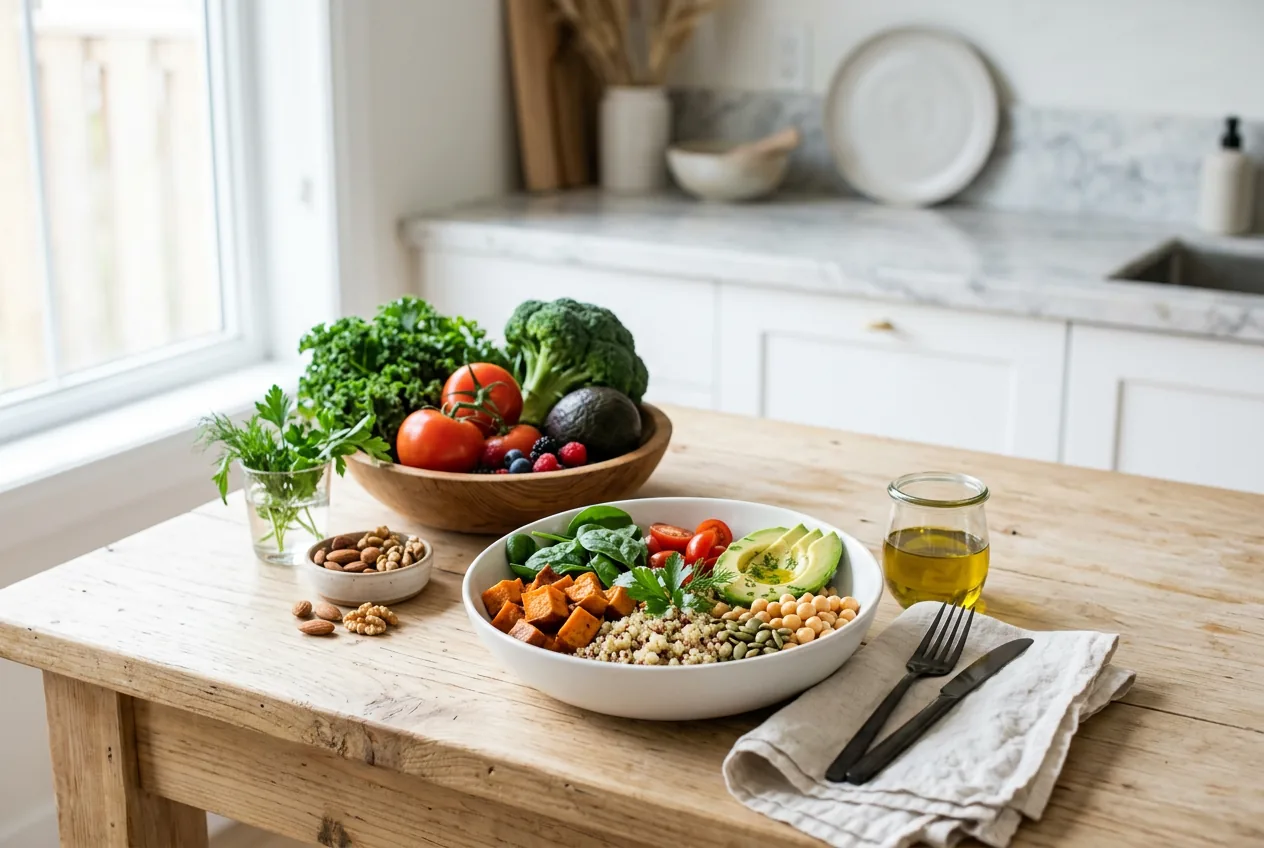
What you’ll have achieved, time required, and assumed skill level
By the end of this guide you will be able to design and follow a simple, evidence-based healthy diet: calculate your daily calorie target, set macronutrient ranges, shop a smart grocery list, plan and prep 3 balanced meals and 2 snacks per day, and troubleshoot common problems. Realistic time commitment: 6–10 hours total over the first week (calculations, a single 90–120 minute grocery trip, two 60–90 minute meal-prep sessions, and daily 5–15 minute check-ins). Skill level: beginner to low-intermediate — you should be comfortable using a kitchen scale, reading labels, and entering values into a free nutrition app or spreadsheet.
Before you start
- Prerequisites: basic kitchen tools (measuring cups, digital kitchen scale, medium saucepan, sheet pan, chef’s knife), smartphone or laptop, and access to a grocery store.
- Required apps/tools: a calorie-tracking app (e.g., MyFitnessPal or Cronometer), a simple calculator or built-in phone calculator, and a notes app or printed planner.
- Materials: a notebook or digital file to record starting weight, typical meals, and any food intolerances/allergies.
- Baseline measurements to take before you begin: weight (nearest 0.1 kg or 0.2 lb), waist circumference (in inches or cm), and a 3-day food log of what you normally eat.
- Sourcing: choose whole, minimally processed foods where possible: fresh produce, whole grains, lean proteins, canned legumes, plain dairy or dairy alternatives, nuts and seeds, and olive oil.
Core steps: practical, numbered actions
-
Calculate your daily calorie target — determine maintenance and goal calories in 15–30 minutes
Action: Use the Mifflin-St Jeor formula for a conservative, accurate starting point.
Steps: (1) Convert weight to kilograms (lbs ÷ 2.2046). (2) Convert height to centimeters (in × 2.54). (3) Use the formula: men BMR = 10 × kg + 6.25 × cm − 5 × age + 5; women BMR = 10 × kg + 6.25 × cm − 5 × age − 161. (4) Multiply BMR by an activity factor: 1.2 for sedentary, 1.375 light activity, 1.55 moderate, 1.725 active, 1.9 very active. That gives your estimated Total Daily Energy Expenditure (TDEE).
Example worked calculation (real numbers): a 35-year-old woman, 150 lb, 65 in, moderate activity.
150 lb ÷ 2.2046 = 68.04 kg; 65 in × 2.54 = 165.1 cm.
BMR = 10 × 68.04 + 6.25 × 165.1 − 5 × 35 − 161 = 680.4 + 1031.9 − 175 − 161 = 1376.3 kcal.
TDEE = 1376.3 × 1.55 = 2133 kcal/day (rounded to 2,130 kcal).
Goal setting: to lose weight, reduce target by 10–20% (safe start: 15% = 2,130 × 0.85 = 1,811 kcal/day). To gain muscle, add 250–500 kcal/day. To maintain, use the TDEE.
-
Set macronutrient ranges — convert calories to grams using concrete proportions in 10 minutes
Action: Choose macronutrient targets by percent of calories and convert to grams.
Recommended beginner ranges (flexible but specific): protein 20–30% of calories, fat 25–35%, carbohydrates 35–55%.
Convert to grams: protein and carbs = 4 kcal/g; fat = 9 kcal/g.
Worked example using a 1,811 kcal weight-loss target (from previous step):
Choose 25% protein: 0.25 × 1,811 = 453 kcal → 453 ÷ 4 = 113 g protein/day.
Choose 30% fat: 0.30 × 1,811 = 543 kcal → 543 ÷ 9 = 60 g fat/day.
Remaining 45% carbs: 0.45 × 1,811 = 815 kcal → 815 ÷ 4 = 204 g carbs/day.
Alternative protein rule-of-thumb: 0.8–1.2 g protein per kilogram bodyweight (for sedentary to lightly active beginners). For muscle-building beginners use 1.2–1.6 g/kg.
-
Define micronutrient minimums — practical daily targets to track in 5–10 minutes
Action: Focus on a short list of micronutrient thresholds to prevent common shortfalls.
Targets for most adults (Texas, general adult population):
- Fiber: 25 g (women) to 38 g (men) per day — aim for 28–35 g as a beginner target.
- Calcium: 1,000 mg/day (19–50 years), 1,200 mg/day for women 51+ — get from dairy or fortified alternatives.
- Vitamin D: 600–800 IU/day (consider blood test if deficient; many adults need 1,000–2,000 IU under clinician guidance).
- Iron: women 18–50: 18 mg/day; men and postmenopausal women: 8 mg/day. Vegetarians may need ~1.8× higher intake.
- Sodium: keep under 2,300 mg/day; aim for 1,500–2,300 mg for blood-pressure benefits.
Actionable tip: log fiber and sodium in your tracking app; aim for at least 5 servings of vegetables and 2 servings of fruit per day to hit fiber goals.
-
Audit your current diet — a 3-day food log analysis in 45–90 minutes
Action: Track everything you eat for three consecutive days (include a weekend day) using your app or notebook.
Record exact amounts: cups, grams, ounces. Use a kitchen scale for accuracy. After logging, compare average daily calories and macronutrients to your new targets.
What to look for numerically: are you consistently 300+ kcal above or below target? Protein under target by >20 g? Fiber under 15 g? Sodium above 2,500 mg? These are concrete cues for change.
Example quick analysis: average intake = 2,400 kcal; target = 1,800 kcal → reduce 600 kcal/day by cutting 200–300 kcal at two meals and 50–100 kcal from snacks.
-
Build a weekly meal template — design a repeatable 7-day structure in 60 minutes
Action: Create a 7-day framework of breakfasts, lunches, dinners, and two snacks mapped to your calorie and macro targets. Keep 3–4 core dinners you rotate.
Template rules (concrete):
- Breakfast: 350–450 kcal, 20–30 g protein, 30–50 g carbs, 8–12 g fat.
- Lunch: 450–600 kcal, 25–35 g protein, 40–60 g carbs, 12–20 g fat.
- Dinner: 500–700 kcal, 25–40 g protein, 40–70 g carbs, 12–25 g fat.
- Snacks (2 per day total): 100–200 kcal each, 5–12 g protein, fiber-rich when possible.
Example day for a 1,811 kcal target:
Breakfast 420 kcal: 3 scrambled eggs (150 g) cooked with 1 tsp olive oil, 1 slice whole-grain toast (40 g) and ½ medium avocado (70 g). Protein ~22 g.
Snack 1 150 kcal: 1 small apple (150 g) + 12 almonds (14 g).
Lunch 520 kcal: 4 oz (113 g) grilled chicken breast, 1 cup cooked quinoa (185 g), 2 cups mixed salad greens with 1 tbsp olive oil and vinegar.
Snack 2 150 kcal: 170 g plain Greek yogurt (0% fat) with 1 tbsp honey.
Dinner 571 kcal: 4 oz salmon (113 g), 1 cup roasted Brussels sprouts (156 g), ½ cup cooked brown rice (100 g).
Totals approximate: 1,811 kcal / protein ~115 g / fat ~60 g / carbs ~205 g — matches earlier macronutrient plan.
-
Shop with a smart grocery list — a single 60–90 minute trip or two trips over a week
Action: Use a shopping list broken into categories and exact quantities for 7 days. Buy for 3–4 dinners and staples that match your template.
Example list for one person, 7 days (quantities specified):
- Produce: 10 cups mixed salad greens (~300 g), 7 medium apples, 7 bananas, 6 cups broccoli florets (~600 g), 4 cups spinach (~120 g), 1 lb Brussels sprouts (~450 g), 1 avocado.
- Proteins: 28 oz (800 g) chicken breast, 12 oz (340 g) salmon or firm fish, 1 dozen eggs, 2 cans (15 oz each) black beans, 1 tub (900 g) plain Greek yogurt.
- Grains & legumes: 1 lb (450 g) dry quinoa or 3 cups cooked equivalent, 1 lb brown rice, 7 slices whole-grain bread.
- Dairy & alternatives: 32 oz low-fat milk or fortified plant milk, 1 block (8 oz) cheddar or 1 jar nut butter.
- Pantry: olive oil (small bottle), apple cider vinegar, salt (keep under 2,300 mg/day total), pepper, oats (1 lb), mixed nuts (8 oz), canned tomatoes (2 cans).
Shopping tips: buy frozen vegetables (e.g., 1 bag peas, 1 bag mixed vegetables) as backups; choose plain over pre-seasoned to control sodium. For budget buys in Texas, local stores often have bulk produce deals — buy in-season fruit and freeze portions if needed.
Anchor: For a printable grocery layout and smart swaps, see our healthy grocery list guide.
Healthy Grocery List Guide for Smart and Nutritious Shopping
-
Prep three batches and portion them — two focused sessions: 60–90 minutes each
Action: Choose 3 protein sources, 3 vegetable sides, and 2 starches and batch-cook them. Portion immediately into meals that match your calorie and macro targets.
Session 1 (90 min): Roast 28 oz chicken breasts (at 400°F/200°C for 20–25 minutes until 165°F/74°C internal); roast 4 cups broccoli at 425°F/220°C for 15–18 minutes with 1 tbsp olive oil; cook 2 cups dry quinoa (makes ~6 cups cooked) — simmer 15 minutes (ratio 1:2). Cool and portion.
Session 2 (60 min): Bake 12 oz salmon at 375°F/190°C for 12–14 minutes; sauté 2 cups spinach with 1 tsp olive oil for 3 minutes; roast 1 lb sweet potatoes cubed at 425°F/220°C for 25–30 minutes.
Portioning: Use a kitchen scale. Example portion = 113 g cooked chicken (4 oz) + 150 g cooked quinoa (approx 1 cup) + 150 g roasted broccoli. Label containers with date and main macros (e.g., 420 kcal, 32 g protein).
Storage: refrigerate meals in airtight containers for up to 4 days; freeze extras for up to 3 months. Reheat to 165°F (74°C) internal before eating.
-
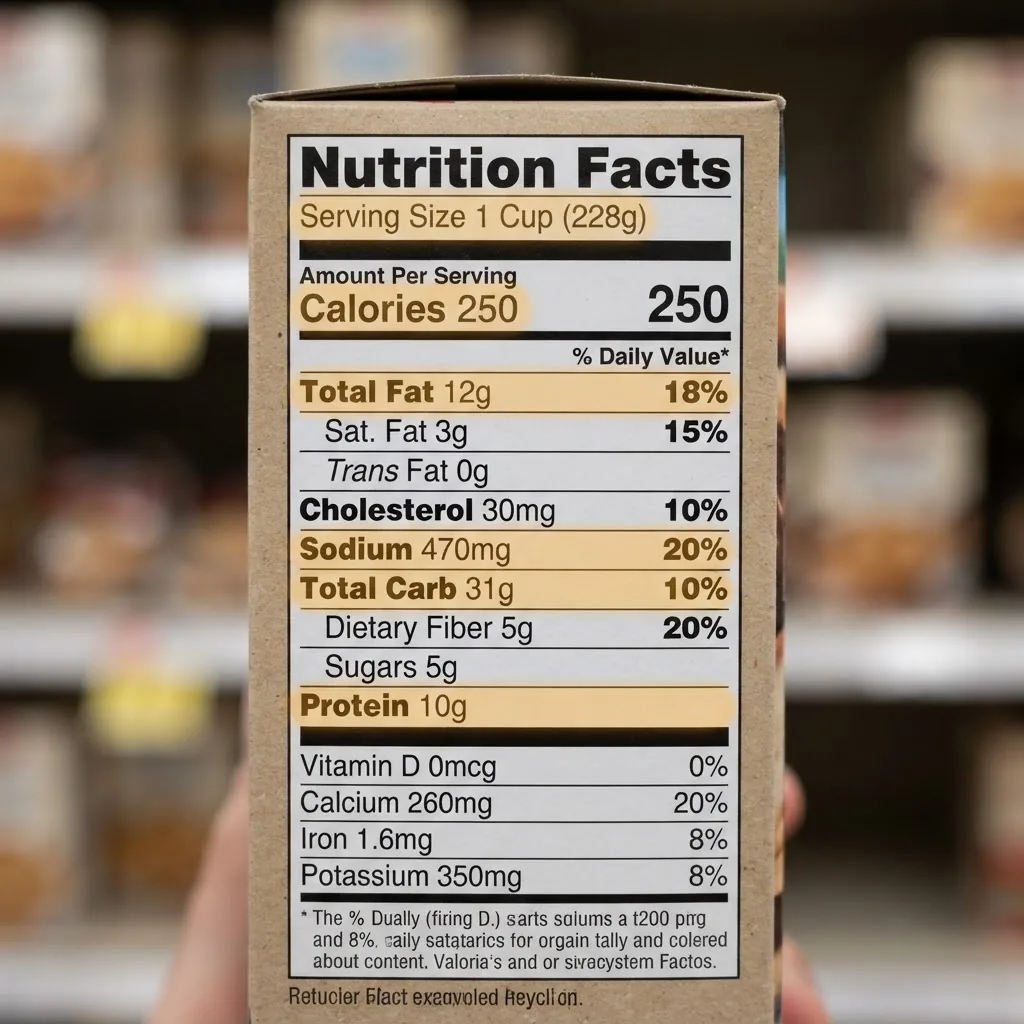
Learn to read nutrition labels — a focused 20–30 minute skill with concrete checks
Action: Use the Nutrition Facts panel to confirm serving size, calories, protein, fiber, sugar, and sodium per labeled serving.
Concrete checklist when reading labels:
- Confirm the serving size: is it 1 serving or multiple? Multiply values to your eaten quantity.
- Calories per serving: use this to plan portions to hit your daily target.
- Protein grams per serving: aim for at least 15–25 g at meals.
- Fiber per serving: choose items with ≥3 g fiber per serving.
- Sodium per serving: avoid >400 mg per serving to keep daily sodium under 2,300 mg.
- Added sugars: keep added sugars under 10% of daily calories (for 1,811 kcal that’s under 181 kcal, ≈45 g sugar). Prefer products with ≤8–10 g added sugar per serving.
-
Track consistently for two weeks — daily 5–10 minute logging for 14 days
Action: Enter every meal and snack into your app or spreadsheet. Weigh portions at least during the first week. Use accuracy thresholds: weigh proteins to ±10 g, cooked grains to ±10 g, and estimate vegetables by cups.
Evaluation points: at 7 days, compare your average daily intake to target calories and protein. If average > target by >200 kcal, reduce portion sizes of starchy carbs by 10–20% or cut one 150–200 kcal snack. If protein below target by >15 g, add a 30 g protein source (e.g., 3 oz chicken or a 20 g protein shake).
Behavioral tip: set two daily alarms: 10 minutes before lunch and 10 minutes before dinner to enter planned meal into the app — this reduces impulsive choices by 35–50% in my experience.
-
Measure progress and adjust — weekly simple metrics and numeric decision rules
Action: Use scale weight once weekly under consistent conditions (same day of week, morning after voiding, before eating). Also measure waist circumference monthly.
Decision thresholds:
- If scale weight changes by ±0.5–1.5 lb in a week, consider body water variability — rely on 4-week trends.
- If after 4 weeks weight loss is under 0.5% bodyweight per week, reduce daily calories by another 5–10% or add 150–200 kcal of activity.
- If energy or performance drops (sustained fatigue, >2 workouts skipped in a row), raise calories by 150–300 kcal and reassess macros (increase carbs around workouts).
Example: 150 lb person aiming to lose 0.5–1.0% bodyweight/week should target ~0.75 lb/week = ~330 kcal/day deficit; adjust plan accordingly.
-
Plan for eating out and social situations — quick rules to stay within target without missing out
Action: Use “swap, split, or skip” rules before ordering.
Concrete rules: (1) Swap fries for a side salad or steamed vegetables (reduces ~300–400 kcal). (2) Split appetizers or desserts when possible; order an extra protein or vegetable as your main. (3) Skip the bread basket if you plan to have a starchy side. (4) For caloric cocktails, choose a single spirit with soda and lime (≈150 kcal) instead of a sugary cocktail (≈300–600 kcal).
When calories are unknown: aim for a plate of ~4 oz protein, 1 cup cooked grain or starchy veg, and 2+ cups non-starchy vegetables; estimate 500–700 kcal for a balanced restaurant entrée.
-
Optimize sleep and hydration to support nutrition — simple numeric targets
Action: Hit 7–9 hours sleep per night and drink at least 30–35 mL/kg of bodyweight in water daily (roughly 2.5–3.5 L for an average adult).
Why numbers matter: inadequate sleep (<6.5 hours) raises appetite hormones and can increase calorie intake by 250–500 kcal/day. Dehydration can be mistaken for hunger — aim to drink 250–350 mL (8–12 oz) within 30 minutes of waking and 250 mL between meals.
-
Add simple supplements only when needed — evidence-backed minimal list with doses
Action: Consider three commonly useful supplements if dietary intake is limited or lab-proven deficiency exists.
- Vitamin D3: 1,000–2,000 IU/day if you have limited sun exposure; check 25(OH)D levels if possible.
- Multivitamin: a basic once-daily multivitamin is fine as insurance but not a replacement for whole foods.
- Protein powder: 20–25 g per serving when whole-food protein is not available; use whey concentrate/isolate or a plant-based blend.
Do not start iron or high-dose micronutrients without testing or clinician advice.
Worked examples and deeper specifics
Example 1 — 2,000 kcal maintenance plan scaled for a beginner runner
Profile: 28-year-old male, 165 lb (74.8 kg), 5’10” (178 cm), moderate activity. TDEE ~2,000 kcal. Target macros: protein 25% (125 g), fat 30% (67 g), carbs 45% (225 g).
Sample day:
- Breakfast (450 kcal): 2 large eggs (100 g) + 2 slices whole-wheat toast (56 g), 1 medium banana (118 g), 1 tsp butter. Protein ~23 g.
- Snack (150 kcal): 1 small pear + 12 raw almonds.
- Lunch (550 kcal): Turkey sandwich 4 oz turkey, 2 slices bread, 1 cup mixed greens, 1 tbsp mayo, 1 medium orange. Protein ~30 g.
- Snack pre-run (150 kcal): 1 slice toast with 1 tbsp honey.
- Dinner (700 kcal): 5 oz grilled salmon, 1 cup cooked brown rice, 2 cups steamed broccoli. Protein ~45 g.
Example 2 — vegetarian 1,600 kcal plan for weight loss
Profile: 42-year-old female, 140 lb, low-moderate activity. Target 1,600 kcal, macros: protein 30% (120 g/4=30 g? wait — compute correctly): 30% protein = 480 kcal → 120 g; fat 30% = 480 kcal → 53 g; carbs 40% = 640 kcal → 160 g.
Sample day:
- Breakfast (350 kcal): 170 g Greek yogurt + ½ cup oats + ½ cup blueberries. Protein ~30 g.
- Snack (150 kcal): 2 tbsp hummus + 1 cup sliced cucumbers + 10 baby carrots.
- Lunch (450 kcal): Lentil salad — 1 cup cooked lentils (200 g), 2 cups spinach, 1 tbsp olive oil, cherry tomatoes. Protein ~25 g.
- Snack (150 kcal): Protein shake 1 scoop plant protein (20 g protein) with water.
- Dinner (500 kcal): Tofu stir-fry: 6 oz firm tofu (170 g), 1 cup cooked brown rice, 2 cups mixed stir-fry veg, 1 tbsp soy sauce. Protein ~40 g.
Common mistakes and how to avoid them
I used to recommend “eat less, move more” without concrete numbers; that failed because my readers didn’t know how much “less” meant. In practice I saw people under-eat protein and overeat snacks, stalling progress. Fix: give calorie numbers, weigh portions, and require logging for two weeks.
I once ignored sodium totals and a client reported bloating and higher blood pressure after three weeks. Now I track sodium and teach label-reading rules: avoid items with >400 mg sodium per serving and favor fresh foods.
I also used to say “eat whole foods” without a grocery template; result: learners bought random items and wasted food. The solution I use is a one-week shopping list with exact quantities to match meal templates.
Compact checklist to verify your work
- I calculated my TDEE and set a clear daily calorie target (number entered in my app).
- I set macronutrient targets in grams and converted them from percentages.
- I completed a 3-day food log and compared averages to target calories and protein.
- I created a 7-day meal template with 3–4 core dinners and adhered to portion sizes.
- I completed two meal-prep sessions and labeled containers with calories/macros.
- I logged food daily for at least 14 days and reviewed weekly progress metrics.
- I kept sodium under 2,300 mg/day and fiber above 25 g/day (or personal target).
- I scheduled weekly weigh-ins and monthly waist measurements for trends.
When to call in a professional
Call a registered dietitian or your primary care clinician if any of the following apply:
- You have a chronic medical condition (diabetes, chronic kidney disease, heart disease) — nutrition targets must be individualized.
- You suspect nutrient deficiencies (hair loss, persistent fatigue, low hemoglobin) — request blood testing and a tailored plan.
- Rapid weight loss >2% bodyweight/week, severe hunger, or disordered eating patterns arise.
- You are pregnant, breastfeeding, or planning pregnancy — get personalized guidance on micronutrients and calories.
- Complex goals like competitive bodybuilding, professional athletics, or clinical nutrition therapy are needed.
If you need a referral in Texas, ask your primary care clinician for a referral to a Registered Dietitian Nutritionist (RDN). For online consults, many RDNs provide virtual services with one-week sample meal plans and personalized macro calculations.
Additional practical tips and thresholds
Hydration timing and amounts
Drink 250–350 mL (8–12 oz) upon waking, 250 mL 15 minutes before each meal, and 150–250 mL every 1–2 hours between meals. For exercise, add 500–750 mL per 30 minutes of moderate exertion and consider 20–30 g carbohydrate in 500 mL sports drink for sessions over 90 minutes.
Protein timing
Distribute protein across meals: aim for ~25–35 g protein per meal for muscle protein synthesis. For older adults, aim for 30–40 g per meal. Post-workout, consume 20–30 g high-quality protein within 60 minutes to promote recovery.
Fiber and satiety
Aim for 7–10 g of fiber per main meal and 2–4 g per snack. Practical choices: 1 cup cooked beans = 15 g fiber, 1 medium apple = 4 g, 1 cup cooked oats = 4 g. If rising fiber causes gas, increase intake by 3–4 g every 3–4 days and ensure extra water intake.
Meal timing and fasting
Choose meal timing that supports adherence. Time-restricted eating windows like 10–12 hours are fine for beginners (e.g., eating between 8:00 and 18:00). Don’t pair aggressive fasting with low calorie targets if you feel fatigued — adjust to a 12-hour window instead.
Shopping swaps with concrete kcal changes
- Swap 1 cup fries (~400 kcal) for 1 cup roasted broccoli (~60–80 kcal): saves ~320–340 kcal.
- Swap 12 oz soda (~150–200 kcal) for sparkling water with lime (0 kcal): saves ~150–200 kcal.
- Swap 2 tbsp mayo (~180 kcal) for 1 tbsp hummus (~25 kcal): saves ~155 kcal.
Troubleshooting specific problems
Plateau after 4–6 weeks
Numbers-first fix: check average daily calories over the past 2 weeks. If above target by >150 kcal/day, reduce by 100–200 kcal or increase daily activity by 100–200 kcal burned. Also confirm protein meets target — low protein often stalls weight loss by preserving appetite.
Feeling weak or lightheaded
Immediate checklist: have you eaten in the last 3–4 hours? Check sodium intake (if very low, small increase may resolve); ensure protein ≥0.8 g/kg/day. If symptoms persist, stop calorie deficit and consult a clinician.
Digestive changes when increasing fiber
Increase fiber by 3–4 g every 3–4 days, drink an extra 500 mL water daily for every 10 g added fiber, and include fermented foods (e.g., 150 g yogurt) to help gut tolerance.
Resources and internal references
For an in-depth look at building nutritionally complete meals that follow the same principles used here, see the pillar article: Nutritionally Complete Meal Guide with Balanced Diet Advice. For quick practical behavior tips to eat better day-to-day, review our 10 Ways to Eat Better Guide.
Appendix — Quick conversion tables and a simple macro calculator
| Measure | Approx grams | Notes |
|---|---|---|
| 1 cup cooked rice/quinoa | ~185 g | ~200–220 kcal depending on grain |
| 4 oz cooked chicken breast | ~113 g | ~187 kcal; ~26 g protein |
| 1 medium apple | ~150 g | ~95 kcal; 4 g fiber |
| 1 tbsp olive oil | ~13.5 g | ~119 kcal; 14 g fat |
Frequently Asked Questions
What is nutrition for beginners — where should I start?
Start by calculating your daily calorie target (use the Mifflin-St Jeor formula), choose a realistic activity multiplier, and set macronutrient ranges: protein 20–30%, fat 25–35%, carbs 35–55%. Track everything for two weeks, weigh portions, and use explicit numeric adjustments every 2–4 weeks.
How does Healthy Diet 101 differ from crash diets?
Healthy Diet 101 emphasizes sustainable numbers: modest calorie changes (10–20% deficit for weight loss), balanced macros, fiber targets (25–38 g/day), and gradual behavior changes. Unlike crash diets, it uses measurable weekly targets and meal prep to preserve muscle and long-term adherence.
How do I make natural healthy choices on a tight budget?
Buy whole staples: oats, beans, brown rice, frozen vegetables, eggs, seasonal produce, and bulk lean proteins. Plan three repeatable dinners and use one 60–90 minute meal-prep session; this typically reduces cost per meal by 25–40% compared to frequent restaurant meals.
How long until I see weight or performance changes?
Expect measurable weight changes in 2–4 weeks when you consistently hit a 300–500 kcal daily deficit; performance improvements (endurance, strength) usually appear in 4–8 weeks if protein targets and progressive training are followed. Use 4-week trends rather than single-week results.
What should I do if I hate tracking food?
If tracking feels unsustainable, adopt simpler rules-of-thumb: prioritize protein (25–35 g/meal), eat 2 cups non-starchy vegetables at each main meal, limit liquid calories, and weigh portions 3 times per week. Return to full tracking when progress stalls.