
This guide summarizes current nutrition science updates, explains how to read nutrition news, lists trustworthy nutrition websites and databases, and shows how to apply new findings safely to meal planning. It prioritizes study quality, conflicts of interest, and practical nutrition info so you can use accurate nutrition data for healthier choices.
What are the most important nutrition science updates right now?
Answer: The key updates are refined dietary patterns emphasizing whole foods, updated nutrient targets for specific subgroups, clearer evidence on ultra-processed foods and cardiometabolic risk, and new large trials that change guidance on supplements and dietary fats.
Recent high-quality research has shifted the focus from single nutrients toward eating patterns that prioritize vegetables, legumes, whole grains, nuts, lean proteins, and minimal ultra-processed foods.
Systematic review: a structured summary that identifies, appraises and synthesizes all relevant studies on a question.
Meta-analysis: a statistical method that combines results from multiple studies to estimate an overall effect.
Large randomized controlled trials (RCTs) and meta-analyses published in leading journals frequently drive updates by reducing uncertainty about effects such as the impact of saturated fat replacement or omega-3 supplementation.
Policy updates and professional guidance now incorporate subgroup-specific targets for older adults, pregnant people, and those with metabolic disease, reflecting differential risk and nutrient needs.
How should I evaluate a nutrition study before treating it as news?
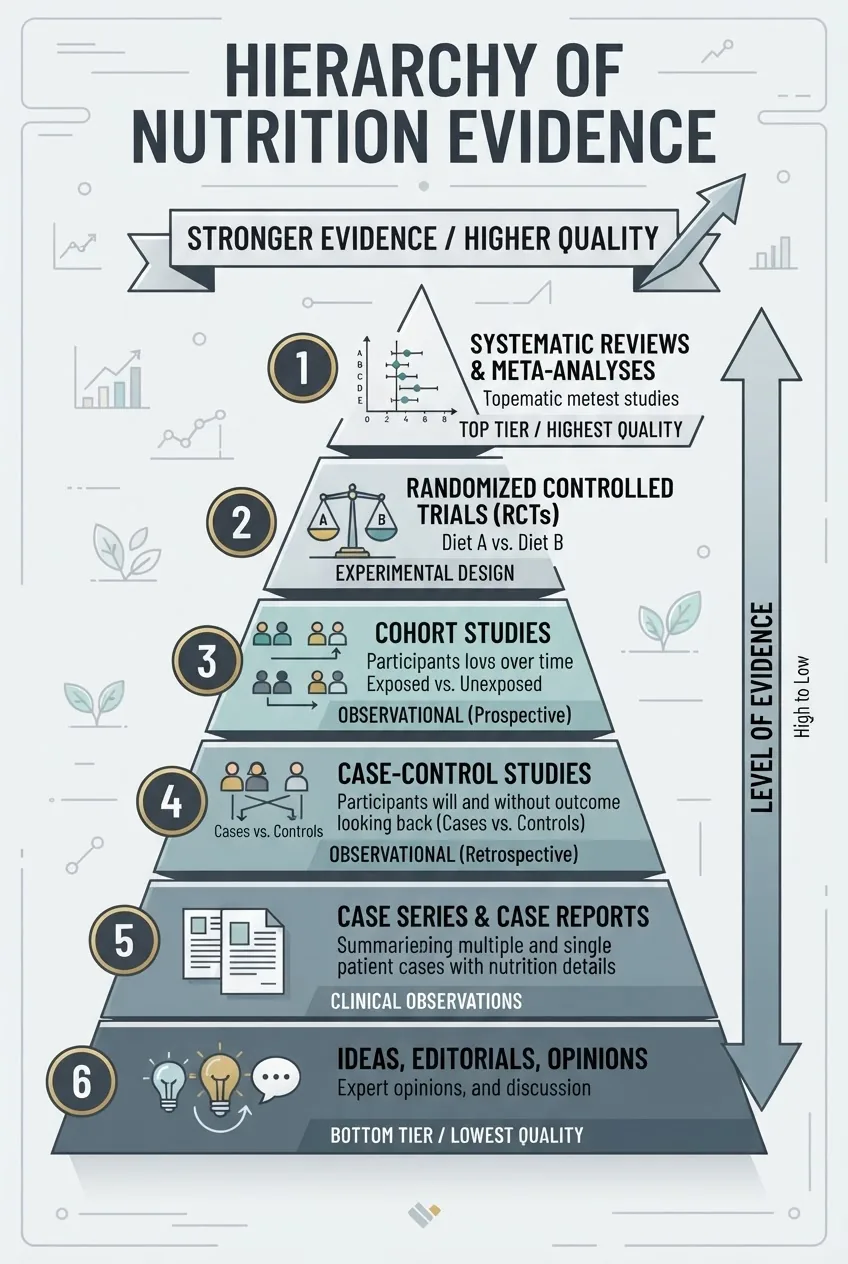
Answer: Check study type, sample size, funding sources, primary outcomes, effect sizes and whether the result was replicated; prioritize randomized trials and systematic reviews over single observational studies.
Randomized controlled trial (RCT): a study where participants are randomly assigned to an intervention or control to measure causal effects.
- Identify the study design: RCTs > cohort studies > cross-sectional for causal inference.
- Scan sample size and duration: small or very short studies are preliminary.
- Look at primary vs secondary outcomes: primary outcomes are prespecified and more reliable.
- Check conflicts of interest and funding: industry funding can bias interpretation.
- Assess statistical and clinical significance: small p-values with tiny effects may not be meaningful.
Worked example: a headline says “X food reduces heart attacks.” Read the abstract: if the study is observational with dietary recall and a hazard ratio of 0.95 (95% CI 0.90–1.00), the effect is minimal and possibly confounded; then search for RCTs or meta-analyses on the same exposure.
What does “nutritional value” really mean and how is it measured?
Answer: Nutritional value is the quantified content of macronutrients, micronutrients and bioactive compounds per amount of food and is measured using lab assays, food composition databases, and standardized portion references.
Nutritional value: the measurable amounts of calories, macronutrients (carbohydrate, protein, fat), vitamins, minerals and other bioactives in a defined serving of food.
Nutrition labs use chemical analysis, chromatography and spectrometry to quantify nutrients; results feed into national nutrition facts databases and manufacturer labels.
Databases report values per 100 g and per serving; always compare like-for-like (per 100 g or per serving) and check if preparation (raw, cooked, drained) affects numbers.
Practical tip: calculate nutrient density by dividing a key nutrient (e.g., protein grams) by calories to compare foods for that nutrient per calorie.
Which websites and databases are best for reliable nutrition info?
Answer: Use government and academic databases (USDA FoodData Central), professional organizations, peer-reviewed journals, and university extension sites; prioritize sites with transparent methods and citations.
Internal resources in this cluster that explain application include our pillar on balanced meals and the specialist pieces on nutrition science and study news linked below.
- Nutritionally Complete Meal Guide — balanced meal application and targets.
- Nutrition Science Guide — deeper methods and interpretation.
- Nutrition Study News — curated updates and summaries.
Table: comparison of common nutrition sites and databases
| Site | Type | Best use | Cost |
|---|---|---|---|
| USDA FoodData Central | Government database | Food composition, lab values | Free |
| PubMed / Google Scholar | Academic index | Primary studies, reviews | Free |
| Professional societies (academy/associations) | Guidelines & statements | Practice guidance and statements | Mostly free |
| University extension sites | Educational resources | Practical recipes and food safety | Free |
External authoritative sources include government nutrition databases such as the USDA; use their data for precise nutrition facts and food composition when calculating meals. USDA.
How do nutrition facts databases differ and which should I use?
Answer: Databases vary by data source (laboratory vs manufacturer), update frequency, and level of detail; choose government or research-based databases for accuracy and manufacturer databases for branded product specifics.
Nutrition facts database: a searchable collection of food composition entries listing calories, macronutrients, micronutrients and reference measures for individual foods and recipes.
Government databases (USDA FoodData Central) compile lab-analyzed values and peer-reviewed entries; manufacturer databases list branded products and may reflect proprietary recipes that change seasonally.
Use a government database when you need standardized values for comparisons, and use a branded database or label data when tracking intake of a specific packaged product.
Practical workflow:
- For meal planning: start with USDA/academic database for base values.
- When using packaged items: replace database values with the label-listed nutrition facts to reflect product-specific content.
- When precision matters (research or clinical): document source and preparation method and use lab-analyzed values if available.
How do updates in nutrition science affect dietary recommendations and policy?
Answer: New high-quality evidence can prompt guideline committees to revise recommended intake ranges, food-group emphasis, and public health campaigns, but change usually follows systematic review and consensus, not single studies.
Policy-making bodies integrate multiple studies through systematic reviews and advisory committees before changing public guidance; this ensures replicability and population-level relevance.
Examples of impact:
- Updated saturated fat guidance when replacement nutrients (PUFAs vs carbs) show different effects on cardiovascular risk.
- Shifts toward dietary patterns (Mediterranean, DASH) when multiple trials and cohort studies demonstrate consistent benefits.
- Supplement recommendations adjusted after large trials find no benefit or potential harm for some populations.
Timeframe: guideline revisions often take years because committees review emerging evidence, solicit public comment, and model population impacts before formalizing changes.
What common errors do journalists make when reporting nutrition science updates?
Answer: Common errors include overgeneralizing observational associations into causation, ignoring effect size, omitting study limitations, and failing to disclose funding or conflicts of interest.
Journalists often translate relative risk into dramatic-sounding headlines without stating absolute risk; a 20% relative reduction can be a 0.2% absolute change if baseline risk is low.
Checklist to spot errors in headlines:
- Does the article report study type and sample size?
- Is absolute risk or effect size given, or only relative percentages?
- Are limitations and potential confounders described?
- Is there context with prior research or replication status?
When a report lacks these items, consult the original paper or a trusted science summary to avoid overreacting to preliminary claims.
How can I apply nutrition science updates to my meal planning safely?
Answer: Translate evidence into actionable changes by prioritizing proven patterns (e.g., more whole plant foods, fewer ultra-processed foods), test one change at a time, monitor how you feel, and consult a registered dietitian for clinical conditions.
Practical step-by-step plan:
- Identify the specific update (e.g., decrease ultra-processed snack intake).
- Map the change onto daily meals (swap processed snack for a piece of fruit + nuts).
- Adjust recipes or portion sizes using nutrition facts data from USDA or labels.
- Track outcomes for 4–12 weeks (weight, blood pressure, energy, lab tests) before further changes.
Worked example: If a new meta-analysis shows replacing refined grains with whole grains reduces fasting glucose modestly, aim to replace 1–2 daily refined-grain servings (white bread, pastries) with whole-grain options (oats, brown rice) and log changes in blood glucose or symptoms.
What are red flags that a nutrition news story is unreliable?
Answer: Red flags include sensational headlines, single-study claims without link to the paper, absence of study design, reliance on animal or test-tube data to extrapolate to humans, and undisclosed industry funding.
List of red flags to watch for:
- No link to the original study or DOI.
- Claims based on preprints not yet peer-reviewed without caveats.
- Use of anecdote or celebrity endorsement as evidence.
- Overstated causal language (e.g., “X cures Y”) for observational findings.
If you see these signs, search for corroborating high-quality evidence in PubMed or summaries by professional societies before altering your diet or spending money on supplements.
How much do nutrition research updates cost to implement for the average household?
Answer: Costs depend on the change: swapping ultra-processed foods for whole foods can be neutral to slightly higher, while simple pattern shifts (more beans, pulses, seasonal produce) can be cost-saving; budget implementation averages $0–$50 per month.
Table: typical cost impact of common evidence-based changes
| Change | Typical monthly cost impact | Notes |
|---|---|---|
| Replace snacks with fruit & nuts | +$10–$30 | Costs vary by nut choice; buy in bulk to save. |
| Increase legumes instead of meat twice weekly | –$5 to –$20 | Legumes are low cost and nutrient-dense. |
| Choose fresh wild salmon twice monthly | +$10–$40 | Seasonal or frozen alternatives reduce cost. |
Low-cost implementation strategies include meal planning, using legumes and frozen vegetables, buying whole grains in bulk, and substituting processed items with homemade versions to control both nutrition and spending.
How can I spot conflicts of interest and bias in nutrition research?
Answer: Read the funding and disclosure statements in the paper, check authors’ past publications for industry links, and prefer independent trials and systematic reviews with transparent conflict declarations.
Signposts of potential bias:
- Industry funding for trials that favour the sponsor’s product without independent replication.
- Authors with multiple industry ties and minimal public data sharing.
- Selective outcome reporting or unusual changes in pre-registered outcomes.
Where possible, follow independent reviews from academic consortia or government panels; when industry-funded studies are used, look for confirmation from non-industry-led research before changing practice.
Which nutrition learning resources are best for Texas readers wanting local context?
Answer: Use national databases for composition plus Texas A&M AgriLife Extension and regional university cooperative extension sites for local food safety, seasonal produce, and culturally relevant recipes.
Local resources often provide guidance on food availability, farming calendars and public health programs; they can help adapt national guidance to regional diets and budgets.
- University extension pages for canning, preservation and seasonal produce.
- Local public health department nutrition programs for SNAP-Ed and community classes.
- Regional farm-to-table and farmers’ market listings to source affordable produce.
Combining national evidence with local practical resources yields guidance that is both evidence-based and feasible in a Texan household context.
How often should I check nutrition science updates and how do I subscribe responsibly?
Answer: Check curated updates monthly and subscribe to newsletters from professional societies, government databases, and academic review platforms; avoid alert overload by filtering for topics you act on.
Subscription recommendations:
- Subscribe to a professional society summary for clinical-grade updates.
- Follow government database release notifications (USDA) for data updates.
- Use curated research summaries from trusted university labs rather than general news feeds for methodological nuance.
Set rules for yourself: act on guideline changes and large high-quality RCTs or meta-analyses, not every single paper; maintain a folder or bookmark list to track items you want to discuss with a dietitian or clinician.
What practical tools let me compare nutrition info and calculate meals?
Answer: Use a combination of USDA FoodData Central, nutrition calculator apps that cite databases, spreadsheet templates, and a kitchen scale to convert from grams to serving sizes for accurate meal calculations.
Essential toolkit:
- Access to a reliable food composition database (USDA FoodData Central).
- A digital kitchen scale for consistent portion measurement.
- A nutrition-tracking app or spreadsheet that allows you to set targets and export data.
- Recipe analysis: break recipes into ingredients, use database values, and sum nutrients per serving.
Worked spreadsheet example: to calculate protein per serving for a stew, list ingredient weights, multiply each ingredient weight by protein per 100 g from the database, sum protein, and divide by number of servings.
What are the limits of current nutrition science updates?
Answer: Limits include reliance on self-reported intake, heterogeneity in food definitions, short trial durations for chronic disease outcomes, and population-specific results that may not generalize.
Specific limitations to account for:
- Dietary assessment error: recall bias and misreporting reduce precision in observational studies.
- Food heterogeneity: “ultra-processed” or “Mediterranean” diets vary between studies.
- Surrogate endpoints: many trials use biomarkers rather than hard clinical outcomes.
- Underrepresentation of diverse populations, limiting generalizability.
Responsible interpretation recognizes these constraints and requires replication, longer follow-up, and diverse samples before wide-scale policy or clinical changes.
How do I translate a new nutrient target from a study into a shopping list?
Answer: Convert the nutrient target into food equivalents using a database, prioritize whole-food sources, and plan substitutions consistent with your budget and preferences.
Stepwise method:
- Note the nutrient target (e.g., add 300 mg extra magnesium weekly).
- Use a database to find foods high in that nutrient (e.g., 100 g almonds ≈ 270 mg magnesium).
- Create swaps: replace a low-magnesium snack with 30 g almonds three times a week.
- Draft a shopping list with quantities and cost estimates based on local pricing or frozen/canned alternatives.
Example shopping list change: if a study suggests more dietary fiber, add oats, canned beans, and frozen berries to the list and remove one box of sugary cereal; use database values to confirm fiber grams per serving.
Frequently Asked Questions
What makes a nutrition study high quality?
High-quality nutrition studies are those with randomized design for causal claims, sufficiently large and diverse samples, pre-registered protocols, clear primary outcomes, low loss to follow-up, transparent funding disclosures, and replication or synthesis in systematic reviews.
Can one study change dietary guidelines immediately?
No; guideline changes typically require systematic evidence accumulation including multiple independent trials or meta-analyses, evaluation by expert panels, and public consultation before formal recommendations are updated.
How do I use nutrition facts labels versus databases?
Use the product label for packaged items to reflect manufacturer formulations and use standard databases like USDA FoodData Central for generic foods and recipe analysis; always match serving sizes and preparation states for accurate comparison.
Are nutrition preprints reliable sources for news stories?
Preprints can indicate emerging research but lack peer review; treat them as preliminary, check for peer-reviewed follow-up, and avoid making major dietary changes based solely on preprint findings.
How can I verify the claims in a nutrition headline quickly?
Open the original study, note design and sample size, check whether outcomes are absolute or relative, look for replication or meta-analyses, and scan disclosures for conflicts; prioritize independent expert summaries when available.
Which trusted nutrition websites should I bookmark first?
Bookmark USDA FoodData Central for composition data, PubMed for primary research, and professional society pages for guideline updates; locally, save your university extension site for regionally relevant food guidance.
How do ultra-processed foods factor into current nutrition updates?
Current evidence links higher intake of ultra-processed foods to increased cardiometabolic risk in observational studies and some trials; recommendations emphasize reducing ultra-processed food, replacing them with whole or minimally processed options when possible.