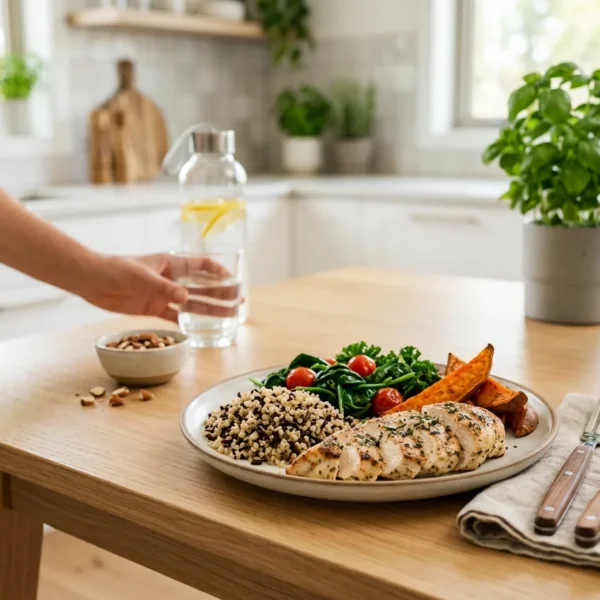

What you’ll finish with, time required, and assumed skill level
By the end of this guide you will have designed and tested a personalized proper diet for men: a 7-day male meal plan with daily calorie and macro targets, a grocery list, a two-week meal-prep schedule, and rules for ongoing adjustment (weight loss, muscle gain, or maintenance). Realistic completion time: two focused sessions — a 90–120 minute planning and shopping session, and a 3–4 hour meal-prep session the following weekend — plus daily execution. Skill level assumed: beginner to intermediate cooking skills and comfort with simple math (percentages and multiplication).
Before you start
- Kitchen scale (digital, reads in grams and ounces) and measuring cups/spoons.
- Food-tracking app (MyFitnessPal, Cronometer, or equivalent) and a notebook or spreadsheet.
- Reliable weight and tape measure for waist and body measurements.
- Basic cookware: 10–12″ nonstick skillet, 4-6 quart pot, baking sheet, mixing bowls, storage containers (6–12 containers).
- Access to recent bloodwork (within 12 months) if possible: fasting glucose, lipid panel, vitamin D, PSA if over 50.
- 60–90 minutes of uninterrupted time to calculate needs and build the 7-day plan; 3–4 hours for batch-cooking.
- Pen, highlighter, and a printed copy of this guide (or an open tab) to check off steps.
Core plan: step-by-step numbered process
-
Step 1 — Measure your baseline: weigh and measure
Record your current body weight in pounds and kilograms, and measure waist circumference at the level of your navel. Example target readings to record: body weight to the nearest 0.1 lb, waist in inches to the nearest 0.25″. Take three morning weight readings on consecutive days and average them to reduce daily variability. Also note age and height in cm and inches — these feed into the calorie calculation.
Why: weight and waist determine whether your initial goal is weight loss, maintenance, or muscle gain and calibrate metabolic equations.
-
Step 2 — Calculate your starting calorie target using Mifflin–St Jeor
Use the Mifflin–St Jeor equation to estimate resting metabolic rate (RMR):
RMR (kcal/day) = 10 × weight(kg) + 6.25 × height(cm) − 5 × age(years) + 5
Then apply an activity multiplier to get Total Daily Energy Expenditure (TDEE): sedentary ×1.2, lightly active ×1.375, moderately active ×1.55, very active ×1.725. Example worked case:
Example: 40-year-old male, 5’10” (178 cm), 180 lb (81.6 kg), moderately active.
- RMR = 10×81.6 + 6.25×178 − 5×40 + 5 = 816 + 1112.5 − 200 + 5 = 1733.5 kcal
- TDEE = 1733.5 × 1.55 = 2687 kcal/day (maintenance).
Set a goal:
- For weight loss: -15% to -20% from TDEE. Example target = 2687 × 0.80 = 2150 kcal/day.
- For lean muscle gain: +250–350 kcal over TDEE (example = ~2950–3035 kcal/day).
- For maintenance: ±5% of TDEE.
Record your selected daily calorie target as one fixed number for 2–4 weeks before adjusting.
-
Step 3 — Choose your macro split tailored to goal and age
Use these evidence-backed starting splits. Adjust after two weeks based on energy and progress.
- Weight loss (preserve muscle): 30% protein / 35% carbohydrate / 35% fat.
- Muscle gain: 28% protein / 40% carbohydrate / 32% fat.
- Maintenance or general health: 25% protein / 45% carbohydrate / 30% fat.
Convert split to grams: At 2,150 kcal with a 30% protein target, protein kcal = 645 kcal / 4 = 161 g protein/day. Use the same math for carbs (4 kcal/g) and fat (9 kcal/g).
Age adjustments:
- Men over 40: increase protein target to 1.0–1.2 g/kg bodyweight to offset sarcopenia risk. So for an 82 kg man, target 82–98 g protein minimum; for weight loss use 1.2–1.6 g/kg.
- Men over 50: prioritize protein at meals: 30–40 g protein per meal across 3–4 meals per day (e.g., 35 g × 3 meals = 105 g/day).
-
Step 4 — Build a balanced plate
Use a simple plate rule for every lunch and dinner:
- Protein: 25–40% of plate (3–6 oz cooked — about 85–170 g). For example, 4 oz (113 g) of cooked chicken breast ≈ 35 g protein.
- Vegetables: 35–50% of plate (2–3 cups non-starchy veg cooked or raw).
- Carbohydrate/Whole grains: 15–25% of plate (½–1 cup cooked rice, 1 medium potato, or 1 cup whole grains).
- Healthy fats: 1–2 servings (1 tbsp olive oil, 10–15 almonds, or 1/4 avocado ≈ 7–15 g fat).
Breakfast rule: 20–30 g protein, 30–45 g carbohydrates, 10–15 g fat. Example: 3 large eggs (18 g protein) + 1 cup Greek yogurt (17 g protein) + 1/2 cup berries (8–10 g carbs) = ~35 g protein.
-
Step 5 — Plan a specific 7-day meal schedule
Create meals with numbers, not vague ideas. Below is a sample day for a weight-loss goal of 2,150 kcal with 30% protein (161 g), 35% carbs (188 g), 35% fat (84 g):
Meal What to eat Calories / Macros Breakfast (7:00) 3 eggs scrambled with 1 cup spinach + ¾ cup plain Greek yogurt + ½ cup blueberries ~470 kcal — 42 g P / 32 g C / 18 g F Snack (10:00) 1 medium apple + 14 almonds ~210 kcal — 5 g P / 24 g C / 11 g F Lunch (13:00) 4 oz grilled salmon + 1 cup quinoa cooked + 2 cups mixed salad greens with 1 tbsp olive oil ~600 kcal — 42 g P / 55 g C / 22 g F Snack (16:00) 1 cup cottage cheese (2% fat) + 1/2 cup pineapple ~180 kcal — 24 g P / 18 g C / 4 g F Dinner (19:00) 5 oz lean beef + 1 cup roasted Brussels sprouts + 1 medium sweet potato (150 g) with 1 tsp butter ~660 kcal — 48 g P / 59 g C / 28 g F Repeat and rotate this pattern across seven days with swaps: swap salmon for chicken or tofu; quinoa for brown rice; berries for an orange; sweet potato for 1 cup cooked pasta. Include one higher-calorie meal per week if desired (re-feed) but keep weekly calorie deficit consistent for weight loss.
-
Step 6 — Create a practical grocery list and shopping strategy
Buy quantities for a 7-day plan for one man based on the sample above. Quantities given exactly:
- Proteins: 3 lb chicken breast (approx 1,360 g raw), 2 lb salmon (900 g), 2 lb lean ground beef (900 g), 2 dozen large eggs.
- Dairy & alternatives: 7 cups plain Greek yogurt, 4 cups cottage cheese.
- Grains & starches: 3 cups dry quinoa (makes ~9 cups cooked), 7 medium sweet potatoes (~1.5–2 kg total), 7 cups brown rice cooked or 2.5 cups dry.
- Vegetables: 14 cups leafy greens (bags), 7 cups broccoli, 3 lb Brussels sprouts, 6 bell peppers, 2 lb frozen mixed vegetables for quick sides.
- Fruits: 7 apples, 3 cups berries, 3 bananas, 2 pineapples or equivalent canned in juice.
- Fats & extras: 16 oz olive oil, 1 jar natural peanut butter (16 oz), 1 bag almonds (8 oz), 4 avocados.
- Pantry: low-sodium broth, canned beans (4 cans), herbs & spices, mustard, hot sauce, coffee/tea.
Shopping strategy:
- Shop the perimeter first: fresh produce and proteins.
- Buy frozen vegetables and fish if fresh prices spike — frozen retains nutrients and is cheaper.
- Stick to canned/shelf items with no added sugar or high sodium; rinse canned beans before use.
-
Step 7 — Batch-cook and portion for efficiency
Allocate 3–4 hours for one batch session that covers breakfasts and lunches for 5–7 days. Specific schedule:
- 0:00–0:15 Prep: set oven to 400°F (205°C), wash produce, preheat pans.
- 0:15–1:00 Roast proteins: line a baking sheet with 2.5 lb chicken, season, roast 20–25 minutes until internal temp 165°F (74°C). Roast 2 lb salmon for 12–15 minutes until 145°F (63°C).
- 1:00–1:30 Cook grains: 3 cups dry quinoa (ratio 1:2 liquid, cook 18 minutes), 2.5 cups dry brown rice (cook 40–45 minutes) simultaneously;
- 1:30–2:00 Cook vegetables: steam 10 cups broccoli 6–8 minutes; pan-sear Brussels sprouts 10–12 minutes.
- 2:00–2:30 Portion: weigh cooked protein into 4–6 oz servings (113–170 g), portion grains into ½–1 cup cooked servings, fill containers with vegetables and add fat servings (olive oil or nuts).
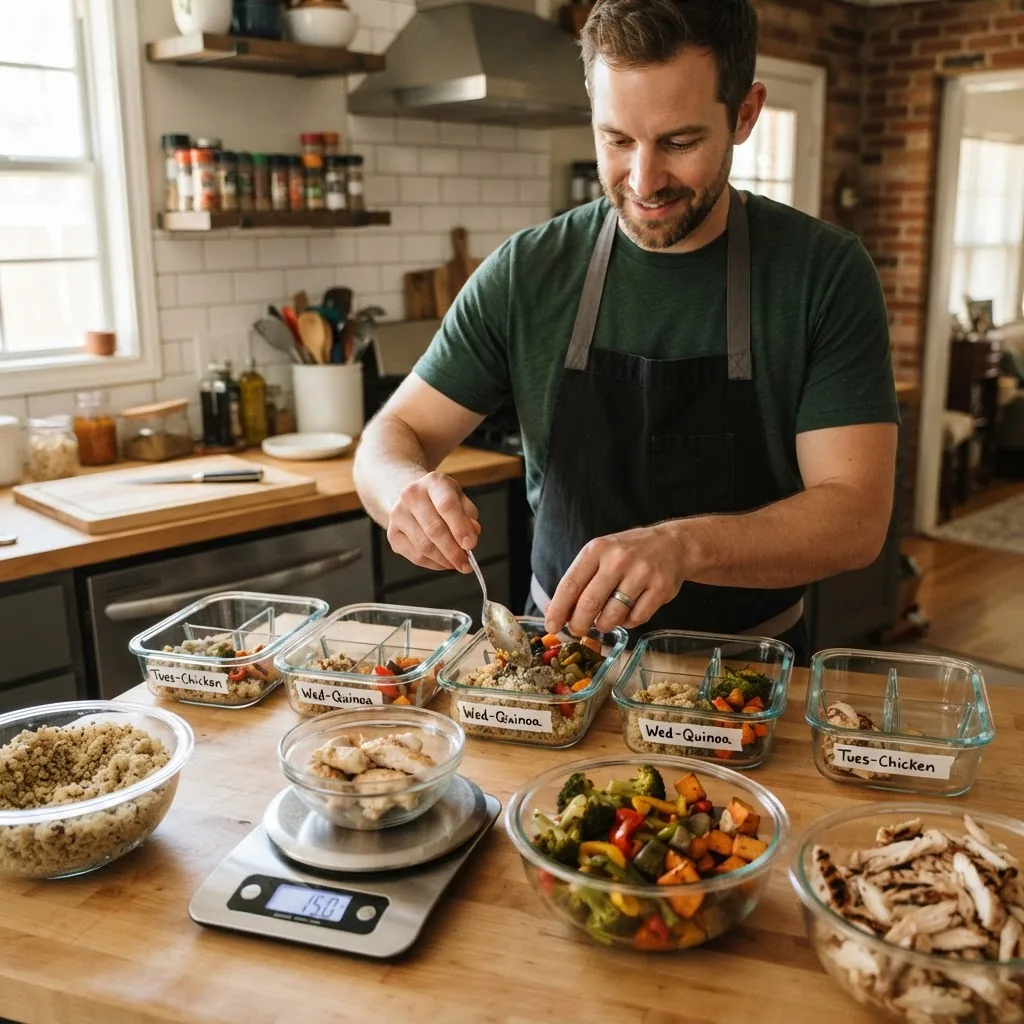
Label containers with meal name, date, calories and macros (e.g., “Lunch Mon — 600 kcal — 42P/55C/22F”). Store up to 4 days in the refrigerator and freeze the rest in single-serving freezer-safe containers.
-
Step 8 — Track intake and progress for two weeks without changing targets
Enter every meal into your chosen food-tracking app. Key rules:
- Weigh cooked protein and grains for accuracy (not portion-by-eye).
- Record condiments and oil: 1 tsp olive oil = 40 kcal, 1 tbsp = 120 kcal.
- Weigh snacks like nuts: 1 oz almonds = 23 nuts ≈ 164 kcal.
Weekly checks:
- Weigh in each morning across seven days — use the weekly average to detect change.
- Track waist measurement once per week, same time and place.
- If weight drops >1.5% per week, increase calories 5–10%. If no change after two weeks and compliance is >90%, reduce calories 5–10% for weight loss.
-
Step 9 — Adjust micronutrients and supplements conservatively
Prioritize food-first but address common male-specific needs with numbers and thresholds:
- Vitamin D: aim for 25–50 ng/mL; consider 1,000–2,000 IU/day if test shows <30 ng/mL. Re-test in 3 months.
- Omega-3: aim for 1,000 mg combined EPA+DHA daily from fish or 1 g fish oil if fish intake <2 servings/week.
- Magnesium: if sleep is poor or muscle cramps occur, 200–300 mg magnesium citrate at night is typical; keep total daily magnesium under 350 mg supplemental unless advised otherwise.
- Protein supplements: whey concentrate or isolate to fill gaps; 20–30 g per shake post-workout is a useful rule.
Note: Do not start high-dose supplements (e.g., >3,000 IU vitamin D/day, iron) without bloodwork. If on medication, consult your physician before starting supplements.
Internal link for reference on complete meals and balanced diet: see the nutritionally complete meal guide for detailed food combinations and nutrient-density charts.
-
Step 10 — Specialize your plan: weight loss, muscle gain, or age-specific adjustments
Three short protocols with numbers:
Weight loss diet for men
Calorie: TDEE −15–20%. Protein: 1.2–1.6 g/kg. Resistance training: 3 sessions/week minimum. Weekly target: 0.5–1% bodyweight loss per week (e.g., 1.0–2.0 lb for a 200 lb man).
Muscle gain diet for men
Calorie: TDEE +250–350 kcal. Protein: 1.6–2.0 g/kg for active lifters. Carbohydrate: prioritize around workouts — 0.5–0.8 g/kg in the pre/post workout window; aim for 20–40 g of fast carbs post-workout with 20–30 g protein.
Healthy diet for men over 40 and over 50
Over 40: Increase protein and vitamin D checks. Over 50: add calcium intake to 1,000–1,200 mg/day (food + supplement), monitor PSA annually if recommended, and reduce daily sodium to <2,300 mg if blood pressure is elevated.
For tailored plans see sibling guides on meal planning and supplements: 7 day diet menu to lose weight and best supplements for men.
-
Step 11 — Optimize meal timing and workout nutrition
Timing guidelines with thresholds:
- Pre-workout: 1–2 hours before, eat 20–40 g carbs + 15–25 g protein (e.g., banana + 1 scoop whey). Closer than 45 minutes choose 15–30 g carbs only to avoid GI upset.
- Post-workout: within 60 minutes, consume 20–40 g fast-digesting protein and 0.4–0.6 g/kg carbs if the goal is muscle gain (e.g., 30 g whey + 1 cup cooked rice ≈ 45 g carbs).
- Intermittent fasting: If using 16:8, keep total daily calories and macros identical; distribute protein so each meal has 25–40 g protein to minimize muscle loss.
-
Step 12 — Monitor labs, energy, sex drive, and strength
Track outcomes beyond scale weight. Indicators that diet is appropriate:
- Strength: maintain or increase weight lifted in compound movements week-to-week during a weight-loss phase — if strength drops by >10% over 3 weeks, increase calories 5%.
- Energy: rate average daily energy 1–10; aim for 6–8 most days. Persistent 4 or lower indicates underfueling.
- Libido and mood: marked declines warrant evaluation of calorie intake and sleep; consider checking testosterone if clinically indicated.
- Lab re-checks: fasting glucose, lipids, HbA1c, vitamin D after 3 months if you changed diet significantly.
-
Step 13 — Set a 4-week experiment and re-calibrate
Plan: Run the chosen calorie and macro plan for 4 weeks with >85% compliance. At the end of 4 weeks:
- Compare starting and ending weekly average weight.
- If the weight change is within ±0.5% and no other goals met, change calories by −5% (if losing weight) or +5% (if gaining muscle) and re-test for 2 weeks.
- If energy or strength declined, increase protein by 5–10 g/day and add 100 kcal from carbs or fat and re-evaluate after 2 weeks.
-
Step 14 — Fine-tune for social life, travel, and eating out
Rules with numeric allowances:
- Dining out: estimate meal calories using server-provided portions; add 200–400 kcal buffer if unsure. Choose grilled over fried; ask for sauces on the side.
- Alcohol: 1 standard drink ≈ 150 kcal (12 oz beer) or 100–120 kcal (5 oz wine). Limit to ≤2 drinks on occasion; subtract those calories from daily total if weight-loss goal active.
- Travel days: pack 2–3 single-serving protein packets (20–30 g), 1 portable scale if feasible, and buy cooked vegetables or salads on site.
-
Step 15 — Create habit anchors and a 12-week maintenance plan
Habit anchors are specific, observable actions tied to daily events. Examples:
- After my morning shower, I log yesterday’s meals in my app (5 minutes).
- Every Sunday at 10:00 AM I cook and portion at least five lunches (3–4 hours).
- On lifting days I add an extra 100 kcal from carbs within 60 minutes of training.
12-week maintenance checklist: maintain weight within ±3% of target, maintain strength, and keep bloodwork within recommended ranges for your age. If you meet these for 12 weeks, widen food variety and move to long-term scheduling instead of rigid tracking.
Common mistakes and how to avoid them (practitioner experience)
I’ve seen these mistakes repeatedly; here is how they happened and exactly how to prevent them.
1) “I trusted eyeballing portions and stalled.” — I learned that a man who thought his chicken was 6 oz was actually eating 3.5 oz cooked. Fix: weigh cooked protein and grains for the first 4 weeks; this eliminates the largest error source. If you must eyeball, use a 4 oz portion as the size of a deck of cards.
2) “I trimmed calories too aggressively and lost strength.” — In practice, a 40-year-old client cut 30% of calories and felt weak within 10 days. Fix: cap initial deficit at 15–20%, and keep protein ≥1.2 g/kg to preserve muscle.
3) “I skipped tracking fats and sauces.” — Hidden oils and dressings added 300–500 kcal/d to one man’s intake. Fix: log oil by teaspoon; 1 tsp = 40 kcal. Put sauces on the side and measure 1 tbsp servings.
4) “I compared myself to younger gym-goers.” — Expect slower recovery after 40. Fix: add an extra rest day when lifting (4–5 sessions per week split) and prioritize sleep 7–8 hours for recovery.
Compact verification checklist
- Baseline: weight and waist measured and logged.
- Calories set using Mifflin–St Jeor + activity, and chosen target recorded.
- Macros converted to grams and logged in app for each day.
- 7-day meal plan written with exact portions (grams/oz) and calories per meal.
- Grocery list generated with exact quantities for 7 days.
- Meal-prep session scheduled and completed (3–4 hours) with at least 5 days prepped.
- Tracked intake daily for 14 days with weekly average weight recorded.
- Adjustments planned per 2- and 4-week rules.
- Supplements and labs scheduled or checked if needed (vitamin D, omega-3 baseline).
When to call in a professional
Hire a registered dietitian or physician if any of the following apply:
- You have chronic disease (type 1 or type 2 diabetes, heart disease, kidney disease) — call before radical diet changes.
- Sustained unintentional weight loss >5% bodyweight in 3 months or unexplained weight gain >5%.
- Resting heart rate consistently >100 bpm or symptomatic blood pressure readings above 160/100 mmHg — seek medical evaluation.
- Persistent low libido, fatigue, or depressive symptoms — consider endocrine workup including testosterone and thyroid tests.
- Complex dietary restrictions (multiple food allergies, celiac disease, GI malabsorption) where a tailored plan is required.
Additional practical resources and templates
Use these single-page templates to accelerate planning:
- Weekly meal planner: 7 rows × 4 columns (breakfast, lunch, snack, dinner) with portion sizes in grams.
- Simple shopping list split into Proteins / Dairy / Vegetables / Fruits / Grains / Fats & Snacks with exact quantities for one week.
- Training nutrition quick guide: pre/post workout combos with grams and timing.
For more detailed approaches to meal plans that work, see the meal plan for weight loss guide and the diet to get fit and lean guide.
Sample 7-day plan (compact, one-week view) — numbers included
Below is a compact one-week rotation for a 2,150 kcal/day weight-loss target. Swap proteins and grains keeping portion sizes identical to match macro targets.
| Day | Breakfast | Lunch | Dinner |
|---|---|---|---|
| Mon | 3 eggs + ¾ cup Greek yogurt + ½ cup blueberries (470 kcal) | 4 oz salmon + 1 cup quinoa + salad (600 kcal) | 5 oz beef + 1 sweet potato + 2 cups veg (660 kcal) |
| Tue | Oatmeal 1/2 cup dry + 1 scoop whey + 1 tbsp peanut butter (480 kcal) | 4 oz chicken + 1 cup brown rice + broccoli (580 kcal) | Turkey chili 1.5 cups + salad (610 kcal) |
| Wed | Smoothie: 1 scoop whey + 1 cup spinach + 1 banana + 1 cup almond milk (420 kcal) | Tuna salad 4 oz + 1 cup cooked pasta + veggies (610 kcal) | Grilled pork 5 oz + roasted veg + 1/2 cup quinoa (610 kcal) |
| Thu | 3 eggs + 2 slices whole-grain toast (470 kcal) | Beef stir-fry 4 oz + 1 cup rice + veg (600 kcal) | Baked cod 5 oz + sweet potato + greens (650 kcal) |
| Fri | Greek yogurt bowl 1 cup + 1/2 cup granola + berries (480 kcal) | Chicken salad wrap with 4 oz chicken + whole grain wrap (610 kcal) | Steak 5 oz + baked potato + 2 cups veg (640 kcal) |
| Sat | Pancakes (2 medium) + 3 egg whites + fruit (520 kcal) | Leftover turkey chili + salad (600 kcal) | Salmon bowl 4 oz + 1/2 cup rice + edamame (610 kcal) |
| Sun | Omelet 3 eggs + veggies + 1 slice whole-grain toast (500 kcal) | Grill chicken 4 oz + quinoa 1 cup + greens (600 kcal) | Family meal: control portion (aim for 700 kcal) — enjoy one moderate higher-calorie meal. |
Troubleshooting common scenarios
I’m tracking calories but not losing weight
First, check adherence: if app shows >90% compliance, weigh cooked portions and ensure you logged oils and condiments. Measure weekly average weight; if no drop, reduce daily calories by 5% (≈100–150 kcal for most men) and continue for two weeks. If still no change and activity level hasn’t changed, retest RMR calculation — body composition shifts can require recalculation.
My energy or gym performance dropped
If average daily energy falls below 6/10 for more than one week, increase calories by 100–200 kcal/day from carbohydrate or mixed carbs + fat, and ensure protein stays constant. For strength loss greater than 10% across two consecutive workouts, add 200–300 kcal and evaluate sleep (target 7–8 hours).
Feeling hungry often despite hitting calories
Raise protein by 10–20 g/day and add 1–2 cups of non-starchy vegetables at meals (high volume, low calories). Also increase water and soluble fiber to a minimum of 25–30 g fiber/day — add ½ cup cooked beans (≈7–8 g fiber) twice weekly.
Evidence-backed food choices and why they matter
Include these nutrient-dense foods regularly, with suggested frequency and portion sizes:
- Fatty fish (salmon, mackerel): 2 servings/week, 3–4 oz cooked per serving to meet omega-3 targets.
- Leafy greens: 2 cups/day raw or 1 cup cooked to support vitamins A, K, and folate.
- Legumes: 3–4 servings/week, ½ cup cooked per serving for fiber and plant-based protein.
- Whole grains: 3–5 servings/day, ½ cup cooked per serving, favor quinoa, brown rice, oats.
- Nuts & seeds: 1–2 oz/day (28–56 g) as fat portions and for vitamin E and magnesium.
Local Texas considerations
If you live in Texas, use in-season produce to save money and improve freshness: peaches in summer (1 medium ≈ 68 kcal), sweet potatoes are affordable year-round for complex carbs, and locally sourced lean beef can be an economical protein if trimmed and portioned. For hot months, prioritize hydration: men should aim for 3.7 L total water/day (per general guidelines), increase by 0.5–1.0 L per hour of heavy outdoor work.
Final notes and implementation timeline
Implementation timeline you can follow:
- Day 0–2: Measure, calculate TDEE, set calories and macros, build 7-day menu (90–120 minutes).
- Day 3: Grocery shop with exact quantities (60–90 minutes).
- Day 4 (weekend): Batch-cook and portion for 5–7 days (3–4 hours).
- Day 4–18: Track daily intake, weigh and measure weekly, adjust at week 2 if needed.
- Week 4: Reassess and update plan for the next 4 weeks.
Frequently Asked Questions
What is the proper diet for men to lose weight safely?
A proper diet for men to lose weight safely reduces daily calories by 15–20% from estimated TDEE, provides 1.2–1.6 g protein per kg bodyweight, prioritizes whole foods, and keeps a weekly weight-loss target of 0.5–1% bodyweight. Track intake and adjust after two weeks based on measured progress.
Which diets are best for men who want both fat loss and muscle gain?
A modest calorie deficit for fat loss while keeping protein at 1.6–2.0 g/kg, combined with progressive resistance training, preserves lean mass. For simultaneous gains in beginners, a slight calorie surplus timed to training can favor muscle gain. Adjust by small calorie steps (±250 kcal).
How do I choose the healthiest diet for men over 50?
The healthiest diet for men over 50 emphasizes 25–40 g protein per meal, 1,000–1,200 mg calcium/day, vitamin D monitoring, 25–30 g fiber per day, reduced sodium if hypertensive, and regular strength training to preserve muscle and bone density.
What diet schedule for men boosts gym performance and recovery?
Eat 20–40 g carbs and 15–30 g protein 60–90 minutes before training, then 20–40 g fast protein and 0.4–0.6 g/kg carbs within 60 minutes post-workout. Maintain overall daily calories and protein targets to support recovery and strength gains.
How long before I should hire a dietitian or doctor?
Call a registered dietitian or physician if you have chronic illness, unexplained weight changes exceeding 5% in 3 months, or symptoms like persistent fatigue or marked strength loss. For general optimization, a 4–6 week check with a professional is reasonable if progress stalls.