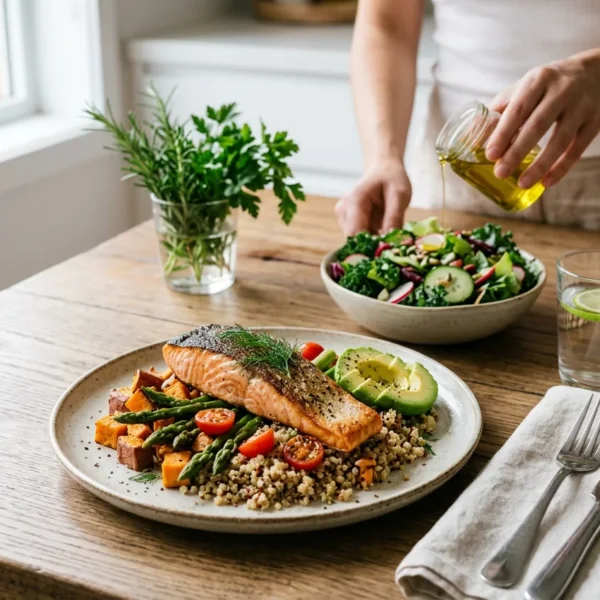

What are practical nutrition goals examples I can use today?
Practical nutrition goals examples are specific, measurable eating or nutrient targets — for example, “Eat 25–30 grams of fiber daily” or “Lose 10 pounds in 12 weeks with a 500 kcal daily deficit” — that map to behavior changes, tracking metrics, and a realistic timeline so progress is verifiable and repeatable.
What is a SMART nutrition goal and how do I write one?
Answer: A SMART nutrition goal is specific, measurable, achievable, relevant, and time-bound; write it by naming the behavior, the measure, the frequency, and the deadline (e.g., “Eat three servings of vegetables daily for 90 days”).
SMART goal: A planning framework that ensures goals are Specific, Measurable, Achievable, Relevant, and Time-bound.
To build one:
- Specific: state the exact food or metric (servings of veg, grams of protein).
- Measurable: include numbers (grams, calories, servings, minutes of meal prep).
- Achievable: set a realistic cadence based on current habits.
- Relevant: connect to a larger objective (energy, weight, lab results).
- Time-bound: give a clear deadline (weeks or months).
What counts as a measurable nutrition target for weight change?
Answer: Measurable nutrition targets for weight change include daily calorie targets, protein grams per day, weekly weight change goals (e.g., 0.5–1.0% bodyweight), and step or activity targets that together create a predictable deficit or surplus.
Calorie: The unit of energy used to quantify food; one kilocalorie (kcal) equals the energy needed to raise 1 kg of water by 1°C and is the standard on nutrition labels.
Common measurable targets:
- Daily calorie goal (e.g., 1,600 kcal/day for a calculated deficit).
- Protein intake (e.g., 1.6 g/kg bodyweight/day for preservation during weight loss).
- Weekly weight change target (e.g., 0.5–1.0% of bodyweight per week).
- Body composition proxy metrics: waist circumference, clothing fit, or photos every 2–4 weeks.
How do macronutrient targets differ by nutrition goal?
Answer: Macronutrient targets shift by goal: weight loss typically emphasizes moderate protein (1.2–2.0 g/kg) and reduced total calories, muscle gain uses a calorie surplus with higher protein (1.6–2.2 g/kg), and maintenance balances macros to preserve body composition and energy needs.
Macronutrient: A macronutrient is a major nutrient group needed in large amounts — protein, carbohydrate, and fat — that provides calories and structural/functional roles.
Practical ranges by goal (per day):
- Weight loss: Protein 1.4–2.0 g/kg, Fat 20–35% of kcal, Remaining calories from carbs.
- Muscle gain: Protein 1.6–2.2 g/kg, Fat 20–30%, Carbs higher to fuel training.
- Maintenance: Protein 1.2–1.8 g/kg, Fat 25–35%, Carbs adjusted to activity.
How do I calculate calorie targets for a nutrition goal?
Answer: Calculate calorie targets by estimating Basal Metabolic Rate (BMR) with an equation, multiplying by activity to get Total Daily Energy Expenditure (TDEE), then add or subtract a planned surplus/deficit (typically 250–750 kcal) to reach weight goals.
BMR: Basal Metabolic Rate is the energy your body uses at complete rest to maintain vital functions.
TDEE: Total Daily Energy Expenditure is BMR multiplied by an activity factor to estimate daily calorie needs including movement and exercise.
Step-by-step example (Mifflin–St Jeor):
- Calculate BMR: For women: BMR = 10 × weight(kg) + 6.25 × height(cm) − 5 × age(years) − 161. For men, add +5 instead of −161.
- Estimate activity factor: Sedentary 1.2, Light 1.375, Moderate 1.55, Active 1.725, Very active 1.9.
- Compute TDEE: BMR × activity factor = maintenance kcal.
- Apply goal adjustment: Subtract 250–500 kcal for moderate weight loss, add 250–500 kcal for slow weight gain.
Worked calculation:
- 35-year-old woman, 75 kg, 165 cm: BMR = 10×75 + 6.25×165 − 5×35 −161 = 750 + 1031.25 −175 −161 = 1445.25 kcal.
- Moderate activity (1.55): TDEE ≈ 1445 × 1.55 = 2240 kcal maintenance.
- For 0.5 lb/week weight loss ≈ 250 kcal deficit: target ≈ 1990 kcal/day; for 1 lb/week ≈ 500 kcal deficit: target ≈ 1740 kcal/day.
What daily and weekly nutrition goals should beginners set for healthy eating?
Answer: Beginners should set simple, habit-focused daily goals like “two servings of fruit and three of vegetables daily,” “30 g protein at breakfast,” and a weekly prep goal such as “cook two balanced dinners at home,” progressing incrementally over 4–12 weeks.
Micronutrient: A nutrient (vitamins and minerals) needed in small amounts for physiological function, often tracked indirectly by food variety and quality.
Starter targets (practical, low-barrier):
- Daily: ≥25 g fiber, ≥2 L water, 3 cups vegetables, 1–2 pieces of fruit.
- Protein: Aim for a source at each meal (e.g., 20–30 g per main meal).
- Meals at home: 4–6 home-cooked meals per week to control portions.
- Weekly: Plan a grocery list and prep 1–2 components (grains, roasted veg, lean protein).
How do I convert long-term nutrition goals into weekly and daily targets?
Answer: Divide the long-term objective into measurable weekly milestones (weight, inches, performance) and translate those into daily calorie and macro targets plus behavior actions (meals, servings, prep minutes) with checkpoints every 1–2 weeks.
Conversion framework:
- Define the long-term outcome (e.g., lose 20 lbs in 20 weeks).
- Compute weekly target (20 lbs / 20 weeks = 1 lb/week).
- Translate to daily calorie deficit (~500 kcal/day for 1 lb/week) and macro distribution (protein target to preserve lean mass).
- Make daily behavior targets: number of meals, protein grams per meal, servings of vegetables, and water intake.
Example:
- Goal: Lose 10 lbs in 12 weeks → weekly ≈ 0.83 lb → daily deficit ≈ 400 kcal.
- If maintenance = 2,200 kcal, daily target ≈ 1,800 kcal; set protein 1.6 g/kg, fat ~25% of kcal, rest from carbs.
- Daily behaviors: breakfast 25 g protein, lunch 30 g, dinner 30 g, two vegetable servings, one fruit, limit sugary drinks.
What are effective habit-based nutrition goals that support healthy eating long-term?
Answer: Effective habit-based nutrition goals focus on consistent behaviors like meal timing, portion control, cooking frequency, food variety, and tracking, for example “Prepare lunch at home 5x per week” or “Replace sugary drinks with water for 30 days.”
Habit goal examples:
- Food environment: Keep fruit visible and cut vegetables prepared for easy access.
- Meal structure: Eat three balanced meals and one optional snack; avoid grazing.
- Cooking: Batch-cook protein twice weekly; freeze portions for busy days.
- Mindful eating: Put fork down between bites, aim for 20–30 minutes per meal.
- Tracking: Log meals or at least protein and vegetables three times per day for 14 days.
How should nutrition goals vary for athletes or strength-training clients?
Answer: Athletes and strength trainees need higher protein (1.6–2.4 g/kg), adequate carbs timed around workouts, and calorie targets adjusted for training load to support recovery and performance rather than just weight change.
Practical athlete targets:
- Protein: 1.6–2.4 g/kg/day, distributed evenly across meals.
- Carbs: 3–7 g/kg/day for general training; endurance athletes may require more.
- Calories: Align to training day intensity; use smaller deficits or cycling to protect performance.
- Hydration and electrolytes: plan pre/post workout fluids and sodium for heavy sweat losses.
How do I personalise nutrition targets for seniors or people over 60?
Answer: Personalise senior targets by prioritising protein (1.0–1.6 g/kg), sufficient calories to prevent unintentional loss, calcium and vitamin D intake, small frequent meals if appetite is low, and lower sodium for cardiovascular concerns.
Senior adjustments:
- Protein to preserve muscle and bone: 1.0–1.6 g/kg/day depending on activity and health.
- Energy: Avoid large calorie deficits; target slow, medically supervised changes for weight management.
- Micronutrients: Ensure calcium, vitamin D, B12, and iron status are adequate through diet or testing.
- Texture and appetite: Use nutrient-dense, easy-to-chew options and fortified foods if intake is low.
How should nutrition goals be adapted for diabetes or metabolic conditions?
Answer: For diabetes or metabolic issues, set glucose-management focused targets: carbohydrate distribution, consistent meal timing, portion control, fiber goals (≥25–30 g/day), and individualized calorie targets coordinated with medication and clinician guidance.
Diabetes-focused targets:
- Carbohydrate counting or distribution: set grams per meal aligned with medication/insulin plan.
- Fiber: aim for ≥25–30 g/day to moderate glycemic response.
- Weight goal: small, steady weight loss (0.5–1.0% bodyweight/week) when indicated.
- Lipids and sodium: prioritize heart-healthy fats and limit sodium where advised.
What objective metrics should I use to track progress besides the scale?
Answer: Use multiple objective metrics: body composition or circumference measures, strength/performance improvements, daily energy and hunger patterns, lab markers (lipids, HbA1c), and photographic progress every 2–4 weeks.
Tracking metrics list:
- Weight and weekly change (same scale, same time of day).
- Waist, hip, and limb circumferences measured every 2–4 weeks.
- Bioelectrical impedance or DEXA-based body fat if available (consistent method).
- Performance: lift amounts, cardio times, repetitions at submaximal loads.
- Lab values: fasting glucose, HbA1c, LDL/HDL, triglycerides when medically indicated.
- Dietary adherence: days meeting protein/veg/fiber targets over a two-week window.
How often should I review and adjust my nutrition goals?
Answer: Review goals every 2–4 weeks for behavioral targets and every 4–12 weeks for outcome targets; adjust calorie or macro targets if progress is too slow, too fast, or stalled, while keeping changes small (100–250 kcal) to evaluate effects.
Adjustment protocol:
- Behavioral goals: weekly check-ins and troubleshooting.
- Weight/outcome goals: evaluate after 4 weeks; small tweaks if change <50% of expected or if exceeding safe rates.
- Plateaus: cycle calories, alter macros, increase activity, or re-measure TDEE if prolonged stall beyond 4–8 weeks.
What common mistakes undermine nutrition goals and how do I avoid them?
Answer: Common mistakes include vague goals, ignoring protein, extreme calorie cuts, inconsistent tracking, all-or-nothing thinking, and lack of planning; avoid them by using SMART framing, prioritising protein and fiber, sustainable calorie changes, and simple tracking habits.
Mistakes and fixes:
| Mistake | Why it hurts | Quick fix |
|---|---|---|
| Vague goals | Hard to measure progress | Make them SMART with numbers |
| Skipping protein | Loss of muscle, increased hunger | Aim for a protein source each meal |
| Too rapid calorie cuts | Metabolic slowdown, cravings | Use 250–500 kcal/day adjustments |
| No planning | Reliance on convenience foods | Set 1–2 weekly meal-prep actions |
What does a sample 12-week nutrition plan look like for losing 20 pounds?
Answer: A sample 12-week plan for 20 pounds focuses on a sustainable deficit (~600–700 kcal/day initially), protein at 1.6–2.0 g/kg, weekly strength training, progressive weekly check-ins, and scheduled refeed or calorie adjustments at plateaus.
Example profile and plan (worked):
- Profile: 38-year-old female, 78 kg, 168 cm, moderate activity, maintenance ≈ 2,300 kcal.
- Target: Lose 9 kg (20 lb) in 12 weeks → ~0.75 lb/week; daily deficit ≈ 500–600 kcal.
- Initial daily target: 1,700–1,800 kcal with protein 1.8 g/kg → ~140 g/day protein.
- Macros: Protein 140 g (33% kcal), Fat 60–70 g (30% kcal), Carbs remainder ~150–200 g (37% kcal).
- Training: 3 strength sessions/week and 2 moderate cardio sessions; increase NEAT (steps) by 1,000 steps/day.
- Progress checks: weigh and measure weekly; photo every 3 weeks; adjust calories down 100–150 kcal if weight loss below expected after 3–4 weeks.
- Refeed: schedule higher-carb day every 10–14 days to support thyroid/mental health if desired.
How do I pick nutrition goals when I want to gain muscle without excess fat?
Answer: For lean muscle gain, set a small calorie surplus (200–300 kcal/day), a high protein target (1.6–2.2 g/kg), progressive resistance training, and weekly strength or body-composition checkpoints to minimise fat gain while maximising muscle.
Practical steps:
- Start with a 200–300 kcal surplus above measured TDEE.
- Protein 1.6–2.2 g/kg; spread across 3–5 meals.
- Carbs timed around workouts to support intensity.
- Monitor body composition and adjust calories if excess fat accumulates (>0.5% bodyweight/week).
How do portion and plate-based goals compare to calorie counting?
Answer: Plate-based and portion goals are simpler, behavior-focused methods that reduce tracking burden while calorie counting provides precision; choose plate methods for sustainable habit change and calorie tracking for specific weight or performance targets.
| Method | Pros | Cons |
|---|---|---|
| Plate method (half veg, quarter protein, quarter carb) | Easy, sustainable, no tracking app | Less precise for macronutrient-specific goals |
| Portion guides (hand portions) | Portable and practical | Varied hand sizes reduce accuracy |
| Calorie & macro counting | Precise, supports performance goals | Time-consuming, may encourage obsessive tracking |
How can I write nutrition goals to fit a busy Texas lifestyle?
Answer: For busy schedules, prioritise time-efficient, high-impact goals like “prep three protein-rich meals on Sundays,” “carry cut fruit for snacks,” and “aim for 20 minutes of walk-based NEAT each workday” to improve consistency without heavy tracking.
Time-saving goal examples:
- Sunday prep: cook a lean protein and a grain to mix across lunches.
- Snack plan: portion nuts and fruit into grab-and-go packs.
- Commute activity: park farther, walk stairs, 10-minute walk after lunch.
- Restaurant strategy: order grilled protein, extra vegetables, and request sauces on the side.
What modern healthy eating approaches should inform my nutrition targets?
Answer: Modern healthy eating approaches that shape targets include flexible dieting (focus on macros and food quality), Mediterranean-style patterns (plant-forward, healthy fats), time-restricted eating for some people, and emphasis on nutrient density and whole foods rather than perfection.
Nutrition goals: Specific aims for dietary intake or behavior that guide meal choices and planning.
How to integrate approaches:
- Flexible dieting: allow personal food preferences while meeting macro and calorie targets for sustainability.
- Mediterranean pattern: set goals for olive oil, fish twice weekly, legumes, and whole grains.
- Time-restricted eating: if chosen, set consistent eating window (e.g., 10 am–6 pm) as a behavior goal.
- Nutrient density: aim for at least 5 different vegetable types per week and two oily fish servings weekly.
Related reading on meal completeness and balanced plates is here: nutritionally complete meal guide, and for simple daily habits see 10 ways to eat better.
What tools and apps help set and track nutrition goals effectively?
Answer: Tools that help include calorie/macro tracking apps, simple habit trackers, photo food journals, grocery list apps, smart scales, and wearable trackers for activity; choose tools that match your need for precision and your tolerance for tracking.
Tool categories and purpose:
- Calorie/macro apps: precise tracking and nutrient reports.
- Habit trackers: reinforce behaviors like meal prep and water intake.
- Photo journals: visual accountability with minimal detail logging.
- Smart scales/wearables: quantify body metrics and activity trends.
For basic “what to eat” guidance, see What should I be eating everyday for simple plate and meal composition targets.
How should I set cost-conscious nutrition goals and budget-friendly targets?
Answer: Set budget-aware goals by prioritising whole-food staples (beans, oats, frozen vegetables, eggs), batch-cooking, limiting processed convenience items, and planning a weekly shopping list that meets your protein, fiber, and vegetable targets affordably.
Budget-friendly targets and tactics:
- Staples: buy beans, lentils, eggs, canned fish, oats, rice, and frozen veg in bulk.
- Protein per dollar: use canned tuna, eggs, Greek yogurt, and tofu for economical protein grams.
- Batch cook: for 2–4 meals to reduce per-meal cost and decision fatigue.
- Shop sale cycles and plan two recipes around discounted proteins each week.
How do I write short, example nutrition goals I can copy and adapt?
Answer: Use concise templates: “Daily: 1600 kcal, 120 g protein, 30 g fiber; Weekly: 4 strength sessions, 2 home-cooked dinners; 12-week: lose 10 lbs” — adapt numbers for your weight, activity, and timeline.
Copy-ready templates (modify numbers to match your TDEE and bodyweight):
- Weight loss, moderate: “Eat 1,700 kcal/day, ~1.6 g/kg protein, 25 g fiber, 3 strength sessions/week; reassess in 4 weeks.”
- Muscle gain: “Eat maintenance +250 kcal, protein 1.8–2.0 g/kg, 4 resistance sessions/week; track strength monthly.”
- Healthy habits: “5 servings vegetables/day, 2 liters water/day, cook 4 nights/week, log meals 5 days/week for 8 weeks.”
How do I transform a calorie or macro goal into actual meals and grocery lists?
Answer: Convert targets into meals by assigning macro and calorie targets per meal (e.g., breakfast 20–30% of daily kcal with 25–30 g protein), then build grocery lists around required protein sources, vegetables, healthy fats, and whole grains to meet those portions across the week.
Meal assignment example (1,800 kcal/day):
- Breakfast 25%: 450 kcal, 30 g protein — eggs, whole-grain toast, spinach.
- Lunch 30%: 540 kcal, 35 g protein — chicken salad with quinoa.
- Dinner 30%: 540 kcal, 35 g protein — salmon, sweet potato, mixed veg.
- Snacks 15%: 270 kcal, 20 g protein — Greek yogurt, fruit, nuts.
From those meals create a grocery list with quantities for the week (protein portions, grain cups, number of vegetable servings). This reduces decision load and enforces targets.
How can I set nutrition goals that my family will follow too?
Answer: Choose family-friendly goals: increase shared vegetable servings, standardize breakfasts, rotate favorite proteins, and set household meal-prep nights so individual targets align with family meals and reduce conflict.
Family goal tactics:
- Make half the plate vegetables at dinner a household rule.
- Batch-provide two protein options (chicken and legumes) to suit preferences.
- Teach simple swaps: whole-grain for refined grain, water instead of sweetened drinks.
- Use family grocery lists to ensure affordable variety and consistent staples.
When should I get professional help for nutrition goals?
Answer: Seek a registered dietitian or clinician if you have chronic medical conditions (diabetes, kidney disease), complex weight history, eating disorder risk, or if you need tailored performance nutrition plans beyond general guidance.
If you have specific illnesses, medication interactions, or rapid weight changes, a professional assessment ensures safety and personalised targets.
What is an example table of nutrition goals for common objectives?
Answer: The table below compares typical daily calorie and macro targets for maintenance, moderate weight loss, aggressive weight loss, and muscle gain so you can match your objective to a starting plan and then personalise.
| Objective | Starting kcal (example) | Protein target | Typical timeline |
|---|---|---|---|
| Maintenance | TDEE (e.g., 2,200 kcal) | 1.2–1.8 g/kg | Ongoing |
| Moderate weight loss | TDEE −250 to −500 kcal (e.g., 1,700–1,950) | 1.4–2.0 g/kg | 0.5–1% bodyweight/week |
| Aggressive weight loss | TDEE −500 to −750 kcal (e.g., 1,400–1,700) | 1.6–2.0 g/kg | Up to 1–2% bodyweight/week (short-term) |
| Lean muscle gain | TDEE +200 to +400 kcal | 1.6–2.2 g/kg | Months to years depending on experience |
How do I write weekly check-ins to measure nutrition goal adherence?
Answer: Weekly check-ins should record the primary metric (weight or strength), adherence rate to key behaviors (protein, veg servings, meal prep), one barrier encountered, and one adjustment for the next week.
Weekly check-in template:
- Date and body weight (same scale/time).
- Adherence: Days meeting protein target /7, days with 3+ veg servings /7, meals cooked /7.
- Performance: Strength workout progress or cardio minutes.
- Barriers: note obstacles (travel, illness) and plan a specific mitigation.
- Adjustment: small change for the coming week (add protein snack, increase steps).
How do I maintain motivation when nutrition goals feel slow to progress?
Answer: Maintain motivation by focusing on process goals, non-scale victories (energy, sleep, strength), scheduled mini-goals, social accountability, and periodic rewards for adherence rather than outcome-only celebrations.
Motivation tactics:
- Set a 2-week process goal with a small reward at completion.
- Track energy and performance metrics as evidence of progress.
- Use accountability partners or a coach for weekly check-ins.
- Limit weighing frequency to weekly or biweekly to avoid daily noise.
How do I make a nutrition goal that complements a fitness or diet program?
Answer: Align goals by matching calorie and macronutrient targets to program demands (e.g., higher carbs on heavy training days), set performance-based milestones (lift numbers, run times), and include recovery and refueling goals after sessions.
Program alignment checklist:
- Identify program demands: strength vs endurance vs mixed.
- Set daily carbs to match training load and protein for recovery.
- Include pre- and post-workout nutrition goals (timing and approximate grams).
- Adjust calories on rest days vs heavy days (calorie cycling) if desired.
How do I phrase short-term versus long-term nutrition goals?
Answer: Phrase short-term goals as specific actions with short deadlines (“Log protein and vegetables daily for 14 days”), and long-term goals as measurable outcomes with realistic timelines (“Reduce body fat 5% in 6 months while preserving lean mass”).
Examples:
- Short-term (2–6 weeks): “Increase vegetable intake to five servings per day for 21 consecutive days.”
- Mid-term (6–12 weeks): “Lose 6–8 pounds with a 400 kcal/day deficit and three strength sessions per week.”
- Long-term (6–12 months): “Sustain weight loss of 20 pounds and maintain strength improvements while keeping protein ≥1.6 g/kg.”
How do I ensure my nutrition goals align with modern guidance and safety?
Answer: Ensure alignment by using evidence-based ranges (moderate calorie changes, adequate protein), including nutrient-dense foods, avoiding extreme restriction, and checking with a registered dietitian for medical concerns or complex dietary needs.
Safety checklist:
- Limit daily deficits to 500–750 kcal for short-term only; prefer 250–500 kcal for longer-term safety.
- Ensure protein and essential micronutrients are met to avoid deficiency.
- Monitor energy, mood, sleep, and menstrual health as signals to reassess.
- Consult professionals for pregnancy, chronic disease, eldercare, or eating disorders.
How can I test a nutrition goal for two to four weeks to see if it fits my life?
Answer: Run a 2–4 week pilot where you apply the goal, record adherence and side effects daily, track one objective metric (weight, performance, hunger scale), and then evaluate feasibility, stress, and results to decide whether to continue or modify.
Pilot test steps:
- Choose one primary metric and 2–3 supporting behaviors to track.
- Log adherence daily and note context (travel, social events).
- Review at 7 days and 14 days for initial feasibility; adjust minor barriers.
- At 4 weeks, evaluate outcome and subjective sustainability; iterate the goal.
How should I write public or social accountability nutrition goals?
Answer: Public accountability goals should be specific, time-bound, and framed as behavior commitments (e.g., “I will post a photo of my lunch five weekdays a week for 8 weeks”) to invite support and reduce shame if adjustments are needed.
Social accountability tips:
- Share process goals rather than only outcomes to reduce pressure.
- Use private groups or trusted friends for supportive feedback.
- Set clear boundaries on negative or unhelpful commentary.
Where can I learn more about building balanced meal goals and everyday food choices?
Answer: Explore practical meal guides, daily-food recommendations, and meal-planning resources that explain balanced plates, nutrient density, and simple swaps; start with the site’s pillar guide on balanced meals and complementary sibling articles for habit tips and daily food checklists.
Start here:
- Nutritionally complete meal guide with balanced diet advice — for composition of meals.
- 10 ways to eat better — for habit-focused changes.
- What should I be eating everyday — for daily targets and plate examples.
Frequently Asked Questions
What are simple nutrition goals examples for beginners?
Simple beginner goals include: eat three balanced meals daily, add two servings of vegetables per day, include a protein source at each meal, drink two liters of water, and prepare two home-cooked dinners per week for four weeks to build consistency.
How many calories should I set as a nutrition target to lose weight safely?
A safe calorie target is typically 250–500 kcal below your estimated TDEE, producing 0.5–1.0 pound per week weight loss; calculate TDEE, subtract 250–500 kcal, and prioritize protein to preserve lean mass while monitoring progress.
What is a measurable nutrition goal for improving energy and sleep?
A measurable goal: “Increase daily protein to 1.6 g/kg, reduce added sugar to <25 g/day, and finish eating two hours before bed for 6 weeks," then track daily sleep quality and energy ratings to quantify effects.
How long should I expect before seeing results from a new nutrition goal?
Behavior changes often show subjective improvements in 1–2 weeks (sleep, energy), measurable weight or composition changes in 2–6 weeks, and more durable outcomes in 12 weeks; exact timing depends on the goal, adherence, and starting point.
How can I set nutrition goals if I hate tracking apps?
Use plate-based goals, portion guides, and habit targets (vegetable servings, protein at meals, meal prep frequency) instead of apps; supplement with weekly photo logs or one checked weighed meal weekly for simple feedback.
What is a realistic protein target to include in nutrition goals?
A realistic protein target is typically 1.2–2.0 g per kilogram of bodyweight per day: 1.2–1.6 g/kg for general health, 1.6–2.2 g/kg for muscle gain or preserving lean mass during weight loss, adjusted for age and activity.
How do I adjust nutrition goals when progress stalls?
If stalled for 3–6 weeks, reassess calorie estimate and activity, reduce or increase daily calories by 100–250 kcal, reassess protein and fiber, and vary activity; small iterative changes help identify effective adjustments without overshooting.