
What you’ll have when you finish, time and skill level
By the end of this guide you’ll be able to read any standard nutrition facts label, calculate calories from grams, convert percentages of Daily Value to gram or milligram targets, spot added sugars and misleading serving sizes, and use labels to plan meals for a 2,000- and 1,500-calorie day. Realistic time to complete: 60–90 minutes if you follow each worked example and do the math yourself. Skill level: basic arithmetic, ability to use a calculator or smartphone, and familiarity with decimal and percentage math. No prior nutrition degree required.
Before you start
- Printed food packaging with a visible nutrition facts label (1–5 products to practice).
- A calculator or smartphone calculator app (required) and a pen or note app for jotting numbers.
- Access to the USDA FoodData Central or manufacturer website for cross-checking values (optional but helpful).
- Familiarity with basic units: grams (g), milligrams (mg), micrograms (µg), and kilocalories (kcal).
- Optional: Kitchen scale (for portion verification), spreadsheet or notes app for tracking results.
Core procedure: step-by-step
- Locate and read the serving size immediately — Serving size is the first numeric control on the label. It is given in common household measures (cups, pieces) and metric grams. Example: “Serving size 1 cup (228 g)”. Use the grams value for precise math: if the serving shows 228 g and you eat 456 g, you’re consuming 2 servings. Always do the arithmetic: amount eaten ÷ serving grams = number of servings.
- Confirm servings per container — Check “Servings Per Container.” If the container lists 2 servings and you eat the whole thing, multiply every nutrient by 2. Example: label lists 220 kcal per serving and 2 servings per container → eating the container is 440 kcal.
- Identify calories per serving and calculate total calories — Read “Calories” and then calculate the total calories you will eat using number of servings consumed. Worked example: “Calories 230 per serving, serving size 1 package (1.5 servings eaten) → 230 × 1.5 = 345 kcal.” Use this same multiplication for every nutrient on the label.
- Translate grams to calories for macros — Use the conversion factors: protein = 4 kcal/g, carbohydrate = 4 kcal/g, fat = 9 kcal/g, alcohol = 7 kcal/g. Fiber calories vary (0–2 kcal/g) and are not consistently separated on labels; for practical planning assume 2 kcal/g for fermentable fiber only when estimating energy contribution. Example calculation: a serving with 10 g protein, 30 g carbs, 8 g fat → energy = (10×4) + (30×4) + (8×9) = 40 + 120 + 72 = 232 kcal (compare to label calories to spot rounding or fiber contribution).
- Check Total Fat and Saturated Fat — then compute % of daily fat — Labels show grams and % Daily Value (%DV). For a 2,000-calorie reference, common DVs are: Total Fat 78 g, Saturated Fat 20 g. Example: label lists Total Fat 12 g (15% DV) and Saturated Fat 5 g (25% DV). If you want to keep saturated fat under 15 g/day, eating three servings at 5 g sat fat each gives 15 g total — use multiplication to verify.
- Check sodium and manage thresholds — Sodium is in milligrams (mg). The 2,300 mg DV is the upper recommended limit for most adults. Example: if label shows 480 mg sodium per serving, one serving is 21% DV. If you plan three meals with ~480 mg each, that’s 1,440 mg — still below 2,300 mg, but add restaurant or processed-food sodium to avoid exceeding 2,300 mg/day.
- Spot added sugars and measure them — Look for “Includes X g Added Sugars.” The 2,000-calorie DV for added sugars is 50 g (10% of calories). Example: beverage lists 24 g added sugars → nearly half your daily allowance. If you drink two in a day, you reach 48 g, leaving only 2 g allowed for other foods.
- Read the ingredient list to find hidden nutrients — Ingredients are ordered by weight. If sugar (under any name: sucrose, high fructose corn syrup, rice syrup, maltodextrin) is one of the first three ingredients, the product is sugar-heavy. Look for whole-food ingredients (whole grain, beans, fruit) appearing early. If an added oil or shortening is early, expect high fat. Example: “INGREDIENTS: Enriched flour, sugar, palm oil, whey” — sugar and oil are major constituents.
- Understand % Daily Value (%DV) and convert to targets — %DV shows how a serving contributes to a 2,000-calorie diet. Use %DV to compare products quickly. To convert %DV to an absolute amount: (DV amount × %DV) ÷ 100 = grams or milligrams for that nutrient. Example: label shows 20% DV for fiber; with DV fiber = 28 g → 28 × 20% = 5.6 g fiber per serving.
- Use labels to assemble a meal and track nutrient intake per day — Add calories and grams of macros from each item. Example: Breakfast cereal serving = 120 kcal, 3 g protein, 1 g fat, 26 g carbs; milk 1 cup = 150 kcal, 8 g protein, 8 g fat, 12 g carbs → total breakfast = 270 kcal, 11 g protein, 9 g fat, 38 g carbs. Track against your daily targets (e.g., 2,000 kcal: 50 g protein, 275 g carbs, 78 g fat).
- Check vitamins and minerals — compare to Daily Values — Labels list Vitamin D, Calcium, Iron and Potassium prominently. Standard DVs for 2,000 kcal: Vitamin D 20 µg, Calcium 1,300 mg, Iron 18 mg, Potassium 4,700 mg. Example: a fortified cereal lists 25% DV for iron → 0.25 × 18 mg = 4.5 mg iron per serving. Use these numbers for planning micronutrient-rich meals.
- Watch portion distortions — single-serve packages vs multipack math — Manufacturers sometimes print nutrition for a single serving while packaging contains multiple obvious servings. If a “single-serve” is actually 2 snack units, confirm grams and calculate realistically. Example: “Snack bag 160 g, serving size 40 g, servings per container 4” — many people eat the whole bag; multiply nutrients by 4 to get actual intake.
-
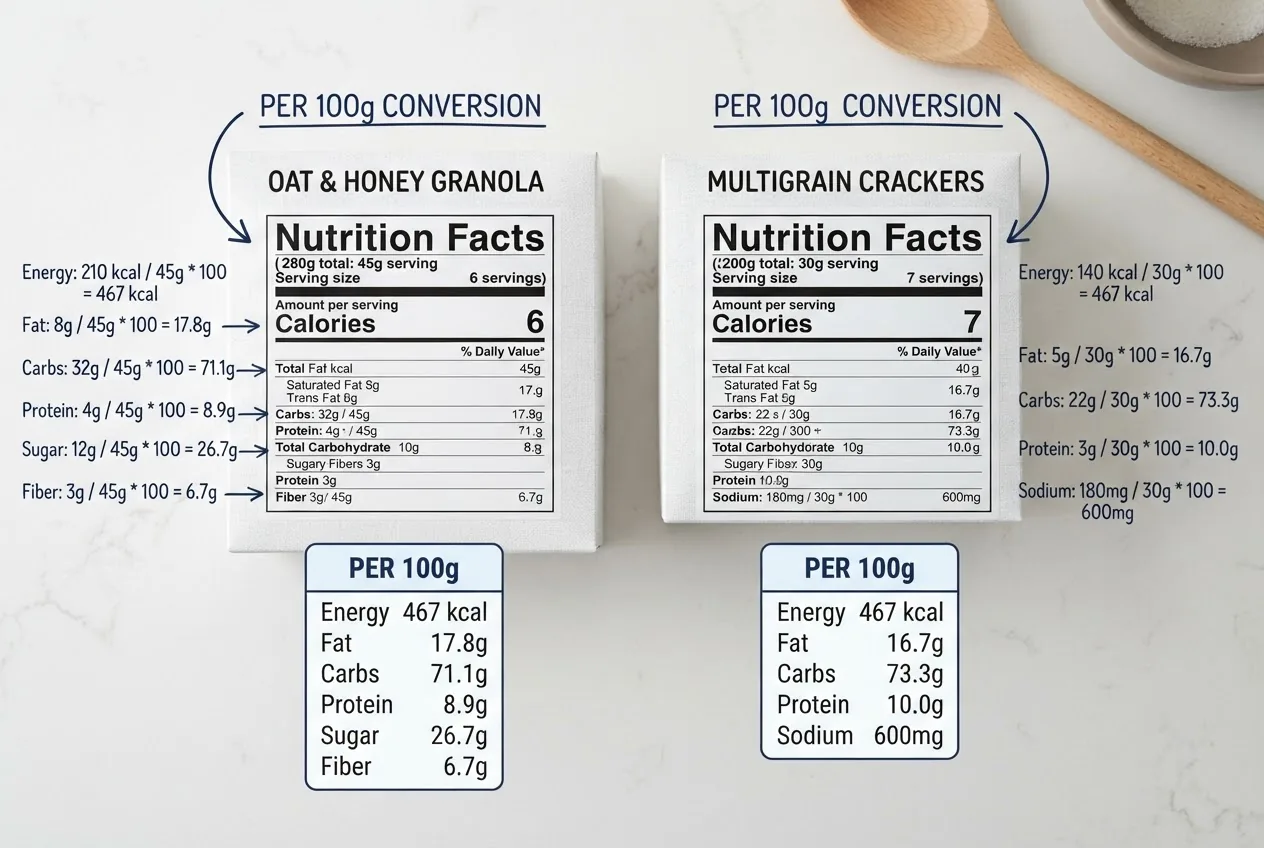
Compare two labels using constant servings — To compare nutrition, standardize to the same serving or use per-100 g values. If Package A lists 250 kcal per 50 g and Package B lists 300 kcal per 75 g, convert to per-100 g: A = 500 kcal/100 g, B = 400 kcal/100 g → Package B is lower energy density. Conversion formula: (kcal ÷ grams) × 100 = kcal per 100 g.
- Check allergens and declarations for diet restrictions — Ingredient statement and “Contains” line list major allergens: milk, eggs, fish, shellfish, tree nuts, peanuts, wheat, soy. For gluten-free or nut-free needs, verify both “Contains” and cross-contamination statements such as “May contain traces of…”. If you have celiac disease, favor products that explicitly state “gluten-free.”
- Decode sugar names and calculate total sugar mass — Sugar appears with many names: sucrose, maltose, dextrose, glucose, evaporated cane juice, corn syrup, barley malt, fruit juice concentrate. When calculating sugar content include both “Total Sugars” and “Includes X g Added Sugars.” Example: “Total Sugars 14 g; Includes 12 g Added Sugars” → 2 g may be intrinsic (fruit), 12 g added.
- Flag fiber and whole-grain claims — verify grams and percent whole grain — Look for “Dietary Fiber” grams. For whole-grain products, check the ingredient list for “whole” grain words at the start (whole wheat, whole oats). A product labeled “multigrain” is not necessarily whole grain — confirm grams of whole grain per serving if provided. The target: at least 3–5 g fiber per serving for a high-fiber food; 5+ g is very good.
- Use the nutrition label to estimate portion sizes with a kitchen scale — If packaging serving grams differ from visual portions, weigh typical portions. Example: label serving = 30 g but your hand portion is 45 g → you eat 1.5 servings, so multiply nutrients by 1.5. Practice: weigh 3 different portions (small, medium, large), record grams and the corresponding calculated nutrients.
- For homemade or unlabelled foods, use USDA or manufacturer databases — When no label exists (restaurant meal, bulk produce), use FoodData Central or the product page to find nutrition facts, then follow the same math. Example: looked up “grilled chicken breast 100 g = 165 kcal, 31 g protein, 3.6 g fat” — convert to your portion size by ratio.
- Record and cross-check calculations using a simple spreadsheet — Set up columns: product, grams consumed, servings, calories, protein (g), carbs (g), fat (g), sodium (mg), fiber (g), %DV equivalents. Maintaining a running total helps you spot double-counting or rounding errors. Example sheet row: “Greek yogurt — 150 g consumed — label serving 150 g (1 serving) — 130 kcal — 12 g protein — 5 g carbs — 4 g fat”.
- Double-check label format differences (US vs other countries) — U.S. Nutrition Facts panels list grams and %DV using the FDA format. Labels in other countries may include kJ, different micronutrient DVs, or serve sizes in mL instead of cups. When traveling or buying imported goods, convert kJ to kcal (1 kcal = 4.184 kJ) and mL to g using water density approximations (not precise for solids).
-
Apply label reading to meal planning and specific goals — For weight loss aim for a caloric deficit of 300–700 kcal/day; for muscle gain add 200–500 kcal/day with at least 1.6 g protein/kg body weight per day. Practical example: 70 kg adult, target protein 1.6 g/kg = 112 g/day → distribute across meals using labels (e.g., 30 g breakfast, 40 g lunch, 30 g dinner, 12 g snacks).
Tip: When tracking for weight or performance, prioritize absolute grams of protein and fiber rather than %DV, because %DV is easier for quick comparison but less precise for personalized goals.
Worked examples — concrete calculations
Example A: One packaged meal
Food label shows: Serving size 1 package (400 g); Servings per container 1; Calories 560; Total Fat 22 g; Saturated Fat 8 g; Carbohydrate 64 g (Dietary Fiber 10 g; Total Sugars 8 g; Includes 0 g Added Sugars); Protein 28 g; Sodium 980 mg.
Interpretation and checks:
- One package is one serving — you will eat 560 kcal if you eat the package.
- Calories from macros: (Protein 28 g × 4 = 112 kcal) + (Carbs 64 g × 4 = 256 kcal) + (Fat 22 g × 9 = 198 kcal) = 566 kcal. The 6 kcal difference is due to rounding on the label and possible fiber energy contribution; acceptable variance within 10 kcal.
- Fiber target: 10 g is 36% DV (10 ÷ 28 g DV × 100). This is a high-fiber meal — useful for satiety.
- Sodium 980 mg is 43% of a 2,300 mg/day limit — plan lower-sodium choices at other meals.
Example B: Comparing two snack bars
Bar A: Serving 40 g, Calories 180, Protein 8 g, Sugar 12 g, Fiber 4 g. Bar B: Serving 50 g, Calories 220, Protein 10 g, Sugar 16 g, Fiber 6 g.
Normalize to per-100 g to compare energy density:
- Bar A per 100 g = (180 ÷ 40) × 100 = 450 kcal/100 g.
- Bar B per 100 g = (220 ÷ 50) × 100 = 440 kcal/100 g.
- Protein per 100 g: A = (8 ÷ 40) × 100 = 20 g; B = (10 ÷ 50) × 100 = 20 g — same protein density.
- Fiber per 100 g: A = 10 g; B = 12 g — Bar B is slightly better for fiber and marginally lower in energy density. If your priority is fiber, choose Bar B; if you’re monitoring sugars, both are high and should be one part of a meal rather than the whole snack for blood sugar control.
Nutrition label example (visualized table)
Below is a simplified nutrition facts table (example). Use it to practice converting %DV and to perform the steps above.
| Nutrition Facts | Per Serving |
| Serving size | 1 cup (240 g) |
| Servings per container | 2 |
| Calories | 320 |
| Total Fat (g) — %DV | 14 g — 18% |
| Saturated Fat (g) — %DV | 4 g — 20% |
| Sodium (mg) — %DV | 610 mg — 27% |
| Total Carbohydrate (g) — %DV | 32 g — 12% |
| Dietary Fiber (g) — %DV | 6 g — 21% |
| Total Sugars (g) | 8 g |
| Includes Added Sugars (g) — %DV | 4 g — 8% |
| Protein (g) | 12 g |
| Vitamin D — %DV | 2 µg — 10% |
How to use labels for specific goals
Weight loss
Calculate your target daily calories (example: maintenance 2,400 kcal → for a moderate deficit subtract 500 kcal = 1,900 kcal/day). Use labels to portion meals so total daily calories remain near 1,900. Example: breakfast 380 kcal, lunch 650 kcal, dinner 700 kcal, snacks 170 kcal = 1,900 kcal. Keep protein high: aim 1.2–1.6 g/kg bodyweight; use label protein grams to meet this target.
Muscle gain / strength training
Increase daily calories by 200–500 kcal and prioritize protein: 1.6–2.2 g/kg. If you weigh 80 kg, protein target = 128–176 g/day. Use labeled protein grams to sum meals and reach target — e.g., breakfast 30 g, lunch 40 g, post-workout snack 20 g, dinner 35–40 g, additional snacks fill remainder.
Blood sugar control
Track total and added sugars and prefer items with low net carbs (carbs − fiber). Example: label shows 22 g carbs and 8 g fiber → net carbs = 14 g per serving. Keep consistent carbohydrate portions across meals (e.g., 30–45 g carbs per meal for many adults with diabetes) and use labels to plan.
Label-reading hacks and shortcuts
- Scan %DV first — 5% DV or less = low, 20% DV or more = high for a nutrient.
- Use per-100 g comparisons — standardizes products of different serving sizes for quick energy density checks.
- When in doubt about sugar names — any “-ose” (sucrose, glucose, dextrose), syrup, concentrate, malt, maltose is a sugar source. If you see multiple sugar names in the ingredient list, added sugar load is likely high.
- Prefer higher fiber and protein per 100 g — targets: ≥5 g fiber/serving OR ≥3 g/100 kcal for a high-fiber product; ≥10 g protein/serving is good for a snack.
- Beware “low fat” claims — sometimes replaced by higher sugar or refined carbohydrate to preserve taste; check calories and added sugars.
How to identify ingredients and nutritional values of food beyond the package
For unlabelled items: use the USDA FoodData Central (search by food name), manufacturer websites, or restaurant nutrition calculators. When using a database, copy the exact portion size (grams or ounces). Example: “USDA: raw apple, with skin, 182 g = 95 kcal, 25 g carbs, 4.4 g fiber, 0.5 g protein, 0.3 g fat”. Use these figures directly in your spreadsheet.
Common mistakes and how to avoid them
These are mistakes I’ve seen repeatedly in practice and how I fix them.
- “I once assumed ‘serving size’ was what I served myself” — I learned to always weigh or visually check the grams. Fix: always calculate servings eaten = grams eaten ÷ serving grams, and multiply nutrients accordingly.
- “I’ve added %DV values instead of grams” — %DV is relative and can mislead for customized calorie targets. Fix: convert %DV back to grams using the DV number (e.g., fiber DV 28 g), before summing for personalized goals.
- “I compared two products by calories only and missed sodium” — I saw clients lower calories but triple sodium. Fix: decide which nutrients matter for you (sodium, fiber, added sugar), then compare those across products, not calories alone.
- “I trusted ‘low-fat’ as healthy” — I found low-fat items with high added sugars. Fix: read both total sugar and added sugars lines and compare energy density.
- “I ignored ingredient order” — I once recommended a cereal as ‘whole grain’ until I saw sugar at the top of the list. Fix: always read the ingredient list first three items for composition clues.
Checklist: verify your work
- I confirmed serving size in grams and calculated servings eaten (grams eaten ÷ serving grams).
- I multiplied calories and all nutrient grams by the number of servings consumed.
- I converted grams of protein, carbs, and fat to calories when needed (4/4/9 kcal per g) and checked against the label calories for rounding errors (within ±10 kcal acceptable).
- I converted %DV to absolute grams or milligrams where relevant (e.g., fiber, sodium, calcium).
- I checked ingredient order for added sugars or fats listed among the first three ingredients.
- I recorded totals in a spreadsheet or notebook and confirmed daily totals against my calorie and macro targets.
- I verified any allergen statements if I have dietary restrictions.
When to call in a professional
Call a registered dietitian or licensed nutritionist if any of the following apply:
- You need precise macronutrient prescriptions (e.g., medically supervised weight loss, clinical muscle-gain plan) — expect a RD to provide a written plan with gram targets and weekly check-ins.
- You have complex medical needs (Type 1 diabetes, severe kidney disease, phenylketonuria, severe allergies) — a clinician will set strict nutrient thresholds (e.g., potassium limit <2,000 mg/day or protein limited to X g/day) and monitor labs.
- You’re experiencing unexplained weight changes >10% body weight in 3–6 months, new digestive symptoms, or lab abnormalities — these need medical assessment and tailored diet adjustment.
- You are planning a major diet overhaul for athletic performance and require meal-timing and supplement supervision — a sports RD can write timed carbohydrate/protein prescriptions (e.g., 20–40 g protein and 0.4–0.6 g/kg carbs post-workout depending on goal).
Resources and internal links
For templates and a blank label you can use to practice, try our Blank Nutrition Label Maker and Nutrition Facts Template. For broader meal planning using labels, see the pillar guide on building a balanced plan: Nutritionally Complete Meal Guide with Balanced Diet Advice. If you want a more general primer, read Nutrition for Beginners and our focused Food Labels Guide to Understanding Nutritional Information.
Quick reference numbers (for a 2,000-calorie diet)
Common Daily Values (DV) used on U.S. labels — use these for conversions and %DV math:
- Total Fat: 78 g
- Saturated Fat: 20 g
- Cholesterol: 300 mg
- Sodium: 2,300 mg
- Total Carbohydrate: 275 g
- Dietary Fiber: 28 g
- Added Sugars: 50 g
- Protein: 50 g
- Vitamin D: 20 µg (800 IU)
- Calcium: 1,300 mg
- Iron: 18 mg
- Potassium: 4,700 mg
Advanced label topics
Net carbs and fiber types
Net carbs = Total Carbohydrates − Dietary Fiber − Sugar Alcohols (if listed). Fiber types: soluble (viscous, can slow glucose rise) and insoluble (adds bulk). Labels rarely separate soluble vs insoluble fiber; if a manufacturer lists “soluble fiber 3 g”, use that figure when you need glycemic estimates.
Alcohol on labels
Alcohol provides 7 kcal/g. If you read a label for flavored malt beverages or liqueurs, use 7 kcal/g to estimate alcoholic energy; some beverages show calories but not alcohol grams. If ethanol grams are listed, calculate: grams ethanol × 7 = kcal from alcohol.
Rounding rules and label tolerances
FDA allows certain rounding: grams may be rounded to nearest integer, and small differences between calculated macro kcal and label calories are typical (±10–20 kcal). When exact precision matters for clinical reasons, use laboratory-tested data or a registered dietitian’s resources rather than package rounding.
Closing practical plan: 30-minute practice routine
To make these skills automatic, practice this routine once daily for a week:
- Gather three products — one breakfast item, one snack, and one dinner item with labels.
- Weigh a typical portion — record grams and calculate servings eaten.
- Compute calories and macros — multiply per-serving values by servings eaten; convert grams to kcal and compare to label calories.
- Compare two similar products — normalize to per-100 g and choose based on your objective (lower sugar, higher protein, lower sodium).
- Enter data in a simple spreadsheet — maintain a weekly log and review totals against your daily targets every evening.
Frequently Asked Questions
How do I read the nutrition label on food to determine calories per serving?
Find “Serving size” (use grams), note “Calories” per serving, then calculate calories eaten by multiplying calories per serving by number of servings consumed (grams eaten ÷ serving grams). Example: serving 100 g, calories 200; you eat 150 g → 200 × 1.5 = 300 kcal.
What does % Daily Value on a nutrition facts label mean?
% Daily Value (%DV) shows how much a nutrient in one serving contributes to recommended daily intake based on a 2,000-calorie diet. Convert %DV to grams via (DV amount × %DV) ÷ 100 to get the absolute amount for that serving.
How many grams per calorie are protein, carbs and fat?
Protein and carbohydrates each provide 4 kcal per gram; fat provides 9 kcal per gram; alcohol provides 7 kcal per gram. To get grams from calories for protein, divide calories from protein by 4 (e.g., 200 kcal from protein = 50 g).
How can I tell if a food has a lot of added sugar from the nutrition label?
Read “Includes X g Added Sugars” on the label; compare to the 50 g DV for a 2,000-calorie diet. Also check the ingredient list for sugar synonyms early in the list; many sugar names or syrups among the first three ingredients indicate high added sugar.
Where do I find nutrition facts if a product doesn’t have a label?
Use the USDA FoodData Central or the manufacturer’s website for standardized nutrition facts. For restaurants, consult the chain’s published nutrition calculator; for whole foods, search the USDA database and match your portion size in grams.