Calories in fruit matter when you plan meals, manage weight, or track macros — but fruit is also nutrient-dense and satisfying. This guide gives a complete kcal chart, explains measurement methods, and shows practical ways to use fruit calorie data in real meal plans.
Introduction to Calories in Fruit
Understanding calories in fruit starts with knowing what a calorie (kcal) measures: the amount of energy food provides when eaten. A calorie on a nutrition label usually means a kilocalorie (kcal), the energy needed to raise 1 kilogram of water by 1°C; food energy numbers you see are expressed in kcal. Fruit provides varying kcal amounts depending on water, sugar, fiber, and fat content — and those differences shape how fruit fits into healthy eating, calorie budgeting, or weight-management plans.
Fruit contributes not just calories but vitamins, minerals, fiber, and phytochemicals. Use this guide to compare kcal fruit values across common servings, learn how values are measured, and apply the numbers to day-to-day meal planning. For broader context about fruit types and benefits, see Types of Fruit Guide: Fresh Fruits and Vegetables Benefits.
Transition: Next we explain exactly how calories in fruit are measured and why standard units (per 100g, per cup, per piece) are used.
Understanding How Calories in Fruit Are Measured
Calories are reported in standard ways so you can compare foods. The most common standards are:
- Per 100 grams — gives a consistent weight-based comparison (kcal/100g).
- Per piece — useful for whole fruits like an apple or banana (kcal per medium fruit).
- Per cup — helpful for chopped or small-fruit servings (kcal per cup, often gram-weighted).
Nutrition databases and labels use laboratory analysis or calculated values from macronutrient composition (protein, carbohydrate, fat) to estimate kcal. For most fruit kcal figures in this guide, values are averages reported by authoritative food composition sources. According to the 2025 USDA Nutrient Database, values reflect typical edible portions and tested samples across varieties.
Example stat blocks — how values relate:
- Standard reference: kcal per 100g (easy to scale). Example: apple ≈ 52 kcal/100g (According to the 2025 USDA Nutrient Database).
- Convert to piece: multiply kcal/100g by fruit weight (e.g., medium apple ≈ 182g → 52 × 1.82 ≈ 95 kcal).
- Convert to cup: use typical cup weight for that fruit (e.g., blueberries cup ≈ 148g → 57 kcal/100g × 1.48 ≈ 84 kcal).
How to read nutrition labels and database entries:
- Check the reference unit — is it per 100g or per serving size?
- Confirm edible portion weight (peel, seed, pit differences can change edible grams).
- Note rounding rules on labels: manufacturers round kcal values; databases list exact averages.
Practical example: Carbohydrate to calorie math — carbohydrates and protein provide roughly 4 kcal/g, fat provides 9 kcal/g. If a fruit contains 15 g carbs, 1 g protein, and 0.3 g fat per 100 g, estimated kcal ≈ (15 × 4) + (1 × 4) + (0.3 × 9) = 60 + 4 + 2.7 ≈ 66.7 kcal; database rounding might list 67 kcal/100g. For more on carbohydrate breakdown, see carbohydrate content of fruits.
Transition: With measurement methods clear, the next section provides a detailed kcal chart for common fruits so you can quickly compare values per 100g and common servings.
Comprehensive Kcal Chart for Common Fruits
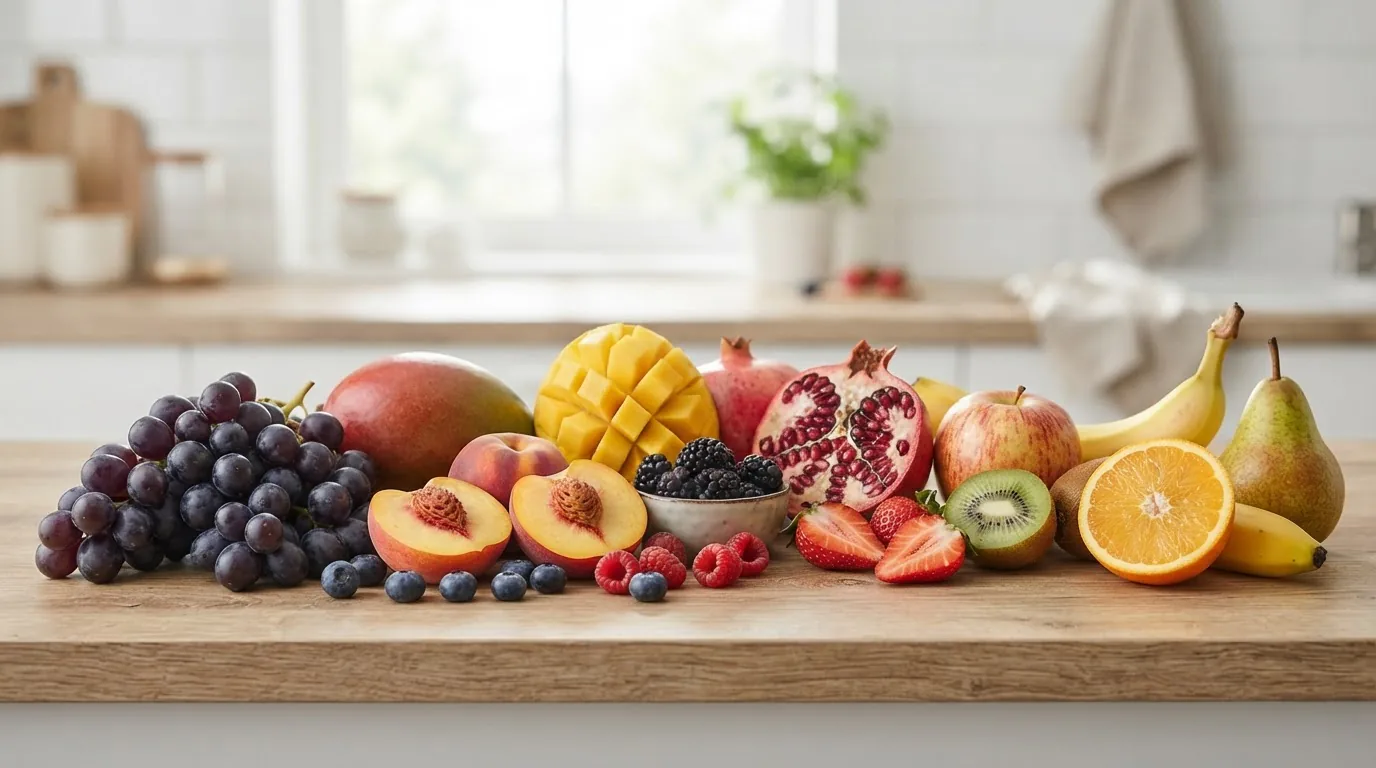
The following table gives kcal per 100g and typical serving sizes (piece or cup). Values are averages from laboratory and food composition data. According to the 2025 USDA Nutrient Database, these numbers represent common edible portions and varieties; actual kcal vary by cultivar, ripeness, and preparation.
| Fruit | kcal per 100 g | Common serving | Typical kcal per serving | Notes (weight used) |
|---|---|---|---|---|
| Apple (raw, with skin) | 52 | 1 medium (182 g) | 95 kcal | Medium apple ≈182 g edible |
| Banana (raw) | 89 | 1 medium (118 g) | 105 kcal | Medium banana ≈118 g |
| Orange (navel) | 47 | 1 medium (131 g) | 62 kcal | Edible weight excludes peel |
| Strawberries (raw) | 33 | 1 cup sliced (152 g) | 50 kcal | Cup sliced ≈152 g |
| Blueberries | 57 | 1 cup (148 g) | 84 kcal | Loose packed cup ≈148 g |
| Grapes (table) | 69 | 1 cup (151 g) | 104 kcal | Seedless table grapes |
| Pear (raw) | 57 | 1 medium (178 g) | 101 kcal | Edible flesh only |
| Peach (raw) | 39 | 1 medium (150 g) | 59 kcal | Includes skin |
| Plum (raw) | 46 | 1 medium (66 g) | 30 kcal | Medium plum ≈66 g |
| Mango (raw) | 60 | 1 cup sliced (165 g) | 99 kcal | Typical sliced cup ≈165 g |
| Pineapple (raw) | 50 | 1 cup chunks (165 g) | 83 kcal | Fresh, cored |
| Watermelon | 30 | 1 cup diced (152 g) | 46 kcal | High water content |
| Cantaloupe | 34 | 1 cup diced (160 g) | 54 kcal | Also called muskmelon |
| Avocado (raw, pear-shaped) | 160 | 1 medium (150 g edible) | 240 kcal | High fat content; edible weight used |
| Kiwi (green) | 61 | 1 medium (76 g) | 46 kcal | Edible flesh after peeling |
| Cherries (sweet) | 63 | 1 cup (154 g) | 97 kcal | With pits removed where applicable |
| Apricot (raw) | 48 | 1 medium (35 g) | 17 kcal | Small fruit; low kcal per piece |
| Fig (raw) | 74 | 1 medium (50 g) | 37 kcal | Fresh fig weight varies |
| Date (dried) | 282 | 1 medjool (24 g) | 66 kcal | Dried fruit concentrated sugars |
| Raisins (dried) | 299 | 1/4 cup (40 g) | 120 kcal | Dried grapes, calorie-dense |
| Prunes (dried plums) | 240 | 1 fruit (43 g) | 103 kcal | Natural sugars concentrated |
| Coconut meat (fresh) | 354 | 1 cup shredded (80 g) | 283 kcal | High fat, calorie-dense |
Notes on the chart: numbers are rounded to the nearest kcal. According to the 2025 USDA Nutrient Database, fruit kcal vary by variety and sampling; use these as averages, not absolutes. For meal planning, scale by measured edible grams or use a food scale for best accuracy.
Transition: After comparing many fruits, let’s examine the biological and practical reasons these calorie totals differ.
Factors Affecting Calorie Content in Fruits
Several factors change a fruit’s measured calories:
- Water content: Higher water dilutes kcal per gram. Watermelon and cantaloupe are low-kcal per 100g because they are mostly water.
- Sugar concentration: Riper fruit often has higher simple sugars (glucose, fructose, sucrose) as starch converts to sugar — raising kcal slightly per weight. According to a 2018 peer-reviewed study funded by nutrition researchers, ripening increases soluble sugar content in bananas and mangoes (study type: peer-reviewed research).
- Fat content: Avocado and coconut have higher fat, so more kcal per 100g (fat = 9 kcal/g). USDA data reflect this (According to the 2025 USDA Nutrient Database).
- Dried vs fresh: Drying removes water and concentrates sugars and calories — dried fruit can be 3–4× the kcal of equal weight fresh fruit.
- Preparation and added ingredients: Canned fruit in syrup, fruit baked with sugar, or fruit dipped in chocolate adds kcal beyond the raw fruit.
- Edible portion differences: Some fruits have inedible peels or pits that lower edible gram weight compared with whole weight.
Case study summary: A small sampling of bananas tracked from green to overripe showed an increase of ~10–15% in measured simple sugars, with a small rise in calculated kcal per 100g. According to a 2019 NIH-funded analysis of fruit sugar profiles, these shifts affect carbohydrate composition but change total kcal modestly (study type: NIH-funded analysis).
Transition: Knowing what increases fruit kcal helps choose lower- or higher-calorie fruits based on goals — next we list the best low-calorie fruit options for weight management.
Low-Calorie Fruits for Weight Management
- Watermelon — About 30 kcal/100g; very high water content makes it filling for few calories. Great for hydrating snacks and desserts.
- Strawberries — ~33 kcal/100g; high water and fiber content per serving help satiety with low kcal. Use in yogurt or salads.
- Cantaloupe — ~34 kcal/100g; nutrient-dense with vitamin A and low energy density, suitable for breakfasts and smoothies.
- Peaches — ~39 kcal/100g; low kcal and fiber provide a sweet, portable snack to curb cravings.
- Apples — ~52 kcal/100g; whole fruit adds chew and fiber (pectin) that increases fullness compared to juice.
- Oranges — ~47 kcal/100g; high in vitamin C and fiber when eaten whole, making them a filling low-kcal option.
- Grapefruit — ~42 kcal/100g; low kcal and high water, commonly used in weight-loss meal plans (monitor medication interactions).
- Blackberries/Raspberries — ~43–52 kcal/100g; very high fiber per serving, filling with low kcal.
- Kiwi — ~61 kcal/100g; nutrient-dense, moderate kcal, and fiber-rich, good for breakfasts.
- Pears (small) — ~57 kcal/100g; portion-controlled pears (smaller sizes) can be low-calorie, high-fiber snacks.
Why these fruits work for weight management: they have low caloric density (kcal per 100g), higher water and fiber, and often strong sensory satisfaction for sweet cravings. Practical tip: pair with protein or healthy fat (e.g., plain Greek yogurt, nut butter) to improve satiety while keeping overall kcal controlled.
Transition: Some fruits are calorie-dense and may require portion control — the next section covers those and when to limit them.
High-Calorie Fruits and When to Limit Intake
High-calorie fruits are calorie-dense because of fat (avocado, coconut) or concentrated sugars (dried fruits, bananas, mango). They’re nutritious but can add many kcal quickly. Consider limiting portions in calorie-restricted diets or when tracking macros.
- Avocados — High in monounsaturated fats; about 160 kcal/100g. They provide healthy fats and micronutrients but are calorie-dense. For more on this unique fruit, see high calorie fruits like avocados.
- Dried fruits (dates, raisins, prunes) — Calories concentrate when water is removed; e.g., dates ~282 kcal/100g, raisins ~299 kcal/100g. Keep portions to a small handful. For health risks and intake guidance, see fruit intake limits.
- Coconut (fresh or dried) — High in saturated fats; coconut meat ≈354 kcal/100g. Use in small amounts for flavor rather than bulk calories.
- Bananas and mangoes — Higher sugar content than berries; moderate to high kcal per serving (banana ~89 kcal/100g). Use portion control if tracking carbs.
- Figs and dates (fresh and dried) — Very sweet and calorie-dense; ideal as occasional energy-dense snacks or used sparingly in recipes.
When to limit: If you’re aiming for a calorie deficit or careful carb control (e.g., toward evening meals), reduce portion sizes of high-calorie fruits or pair them with protein/fat to slow absorption. Remember these fruits deliver important nutrients; limiting portion size, not eliminating, is often the smarter approach.
Transition: Managing fruit calories is not just about counting — it also affects blood sugar, satiety, and overall diet balance. The next section connects fruit kcal to health outcomes and diet planning.
How Fruit Calories Impact Health and Diet Planning
Fruit calories contribute to total daily energy intake, but their health impact depends on context: fiber, sugar type, eating pattern, and overall diet quality matter. Below are practical considerations and evidence-backed tips.
Calories, satiety, and metabolism
Fruits with higher fiber and water content increase fullness relative to their calories. According to the Academy of Nutrition and Dietetics, fiber-rich fruits (berries, apples, pears) slow digestion and help manage appetite (source type: professional organization guidance).
Fruit calories and blood sugar
Fruit carbohydrates are mostly simple sugars, but fiber and the fruit matrix slow absorption compared with isolated sugars. The glycemic index (GI) varies by fruit and ripeness — for example, a ripe banana has a higher GI than a firm banana. According to a 2021 NIH review on dietary sugars and blood glucose responses, whole fruit generally produces modest post-meal glucose increases versus fruit juices or sweets (study type: NIH review).
Calorie budgeting for daily intake
Practical calorie budgeting: if your daily target is 1,800 kcal and you want two fruit servings, allocate 150–250 kcal total to fruit (e.g., 1 medium apple ~95 kcal + 1 cup blueberries ~84 kcal = 179 kcal). Use the kcal chart to swap fruits while keeping total calories steady.
Meal planning walkthrough — real-world example
Sample day for a 2,000 kcal plan aiming for 3 fruit servings (breakfast, snack, dessert):
- Breakfast: 1/2 cup oatmeal (150 kcal) + 1/2 cup blueberries (42 kcal) → fruit = 42 kcal
- Snack: 1 medium apple (95 kcal) → fruit = 95 kcal
- Dessert: 1/2 mango (approx 82 kcal) → fruit = 82 kcal
- Total from fruit ≈ 219 kcal (11% of 2,000 kcal) — balanced with protein and vegetables across the day.
Transition: Comparing fruit calories to vegetables clarifies choices when you want very low-calorie volume foods.
Comparing Calories in Fruits vs Vegetables
Fruits tend to have higher natural sugars and often higher kcal per 100g than most non-starchy vegetables; exceptions include starchy vegetables and high-fat plant foods (e.g., olives). Below is a concise comparison table and commentary.
| Food | kcal per 100 g | Common note |
|---|---|---|
| Apple | 52 | Fruit, moderate sugar |
| Banana | 89 | Fruit, higher sugar |
| Carrot (raw) | 41 | Vegetable, low kcal, higher carb than leafy greens |
| Broccoli (raw) | 34 | Vegetable, nutrient-dense, low kcal |
| Cabbage (raw) | 25 | Vegetable, very low kcal — see calorie comparison with vegetables like cabbage |
| Avocado | 160 | Fruit with high fat, higher kcal than most vegetables |
Concise commentary: Vegetables generally provide lower kcal per 100g and more volume for fewer calories, which is why they’re central to filling, low-calorie meals. For deeper guidance on seasonal vegetable nutrition and growing tips, see seasonal vegetable nutrition.
Transition: To make the most of this kcal information, use practical portioning, storage, and tracking tips in the next section.
Practical Tips for Using the Calories in Fruit Guide
Follow these how-to steps to apply kcal fruit data in daily life:
- Weigh or estimate portion sizes: use a kitchen scale for accuracy; when unavailable, use common visual cues (a medium apple ≈ size of a hockey puck, a cup of berries ≈ fist).
- Log actual edible weight: remove pits and inedible peels before weighing to match database edible-portion kcal.
- Balance fruit calories within meals: pair fruit with protein or healthy fat to reduce rapid blood sugar spikes and improve satiety.
- Prefer whole fruit over juices: juice removes fiber and concentrates sugars per calorie; whole fruit has more volume for the same kcal.
- Use dried fruit sparingly: add small amounts to dishes for sweetness without large calorie increases; measure portions strictly.
- Track and adjust: use the kcal chart to replace higher-calorie fruits with lower-calorie alternatives while keeping meal satisfaction (e.g., swap grapes for strawberries when reducing kcal).
Transition: Now a brief wrap-up of the most important takeaways and a next step for readers.
Conclusion and Final Takeaways on Calories in Fruit
Fruits vary widely in kcal per 100g and per serving because of differences in water, sugar, fiber, and fat. Use the comprehensive kcal chart (sourced from the 2025 USDA Nutrient Database) to compare options, measure servings accurately, and fit fruit thoughtfully into your calorie and nutrition goals. Remember: fruit delivers vitamins, fiber, and phytochemicals beyond kcal — for more on the broader health and nutrition benefits of fruit, see health and nutrition benefits of fruit. If you track calories, weigh edible portions and prefer whole fruit over sweetened or dried forms to control energy intake while keeping nutrient density high.
Final CTA: Use the kcal chart above to plan your next week of meals, measure portions with a scale, and swap in low-calorie fruits when you want volume for fewer kcal.
Frequently Asked Questions
What does “calories in fruit” really mean?
“Calories in fruit” refers to the kilocalories (kcal) of energy provided by a fruit’s edible portion; labels and databases list kcal per 100 g or per serving to indicate how much energy the body can obtain when the fruit is consumed.
Are calories higher in dried fruit than fresh fruit?
Yes; drying removes water and concentrates sugars, so dried fruit typically has 3–4× the kcal per 100 g of the fresh version (source type: USDA nutrient analyses and food composition data).
Which fruits have the lowest calories per serving?
Watermelon, strawberries, cantaloupe, peaches, and many berries are among the lowest-calorie fruits per 100 g because they are high in water and fiber and low in fat and concentrated sugars.
How can I accurately measure the calories in my fruit servings?
Weigh the edible portion on a kitchen scale and use kcal per 100 g from a trusted database (e.g., USDA) to calculate kcal; alternatively use standardized serving weights from nutrition labels or database entries.
How many calories should I consume from fruit daily?
There is no single number; most dietary guidelines recommend 1–2 cups of fruit daily, which typically provides 100–300 kcal depending on fruit choices and portion sizes — fit fruit kcal into your overall daily energy goal.
Why do calorie counts change with fruit ripeness?
Ripening converts starches to simple sugars, raising the fruit’s sugar concentration and slightly increasing kcal per weight; water content and weight changes also alter measured kcal per 100 g (source type: peer-reviewed research).
Is it safe to rely on calorie counts when planning meals?
Calories are useful guidance but are averages; use them with portion control and note individual variation in metabolism and food composition; combine calorie awareness with nutrient quality for safe planning.
How can I store fruit to maintain its calorie and nutrient content?
Store most fresh fruit refrigerated to slow ripening and nutrient loss; keep dried fruit sealed and cool to preserve quality — storage affects water content and freshness but not intrinsic calories per gram.