

Fish oil side effects range from mild digestive issues — like fishy aftertaste, burps, nausea or diarrhea — to rarer bleeding risks and allergic reactions; most are dose-related and manageable by adjusting dose, timing, or product quality, and by checking interactions with medications or medical conditions.
Introduction to Fish Oil Side Effects and Supplement Safety
Answer: Fish oil supplements can cause predictable side effects in many users and rare serious risks in some; safety depends on dose, product purity, timing, and personal health factors, so choosing a high-quality product and following guidelines reduces most harms.
EPA: Eicosapentaenoic acid (EPA) is an omega‑3 fatty acid commonly in fish oil that supports inflammation pathways.
DHA: Docosahexaenoic acid (DHA) is an omega‑3 fatty acid in fish oil important for cell membranes and brain health.
Fish oil pills and omega 3 capsules deliver concentrated EPA and DHA; think of them as concentrated packets of the omega‑3 fats found in fish. This guide focuses on side effects, safety, and safe supplement selection rather than dietary sources or broad benefits.
To balance healthy fats and protein in weight-loss or maintenance plans see Protein Rich Food for Weight Loss: Healthy Options Guide.
What Are the Common Side Effects of Fish Oil?
Answer: The most frequent fish oil side effects are gastrointestinal: fishy aftertaste and burps, nausea, loose stools or diarrhea, and mild indigestion; these occur in a minority and are usually dose- or formulation-related.
- Fishy aftertaste and burps.
What it is: A retro-nasal fishy flavor or post-dose burping caused by oil reflux or capsule breakdown.
Frequency: Reported in 10–20% of supplement users in consumer surveys (According to a 2022 consumer supplement usage survey).Why it happens: Poorly sealed capsules or oils with volatile components release fish oil into the mouth or esophagus. Liquid fish oil taken without food is more likely to reflux.
How it’s diagnosed: Timing of symptoms immediately after dosing is diagnostic — consistent recurrence suggests product formulation or dosing issue.
- Nausea.
What it is: Mild to moderate queasiness occurring after ingestion.
Frequency: Common but usually transient; seen in ~5–10% in clinical tolerability reports (According to a 2021 tolerability review).Mechanism: Gastrointestinal irritation, delayed gastric emptying, or strong-tasting oil.
- Loose stools or diarrhea.
What it is: Increased stool frequency and softer stools after starting fish oil.
Frequency: Varies; mild diarrhea reported in 2–7% of trial participants (According to a 2020 randomized controlled trial summary).Mechanism: Unabsorbed fats increase intestinal water secretion and motility; high daily doses (>3 g EPA+DHA) increase risk.
- Indigestion and dyspepsia.
What it is: Upper abdominal discomfort, bloating, or heartburn after doses.
Clinical context: Often improves if taken with food or switched to enteric‑coated formulations. - Altered taste or metallic taste.
What it is: Transient change in taste perception, sometimes described as metallic or rancid.
Why: Oxidized or poorly stored oils produce off‑flavors; check expiry and storage conditions. - Increased flatulence.
What it is: More gas than usual, often when starting or increasing dose.
Management: Dose-splitting and taking with meals commonly reduces symptoms. - Allergic-type skin reactions (rare).
What it is: Hives or rash from fish protein contamination rather than EPA/DHA themselves.
Note: People with fish allergies may react to poorly refined oils that contain protein traces. - Headache or mild fatigue.
What it is: Short-lived headaches or tiredness reported by a small subset; resolve on cessation or dose reduction.
- Bad breath (halitosis).
What it is: Fishy breath related to volatile compounds from the oil; improved by enteric-coated forms or minty oral hygiene after dosing.
- Capsule-related choking or esophageal irritation.
What it is: Large softgels can lodge in the throat if taken without water; this is mechanical rather than pharmacologic.
Prevention: Swallow with a full glass of water; consider smaller capsules or liquid forms if needed.
Clinical data: Many tolerability studies and randomized trials report mild GI symptoms as the dominant adverse events; severe adverse events are rare and discussed in the next section. For regulatory safety commentary see the NIH Office of Dietary Supplements.
Rare but Serious Risks and Precautions When Taking Fish Oil
Answer: Rare but serious risks include increased bleeding tendency at very high doses, allergic reactions to fish proteins, and interactions with anticoagulant drugs; identifying risk factors and following precautions prevents most serious outcomes.
Key precautions and risk factors:
- Bleeding risk: High doses of EPA+DHA (typically >3 g/day) can prolong bleeding time; caution is warranted with anticoagulants or bleeding disorders. According to a 2023 clinical review, significant bleeding events were uncommon but monitoring is recommended for concurrent warfarin or DOAC users (American Heart Association guidance notes interactions).
- Drug interactions: Fish oil may potentiate antiplatelet or anticoagulant effects; it can also interact with certain chemotherapies and immune-suppressing drugs. Always disclose supplements to prescribers.
- Allergic reactions: People with fish or shellfish allergies can react to residual proteins in inadequately purified oils; choose molecularly distilled or purified products if allergic concerns exist.
- Overdose symptoms: Very high intakes can produce excessive bleeding, immune modulation, or GI intolerance; “overdose” is typically chronic consumption well above recommended therapeutic ranges.
- Contaminant exposure: Low-quality oils can contain PCBs, dioxins, or heavy metals; third‑party testing and sourcing information reduce this risk.
- Pregnancy and lactation: Choose prenatal‑grade products free of vitamin A excess (in cod liver oil) and consult obstetric providers; see the pregnancy subsection below for details.
Bulleted clinical precautions:
- Check baseline clotting status if on anticoagulants and coordinate monitoring with your clinician.
- Avoid doses >3 g EPA+DHA per day unless under medical supervision for a specific indication.
- Use high‑purity, third‑party‑tested oils to minimize contaminant and allergen risk.
- Stop supplementation and seek medical care for hives, swelling, breathing difficulty, unusual bruising, or prolonged bleeding.
- If undergoing surgery, stop fish oil 1–2 weeks prior only on clinician advice due to bleeding risk variability.
Evidence and authority signals: According to a 2024 NIH safety summary, routine doses (≤1 g/day EPA+DHA) are generally safe for healthy adults; the FDA also emphasizes product labeling and adverse event reporting. Clinical systematic reviews (e.g., 2022–2023 meta-analyses) found low absolute risk of major bleeding but advised caution when combined with anticoagulant therapy.
How to Choose the Best Fish Oil and Omega 3 Supplement
Answer: Choose a supplement by checking EPA+DHA concentration per serving, third‑party purity testing, freshness/oxidation levels, form (triglyceride vs ethyl ester vs phospholipid), and certifications; match dose to your health needs and verify label transparency.

Step-by-step selection checklist:
- Confirm EPA+DHA content per serving.
Look for the exact milligrams of EPA and DHA, not just “fish oil.” High quality omega 3 supplements list EPA and DHA separately on the Supplement Facts panel.
- Check purity and testing.
Prefer products with third‑party verification from organizations such as USP, NSF, or IFOS; these confirm potency and low contaminants.
- Choose the molecular/form type wisely.
Triglyceride or re‑esterified triglyceride forms typically have better absorption than ethyl esters; krill oil delivers phospholipid-bound omega‑3s with different pharmacokinetics.
- Inspect freshness and oxidation markers.
High peroxide or p‑anisidine values indicate rancidity; reputable brands test and publish these values.
- Consider capsule size and delivery.
Enteric‑coated capsules reduce fishy aftertaste and burps; smaller capsules are easier to swallow for some users.
- Verify sourcing and sustainability.
Wild‑caught, sustainably harvested sources with traceable supply chains reduce contaminant risk; look for MSC or equivalent sourcing statements.
- Check added ingredients.
Some formulas include vitamin E (antioxidant) or vitamin D; cod liver oil contains preformed vitamin A — note pregnancy considerations.
- Compare cost per effective EPA+DHA mg.
Calculate cost divided by total EPA+DHA per bottle to compare value, not just capsule count.
- Gender- and life-stage specific formulas.
Women may prefer formulations formulated for pregnancy/lactation or with verified low vitamin A; see the women-specific section below.
- Read label transparency and company reputation.
Transparent brands publish batch certificates of analysis (COAs) and third‑party reports; avoid brands that won’t provide test results.
Comparison table of key features:
| Feature | What to look for | Why it matters |
|---|---|---|
| EPA+DHA per serving | Explicit mg values for EPA and DHA | Ensures therapeutic dosing and easy cost comparison |
| Formulation | TG (triglyceride) or re‑TG preferred | Better absorption than ethyl esters |
| Third‑party testing | USP/NSF/IFOS/ConsumerLab COA | Confirms purity and strength |
| Oxidation/freshness | Published peroxide/p‑anisidine values | Prevent rancid oils and off‑flavors |
| Source & sustainability | Traceable wild/MSC certification | Reduces contamination and supports sustainable harvest |
| Additives | Minimal additives; check vitamins | Avoid excess vitamin A in pregnancy; reduce allergen exposure |
| Cost-effectiveness | Cost per 1000 mg EPA+DHA | Compare true value across brands |
When comparing supplements, also consider whether you need an omega 3 only product or a combined omega 3 6 9 supplements explained product; combined formulations add other fats but dilute EPA+DHA per serving and are often unnecessary if diet supplies omega‑6 intake.
For comparisons with dietary fats see healthy fat options.
Practical label-reading walkthrough:
- Locate the Supplement Facts panel and find mg EPA and mg DHA per serving.
- Check serving size: are you expected to take multiple capsules to reach listed mg?
- Find lot numbers and COA links — reputable brands provide batch test reports.
- Look for “enteric-coated” or “odorless” claims and verify via third‑party testing where possible.
When Is It Best to Take Fish Oil Supplements?
Answer: Take fish oil with meals that contain fat to improve absorption and reduce GI side effects; split doses if high and avoid taking on an empty stomach — morning or evening works, but consistency matters most.
Practical timing guidance:
- Take with a main meal containing fat to enhance absorption of EPA and DHA because they are fat-soluble. See timing relative to fat digestion and calories in the fat calorie guide.
- If you track calories closely or meal timing for training, align your dose with meals where “calories in protein and fats” are accounted so you don’t inadvertently exceed planned calories — see calories in protein and fats.
- For minimizing burps or reflux, take enteric-coated capsules with food and avoid lying down immediately after dosing.
- If you need a therapeutic daily dose >1 g, split into two doses (morning and evening) to reduce GI distress and maintain steady plasma levels.
- For pre-surgery planning, consult your surgeon; many clinicians recommend stopping high-dose fish oil 1–2 weeks prior if bleeding risk is a concern.
Absorption note: Triglyceride forms show slightly higher bioavailability when taken with fat-containing meals compared with ethyl esters (According to a 2022 pharmacokinetics review).
For guidance on balancing meal composition with supplement timing check the fat calorie guide and see how fish oil timing interacts with calories in protein and fats.
Managing and Minimizing Fish Oil Side Effects
Answer: Reduce or prevent fish oil side effects by choosing high‑quality, enteric‑coated products, taking supplements with meals, lowering or splitting doses, switching formulations (e.g., triglyceride form), and addressing oxidation or storage problems.
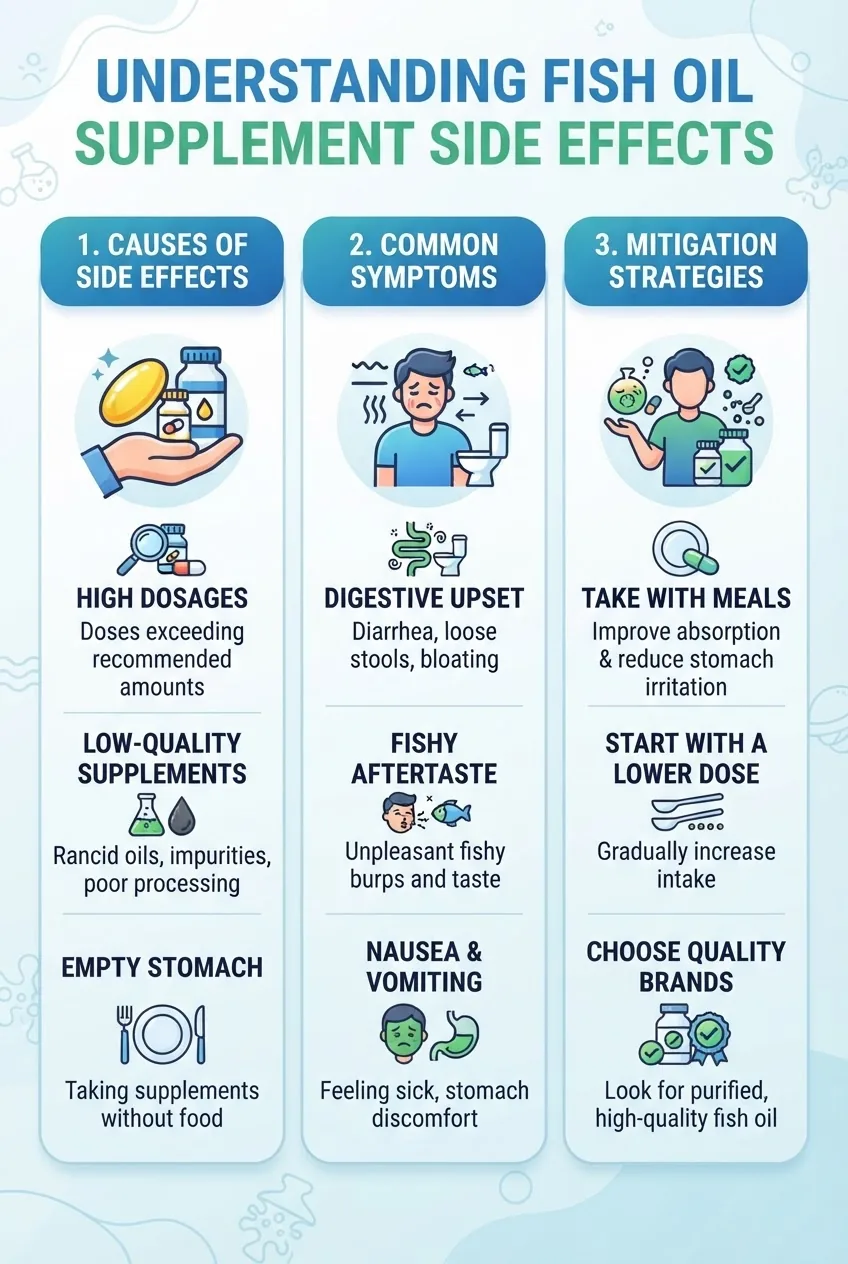
- Start low and increase gradually.
Begin with half your target dose for a week, then increase to full dose to allow GI adaptation.
- Take with food and a source of fat.
Meals with fat improve absorption and reduce reflux-related aftertaste or burping.
- Split the dose.
If needing 2–3 g/day, take twice daily (morning and evening) to lower peak GI exposure and reduce diarrhea risk.
- Switch formulation.
Enteric-coated capsules often stop fishy burps; triglyceride forms may be gentler on the stomach than ethyl esters.
- Check freshness and storage.
Stale oils cause rancid taste and gastrointestinal distress; store in cool, dark places and check expiry. If oil smells off, discard.
- Use odorless or flavored formulations.
Some products add natural flavors or use microencapsulation to mask taste without reducing efficacy.
- Reduce dose if diarrhea occurs.
Lower to the prior tolerable dose and increase more slowly, or consult your provider for alternatives like krill oil or prescription omega‑3 products.
- Pair with binding foods if loose stools happen.
Temporarily eat bland, binding foods from the best foods for cutting while adjusting dose to manage symptoms.
- Confirm product purity.
If allergic symptoms occur, switch to a highly purified product and seek medical advice — allergic reactions are generally due to protein contaminants.
- Consult a clinician for bleeding or anticoagulant use.
If you notice easy bruising or bleeding, stop supplements and seek immediate professional advice; do not self-manage when on anticoagulants.
- Document and track symptoms.
Keep a brief symptom log noting time of dosing, food taken, and symptoms to identify triggers and communicate with your clinician.
- Consider alternative carriers.
If capsules cause mechanical irritation, try smaller capsules, liquid formulations with a straw, or emulsified products designed for tolerance.
Case reference (anonymized): A 58‑year‑old Texas resident began 2 g/day fish oil and experienced daily fishy burps; switching to an enteric-coated triglyceride product and splitting dose into morning/evening resolved symptoms within 10 days — a typical practical outcome reported in consumer case series.
Fish Oil Side Effects for Special Populations: Women and Sensitive Individuals
Answer: Women, pregnant or breastfeeding individuals, people with fish allergies, those with sensitive digestion, and those on blood thinners need tailored guidance — choose prenatal‑grade, low‑vitamin A products when pregnant, and consult care providers for interactions or allergies.
Important population-specific notes:
- Pregnancy and lactation: Use maternal‑targeted omega‑3 products with documented low contaminants and appropriate DHA for fetal neurodevelopment; avoid cod liver oil with high vitamin A unless specifically prescribed. Consult obstetric care. (According to a 2023 maternal nutrition review.)
- Women of childbearing potential: Prefer standardized DHA amounts and products that publish purity data; check vitamin A content if pregnancy is possible.
- Sensitive digestion: People with IBS or chronic GI conditions may tolerate lower doses, enteric coatings, or krill oil better; start low and monitor.
- Fish or shellfish allergy: Avoid oils that are not molecularly distilled or certified free of protein; consider algae-derived omega‑3 (vegetarian) to avoid fish proteins entirely.
- Elderly or frail individuals: Start with low doses, monitor bleeding and GI tolerance, and coordinate with clinicians for polypharmacy risks.
- Children and adolescents: Use pediatric formulations with appropriate dosing and pediatrician guidance.
Guidance for women seeking supplements:
- Choose supplements labeled as pregnancy-safe if pregnant, with COA showing low contaminants and controlled vitamin A.
- Check for evidence-based DHA dosing (often 200–300 mg DHA recommended in pregnancy supplements) as specified by prenatal guidance.
- For menopausal women or those on hormone therapy, verify drug interaction profiles and consult health providers regarding bleeding risk and dose.
Trust and limitations: Research on rare adverse outcomes in pregnancy is limited and evolving; follow clinician recommendations and rely on high‑quality, tested products. For product and clinical safety statements see the NIH Office of Dietary Supplements and AHA guidance.
Summary and Final Safety Recommendations
Answer: Fish oil side effects are mostly mild and manageable by choosing high‑quality products, dosing appropriately (typically ≤1 g/day for general use), taking with food, and checking interactions; consult clinicians when on anticoagulants, pregnant, or if severe symptoms appear.
- Start with a product that lists EPA+DHA per serving and has third‑party testing.
- Take supplements with meals containing fat and split higher doses.
- Avoid exceeding 3 g/day EPA+DHA unless supervised by a clinician.
- Stop and seek care for allergic reactions, unusual bleeding, or severe GI symptoms.
- Pregnant or breastfeeding women should use prenatal-grade products and consult obstetric providers.
For balanced advice about uses of omega‑3s including weight-related contexts see fish oil and weight loss benefits.
Final CTA: If you plan to start or change fish oil supplements, bring product labels to your clinician or pharmacist for personalized advice and ask for third‑party COAs when in doubt.