

Answer: Whether you should eat before or after a workout depends on your goal—performance, muscle gain, or fat loss—and workout length; generally eat before performance-focused or long sessions and eat soon after resistance training to support recovery and muscle synthesis (within 30–120 minutes for most people).
Is it better to eat before or after a workout?
Direct answer: It is better to match eating to your goal—eat before workouts for performance and long endurance sessions, and prioritize a post workout meal after resistance training to promote recovery and muscle repair.
Fasted state: a condition when you have not eaten for several hours and circulating insulin and blood glucose are relatively low.
Explanation: For high-intensity or long-duration training, pre-exercise carbohydrates and some protein supply fuel and delay fatigue. For strength or hypertrophy, post-workout protein and carbs maximize muscle protein synthesis and glycogen restoration. For short low-intensity workouts, eating is optional and depends on comfort and energy needs.
- Performance / endurance: prioritize a pre-workout meal 1–4 hours before.
- Muscle building: prioritize a post-workout meal with fast-absorbing protein soon after exercise.
- Fat loss: eating timing is secondary to total daily energy balance; choose a plan you can sustain.
Should I exercise before I eat or after?
Direct answer: Exercise before you eat if the session is short, low intensity, or you prefer fasted training for adherence; exercise after eating if you need fuel for intensity, are doing long workouts, or want to maximize strength and power.
Practical decision factors:
- Energy needs: choose pre-exercise nutrition for sessions >45–60 minutes or high intensity.
- Comfort: avoid heavy meals within 60 minutes of exercise to limit GI upset.
- Goals: fasted cardio may aid short-term fat mobilization but does not guarantee greater fat loss long-term.
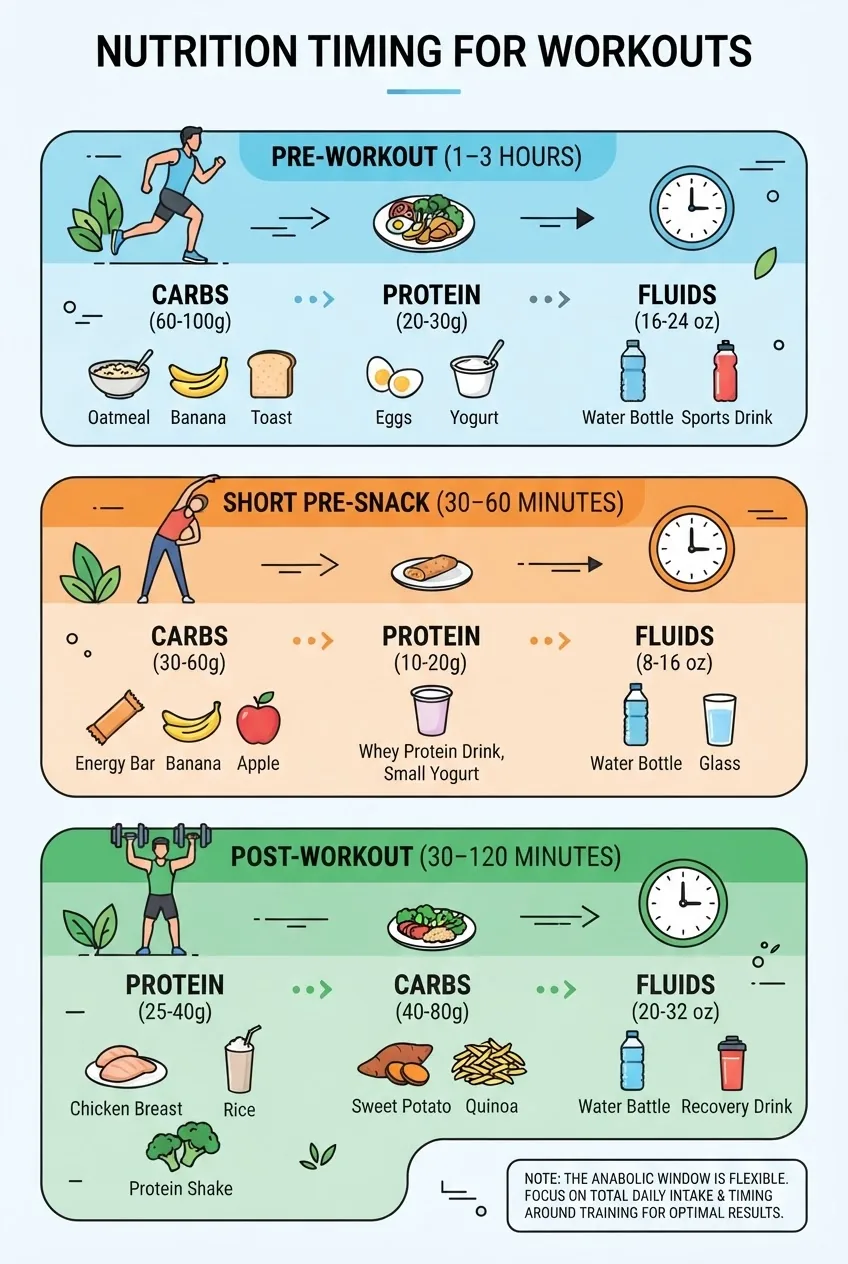
If you split: a small snack (e.g., banana + 10–15 g protein) 30–60 minutes before can bridge performance and convenience without full digestion load.
How soon after working out should you eat?
Direct answer: Eat within 30–120 minutes after exercise; aim for the earlier end (30–60 minutes) for intense resistance sessions and when you have limited daily protein opportunities, otherwise within two hours is adequate.
Anabolic window: the proposed post-exercise period when muscles are especially receptive to nutrients for repair and growth; current evidence shows it is broader (several hours) than once thought, but earlier feeding helps when overall protein intake is low.
Why timing matters: after resistance exercise muscle protein synthesis is elevated and glycogen stores (muscle carbohydrate) are depleted; providing protein and carbohydrate in the 30–120 minute window accelerates recovery, replenishes glycogen, and supports net protein balance. If you consumed a balanced meal 1–2 hours pre-workout, precise timing is less critical.
What is the best thing to eat before training?
Direct answer: The best pre-workout meal combines easily digested carbohydrates and 15–25 grams of protein, timed 1–3 hours before training; for sessions under one hour a small carb-focused snack 30–60 minutes prior can suffice.
Macronutrient: a nutrient class—carbohydrates, proteins, or fats—that provides energy and building blocks for the body.
Examples by timing:
- 2–3 hours before: whole-grain toast with nut butter and turkey, or oatmeal with fruit and Greek yogurt (balanced carbs + protein).
- 60 minutes before: banana and a small whey shake or a low-fat yogurt with berries.
- 30 minutes before (if needed): a sports drink or half a banana for quick carbs; avoid high-fat or high-fiber foods close to start.
Portion guidance: aim for 200–400 kcal for moderate workouts when eating 1–3 hours prior; adjust for body size and training load.
What should you eat after a workout?
Direct answer: After most workouts, prioritize a meal with 20–40 grams of high-quality protein and 0.5–1.2 grams/kg of carbohydrates (for glycogen restoration) within 30–120 minutes; include fluids and electrolytes if sweat loss was large.
Glycogen: stored carbohydrate in muscle and liver used as the primary fuel during moderate-to-high intensity exercise.
Practical post-workout choices:
- Strength session: chicken breast, rice, and steamed vegetables with a fruit snack or whey shake + banana.
- Endurance session >90 minutes: larger carb portion such as pasta or rice bowl plus 20–30 g protein.
- Quick recovery when short on time: whey protein (20–30 g) plus a piece of fruit or a carb drink.
Fats slow digestion; include modest healthy fats but avoid very fatty meals immediately post-exercise if rapid glycogen replacement is the goal.
Is fasted cardio better for weight loss?
Direct answer: Fasted cardio may increase fat oxidation during exercise but it does not produce greater long-term fat loss than fed cardio when total daily calories are equal; choose the approach that improves consistency and performance.
Evidence: Studies show similar weight and fat loss when energy intake and expenditure are matched. Fasted sessions can feel easier to schedule for some but may reduce intensity or total work, which can limit caloric burn.
Guidance:
- For adherence/comfort: fasted morning walks or light cardio are fine.
- For high-intensity or interval training: consume a small carb snack beforehand to maintain intensity and total calorie burn.
How do carbs after workout affect recovery?
Direct answer: Post-workout carbohydrates restore muscle glycogen, reduce fatigue, and enhance recovery—especially crucial after long endurance sessions or multiple daily training bouts.
Mechanism: Carbohydrates raise insulin, which helps shuttle glucose into muscle and stimulates glycogen synthesis; combining carbs with protein accelerates glycogen resynthesis and supports muscle repair.
Recommended amounts:
- Endurance >90 minutes: 0.8–1.2 g/kg body weight in the first 1–4 hours.
- Moderate sessions: 0.5–0.7 g/kg is usually sufficient.
- Strength training: 0.3–0.6 g/kg to top off depleted stores; focus more on protein for synthesis.
How much protein should I eat before and after exercise?
Direct answer: Consume ~15–25 grams of protein before workouts and 20–40 grams after, depending on body size and training intensity; aim for 1.6–2.2 g/kg daily evenly distributed every 3–4 hours for muscle-building goals.
Quality matters: choose complete proteins (contain all essential amino acids) such as whey, dairy, meat, eggs, soy, or a complementary plant-protein combination.
Timing nuance: pre-workout protein supports amino acid availability during exercise; post-workout protein stimulates muscle protein synthesis when paired with resistance training. When daily total protein is adequate, timing becomes less critical but still useful for spacing and recovery.
Should you eat before working out if you want to lose weight?
Direct answer: Eating before a workout can support higher intensity and longer sessions that burn more calories; whether you eat does not inherently change weight loss—total calorie balance does—so pick the approach that sustains exercise intensity and adherence.
Practical points:
- Fasted low-intensity workouts: acceptable if you feel stable and energy is sufficient.
- For high-intensity interval training or long cardio: a small carb snack improves performance and may increase total kcal expenditure.
- Track overall calories and protein to preserve lean mass during weight loss.
How long should you wait to eat after a workout?
Direct answer: Wait no more than 120 minutes after exercise to eat; aim for 30–60 minutes post-resistance training when possible, and within two hours if you recently ate pre-workout.
Why not longer: prolonged delays can prolong muscle protein breakdown and slow glycogen restoration, which matters when training frequency is high or protein intake across the day is low. If you have a full meal planned within two hours and consumed adequate pre-workout nutrition, you can be flexible.
How soon after working out should you eat to build muscle?
Direct answer: To maximize muscle-building, consume 20–40 grams of high-quality protein within 30–60 minutes after resistance training and ensure sufficient total daily protein (1.6–2.2 g/kg) spread over 3–5 meals.
Practical protocol:
- Pre-exercise: 15–25 g protein 1–2 hours before if possible.
- Post-exercise: 20–40 g whey or whole-food protein within an hour for faster amino acid delivery.
- Daily: distribute protein so each serving contains 20–40 g to maximize syntheses peaks.
If you train late and won’t eat for several hours, prioritize a post-workout snack (shake + fruit) to reduce overnight catabolism.
What to eat if your workout is less than 30 minutes?
Direct answer: For short, low-to-moderate sessions under 30 minutes, eating is optional; a small protein-rich snack after training (15–25 g protein) supports recovery if it fits your daily protein target.
Details: Short workouts primarily tap existing energy stores and create modest muscle stimulus. Prioritize total daily nutrition instead of precise peri-workout timing—save larger pre- or post-meals for longer or more intense sessions.
How do morning workouts change eating timing?
Direct answer: For morning workouts, choose between a small pre-workout snack for intensity or fasted training for convenience; always consume protein within 60 minutes of finishing to support recovery, especially if you trained fasted.
Recommendations:
- Fasted morning strength: have 20–30 g protein immediately after.
- Morning endurance: a small carb snack (20–40 g carbs) 30–60 minutes prior helps sustain pace.
- Breakfast post-exercise: combine 20–30 g protein with carbs (e.g., eggs + toast + fruit).
What are the best post workout foods for fast recovery?
Direct answer: Best post-workout foods combine high-quality protein and moderate-to-high carbohydrates: grilled chicken + rice + roasted veggies, a whey shake with banana and oats, or Greek yogurt with honey and berries.
Food examples and quick swaps:
- Whey shake + banana (fast-digesting, portable).
- Turkey sandwich on whole-grain bread + fruit (balanced, solid-food option).
- Salmon, sweet potato, and salad (healthy fats, slower carbs—good if you have longer recovery time).
- Chocolate milk (convenient blend of carbs and protein for casual athletes).
Hydration: pair food with water or a low-sodium electrolyte drink if you sweated heavily; check urine color and bodyweight changes to estimate losses.
How long can you delay a post-workout meal without harming results?
Direct answer: You can delay eating up to 2–3 hours after exercise without major harm if you consumed a full meal 1–2 hours pre-workout and your daily protein is sufficient; avoid repeated long delays after intense training or multiple daily sessions.
Caveats:
- If you trained fasted, keep the delay under 60–90 minutes when possible.
- Multiple daily intense sessions require prompt refueling to maintain performance.
How should someone with diabetes time meals around exercise?
Direct answer: People with diabetes should plan pre-exercise carbs to avoid hypoglycemia for moderate-to-high intensity exercise, monitor blood glucose before/during/after sessions, and include a balanced post-workout meal to stabilize levels; consult a healthcare provider for individualized adjustments.
Practical steps:
- Check blood glucose before starting; if low (<90 mg/dL) consume 15–30 g fast carbs then re-check.
- Carry quick carbs (juice, glucose tablets) during workouts longer than 30 minutes.
- Include protein and carbs after exercise to prevent delayed hypoglycemia and support recovery.
What should people with sensitive stomachs eat before exercise?
Direct answer: Choose low-fiber, low-fat, low-lactose, and moderate-carb snacks 30–60 minutes before exercise—plain toast with honey, a banana, or a small rice cake with nut butter—to reduce GI distress.
Guidelines:
- Avoid raw cruciferous vegetables, beans, high-fat meals, and large volumes of dairy close to training.
- Test foods during low-stakes workouts to find personal tolerances.
Should I prioritize carbs or protein first after exercise?
Direct answer: After resistance training prioritize protein (20–40 g) to stimulate muscle protein synthesis, and include carbs to replenish glycogen; after long endurance work prioritize carbs first if glycogen restoration is the immediate goal.
Reasoning:
- Resistance training: protein supports repair; carbs complement by restoring energy.
- Endurance training: large glycogen deficit makes carbs the priority to speed recovery.
How to time meals if you train twice a day?
Direct answer: For two-a-day training schedule a carb-rich post-session meal and a protein-containing snack before the next session; ensure each session has 20–40 g protein intake and sufficient carbs between sessions to refill glycogen.
Example plan:
- Morning session: small pre-snack (if needed) → post-workout meal with 30–60 g carbs + 25–40 g protein.
- Midday: balanced lunch with carbs and protein if sessions are separated by 4+ hours.
- Pre-evening session: light carb snack 30–60 minutes prior; post-evening session: protein-focused dinner.
How to choose the best pre- and post-workout meals for different training goals?
Direct answer: Select meals by matching energy timing to goals—pre-carb + protein for performance, post protein + carbs for muscle and glycogen restoration; adjust portions and timing based on workout duration and intensity.
Decision matrix (quick):
| Goal | Pre-workout | Post-workout |
|---|---|---|
| Max performance | 1–3 h balanced meal with 30–60 g carbs + 15–25 g protein | 20–40 g protein + 0.5–1 g/kg carbs |
| Muscle gain | 15–25 g protein 1–2 h before | 20–40 g protein + moderate carbs |
| Fat loss | Optional small snack; focus on workout intensity | Protein-focused to preserve lean mass; timing flexible |
How to create a simple meal schedule around the gym (worked example)?
Direct answer: Plan meals by working backwards from workout time—place a balanced pre-meal 1–3 hours before, a recovery snack or meal within 30–60 minutes after, and space remaining protein servings evenly through the day to hit daily targets.
Worked example (70-kg recreational lifter training at 6 PM, goal: hypertrophy):
- Breakfast (8 AM): 30 g protein, whole grains, fruit.
- Lunch (12 PM): 30 g protein, vegetables, moderate carbs.
- Pre-workout snack (4:30 PM): 20 g protein shake + 30 g carbs (banana + oats).
- Workout (6 PM): resistance training 60–75 minutes.
- Post-workout (7:15 PM): 30–40 g protein + 40–60 g carbs (chicken, rice, veggies).
- Evening snack (9 PM): small protein serving if daily protein not met.
This schedule spaces protein across 4–6 feedings and places a timely post-workout meal to maximize recovery and daily protein distribution.
How to adapt timing for older adults or those new to training?
Direct answer: Older adults should prioritize post-workout protein (25–40 g) soon after exercise due to anabolic resistance, and beginners should align eating with comfort and gradual training progression—use smaller, frequent protein servings to stimulate synthesis.
Key adaptations:
- Distribute protein across meals to overcome reduced sensitivity to amino acids.
- Start with moderate-intensity workouts and test food timing for GI tolerance.
- Consider dairy or leucine-rich proteins to boost muscle response.
Practical rule: If your goal is performance or heavy lifting, eat beforehand; if your goal is muscle growth, make the post-workout meal a priority—both timing choices depend on your overall daily nutrition.
How to combine supplements with meal timing?
Direct answer: Use fast proteins (whey) immediately after training if whole food is unavailable; creatine timing is flexible (daily dose matters more than peri-workout timing), and caffeine is best pre-workout for performance.
Supplement quick guide:
- Whey protein: 20–30 g post-workout for rapid amino acid delivery.
- Creatine: 3–5 g daily; can be taken any time but consistently.
- Caffeine: 3–6 mg/kg 30–60 minutes pre-workout for improved power and focus.
What mistakes to avoid for peri-workout nutrition?
Direct answer: Avoid heavy, high-fat, or fiber-rich meals immediately before training, skipping post-exercise protein after intense resistance sessions, and ignoring hydration and electrolyte needs after heavy sweating.
Common errors and fixes:
- Error: Eating a large greasy meal 30 minutes before—Fix: choose low-fat carbs and lean protein instead.
- Error: Relying solely on supplements and neglecting whole foods—Fix: prioritize meals and use supplements as convenience aids.
- Error: Neglecting fluids—Fix: weigh yourself pre/post session to guide rehydration (replace 75–150% of lost fluid over hours).
How to measure if your timing strategy is working?
Direct answer: Track performance (training volume, intensity), recovery (soreness, energy), body composition trends, and practical markers like hunger, sleep quality, and training adherence; adjust timing if performance or recovery declines.
Metrics to monitor:
- Strength or endurance progress week-to-week.
- Daily energy and perceived recovery scores.
- Bodyweight and body composition trends over 3–8 weeks.
Summary action plan: what to do this week
Direct answer: This week, match one pre-workout meal to a training session and prioritize a post-workout protein-containing meal within 60 minutes after resistance training; evaluate energy and recovery and adjust volumes of carbs and protein accordingly.
- Day 1 (strength): Eat 20 g protein 1–2 hours before; 30 g protein + carbs within 60 minutes after.
- Day 2 (easy cardio): Keep meals normal; no strict timing required.
- Day 3 (long run): Eat carbs 2–3 hours before and a higher-carb post workout meal.
- Track energy, GI comfort, and performance; tweak timing for next week.
For a complete framework on building balanced meals that support these choices, see the pillar guide on constructing nutritionally complete meals: Nutritionally Complete Meal Guide. For workout-focused meal plans refer to the Diet to Get Fit and Lean guide: Diet to Get Fit and Lean Guide, and for practical beginner options see Best Diet for Beginners Guide.
Frequently Asked Questions
Should I eat before or after the gym for weight loss?
Answer: For weight loss, prioritize a consistent calorie deficit and adequate protein; choose pre-exercise eating when you need energy to maintain workout intensity, otherwise fasted workouts are acceptable—total calories drive fat loss more than timing.
How long to wait to eat after working out?
Answer: Wait no more than about 120 minutes after exercise to eat; aim for 30–60 minutes post-resistance training when possible to maximize protein-driven recovery, and within two hours if you ate beforehand.
What is the best post workout meal for muscle gain?
Answer: A post-workout meal for muscle gain contains 20–40 g high-quality protein plus 0.5–1.0 g/kg carbohydrates (e.g., chicken, rice, vegetables) to supply amino acids and glycogen for repair and growth.
Is it better to exercise before or after eating if I want performance?
Answer: For maximal performance, exercise after a meal or snack that supplies carbohydrates and some protein; allow 1–3 hours after a substantial meal or choose a light snack 30–60 minutes before high-intensity sessions.
How soon after working out should you eat if you did cardio?
Answer: After moderate cardio keep timing flexible—if session was long or glycogen-depleting eat within 30–60 minutes with carbs and protein; for short easy cardio, prioritize the next scheduled balanced meal.
What to eat before training to avoid stomach upset?
Answer: To avoid GI issues choose low-fiber, low-fat, and low-lactose items 30–60 minutes pre-workout such as white toast with honey, a banana, or a rice cake with a thin spread of nut butter.
How long can you eat after exercise and still get benefits?
Answer: You can still get recovery benefits if you eat within two hours after exercise; earlier feeding offers small advantages for immediate glycogen and protein synthesis, especially after intense or multiple daily workouts.
Should I have protein before my workout?
Answer: A modest protein dose (15–25 g) before training helps supply amino acids during exercise and complements a post-workout protein dose, but total daily protein intake is the major determinant of muscle gains.