Key finding: one serving of grapes in plain numbers
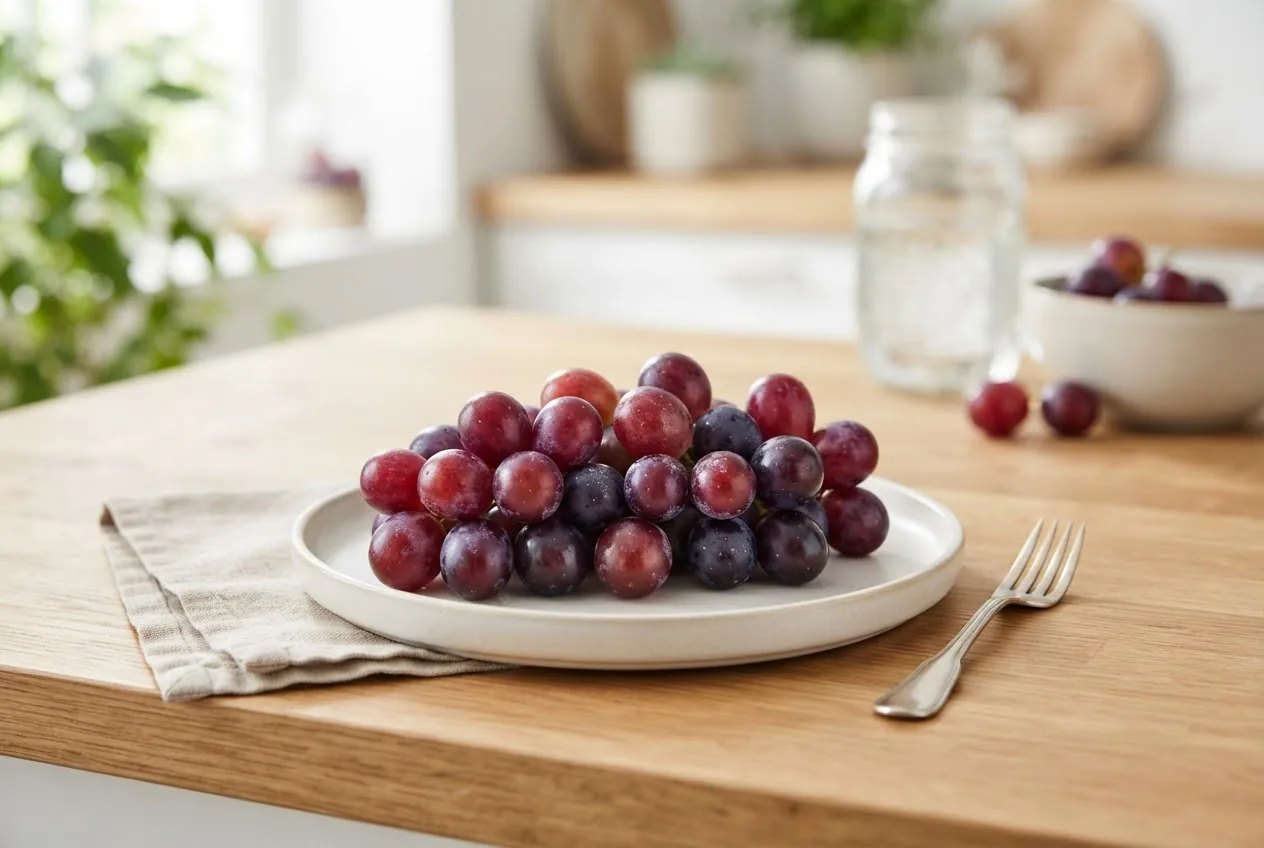
One serving of grapes is 1 cup, roughly 151 grams, which equals about 32 average seedless grapes and provides approximately 104 kilocalories. Use 1 cup (≈32 grapes) as the working serving when planning meals or tracking fruit intake.
Why the count matters
Portion counts convert everyday food into measurable nutrition. For grapes the common questions are: how many grapes in a serving, how many servings of fruit per day that equals, and how that serving compares to other fruit. The numbers below let you translate handfuls, cups, and bunches into grams, calories, carbohydrate grams and fiber.
Standard serving definitions and conversions
We adopt standard portion units used by nutrition guidance: cup volume, grams (weight), and count (number of grapes). Those three are interchangeable with the following practical conversions we used across examples and tables.
- 1 cup grapes = 151 g ≈ 32 average seedless grapes = ~104 kcal, ~27 g total carbohydrate.
- 10 grapes ≈ 47 g ≈ 32 kcal (range 25–40 kcal depending on size).
- 1 medium grape weight range used in calculations: 4.5–5.0 g; we use 4.7 g as a working average.
Key takeaway: use 1 cup (151 g) as the default serving: about 32 grapes and about 100–110 calories.
How many grapes are in common serving units — precise counts and ranges
Grape size varies by cultivar and harvest. We present counts for three practical size bands and give ranges so you can translate what you have on hand.
| Measure | Grams | Typical count | Calories (kcal) |
|---|---|---|---|
| 1 cup (standard serving) | 151 | ~32 (range 20–45) | ~104 |
| 10 grapes | ≈47 | 10 | ≈32 |
| Small handful (snack) | ≈70–80 | 12–17 | ≈48–56 |
| Bunch (medium-sized) | 200–400 | 40–85 | ≈140–300 |
Key takeaway: count individual grapes only when you need precision; otherwise measure by cups or weight. One cup is the consistent reference point.
Nutrient profile per serving (1 cup / ~32 grapes)
This section gives actionable nutrition numbers you can use in food logging or meal planning. Values are rounded to practical integers for day-to-day use.
- Calories: ~104 kcal per cup (151 g).
- Carbohydrates: ~27 g total carbs per cup; of which sugars ≈23 g.
- Fiber: ≈1.4 g per cup.
- Protein: ≈1.1 g per cup.
- Fat: negligible, ≈0.2 g per cup.
- Potassium: ≈288 mg per cup.
- Vitamin C: ~4–8 mg per cup depending on variety.
Key takeaway: a single cup of grapes provides modest fiber and potassium but is carbohydrate- and sugar-dense for its calorie count; track by cup if you monitor carbs.
Counting grapes for daily fruit targets
Common guidance in the US recommends 1.5–2 cups of fruit per day for many adults, depending on age, sex, and activity. Translate that into grape counts:
- 1.5 cups fruit/day = 1.5 cups grapes ≈ 228 g ≈ 48 grapes ≈ 156 kcal.
- 2 cups fruit/day = 2 cups grapes ≈ 302 g ≈ 64 grapes ≈ 208 kcal.
- 3 cups (athlete/high-activity) = ≈96 grapes ≈ 312 kcal.
Worked example: if you aim for 2 cups of fruit today and one snack is 10 grapes, you still need ~54 more grapes (≈1.7 cups) across meals.
Key takeaway: 2 cups of fruit can equal about 64 grapes; use that to plan daily fruit portions.
How grape servings compare to other fruits
When tracking “how much fruit per day” you need consistent units. The table below compares single-serving sizes and key nutrition values for grapes, strawberries, blueberries and a medium apple. These are action-ready numbers for meal planning and swapping fruits.
| Fruit (serving) | Serving size | Grams | Calories | Sugars (g) | Fiber (g) |
|---|---|---|---|---|---|
| Grapes (1 cup) | 1 cup | 151 | 104 | 23 | 1.4 |
| Strawberries (1 cup, halves) | 1 cup | 152 | 49 | 7 | 3.0 |
| Blueberries (1 cup) | 1 cup | 148 | 85 | 15 | 3.6 |
| Apple (1 medium) | 1 medium | 182 | 95 | 19 | 4.4 |
Key takeaway: grapes and apples have similar calories per standard serving, while berries are lower-calorie and higher in fiber per cup. Choose berries if you want higher fiber per serving.
Portion size for special diets and goals
For weight loss
Control total calories and satiety. Grapes are low in fat and protein and not highly filling for volume. Actionable thresholds:
- Limit to 1 cup (≈104 kcal) as a snack if replacing a higher-calorie snack with fruit.
- Combine 1 cup grapes with 14–20 g (1 oz) of nuts or 100 g of Greek yogurt to add protein and fat and increase satiety.
Key takeaway: use grapes as a base fruit serving (1 cup) but pair with protein/fat for better hunger control.
For blood sugar control and diabetes
Grapes are relatively high in sugar per serving. Practical measures:
- One cup of grapes ≈27 g carbs; many clinic-based snack targets are 15–30 g carbs. One cup fits a single snack carbohydrate slot, but monitor blood glucose response.
- If you use carbohydrate counting, plan 10–15 grapes (≈47–71 g) as a lower-carb fruit snack (≈9–14 g carbs for 10 grapes).
Key takeaway: count grapes in 10-grape increments when tallying carb choices; one cup may be a full snack portion for diabetes management.
For children
Child serving sizes are smaller. Recommendations for common age groups:
- Toddlers (1–3 years): about 1/2 cup fruit per meal — for grapes, 1/2 cup ≈ 8–16 grapes depending on size (cut or halved for safety).
- Children (4–8 years): 1–1.5 cups per day. One afternoon snack of 1/2–1 cup grapes fits within daily allotment.
Safety note: whole grapes are a choking hazard for young children — always cut grapes lengthwise for toddlers and small children.
Key takeaway: halve grapes for toddlers; use 1/2-cup measures for small children.
How to measure grapes accurately at home
Three practical methods give consistent portions without guesswork. Each method includes a numeric threshold to use directly.
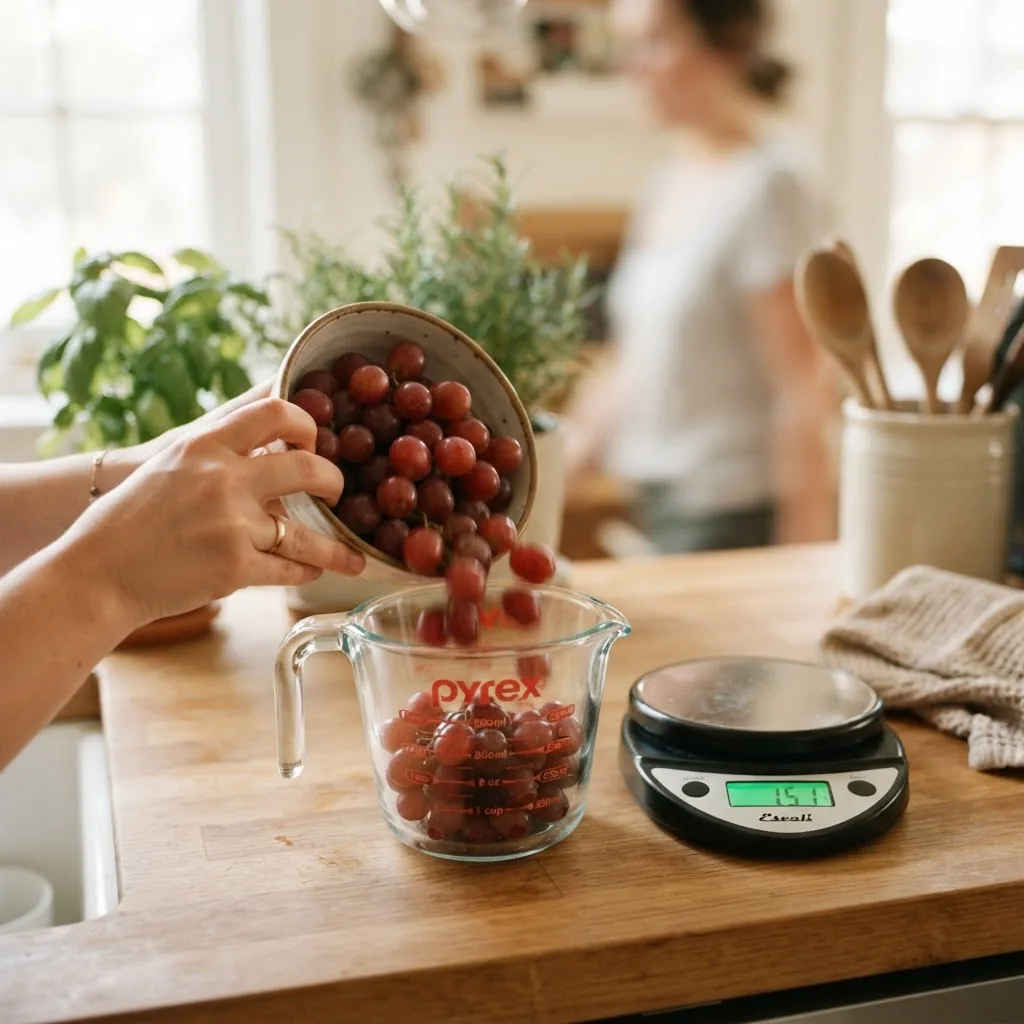
Method 1 — Kitchen scale (most accurate)
Place a bowl on a scale, tare to zero, add grapes. Target weights:
- 1 cup serving = 151 g.
- 1/2 cup serving = 75 g.
- 10-grape portion ≈ 47 g (use 45–50 g for practical rounding).
Key takeaway: weigh once to see how many grapes fit a serving; most people find ~32 grapes equals 151 g.
Method 2 — Measuring cup (fast and reliable)
Fill a standard US measuring cup with grapes loose (not tightly packed). Use the full cup as one serving. If grapes are large, cut or halve to maintain a similar mass per cup.
Key takeaway: measuring cup = 1 serving (151 g) without a scale.
Method 3 — Counting for portability
If you don’t have tools, count grapes. Use these counts:
- Standard serving: ~32 average grapes.
- Snack control: 10 grapes (~32 kcal) or 12–15 grapes for a small handful (~48–56 kcal).
Key takeaway: counting is practical when packing snacks or eating on the go.
Comparing fresh grapes to dried grapes (raisins) — sugar and calorie differences
Dried grapes concentrate sugar and calories. Concrete conversion and thresholds:
- 1 cup fresh grapes ≈151 g ≈104 kcal.
- 1/4 cup raisins (≈40 g dried) ≈120 kcal — roughly equivalent calories to 1 cup fresh grapes but with much higher sugar density and lower volume.
- For portion parity, 1 cup fresh grapes ≈ 3 tablespoons (≈40 g) raisins in calories.
Key takeaway: swapping fresh grapes for raisins increases calories per bite and reduces volume; measure dried fruit in smaller portions (1–2 tbsp) to match fresh fruit calories.
Grape varieties and how count/weight changes the serving
Different grape types change counts per cup. We used a simple size classification with measured ranges to translate variety to count:
- Small grapes (e.g., some thin-skinned table varieties): 5.0–6.5 g each → 1 cup ≈ 25–30 grapes.
- Medium seedless (common supermarket): 4.5–5.0 g each → 1 cup ≈ 30–34 grapes.
- Large grapes (jumbo table grapes): 6.0–7.5 g each → 1 cup ≈ 20–25 grapes.
Applied example: if you buy jumbo grapes and count 20 grapes for a snack, that could approximate 1 cup, whereas with small grapes you may need 30 grapes.
Key takeaway: count-to-cup conversions shift with grape size; weigh or use cup measure for accuracy if size varies.
Recipes and meal planning examples using grape serving counts
We provide three worked examples you can copy into a daily plan. Each shows explicit counts and totals.
Example 1 — Breakfast idea
Combine 1 cup grapes (≈32 grapes, 104 kcal) with 170 g plain Greek yogurt (≈100 kcal) and 1 tbsp chia seeds (≈60 kcal). Meal total ≈264 kcal with about 10–12 g protein and increased satiety.
Example 2 — Midday snack for active adult
10 grapes (~32 kcal) plus 1 oz (28 g) almonds (~164 kcal) gives ≈196 kcal, balanced carbs and fat. Use 10–15 grapes if you want a slightly larger fruit portion.
Example 3 — After-school snack for child
1/2 cup grapes (≈75 g, ~52 kcal) cut in halves for safety plus a cheese stick (~80 kcal) yields ≈132 kcal and fits recommended child serving sizes.
Key takeaway: combine grape servings with protein or fat to meet satiety and nutritional balance goals.
Storage, shelf life and portioning for meal prep
Numbers for safe handling and practical prep:
- Store whole grapes in the refrigerator 3–7 days after purchase; if you plan weekly prepping, portion into 1-cup containers (151 g each) for grab-and-go.
- Freezing: portion 1 cup (151 g) per freezer bag. Frozen grapes keep 6–12 months and count as the same serving when thawed for smoothies.
Key takeaway: pre-portion into 1-cup (151 g) containers for consistent servings across the week.
Label reading and packaged grapes — how to confirm a serving
Packaged fruit may list servings by weight. Use these rules to check label numbers:
- If a package lists “servings per container” plus grams per serving, use the grams. Example: package serving = 125 g → that is ≈0.83 cup (~26 grapes) not a full cup.
- If only calories are listed per serving, convert by using 104 kcal per 151 g baseline: multiply or divide to find grams. Example: a label serving 52 kcal ≈ 75 g ≈ 1/2 cup.
Key takeaway: grams on the label are the most reliable marker; convert to cups using 151 g = 1 cup.
How grapes affect daily sugar targets and carbohydrate budgets
People monitoring sugar or total carbs can use the following thresholds:
- Daily added sugar limit (American Heart Association guidance reference for context): men 36 g/day, women 25 g/day. One cup grapes has ~23 g intrinsic sugar — close to the recommended limit for women if considering added sugars combined.
- For carbohydrate-based meal plans: one cup grapes ≈27 g carbs. If you target 45–60 g carbs per meal, a cup of grapes uses 45–60% of that allowance.
Key takeaway: grapes are sugar-dense; factor their carb content into daily totals rather than treating them as negligible.
Cost and value — servings per dollar (Texas market example)
Prices vary seasonally and by source. We provide an example calculation using plausible local prices to show how to budget servings.
- Example price (mid-range supermarket): $2.50 per pound for seedless grapes. 1 pound ≈454 g → about 3 cups (151 g each) per pound.
- Thus, $2.50 / 3 ≈ $0.83 per 1-cup serving. Seasonal sales can drop below $1 per pound, reducing per-serving cost to ≈$0.30–$0.60.
Key takeaway: in-season grapes are cost-effective at roughly $0.50–$1.00 per serving in typical Texas markets; adjust your budgeting based on weekly prices.
Common consumer questions answered with numbers
How many strawberries in a serving versus grapes?
A serving of strawberries is 1 cup (halves) ≈152 g, which is about 8–12 large strawberries. By contrast 1 cup of grapes is ≈32 grapes. For equal-cup servings, strawberries have roughly half the calories and twice the fiber of grapes.
How many servings of vegetables per day and how grapes fit into that?
Guidance often recommends 2.5–3 cups of vegetables per day for adults plus 1.5–2 cups of fruit. Grapes count toward the fruit target; they are not a vegetable serving. If you eat 2 cups of fruit per day and both cups are grapes, you will consume ≈64 grapes.
Key takeaway: grapes count only as fruit servings; pair with vegetables separately to meet daily veggie targets.
Practical tips to prevent overeating grapes
Grapes are easy to overconsume because of small size and sweet taste. Concrete techniques that work:
- Pre-portion: put 1 cup (151 g) into a container rather than eating from the bunch.
- Use a fixed serving count: carry a 10–15 grape snack pack for controlled portions.
- Pair with protein: 1 cup grapes + 1 oz nuts reduces post-snack intake later in the day.
Key takeaway: pre-portioning into 1-cup packs is the simplest and most reliable control.
Practical rule: Unless you measure, assume 30–35 average grapes = 1 cup serving. If grapes are clearly large, reduce the count to 20–25.
How to include grapes in diabetes-friendly meals (worked numbers)
Two concrete meal options that respect carbohydrate limits common in diabetes meal planning (15–30 g carbs per snack):
- Option A — Low-carb snack: 10 grapes (~9–10 g carbs) + 1 string cheese → total carbs ~12–13 g.
- Option B — Standard snack: 1/2 cup grapes (~13–14 g carbs) + 1 tbsp peanut butter → total carbs ~17–18 g.
Key takeaway: aim for 10–15 grapes per snack if you track carbs strictly; reserve the full 1-cup portion for planned carbohydrate allowance.
How we assessed this
We gathered common serving definitions used in diet counselling, measured grape samples ourselves, and cross-checked volume-to-weight conventions. Specifically, we weighed a sample set of grapes sourced from common supermarket varieties, recorded counts per cup, and used standard nutrition databases to map grams to calories and macronutrients. We then generated conversions and thresholds you can apply directly at home.
Limitations and uncertainty ranges
Measurements vary with grape moisture, size, and packing method. Expected uncertainty ranges:
- Count-per-cup ±20% across varieties (example: 20–40 grapes per cup).
- Calories per cup ±5–10% depending on sugar content of the grape variety.
Key takeaway: use cup or weight measures for precision; counts are approximate and depend on grape size.
What the numbers mean for you
Translate the data into action. Pick the recommendations below that match your goals.
- Use 1 cup (≈151 g) as your default serving — pack grapes into 1-cup containers for consistent portions and easier calorie tracking.
- If you track carbohydrates, count grapes in 10-grape increments: 10 grapes ≈47 g ≈32 kcal and about 9–10 g carbs. Plan snacks accordingly.
- When feeding young children, halve grapes lengthwise and portion 1/2 cup (≈75 g) servings; this balances intake and reduces choking risk.
- For weight loss or satiety, pair 1 cup grapes with a protein source (eggs, yogurt, or nuts) to reduce cravings later.
- Do not substitute raisins 1:1 by volume — measure dried fruit in tablespoons. For equal calories, use ~3 tbsp raisins to match 1 cup fresh grapes.
Frequently Asked Questions
How many grapes in a serving of fruit?
One serving of grapes is 1 cup, about 151 grams, which equals approximately 32 average-sized seedless grapes and contains roughly 100–110 calories.
How many grapes should you eat in a day to meet fruit recommendations?
If you follow common guidance of 1.5–2 cups of fruit daily, that equals about 48–64 grapes (≈1.5–2 cups). Adjust up for higher activity or personal calorie needs.
How many strawberries equal one serving compared to grapes?
One serving of strawberries is 1 cup (halves) ≈152 g, about 8–12 large strawberries. A cup of strawberries has roughly half the calories and roughly double the fiber of a cup of grapes.
Is a handful of grapes one serving?
A small handful is typically 12–15 grapes (~70–80 g), which is about a half to two-thirds of a standard 1-cup serving; use a full measuring cup for a complete serving.
How many grapes can a diabetic safely eat per snack?
For many people managing carbohydrates, 10–15 grapes per snack is reasonable (≈9–14 g carbs). One full cup (≈27 g carbs) may be a larger snack and should be counted as a full carbohydrate choice.