

What you’ll finish with, how long it takes, and who this is for
By the end of this guide you’ll have a complete, personalised weight loss plan: an exact daily calorie target, macronutrient split, a 7-day custom meal plan (with grocery list and batch-cook timings), and a 30- to 90-day adjustment strategy you can follow and measure. Expect to invest 3–6 hours the first day (measurements, calculations, shopping, first batch cook), then 1–2 hours each week to plan and prep. This assumes basic kitchen skills, comfort with a smartphone or spreadsheet, and willingness to track food and weigh in weekly.
Before you start
- Digital kitchen scale (accurate to ±1 g) and measuring cups/spoons
- Smartphone with a food-tracking app or a spreadsheet (Google Sheets or Excel)
- Calculator (or use the spreadsheet formulas below)
- Basic pantry: olive oil, canned beans, rolled oats, brown rice, eggs, canned tomatoes
- Refrigerator with airtight containers and at least one 9×13″ baking dish
- Access to a thermometer and basic cookware (sheet pan, saucepan, skillet)
- Optional but recommended: body tape measure, blood pressure cuff, access to recent blood lipid results
- Paper or digital notebook to log weekly measurements and subjective notes
Overview: how this guide is structured
The central section is a numbered, hands-on step-by-step plan you will execute. Each step begins with an action-first phrase and includes numeric targets, worked examples, and templates you can copy. After the steps you’ll find common mistakes I’ve seen in practice, a final checklist, guidance on when to call a professional, and an FAQ.
Core step-by-step plan
-
Measure and record your starting metrics
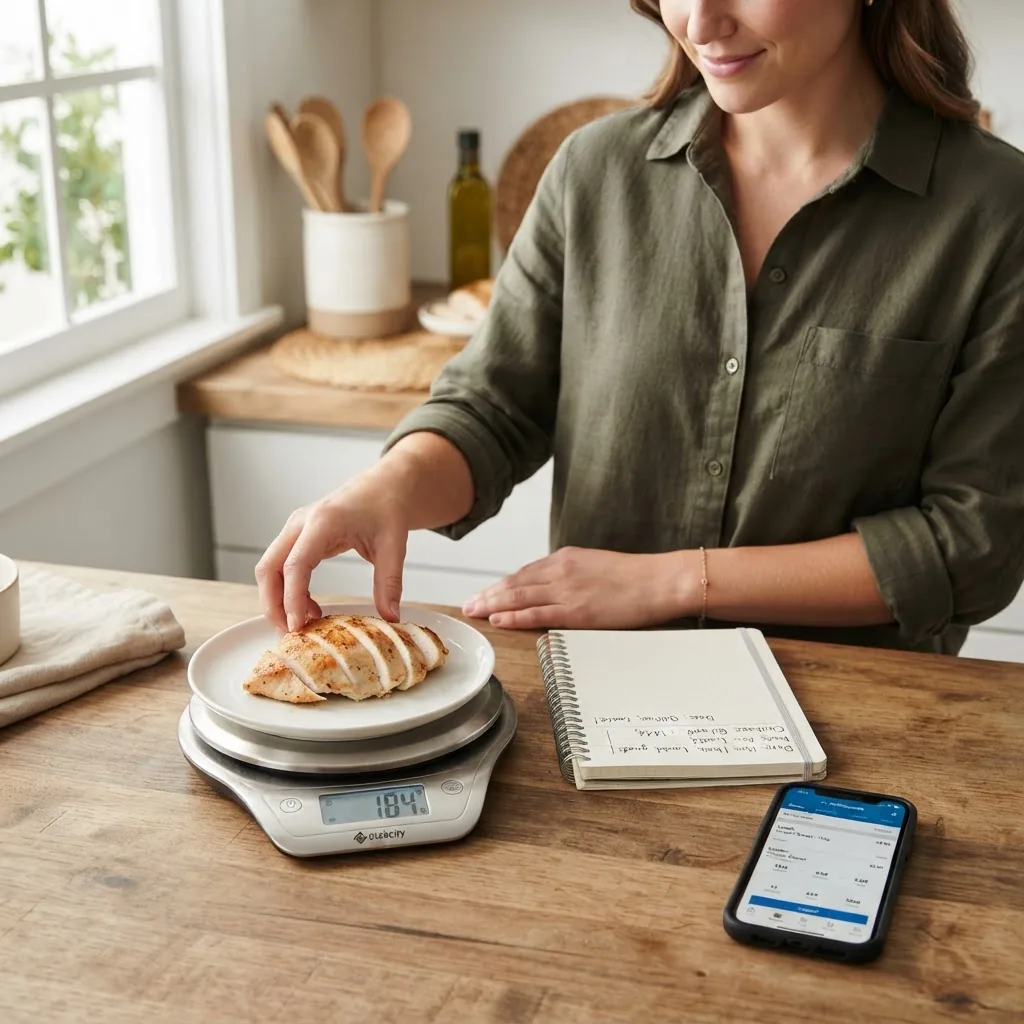
Action: weigh yourself (naked or in light clothing), measure height, waist circumference at the navel, and estimate body fat if you have calipers. Record age and sex. Do three weigh-ins the first morning and average them to reduce scale noise.
Exact items to record: body weight (kg and lb), height (cm and in), waist (cm), age (years), sex, current weekly exercise minutes (and type). Example entry for calculation: male, 35 y, 90 kg (198 lb), 180 cm (5’11”), moderate exercise 150 min/week.
Why: these numbers feed into your Basal Metabolic Rate (BMR) and Total Daily Energy Expenditure (TDEE) calculation below.
-
Calculate your BMR using Mifflin–St Jeor and compute TDEE
Action: compute BMR and multiply by activity factor. Use Mifflin–St Jeor:
For men: BMR = (10 × weight in kg) + (6.25 × height in cm) − (5 × age) + 5
For women: BMR = (10 × weight in kg) + (6.25 × height in cm) − (5 × age) − 161Activity multipliers (pick one):
- Sedentary (desk job, little to no exercise): ×1.2
- Lightly active (light exercise 1–3 days/week): ×1.375
- Moderately active (3–5 days/week moderate): ×1.55
- Very active (6–7 days/week hard training): ×1.725
- Extra active (hard daily training + labor job): ×1.9
Worked example: male, 35 y, 90 kg, 180 cm.
BMR = (10×90) + (6.25×180) − (5×35) + 5 = 900 + 1125 − 175 + 5 = 1855 kcal/day
If moderately active: TDEE = 1855 × 1.55 = 2875 kcal/daySave both numbers; you will set your deficit against TDEE.
-
Set a realistic calorie target and weight-loss rate
Action: choose a daily calorie deficit and projected weekly loss. Target 0.5–1.0 kg/week (1–2 lb/week) using a daily deficit of 500–1000 kcal. Do not go below 1,200 kcal/day for women or 1,500 kcal/day for men without medical supervision.
Use these rules:
- Moderate loss (safer, sustainable): 500 kcal/day deficit → ≈0.45 kg (1 lb)/week
- Aggressive short-term loss: 750–1,000 kcal/day deficit → 1.0–2.0 lb/week (only if starting TDEE > 2,500 and no medical contraindications)
Worked example continued: TDEE = 2,875 kcal. For 500 kcal deficit: target = 2,375 kcal/day. For faster loss (750 kcal): 2,125 kcal/day. I recommend starting at 2,375 kcal/day and re-evaluating after 3 weeks.
-
Choose macronutrient targets (protein, fat, carbs) with numeric targets
Action: set protein first, fat second, then fill remaining calories with carbs.
Recommended ranges:
- Protein: 1.6–2.4 g per kg bodyweight per day (use higher end if resistance training). For a 90 kg male: 1.8 g/kg → 162 g protein/day.
- Fat: 20–30% of calories (minimum ~20% to support hormones; for heart-healthy low-fat aim 20–25%).
- Carbs: remaining calories after protein and fat.
Convert to grams:
- Protein: 162 g × 4 kcal/g = 648 kcal
- Fat: if target 25% of 2,375 kcal = 594 kcal → 594/9 = 66 g fat
- Remaining calories for carbs = 2,375 − (648 + 594) = 1,133 kcal → carbs = 1,133/4 = 283 g carbs
Adjust: if aiming low-fat heart-healthy meal plan, drop fat to 20% (≈53 g) and increase carbs accordingly. If you prefer low-carb for satiety, lower carbs by 100–150 g and raise fat to keep calories stable—but for cardiac concerns, avoid high saturated fat (>7% of total calories).
-
Design 3 plate templates: breakfast, main meal, snack
Action: design repeatable meal templates that hit macros within ±5% per meal. Use a plate-based approach: protein portion, whole grains/starchy veg, non-starchy veg, and healthy fat measured.
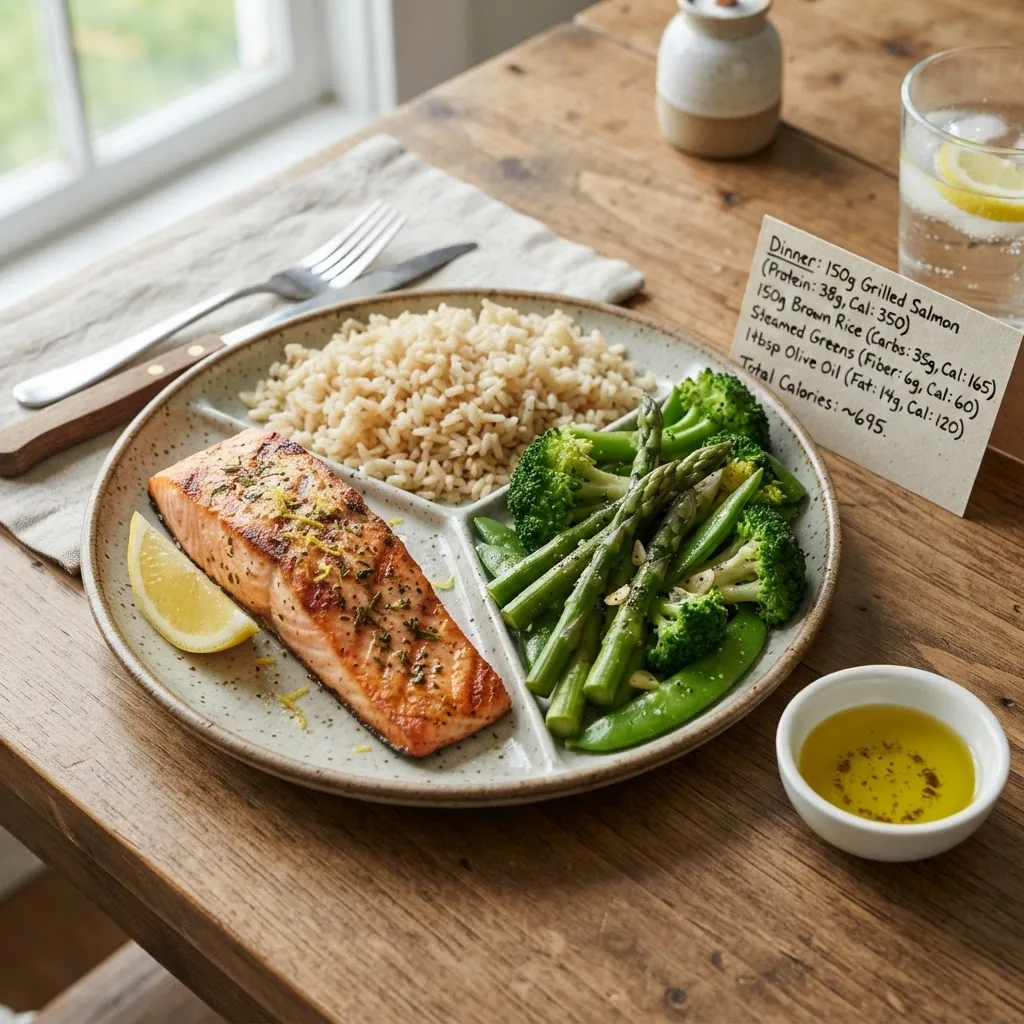
Template A — Moderate-calorie main meal (≈600 kcal): 150 g cooked lean protein (chicken/turkey/fish = ~35 g protein), 150 g cooked whole grain (brown rice or quinoa = ~45 g carbs), 200 g mixed non-starchy veg (broccoli/greens = ~10 g carbs, high fibre), 1 tbsp olive oil (9 g fat ≈ 120 kcal). Salt limit: add <0.25 tsp salt per meal to stay under 2,300 mg/day.
Template B — Breakfast (≈450 kcal): 60 g rolled oats cooked = 40 g carbs, 200 g plain Greek yogurt 0% = 20 g protein, 1 medium banana (100 g = 27 g carbs), 15 g chopped nuts = 9 g fat.
Template C — Snack (≈200–300 kcal): 1 medium apple + 30 g peanut butter (or 200 g cottage cheese for higher protein).
These templates scale: to reach daily targets, combine two mains, one breakfast, and two snacks or adjust portion sizes to match your calculated calories and macros.
-
Create a 7-day sample meal plan with exact portions and calories
Action: use the templates above to make a practical 7-day plan. Below is a one-person example for a 2,375 kcal/day target (adjust portion sizes proportionally if your target differs).
Day Breakfast Lunch Dinner Snacks Mon 60g oats + 200g 0% Greek yogurt + 1 banana — 470 kcal 150g turkey breast + 150g quinoa + salad — 620 kcal 150g baked cod + 200g sweet potato + veg — 560 kcal Apple + 30g almonds; 200g cottage cheese — 720 kcal Tue Smoothie: 40g oats, 200g berries, 1 scoop protein — 480 kcal Lentil salad 200g cooked lentils + veggies + 1 tbsp olive oil — 630 kcal 150g chicken breast + 150g brown rice + greens — 580 kcal Carrot sticks + 45g hummus; pear — 685 kcal Wed 2 eggs + 2 egg whites omelette + 2 slices wholegrain toast — 470 kcal Tuna salad (150g tuna in water drained) + 150g potato — 640 kcal Stir-fry: 150g shrimp + 200g mixed veg + 100g rice noodles — 560 kcal Greek yogurt + 20g walnuts; orange — 705 kcal Thu 60g muesli + 200g milk + 1 apple — 480 kcal Chicken wrap: 120g chicken + wholegrain wrap + salad — 620 kcal 150g turkey meatballs + 150g pasta + tomato sauce — 580 kcal Mixed berries + 30g dark chocolate; celery + peanut butter — 695 kcal Fri Smoothie bowl: 40g oats, 150g yogurt, banana — 470 kcal Grilled salmon 120g + 150g barley + salad — 650 kcal Veg curry: 200g chickpeas + 200g veg + 100g rice — 580 kcal Protein bar (store-bought 20g protein) + apple — 675 kcal Sat 2 eggs + avocado 50g + 1 slice toast — 480 kcal Quinoa bowl: 150g quinoa + 150g tofu + veg — 630 kcal Beef stir-fry 130g lean beef + veg + 150g rice — 590 kcal Greek yogurt + honey 1 tbsp; nuts — 675 kcal Sun 60g oats + berries + protein powder — 470 kcal Leftovers buffet (choose two mains, salad) — 700 kcal Roasted chicken 150g + roasted veg 300g + 1 tbsp olive oil — 540 kcal Banana + 30g almonds; carrot sticks + hummus — 665 kcal Notes: every day totals ≈2,350–2,425 kcal, protein ~160 g, fat 60–75 g (≈23–28% of calories), carbs fill remainder. Swap similar items to keep variety. If your target is lower/higher, scale all carbohydrate portions by ±10–20 g per 100–200 kcal difference.
Link your plan to the 7-day menu method for extra recipes: see 7-day diet menu to lose weight.
-
Build a one-person 7-day grocery list with quantities
Action: create a shopping list with exact quantities for one adult for 7 days for the sample menu above. Multiply by household size.
Proteins: chicken breast 1.4 kg, turkey breast 0.4 kg, salmon 0.24 kg, cod 0.15 kg, tuna cans (4 × 150 g drained), eggs 14, Greek yogurt 2.8 kg, cottage cheese 1 kg, tofu 400 g, lean beef 0.13 kg, shrimp 0.2 kg.
Grains & starches: rolled oats 500 g, quinoa 700 g (cooked weight ~150 g portions), brown rice 1 kg, pasta 400 g, barley 200 g, wholegrain wraps 4, bread 1 loaf.
Vegetables & fruit: mixed salad greens 700 g, broccoli 700 g, sweet potatoes 1.4 kg, potatoes 700 g, bananas 7, apples 7, mixed berries 1.4 kg, carrots 700 g, onions 500 g, canned tomatoes 2 × 400 g.
Fats & extras: olive oil 250 mL, peanut butter 250 g, almonds 200 g, walnuts 100 g, hummus 200 g, dark chocolate 100 g.
Pantry staples: canned chickpeas 3 × 400 g, lentils 500 g (or 3 cans), low-sodium broth 2 L, spices, salt & pepper.Use this list to shop once weekly and plan two 90-minute batch-cook sessions (Sunday evening and Wednesday) to split perishable items.
-
Set up your meal-tracking system and spreadsheet
Action: pick a tracker (free: MyFitnessPal, Cronometer) or build a single-sheet spreadsheet. Track at minimum: date, food, weight (morning), calories, protein, fat, carbs, sodium, and subjective notes (sleep, hunger).
Spreadsheet column headers (left to right): Date | Morning weight (kg) | Calories | Protein (g) | Fat (g) | Carbs (g) | Sodium (mg) | Steps | Notes. Add formulas:
- Total calories per day = SUM of meal calories (enter each meal row)
- Weekly average weight = AVERAGE(last 7 morning weights)
- Weekly weight change = current weekly average − previous weekly average
Tip: export weekly CSV from your food tracker and paste into the sheet to auto-populate macros if you prefer automation.
-
Batch cook and portion: efficient timings and safe storage
Action: schedule two batch-cook sessions: one 90–120 minute session on Sunday, one 45–60 minute midweek refresh. Key temperatures and storage durations:
- Oven roast chicken or vegetables at 200°C (400°F) for 25–35 minutes depending on size.
- Bake salmon fillets at 180°C (350°F) for 12–15 minutes per 150 g fillet.
- Cook brown rice in a saucepan: 1 part rice : 2 parts water, simmer 35–40 minutes.
- Safe refrigerated storage: fully cooled, airtight containers, 3–4 days; freeze up to 3 months (label with date).
- Thaw frozen meals overnight in refrigerator; reheat to internal temperature 74°C (165°F).
Portioning: use the kitchen scale to place cooked portions into containers by weight (e.g., 150 g cooked protein, 150 g cooked grain, 200 g veg). Label each container with meal name and calories using a permanent marker (e.g., “Chicken rice 610 kcal”).
-
Adjust for heart-healthy needs and low-fat options
Action: if you need a heart-healthy diet or low fat diet meal plan, follow these numeric rules: saturated fat <7% of total calories, sodium <2,300 mg/day (ideally <1,500 mg if diagnosed hypertension), soluble fibre ≥10–25 g/day (oats, beans), and daily oily fish 100–150 g twice weekly.
Practical swaps:
- Replace high-saturated fats (butter, fatty cuts) with olive oil (limit 1–2 tbsp/day) and use 0% dairy when possible.
- Choose skinless poultry and lean cuts (≤10% fat) and prepare by baking/grilling rather than frying.
- Use beans and lentils as protein sources 3–4 times/week to increase fibre and lower cost.
If you want printable cardiac diet menus or a 30-day heart healthy meal plan pdf, link the plan’s meals to the heart-healthy recipe list in this cluster: see Heart Healthy Foods Guide.
-
Implement daily routines for adherence and measurement
Action: set morning and evening micro-routines to support the plan:
- Morning: weigh immediately after waking, after voiding, before eating; record in sheet. Aim for same conditions each day.
- Pre-meal: photograph plate and log in the tracker before eating for accountability.
- Hydration: drink 2.5–3.0 L water/day (increase with exercise heat). Track liters in your app or spreadsheet.
- Sleep: aim for 7–8 hours; poor sleep increases hunger hormones—if you average under 6 hours for 3 nights, expect decreased adherence.
Visibility: place the weekly plan on your fridge and set two calendar reminders: Sunday night to plan and Wednesday PM to midweek adjust.
-
Monitor progress, troubleshoot plateaus, and re-calc TDEE every 4–6 weeks
Action: assess weekly weight averages. If no progress after 3 full weeks, follow this decision tree:
- Check tracking accuracy: weigh portions on the scale for the next 7 days; correct entries immediately if off by ±10%.
- Confirm steps and exercise: wear a pedometer for 7 days to ensure activity aligns with the activity multiplier used.
- If still plateaued, reduce calories by 5–10% (or add 150–300 kcal/week of additional structured activity). For a 2,375 kcal plan, a −5% change = −119 kcal → target 2,256 kcal.
- Reassess in 3 weeks; if weight loss resumes, maintain new target until stable for 4 weeks then recalculate TDEE using new weight and repeat.
Warning: if your daily calorie target drops below 1,200 kcal (women) or 1,500 kcal (men) during adjustments, stop further cuts and prioritize activity increase or slower expected rate of loss.
-
Troubleshoot common problems with numeric fixes
Action: apply these specific fixes when problems arise.
- Constant hunger: increase protein by 10–20 g at breakfast and add 100–150 g non-starchy veg to meals; try 20 g extra fibre (psyllium or oat bran) per day.
- Low energy during workouts: consume 20–30 g fast carbs 30–60 minutes pre-workout (banana or 30 g sports drink). If persistent, add 100–200 kcal in the pre- or post-workout meal.
- Constipation: increase water to 3 L/day and add 10–15 g soluble fibre (1/2 cup cooked oats daily). If symptoms persist >2 weeks, consult a clinician.
- Rapid weight loss (>1.5–2.0% bodyweight/week): increase calories by 100–200 kcal until loss slows to target range to protect lean mass.
-
Plan for social meals and eating out with numeric strategies
Action: decide in advance how you will handle one to two social meals per week:
- Strategy A (calorie bank): reduce planned non-social meal calories by 150–300 kcal that day to allocate to the restaurant meal.
- Strategy B (menu rules): pick grilled or baked protein ≤200 g, ask for sauces on the side, choose steamed veg instead of fries, and estimate calories using the app (±15% acceptable).
- Strategy C (split dessert): share one dessert to halve the calories.
Example: for a 2,375 kcal plan, if you expect a 900 kcal restaurant dinner, reduce breakfast by 200 kcal and afternoon snack by 200 kcal to stay within weekly energy balance.
-
Transition to maintenance: numeric reverse diet and long-term plan
Action: after reaching goal weight or when you decide to stop losing, increase intake gradually to maintenance to avoid regain. Use this ramp:
- Add 100–150 kcal per week for 4 weeks and monitor weight. If weight increases >0.5–1.0 kg in a week, pause increases and hold for two weeks.
- When stable within ±0.5 kg over two consecutive weeks, continue adding another 100–150 kcal/week until you reach an energy intake that maintains weight (this is new maintenance TDEE).
- Maintain protein at the same gram target used during loss to preserve lean mass (e.g., 1.6–1.8 g/kg).
Example: goal reached at 80 kg. Start at previous deficit intake 1,900 kcal; add 100 kcal/week: week 1 → 2,000 kcal; week 2 → 2,100 kcal. Monitor. Reach stable maintenance at ~2,350 kcal.
Common mistakes and how to avoid them
I once followed a “very low calorie” template and dropped to ~900 kcal/day; within three weeks I felt exhausted, my workouts tanked and I regained fat quickly after stopping. The numeric lesson: do not go below guideline minima (1,200 women, 1,500 men) and prioritize protein.
- I have seen people ignore actual portion weights and estimate — this regularly underreports calories by 15–30%. Fix: weigh three common items for a week until you internalize correct portions.
- I’ve watched users chase the scale daily and make knee-jerk cuts. Fix: use 7-day averages for weight and wait three weeks before changing calories unless you have a clear tracking error.
- Clients often reduce fat to <10% of calories and replace it with refined carbs; clinically that increases triglycerides for some. Fix: keep fat ≥20% and focus on unsaturated sources.
- People with high blood pressure skip the sodium guidance. I’ve seen BP rise when restaurant meals and packaged foods increase; enforce <2,300 mg/day and use low-sodium canned goods.
Final verification checklist
- You have recorded baseline metrics: weight, height, waist, activity level, age.
- BMR and TDEE are calculated and saved in your tracker or spreadsheet.
- Daily calorie target set with deficit 500–1,000 kcal and not below safety minima.
- Macronutrient targets set with protein 1.6–2.4 g/kg, fat 20–30% of calories, carbs filling remainder.
- 7-day meal plan with exact portion sizes and calorie sums created and grocery list prepared with quantities.
- Meal-prep schedule and two batch-cook sessions planned; containers labeled with calories.
- Tracking system is in place; you will record morning weights, weekly averages, and adjust after 3 weeks if needed.
- Sodium and saturated fat targets set if you require a heart-healthy diet (sodium <2,300 mg/day, sat fat <7% of calories for cardiac risk).
- Emergency plan: if energy, mood, or performance drops significantly, you have criteria to reverse or call a professional (see below).
When to call a professional
Call a registered dietitian, primary care physician, or cardiologist if any of the following apply:
- You have diagnosed heart disease, diabetes, kidney disease, or uncontrolled hypertension (BP consistently >140/90 mmHg) — do not start a major caloric deficit without a clinician’s input.
- You need to lose >20% of your bodyweight or have a BMI ≥40 — a tailored medical plan is safer.
- You are pregnant, breastfeeding, or planning pregnancy.
- You have a history of disordered eating or current severe psychological distress.
- Persistent symptoms: dizziness, fainting, marked fatigue, syncope, or severe constipation lasting >2 weeks on appropriate fluid/fiber changes.
For cardiac concerns, request these specific tests: fasting lipid profile (total cholesterol, LDL, HDL, triglycerides), blood pressure monitoring, and if indicated, an ECG. If you have elevated LDL or triglycerides that fail to respond after 8–12 weeks of a heart-healthy low-fat approach, seek specialist care.
Additional resources and internal links
For nutrient-dense plate building and balanced diet background, see the pillar page on a nutritionally complete approach: Nutritionally Complete Meal Guide with Balanced Diet Advice. For heart-specific recipes and cardic diet sample menus consult the Heart Healthy Foods Guide. If you want an actionable quick-start 7-day template, check the 7 Day Diet Menu to Lose Weight.
Practical worked example — full calculation and week 1 checklist
I’ll run one clear worked example so you can copy the math exactly. Client: female, 42 y, 80 kg (176 lb), 165 cm (5’5″), moderately active 150 min/week.
BMR = (10×80) + (6.25×165) − (5×42) − 161 = 800 + 1031.25 − 210 − 161 = 1,460.25 ≈ 1,460 kcal/day
TDEE (moderately active ×1.55) = 1,460 × 1.55 = 2,263 kcal/day
Goal: 0.5–1.0 kg/week → choose 500 kcal deficit → 1,763 kcal/day target.
Protein: 1.8 g/kg → 1.8 × 80 = 144 g → 576 kcal from protein.
Fat: 25% of intake → 0.25 × 1,763 = 441 kcal → 49 g fat.
Carbs: remaining calories = 1,763 − (576 + 441) = 746 kcal → 186 g carbs.
Week 1 checklist for this client (exact actions):
- Buy groceries using the scaled list for one person (see earlier list scaled to 80 kg woman’s portion sizes; reduce protein portions by ~10–20%).
- Batch cook Sunday: roast 800 g chicken, 600 g brown rice cooked, chop 1.2 kg mixed veg.
- Set spreadsheet columns and enter baseline weight and first three morning weigh-ins to average.
- Eat according to templates; weigh portions for every meal for seven days.
- Weigh and log morning weight every day; compute 7-day average on Day 8 and compare to baseline.
Simple printable templates to create your own PDF menus
Action: if you need printable PDFs, create two small sheets in your spreadsheet software: (A) weekly plan grid with meal names and portion weights; (B) grocery list with column for checked boxes. Export as PDF with page size A4 or Letter. Keep one printed copy on the fridge.
Include these fields on the printed weekly plan:
- Daily calories target (large at top), protein grams target, fat grams, carb grams
- Meal slots with exact gram portions (e.g., “Lunch: chicken 150g cooked, rice 150g cooked, veg 200g”)
- Hydration box: tick for each 500 mL up to 3 L
Optional: how to create a personalized nutrition plan for special goals
Action: adapt the structure numerically for these common goals:
- Fat loss + preserve muscle (resistance training): protein 2.0–2.4 g/kg, carbs timed around workouts (30–60 g pre-workout), fat 20–25% of calories.
- Lower LDL cholesterol: increase soluble fibre to 10–25 g/day, include 2 servings fatty fish per week, use nuts (30 g/day) and olive oil, sat fat <7% calories.
- Older adult (≥60 years): keep protein at 1.6–2.0 g/kg, include 6–8 g leucine-rich protein sources at each meal (e.g., 25–30 g of whey or 150–200 g dairy), and ensure 1,200 mg calcium/day and 800–1,000 IU vitamin D unless otherwise advised.
How to create a meal plan that is low-cost and practical
Action: use beans, canned fish, eggs, oats and seasonal veg as staples. Replace one fresh fish meal with canned tuna or mackerel twice weekly. Buy dry beans (500 g) and cook in bulk (yields ~1.2–1.4 kg cooked) — cost per cooked 150 g serving is lower than fresh meat.
Budget batch-cook schedule:
- Batch 1 (90 min): cook 1 kg rice, roast 1.5 kg mixed veg, grill 1 kg chicken, boil 12 eggs.
- Batch 2 (45 min midweek): re-cook small portion of grains, make a legume salad with canned chickpeas, refresh greens.
Measuring success beyond the scale: objective metrics
Action: track these objective markers monthly with numeric targets:
- Waist circumference: aim for a 2–3 cm reduction in 4–8 weeks depending on starting point.
- Performance: increase total weekly resistance training volume by 5–10% across 4 weeks (sets × reps × weight).
- Blood tests: for cardiac risk, check fasting lipids at baseline and after 12 weeks; expect improvements in triglycerides by 10–25% with consistent weight loss and lower saturated fat intake.
Closing practical tips from a senior practitioner
Keep things measurable: if you cannot weigh food at every meal, at least weigh one protein and one grain portion for 7 days, then eyeball similar plates the rest of the time. Keep protein consistent every day — that single rule preserves muscle and keeps hunger lower. Recalculate your plan when your weight changes by 4–5% from baseline.
Frequently Asked Questions
What is a personalised weight loss plan and how is it different from generic diets?
A personalised weight loss plan uses your exact metrics (age, sex, weight, height, activity) to calculate BMR/TDEE and creates a daily calorie and macro target. Unlike one-size-fits-all diets it prescribes precise gram targets, portion sizes, and an adjustment schedule based on measured progress.
How do I calculate my calorie needs for a lose weight online plan?
Calculate BMR with Mifflin–St Jeor, multiply by an activity factor (1.2–1.9) to get TDEE, then subtract 500–1,000 kcal for weight loss. Use a spreadsheet or food-tracking app to apply this online and track your daily intake and progress.
Can I follow a heart healthy meal plan while losing weight?
Yes. Use a low saturated fat approach (<7% of calories), keep sodium under 2,300 mg/day, increase soluble fibre, and prioritize lean proteins and oily fish. Set calorie deficit as usual, but choose heart-healthy swaps listed in step 8.
How long until I should see measurable weight loss on this plan?
Expect to see a measurable change in the 7-day rolling average within 2–3 weeks. Aim for 0.5–1.0 kg/week; if there is no change after three weeks, verify tracking and portion weights before altering calories.
What do I do if I hit a weight-loss plateau?
First check for tracking errors and activity mismatch. If accurate, reduce daily calories by 5–10% or add 150–300 kcal/week of extra activity. Reassess after 3 weeks; if loss resumes hold new target until stable.
Are there free tools I can use as a meal plan creator or meal plan maker?
Yes. Free food trackers and spreadsheets act as meal plan creators: record foods, set your calorie/macro goals, and export weekly logs as CSV. Use a simple Google Sheets template for full control and printing.