Yes — rice is high in carbohydrates: one cooked cup of most rice varieties contains roughly 40–55 grams of carbs, which supplies the majority of its calories. Choice of rice variety, cooking method and portion size determine how quickly those carbs raise blood glucose and their role in a balanced plate.
Carbohydrate: a macronutrient made of sugars, starches and fiber that provides energy; measured in grams on nutrition labels.
Is rice a carbohydrate food and what kinds of carbs does it contain?
Direct answer: Yes — rice is primarily a carbohydrate food composed mainly of starch (long glucose chains), with small amounts of naturally occurring sugars, fiber and resistant starch depending on variety and processing.
Rice’s carbohydrate portion is almost entirely starch, which breaks down into glucose during digestion and becomes available as energy. Different starch types—amylose and amylopectin—affect texture and digestion speed.
Starch: a plant polysaccharide made of glucose units used for energy storage; it’s the main carbohydrate in rice.
Key carbohydrate components in rice:
- Digestible starch (amylopectin and amylose) — the largest share of carbs and the main driver of blood glucose response.
- Resistant starch — a small portion in some rice that resists digestion and acts like fiber in the colon.
- Dietary fiber — modest in whole-grain rice (brown, wild); usually low in refined white rice.
- Simple sugars — negligible in most rice varieties.
How many carbs are in common rice types per serving?
Direct answer: Carb content varies by variety and state (cooked vs dry), but a standard cooked cup (about 158–200 g depending on type) generally provides 40–55 g of carbohydrates.
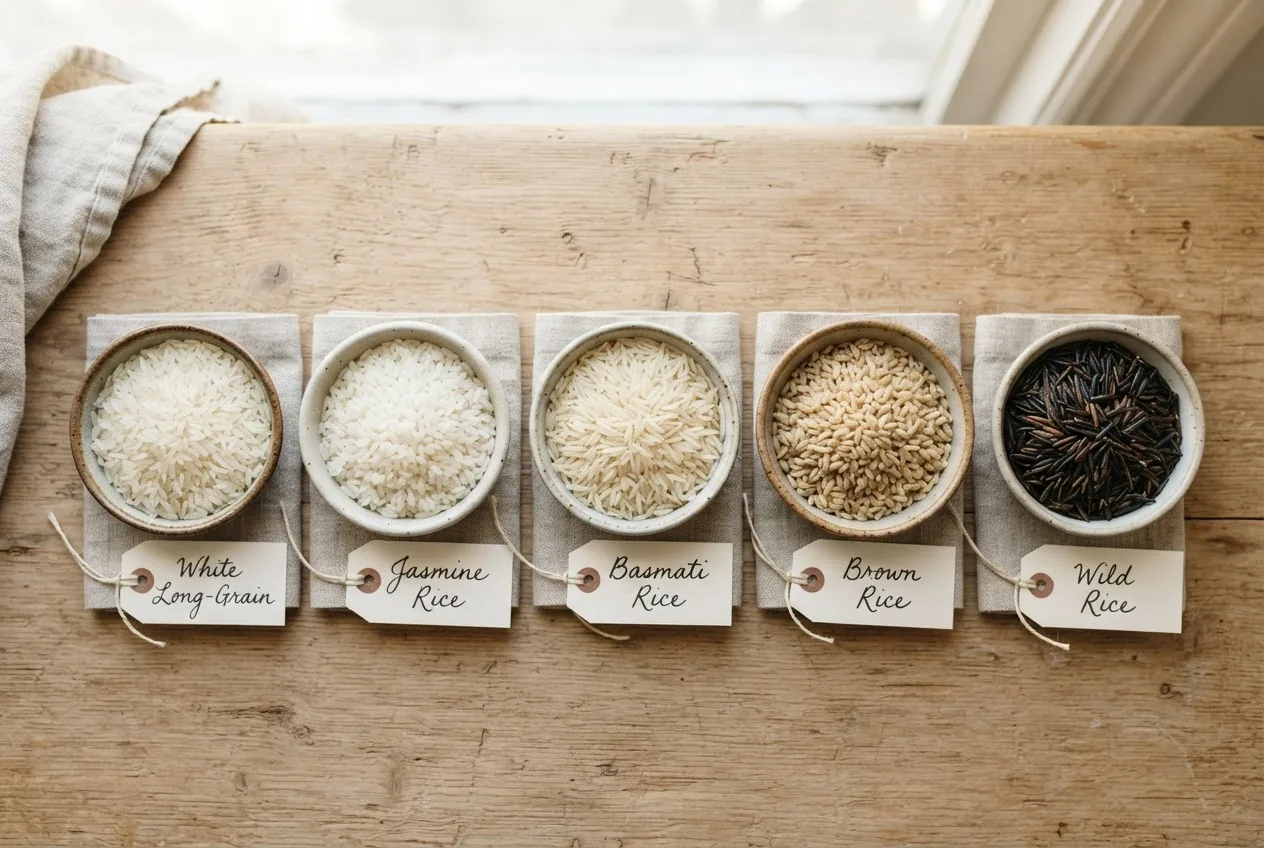
This table compares typical cooked and dry values per commonly eaten rice types; values are approximate averages used for meal planning and carb counting.
| Rice type | Cooked 1 cup (g) | Carbs (g) | Fiber (g) | Calories |
|---|---|---|---|---|
| White long-grain | 158 g | 45 g | 0.6 g | 205 kcal |
| Jasmine (white) | 140 g | 45–49 g | 0.4 g | 205–240 kcal |
| Basmati (white) | 200 g | 45–50 g | 0.5 g | 220 kcal |
| Brown (long-grain) | 195 g | 44–48 g | 3.5–4.5 g | 215–230 kcal |
| Wild rice (cooked) | 164 g | 35 g | 3 g | 166 kcal |
| Converted dry 1 cup (uncooked white rice) | 200 g | 150 g (approx.) | 1–2 g | ~715 kcal |
Notes: cooked volumes vary by rice type and water ratio; dry-to-cooked expansion multiplies carbs per cup when measured uncooked.
Does cooking rice change its carbohydrate content or glycemic effect?
Direct answer: Cooking doesn’t change the total carbohydrate mass in the rice grain, but it alters density, water content and starch structure, which affect carbs per serving and how quickly those carbs are digested.
Rice absorbs water while cooking, increasing weight and lowering carbs per gram of cooked rice compared with dry rice. For example, one cup dry rice contains far more carbs than one cup cooked because cooked rice includes added water weight.
Cooking temperature and duration change starch gelatinization (how starch swells and becomes digestible). Greater gelatinization typically increases immediate digestibility and raises glycemic response; gentler cooking that leaves more intact starch can slightly lower spike magnitude.
Gelatinization: the process by which starch granules absorb water and swell during heating, making them easier to digest.
What is the glycemic index (GI) of rice and which types have lower GI?
Direct answer: Rice GI ranges widely (low ~50 to very high ~90); basmati and brown rice usually have lower GI (~50–65) while short-grain white and jasmine rice often score higher (~68–90).
Glycemic Index (GI) ranks carbohydrate foods by their blood-glucose raising potential compared with glucose. A lower GI suggests slower glucose release; variety, amylose content, processing and cooking all shift GI values for rice.
Glycemic index: a scale (0–100) ranking carbohydrate foods by how much they raise blood glucose compared with pure glucose.
Glycemic load: an index that multiplies a food’s GI by its available carbs per serving and divides by 100 to estimate real-world blood sugar impact.
Typical GI examples:
- Basmati white: GI ~50–58 (lower due to higher amylose)
- Brown long-grain: GI ~50–65 (fiber and intact bran slow absorption)
- Short-grain white (sushi): GI ~70–90 (higher amylopectin content)
- Jasmine white: GI ~68–80 (sticky texture, high amylopectin)
How does rice affect blood sugar and insulin response?
Direct answer: Rice raises blood glucose proportional to digestible carbs and GI; larger portions and high-GI varieties cause faster, higher spikes in blood sugar and require more insulin to return levels to baseline.
The speed and magnitude of post-meal glucose rise depend on rice type, portion size and accompanying foods. A high-GI rice eaten alone spikes glucose quickly; the same portion paired with protein, fat and fiber slows absorption and reduces peak glucose.
Glycemic load (GL) is a practical way to predict impact: GL = (GI × available carbs per serving)/100. Example: 1 cup cooked jasmine (~48 g carbs) with GI 75 gives GL = (75×48)/100 ≈ 36, which is a high glycemic load for a single serving.
Is brown rice lower in carbs than white rice?
Direct answer: Brown rice typically has a similar total carbohydrate amount per cup as white rice but contains more fiber, micronutrients and intact bran, which slows digestion and lowers glycemic response.
Brown rice is a whole grain — the bran and germ remain intact — so fiber content is higher, usually 3–4 g per cooked cup versus ~0.5–1 g in white rice. That added fiber doesn’t markedly reduce total carbs but changes available carbs and slows glucose absorption.
Whole grain: a grain that contains the bran, germ and endosperm in its original proportions; it retains more fiber and micronutrients than refined grain.
Can you eat rice if you have diabetes or are on a low-carb diet?
Direct answer: Yes, with portion control, careful variety selection (lower GI), and pairing with fiber and protein; many people with diabetes can include rice but must count carbs and monitor glycemic response.
Practical strategies for diabetes or low‑carb plans:
- Limit portions: aim for ¼–½ cup cooked rice (about 10–25 g carbs) per meal as needed for blood sugar targets.
- Choose lower‑GI varieties: basmati or brown rice are preferable for slower absorption.
- Combine with protein, healthy fat and non-starchy vegetables to blunt spikes.
- Use GL to plan: keep meal GL lower by reducing rice quantity or GI.
- Monitor blood glucose to see individual response and adjust portions.
For stricter low-carb diets (e.g., <50 g carbs/day), rice often must be replaced or dramatically reduced because a single cup provides most of that allowance.
How do you measure and track rice carbs for accurate meal planning?
Direct answer: Track rice carbs by weighing uncooked rice or using consistent cooked portions, then use nutrition data (per 100 g or per cup) to calculate available carbs; use food scales and a carb-tracking app for precision.
Steps to track accurately:
- Decide whether to track dry or cooked — choose one and be consistent (dry measures are less variable).
- Weigh rice with a food scale: dry 1/4 cup uncooked white rice ≈ 45 g (≈36 g carbs when uncooked).
- Use a reliable food database or the product label to get grams of carbs per measured amount.
- Account for recipes: calculate carbs contributed by rice portion in total dish.
- Log carbs into an app and compare blood sugar responses if you’re monitoring glucose.
Worked example: A 1/3 cup dry white rice (≈60 g) cooks to ~1 cup and contains ~45 g carbs; if you eat half that cooked portion, you consumed ~22–23 g carbs.
Are there cooking methods that reduce rice’s carbohydrate impact?
Direct answer: Yes — cooking, cooling and reheating rice increases resistant starch content slightly, reducing immediate digestible carbs; pairing rice with acid, fat or protein and undercooking can also lower glycemic impact.
Evidence-backed tactics:
- Cook–cool–reheat: cooling cooked rice for 12–24 hours forms resistant starch; reheating does not fully reverse this change and reduces available carbs modestly.
- Higher amylose rice: choose varieties with higher amylose (basmati, some long-grain brown) as they form more resistant starch naturally.
- Pair with vinegar or lemon: adding acidic dressings to rice-based salads can lower GI modestly.
- Include fats and proteins: olive oil, avocado, beans or chicken slow gastric emptying and glucose absorption.
Resistant starch: a portion of starch that resists digestion in the small intestine and functions like fiber, feeding gut bacteria and lowering rapid glucose release.
Does rinsing rice remove carbs?
Direct answer: No — rinsing rice removes surface starch and dust but does not remove significant amounts of intrinsic carbohydrate; it may slightly reduce stickiness but not total carb grams.
Rinsing removes loose surface starch and small particles, which can reduce clumping and change texture; it does not meaningfully alter measured carbohydrate grams on nutrition labels because most carbs are inside the grain.
Are parboiled or converted rice different in carbs and nutrition?
Direct answer: Parboiled (converted) rice has similar total carbs to regular rice but often has slightly lower GI and better retained nutrients because the bran’s nutrients move into the endosperm during processing.
Parboiling partially cooks and dehydrates rice while it’s still in the hull, making the grain firmer and less sticky. That structural change typically raises amylose availability and can reduce GI; total carbohydrate content per cup remains comparable to other white rice types.
How does rice compare to other staples like pasta, potatoes and quinoa?
Direct answer: Rice has similar or slightly higher carbs per cooked cup than pasta or quinoa and generally higher carbs than non-starchy vegetables; quinoa and legumes provide more protein and fiber per cup, lowering net carb impact.
Comparison table (approximate cooked values per 1 cup):
| Food | Carbs (g) | Fiber (g) | Protein (g) |
|---|---|---|---|
| White rice (1 cup cooked) | 45 g | 0.6 g | 4 g |
| Brown rice (1 cup cooked) | 46 g | 3.5 g | 5 g |
| Quinoa (1 cup cooked) | 39 g | 5 g | 8 g |
| Pasta (enriched wheat, 1 cup cooked) | 41 g | 2.5 g | 8 g |
| Boiled potato (1 cup, diced) | 31 g | 3 g | 3 g |
Interpretation: quinoa and pasta often provide more protein and fiber per cup than white rice, reducing net carbohydrate impact per meal; potatoes vary with cooking and serving sizes.
What are low-carb substitutes for rice that retain texture and function?
Direct answer: Low-carb rice alternatives include cauliflower rice, shirataki rice (konjac), riced vegetables and small servings of high-fiber grains like cooked barley or bulgur mixed with vegetables for bulk.
Common substitutes with approximate carbs per cup:
- Cauliflower rice (1 cup cooked): ~5 g carbs, high water and fiber.
- Shirataki rice (konjac, 1 cup): ~1–3 g carbs (mostly fiber), near zero calories.
- Riced broccoli/carrot mixes (1 cup): ~6–10 g carbs depending on vegetables.
- Mixing small amounts of quinoa or barley with cauliflower increases texture but keeps carbs lower per serving.
How much rice is a serving and how should I portion for weight management?
Direct answer: A typical serving for most calorie-controlled plans is ½ cup cooked (≈22–27 g carbs); ¼ cup cooked (≈10–13 g carbs) is reasonable for strict carb targets.
Portion guidance by goal:
- General healthy eating: ⅔–1 cup cooked (30–50 g carbs) with vegetables and protein.
- Weight loss/moderate carbs: ½ cup cooked (≈20–25 g carbs) as a side.
- Low-carb (<50 g/day): avoid rice or limit to ¼ cup cooked per meal and balance other carbs.
- Athletic fueling: 1–1½ cups cooked before or after heavy training to replenish glycogen.
Always measure with a cup or preferably a scale. Many restaurant servings are 1.5–2 cups, which can double or triple planned carb intake.
Does rice have fiber and how much varies by type?
Direct answer: Yes — whole-grain rice like brown and wild rice contain measurable fiber (3–4.5 g per cooked cup), while refined white rice has minimal fiber (<1 g per cup).
Fiber in rice matters because it reduces the net digestible carbohydrate load and supports gut health. Net carbs can be estimated as total carbs minus fiber for purposes of digestive load, though glycemic response depends on more than net carbs alone.
Dietary fiber: indigestible plant carbohydrate that slows digestion, supports gut health and is counted separately from digestible carbs.
What is resistant starch in rice and why is it beneficial?
Direct answer: Resistant starch is the fraction of rice starch that resists digestion, acting like fiber; it increases with cooling and in high‑amylose varieties, and benefits gut bacteria and post-meal glucose control.
Benefits of resistant starch:
- Feeds beneficial colon bacteria, producing short-chain fatty acids (e.g., butyrate).
- Reduces postprandial glucose rise by lowering immediately digestible carbs.
- May support satiety and improved metabolic markers with regular intake.
How to increase resistant starch in rice: cook rice, cool it for 12–24 hours in the refrigerator (e.g., rice salads), then consume cold or gently reheated; this modestly lowers available carbs per serving.
Are there nutrient differences besides carbs between rice types?
Direct answer: Yes — whole-grain rice (brown, black, red) retains vitamins, minerals and healthy fats from the bran and germ, while refined white rice is lower in micronutrients unless enriched.
Typical nutrient contrasts:
- Brown rice: higher in magnesium, phosphorus, B vitamins and some antioxidants.
- Wild rice: higher protein and certain minerals; technically a grass seed, often richer in micronutrients.
- White rice (enriched): iron and select B vitamins may be added back after milling, but fiber remains low.
Choose whole-grain rice when you want more fiber and micronutrients; choose enriched white rice when texture or shelf life is the priority but balance with vegetables and protein to boost nutrition.
How does rice factor into cultural diets and serving sizes in Texas and the USA?
Direct answer: Rice is a common side dish in many Texan and American cuisines; restaurant portions in Texas typically exceed standard serving sizes, so expecting 1–2 cups per plate is realistic unless specified otherwise.
Practical notes for Texas diners:
- Tex‑Mex, Cajun/Creole, and Asian restaurants often serve rice in larger portions—ask for half or a small side to control carbs.
- Rice bowls and catered meals often include sauces that add carbs and calories—factor these into total carb counts.
- When ordering takeaway, request dressing on the side and add vegetables or beans to increase fiber and reduce relative carb density.
Does rice contain arsenic and does that affect how much you should eat?
Direct answer: Rice can contain low levels of inorganic arsenic absorbed from soil and water, which suggests varying rice sources and moderation in high-risk populations may be prudent rather than daily large servings.
Health agencies advise diversifying grains (e.g., alternating rice with quinoa, barley or wheat) to reduce chronic arsenic exposure. Rinsing and cooking rice in excess water (6:1 water to rice, draining excess) can lower arsenic content modestly.
How to read nutrition labels on rice and packaged rice mixes?
Direct answer: Read serving size, carbs per serving, fiber, and whether values are for cooked or uncooked rice; adjust serving to your measured portion and watch added sugars or sauces in mixes.
Label reading tips:
- Check whether serving size is dry or cooked—many packages list dry servings that expand when cooked.
- Subtract fiber to estimate net carbs if you use that metric for diet planning.
- Inspect ingredient lists for added sugars, oils or flavorings that increase carb and calorie content.
- Use the label to scale carbs proportionally to the portion you actually eat (weigh for accuracy).
How to reduce carbs in rice recipes without losing satisfaction?
Direct answer: Reduce rice quantity and bulk the dish with low-carb vegetables, legumes or riced cauliflower; mix rice with extra vegetables or use lower-carb rice alternatives to preserve texture and volume.
Recipe techniques:
- Mix 50/50: combine half rice with half riced cauliflower or finely chopped cauliflower for similar texture and fewer carbs.
- Bulking: add beans, lentils, mushrooms or zucchini to stretch flavor and volume while adding protein and fiber.
- Use herbs, spices and umami (mushrooms, soy, miso) to enhance satisfaction so you need less rice.
- Swap to konjac/shirataki rice in stir-fries and bowls for near-zero-carb base.
What are practical meal examples with carb counts using rice?
Direct answer: Example meals show how portioning and pairings alter carbs: ½ cup cooked white rice (≈22 g carbs) with 4 oz chicken and vegetables; 1 cup cooked brown rice (≈46 g carbs) in a grain bowl with beans and greens yields ~55–65 g total meal carbs depending on toppings.
Worked examples:
- Light lunch: ½ cup cooked basmati (22 g carbs) + 3 oz salmon + mixed greens = ~25–30 g total carbs.
- Grain bowl: 1 cup brown rice (46 g) + ½ cup black beans (20 g) + vegetables (8 g) = ~74 g carbs; split into two meals to lower per-meal carb load.
- Pre-workout: 1–1¼ cups white rice (45–55 g carbs) with lean protein for fast glycogen replenishment for endurance training.
How should athletes use rice for fueling and recovery?
Direct answer: Athletes commonly use rice for quick glycogen replenishment; white rice is effective pre- or post-exercise because of rapid digestion and high carbohydrate density, while brown rice offers slower-release energy for sustained activity.
Guidelines for athletes:
- Pre-competition: 1–2 g carbs/kg body weight in the 1–4 hours before heavy exercise; rice can provide a concentrated source.
- Post-exercise: 0.5–1.2 g carbs/kg within 30–60 minutes helps glycogen recovery; combine rice with protein (20–30 g) for muscle repair.
- Endurance athletes may need larger rice portions compared with recreational exercisers; tailor to training load.
Can reheating rice increase food safety risks and how to store cooked rice safely?
Direct answer: Yes — cooked rice can harbor Bacillus cereus spores; cool rice quickly, refrigerate within 1–2 hours, and reheat only once to steaming hot to minimize foodborne risk.
Safe rice storage steps:
- After cooking, spread rice thinly to cool faster or divide into shallow containers.
- Refrigerate within 1–2 hours and use within 3–4 days.
- Reheat to steaming hot (165°F/74°C) and discard leftovers not reheated promptly.
How often should you eat rice and how to include it in a balanced diet?
Direct answer: Eat rice in moderation within a varied diet — several small servings per week is typical; choose whole-grain rice more often, and rotate grains to optimize nutrients and reduce contaminant exposure.
Balanced-diet tips:
- Use rice as one component of a plate that includes vegetables, lean protein and healthy fats.
- Prioritize whole-grain varieties for fiber and micronutrients unless specific needs require refined rice.
- Diversify grains (quinoa, barley, millet) to broaden nutrient intake and reduce repetitive exposures like arsenic.
For more on whole grains and fiber choices, see our pillar guide Foods High in Whole Grains and Fiber and the rice‑specific exploration at Whole Grains Rice Guide.
How do rice mixes, sauces and restaurant dishes change carbohydrate totals?
Direct answer: Additions such as sugary sauces, breading, starchy vegetables and sweet condiments can significantly increase carbs—sometimes doubling carbs per serving—so inspect ingredient lists and portion sizes.
Watch for these carb add-ons:
- Sauces: sweet and thick sauces (teriyaki, sweet-and-sour) contain added sugars.
- Breading and tempura: add flour-based carbs on proteins and vegetables.
- Rice pilafs and fried rice: often include peas, carrots and added sauces, raising carb totals compared with plain steamed rice.
Tip: Ask for sauces on the side and request plain steamed rice or a smaller portion to control carbs in restaurant meals.
Are packaged “low-carb” rice products reliable and how to evaluate them?
Direct answer: Many packaged low-carb rice alternatives (konjac, fiber-enriched) lower carbs substantially, but check ingredient labels for added fillers, sodium or unexpected starches and verify net-carb claims by reading total carbs and fiber.
Evaluation checklist:
- Confirm total carbohydrate and fiber per serving; low-carb options should show very low available carbs.
- Look for minimal additives; high sodium or preservatives change health value.
- Test texture: some alternatives work well in certain dishes but not in all recipes.
How does the carb content of dry rice compare to cooked rice and why does this matter?
Direct answer: Dry rice has a much higher carb concentration by weight because cooking adds water; meal planning should be consistent in measuring either dry or cooked amounts to avoid miscounting carbs.
Example: 1 cup uncooked white rice (~200 g) can yield about 3 cups cooked and contains roughly 150 g carbs total; measuring 1 cup cooked is not the same as 1 cup uncooked, so always use the same basis when tracking carbs to avoid tripling or halving intake by mistake.
What research links rice intake to chronic disease risk and how should you interpret it?
Direct answer: Observational studies link high white rice intake with modestly increased type 2 diabetes risk in some populations; effect size depends on overall diet, activity, genetics and rice variety, and whole grains show protective associations.
Interpretation guidance:
- Associations from observational studies do not prove causation; they highlight patterns across populations with differing diets.
- Replacing refined white rice with whole grains and improving overall dietary pattern reduces long-term risk more than eliminating rice alone.
- Consider personal risk factors (family history, weight, activity) when sizing rice portions.
How can you practically reduce rice carbs on a weekly shopping list and meal plan?
Direct answer: Buy smaller bags of rice, add cauliflower and frozen vegetables to recipes, prepare pre-measured portions, and plan meals that use rice as an ingredient rather than the main component to control weekly carb totals.
Shopping and meal-planning checklist:
- Portion rice into single-use containers after cooking to prevent overeating.
- Stock low-carb substitutes: frozen cauliflower rice and shirataki products for quick swaps.
- Plan 2–3 rice-based meals per week instead of daily and rotate with other whole grains.
- Use recipe scaling to estimate carbs per serving and log in your meal-tracking tool.
For more on daily carbohydrate targets and individualized planning, consult our Daily Carb Intake Guide.
What are the top troubleshooting questions about rice and carbs?
Direct answer: Common issues include underestimating portions, mistaking dry for cooked serving sizes, not accounting for added sauces, and ignoring individual blood-glucose responses—each solved by measuring, reading labels and testing glucose when necessary.
Troubleshooting tips:
- Underestimated portions: weigh rice instead of eyeballing—use ½ cup cooked as a practical reference for side dishes.
- Restaurant surprises: ask for nutrition information or request a half-portion.
- Unexpected spikes: pair rice with protein and fiber and test your blood glucose 1–2 hours after eating to learn your response.
Where can I learn more about whole grains, fiber and managing carbs in context?
Direct answer: Use evidence-based resources and our cluster articles on whole grains, fiber and carb intake to build practical habits—start with the pillar page on whole grains and related posts in this cluster for in-depth guidance.
Recommended internal reading (relative URLs):
- Foods High in Whole Grains and Fiber: Healthy Eating Guide (pillar page)
- Whole Grains Rice Guide
- Daily Carb Intake Guide
- Beans a Carbohydrate? — for legume alternatives and fiber-rich swaps
Frequently Asked Questions
Is rice high in carbohydrates?
Yes: most cooked rice portions contain about 40–55 grams of carbohydrates per cup, so rice is considered a carbohydrate-rich food; portion size and rice variety determine its glycemic and dietary effects.
Does brown rice have fewer carbs than white rice?
No: brown rice has a similar total carbohydrate amount per cup but contains more fiber and micronutrients, which slow digestion and lower the glycemic response compared with white rice.
Can I eat rice on a low-carb diet?
Possibly: include very small portions (¼–½ cup cooked) or choose low-carb substitutes like cauliflower rice or shirataki products; strict low-carb plans often exclude typical rice servings because a single cup can contain most of the daily carb allowance.
Does cooking and cooling rice reduce carbs?
Cooking and cooling increases resistant starch modestly, reducing immediately digestible carbs and lowering glycemic impact somewhat, but total carbohydrate grams measured on labels do not change materially.
Which rice types have the lowest glycemic index?
Basmati and many long-grain brown rices generally have lower glycemic index values (≈50–65) compared with short-grain white and jasmine rices, which tend to be higher (≈68–90).
How should diabetics count rice carbs?
Weigh rice or use consistent cooked portions, use nutrition data to calculate grams of carbohydrates per serving, pair rice with protein/fiber and monitor blood glucose to adjust portions and timing to meet targets.
Are there safe ways to reduce arsenic in rice?
Yes: rinse rice, cook in excess water and drain, choose a variety of grains regularly, and buy rice from different sources; these steps lower arsenic exposure but do not eliminate it entirely.
What is a practical portion of rice for weight loss?
A practical portion for most weight-loss plans is ½ cup cooked (≈20–25 g carbs); combine it with large portions of vegetables and lean protein to increase satiety without excess calories.