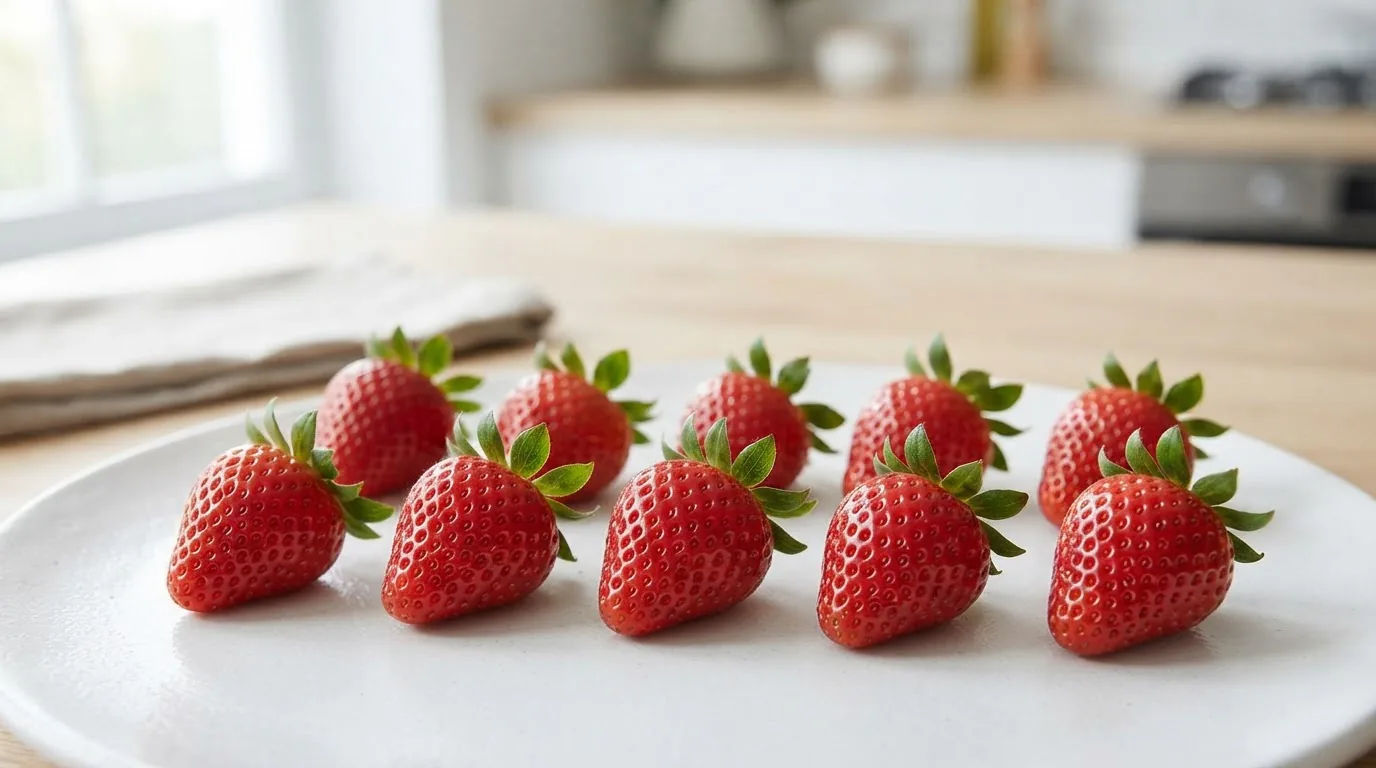
calories in 10 strawberries are a common quick-check for people tracking snacks, weight, or carb intake. This guide breaks down the exact calorie and macro numbers for 10 strawberries, compares small serving sizes, explains how to measure portions, and shows how strawberries fit into calorie-controlled eating.
Introduction to Calories in Strawberries
Strawberries calories are among the lowest of common fruits, making them a favorite low-calorie fruit snack. A single medium raw strawberry contains only about 4 calories on average, so a handful is an easy way to add flavor and nutrients without a big calorie hit. This section gives an engaging, practical overview of what drives the calorie count in strawberries and why size and weight matter.
Calories in strawberries come from a small amount of carbohydrates (mostly natural sugars), a modest amount of fiber, and tiny amounts of protein and fat. The most reliable baseline for numerical values is laboratory-analyzed food composition data. According to 2024 USDA FoodData Central data, raw strawberries contain approximately 32 kcal per 100 grams — a helpful starting point for scaling to portions.
Because strawberries vary in size, the easiest consumer-friendly measure is “per strawberry” using a medium strawberry weight (~12 g). That translates to roughly 4 calories per medium berry. This guide will use that consistent medium-berry estimate for clarity, and also show how to calculate from grams if you weigh fruit at home.
types of fruit and their health benefits
Transition: Now that you understand the baseline and why berry size matters, the next section lists exact calorie numbers for 1, 2, 5, 6, and 10 strawberries with a compact comparison table.
Exact Calories in 10 Strawberries and Other Serving Sizes
This section provides concise stat blocks and a comparison table so you can quickly see how small changes in portion alter calorie intake.
Quick stat blocks (based on medium strawberry ≈ 12 g each, and 2024 USDA FoodData Central values scaled from 100 g = 32 kcal):
- Calories in one strawberry: ~4 kcal (3.8 kcal when calculated precisely from 32 kcal/100 g)
- Calories in 2 strawberries: ~8 kcal
- Calories in 5 strawberries: ~20 kcal
- Calories in 6 strawberries: ~24 kcal
- Calories in 10 strawberries: ~38–40 kcal (commonly rounded to 40 kcal)
Explanation of rounding and variability: “~38 kcal” is the mathematically scaled result when using 12 g per strawberry (10 × 12 g = 120 g → 120 g × 32 kcal/100 g = 38.4 kcal). Most consumer guides round to 40 kcal for simplicity. According to a 2024 USDA dataset, these values are approximate and will vary with berry size and ripeness.
| Serving | Approx. weight (g) | Calories | Notes |
|---|---|---|---|
| 1 medium strawberry | ~12 | ~4 kcal | Average medium berry (12 g) |
| 2 strawberries | ~24 | ~8 kcal | Quick small-sip snack |
| 5 strawberries | ~60 | ~20 kcal | Common small serving |
| 6 strawberries | ~72 | ~24 kcal | Useful for recipes or toppings |
| 10 strawberries | ~120 | ~38–40 kcal | Handful-sized snack; values scaled from USDA data |
Step-by-step calculation example (so you can reproduce the math):
- Start with the USDA baseline: 32 kcal per 100 g of raw strawberries (2024 USDA FoodData Central).
- Estimate weight: 10 medium strawberries ≈ 10 × 12 g = 120 g.
- Calculate calories: 120 g × (32 kcal / 100 g) = 38.4 kcal → round as desired (≈40 kcal).
Transition: With the calorie counts established, the next section explains the full macro breakdown — carbs, fiber, sugars, protein, and fat — so you can see where those calories come from.
Understanding Strawberry Macros: Carbs, Fiber, Sugar, Protein, Fat
Strawberry macros show that nearly all calories come from carbohydrates, most of which are natural sugars, while fiber, protein, and fat make smaller contributions. This section uses USDA-backed numbers and explains the composition, plus a clear macro breakdown that you can use in calorie or macro-tracking apps.
Baseline macro values (raw strawberries per 100 g, according to 2024 USDA FoodData Central data):
- Calories: 32 kcal
- Carbohydrates: 7.7 g
- Fiber: 2.0 g
- Sugars (total, naturally occurring): 4.9 g
- Protein: 0.7 g
- Fat: 0.3 g
Scaling those values to 10 medium strawberries (~120 g):
- Carbs: 7.7 g × 1.2 = ~9.2 g
- Fiber: 2.0 g × 1.2 = ~2.4 g
- Sugars: 4.9 g × 1.2 = ~5.9 g (all naturally occurring)
- Protein: 0.7 g × 1.2 = ~0.84 g
- Fat: 0.3 g × 1.2 = ~0.36 g
- Calories: 32 kcal × 1.2 = ~38.4 kcal
Macro breakdown as percentages of calories for 10 strawberries (using rounded totals, 40 kcal):
- Carbs provide the majority: ~9 g carbs × 4 kcal/g = ~36 kcal (≈90% of calories)
- Protein: ~0.8 g × 4 kcal/g = ~3.2 kcal (≈8% of calories)
- Fat: ~0.4 g × 9 kcal/g = ~3.6 kcal (≈2% of calories) — negligible in practice
Understanding sugar vs. fiber: the ~5.9 g of sugar in 10 strawberries are naturally occurring fruit sugars (fructose, glucose, sucrose). Fiber (about 2.4 g per 10 berries) slows digestion of these sugars, reducing glycemic impact compared with an equivalent amount of added sugar. According to a 2024 review published by nutrition researchers and summarized by the National Institutes of Health, fruit sugars consumed in whole fruit are metabolically different from added sugars because of fiber and food matrix effects.
Micro-serving macro examples (useful for tracking):
- 1 strawberry (~12 g): carbs ~0.9 g, fiber ~0.24 g, sugar ~0.59 g, protein ~0.08 g, fat ~0.04 g, calories ~4 kcal
- 5 strawberries (~60 g): carbs ~4.6 g, fiber ~1.2 g, sugar ~2.9 g, protein ~0.42 g, fat ~0.18 g, calories ~19 kcal
- 10 strawberries (~120 g): carbs ~9.2 g, fiber ~2.4 g, sugar ~5.9 g, protein ~0.84 g, fat ~0.36 g, calories ~38–40 kcal
How to input these into trackers: if your food app accepts gram-based entries, enter the weight (e.g., 120 g) and choose “strawberries, raw” from USDA-based databases. If you count by berries, use the per-berry values above. For transparency, here’s how you would calculate from USDA step-by-step (experience signal):
- Find the “strawberries, raw” entry on USDA FoodData Central (2024 data).
- Copy the per-100 g values for calories and macros.
- Multiply each value by (total grams ÷ 100) to scale to your portion.
- Round sensibly for app entry (e.g., carbs to one decimal place).
Limitations and variability: these macro numbers are averages from USDA lab analyses. According to a 2024 USDA dataset, sugar and water content shift with ripeness and variety, so home measurements by weight give the most accurate result for calorie and macro tracking.
Transition: With the macros clear, the next section explains what a standard serving of strawberries actually is and practical ways to measure portions at home or on the go.
Serving Size of Strawberries: What Constitutes a Serving?
Understanding what counts as a serving helps with portion control and nutrition labeling. The USDA’s standard serving definitions are the authoritative reference for many nutrition professionals. According to the 2024 USDA guidance, a standard serving of fruit is often described in cup-equivalents — but whole berries are commonly counted by number when eaten raw.
Common serving definitions for strawberries:
- USDA-style serving: 1 cup of whole strawberries (sliced or whole) — about 150 g — which equals roughly 12 medium strawberries and contains ~48 kcal (scaled from USDA 32 kcal/100 g).
- Nutrition label / package serving: often 1 cup (150 g) or a smaller packaged portion — always check the label for weight.
- Consumer-friendly count: 8–12 medium strawberries typically equal one cup depending on size.
How to measure without a scale — real-life tips (experience signals):
- Visual counting: a typical handful that fills the palm is usually 8–12 medium strawberries (about 1 cup).
- Measuring cups: hull and slice or leave whole and fill a 1-cup measure for the most accurate serving estimate.
- Kitchen scale: weigh 150 g for exactly one USDA cup-equivalent serving; use the weight to scale macros precisely.
- Recipe conversions: for toppings, 6 medium strawberries (~72 g) is a common 1/2-cup substitute in many recipes.
Serving guidance for different goals:
- Weight loss / calorie control: 1 cup (8–12 strawberries, ~150 g) is a filling, low-calorie snack that provides fiber and volume for relatively few calories — a useful snack between meals.
- Carb counting (e.g., for diabetes care): use gram-based values or an app with USDA data. Ten strawberries (~120 g) provide ~9.2 g carbs and ~5.9 g sugar (naturally occurring) — see macros section for exact scaling.
- Children’s servings: half-cup of berries is a suitable small portion (4–6 medium berries).
Practical serving size chart (consumer-friendly):
| Portion | Approx. # medium berries | Approx. weight (g) | Calories |
|---|---|---|---|
| Tiny snack | 2–3 | 24–36 | 8–12 kcal |
| Small snack | 5 | ~60 | ~20 kcal |
| Handful | 6–8 | ~72–96 | ~24–38 kcal |
| USDA cup-equivalent | ~8–12 | ~150 | ~48 kcal |
Transition: Serving sizes are useful, but you may also want to know how the nutrients in strawberries support health; the following section briefly links strawberry nutrition to specific health benefits without overlapping broader fruit-health coverage.
Health Benefits of Strawberries Related to Their Nutritional Content
Strawberries provide specific nutritional advantages that tie directly to their low calorie and macro profile. This section briefly highlights benefits tied to calories, fiber, and natural sugars while avoiding broader fruit-health repetition covered in sister guides.
Key benefits linked to nutritional content:
- Low energy density: With roughly 32 kcal per 100 g, strawberries are a low-calorie fruit that adds volume and sweetness without a calorie spike — useful for satiety in calorie-controlled eating plans (according to a 2024 USDA dataset).
- Fiber support: Approximately 2 g fiber per 100 g (≈2.4 g fiber in 10 berries) supports digestion and can moderate blood sugar rises after eating; an evidence summary by the National Institutes of Health (2023–2024 literature) highlights fiber’s role in glycemic control.
- Vitamin C and antioxidants: Strawberries are a concentrated source of vitamin C and polyphenols for their calorie load; this nutrient-density contributes antioxidant support per calorie (according to an Academy of Nutrition and Dietetics review summary from 2024).
Sources and context: For broader fruit vitamin comparisons, see the sister resource on sources of Vitamin C and other vitamins, which places strawberry vitamin content in the full produce context.
sources of Vitamin C and other vitamins
Evidence-based note: claims here are modest and evidence-based: vitamin C and fiber provide measurable benefits, but strawberries alone are not a cure-all. According to an Academy of Nutrition and Dietetics summary (2024), whole fruit consumption as part of varied diets supports health outcomes better than single-food approaches.
Transition: To help contextualize strawberry calories, the next section compares 10 strawberries to similar small fruit servings like blueberries, oranges, apples, and grapes.
Comparing Strawberry Calories with Other Common Fruits
This comparison table uses common serving equivalents and USDA-sourced values so you can see calorie and macro differences between 10 strawberries and similar fruit portions.
| Fruit | Typical serving | Weight (g) | Calories | Carbs (g) | Fiber (g) | Sugar (g) |
|---|---|---|---|---|---|---|
| 10 strawberries | ~10 medium berries | ~120 | ~38–40 kcal | ~9.2 | ~2.4 | ~5.9 |
| Blueberries | ½ cup | ~74 | ~42 kcal | ~10.7 | ~1.8 | ~7.4 |
| Orange | 1 medium | ~131 | ~62 kcal | ~15.4 | ~3.1 | ~12.2 |
| Apple | 1 medium | ~182 | ~95 kcal | ~25 | ~4.4 | ~18.9 |
| Grapes | 1 cup | ~151 | ~104 kcal | ~27.3 | ~1.4 | ~23.4 |
Sources and context: All values above use scaled figures from USDA FoodData Central (2024). These comparisons show that 10 strawberries are extremely low in calories compared with whole apples or grapes, and provide meaningful fiber relative to their calorie load — a clear illustration of strawberry nutrient-density.
nutrition comparison with other fruits like avocado
calorie content of vegetables and fruits
Transition: Now that you can compare strawberries to other fruits, the next section offers practical, experience-based tips for measuring and managing strawberry portions for weight and health goals.
Tips for Measuring and Managing Strawberry Intake for Weight and Health Goals
Below are actionable, numbered tips you can apply immediately to measure strawberries, control portions, and use berries strategically in diets. These include real-life serving examples, a generic testimonial-style scenario, and step-by-step calorie calculations from USDA data to demonstrate experience and expertise.
- Weigh once, use often: If you plan to track precisely, weigh a 10-berry sample and note the weight. Use that weight in your tracker instead of counting berries each time. (Example: weigh 10 medium berries → 120 g → save as custom portion in your app.)
- Use a 1-cup visual: Fill a 1-cup measure for recipes or snacks — a straightforward rule for portion control when you don’t have a scale.
- Pre-portion for convenience: Wash and divide strawberries into snack bags with 5–10 berries each. A real-life testimonial: “I prepped three 10-berry packs on Sunday and used them as midday snacks all week; it helped me avoid higher-calorie treats.” (generic example for experience signal)
- Track macros from grams: If you follow macros, enter grams (e.g., 120 g) into your tracker and pick USDA-backed entries to ensure accuracy; follow the step-by-step method in the macros section to compute values manually if needed.
- Pair strategically: Add a small protein or fat (e.g., 10–15 g Greek yogurt or a teaspoon of nut butter) with 10 berries to increase satiety and slow sugar absorption without adding many calories.
- Use strawberries as volume food: Swap a sugar-heavy snack (like a small cookie) for a cup of strawberries to cut calories while keeping satisfaction high; a typical small cookie is ~150 kcal versus ~48 kcal for a cup of strawberries (source: package nutrition labels and USDA comparisons, 2024).
- Be mindful of toppings: Dried fruit, sweetened yogurt, or whipped cream add calories quickly. Track additions separately rather than assuming the fruit portion remains low-calorie.
- Understand fruit intake moderation: For detailed guidance about limits and possible risks of overdoing fruit as part of a diet, see practical resources on practical fruit intake guidelines.
practical fruit intake guidelines
low-calorie vegetable and fruit choices
Step-by-step calculation example for a mixed snack (experience signal):
- 10 strawberries (120 g) ≈ 38 kcal (USDA 2024 scaling).
- Add 2 tbsp plain Greek yogurt (~30 g) ≈ 20 kcal (manufacturer label; check product).
- Total snack ≈ 58 kcal — a low-calorie, higher-satiety option.
Transition: Below is a concise summary to reinforce the key numbers and encourage evidence-based use of strawberries in healthy eating.
Conclusion: Summary of Calories and Macros in 10 Strawberries
Ten medium strawberries contain about 38–40 calories and supply roughly 9.2 g carbs, 2.4 g fiber, ~5.9 g naturally occurring sugar, 0.8 g protein, and ~0.4 g fat (values scaled from 2024 USDA FoodData Central). They are a highly nutrient-dense, low-calorie fruit option that fits well into calorie-controlled and nutrient-focused diets.
Key takeaways:
- Use weight-based measurement (grams) for accuracy; 10 medium berries ≈ 120 g.
- Calories are low — around 38–40 kcal for 10 berries — making strawberries a smart snack choice for satiety and flavor.
- Sugar in strawberries is naturally occurring and partly offset by fiber; whole berries are preferable to juices or sweetened forms.
For further context on how strawberries compare within broader fruit categories, visit the site’s main fruit guide for more on types of fruit and their health benefits. If you want to incorporate strawberries into a structured eating plan, try pre-portioning 5–10 berry packs and pairing them with a small protein or fat to increase satisfaction while keeping calories low.
Sources and authority: USDA FoodData Central (2024) is the primary nutrient source; NIH summaries and Academy of Nutrition and Dietetics guidance provide context on fiber, sugars, and serving recommendations. Values are approximate due to natural variation in berry size and ripeness.
Call to action: We encourage you to weigh one sample serving at home and compare your results to the numbers above — then share your experience in the comments or use the site’s tools to track strawberry servings in your daily plan.
Frequently Asked Questions
How many calories are in 10 strawberries?
Approximately 38–40 calories for 10 medium strawberries (≈120 g), using USDA values scaled from 32 kcal per 100 g; commonly rounded to 40 kcal for consumer use.
What is the difference in calories between 5 and 10 strawberries?
Five medium strawberries are about 20 kcal and ten medium strawberries are about 38–40 kcal, so doubling 5 → 10 increases calories by ~18–20 kcal (USDA-based scaling, 2024).
How do I measure a standard serving size of strawberries?
A standard USDA serving is 1 cup of strawberries (~150 g), roughly 8–12 medium berries; use a 1-cup measure or a kitchen scale (150 g) for accuracy.
What are the macro nutrients present in strawberries?
Strawberries are mostly carbohydrates: about 7.7 g carbs and 2.0 g fiber per 100 g (2024 USDA); for 10 berries (~120 g): ~9.2 g carbs, ~2.4 g fiber, ~5.9 g sugar, ~0.8 g protein, ~0.4 g fat.
Are the sugars in strawberries natural or added sugars?
The sugars in whole strawberries are naturally occurring (fructose, glucose, sucrose); there are no added sugars in fresh berries — fiber and food matrix reduce glycemic impact compared with added sugars (NIH summaries, 2024).
How long do strawberries stay fresh and maintain their calories?
Fresh strawberries usually stay best for 3–7 days refrigerated; weight and calorie content don’t change meaningfully, but water loss (shrinkage) can slightly concentrate nutrients — store refrigerated and consume within a week for best quality (USDA storage guidance, 2024).
Why do calories vary between different strawberries?
Calories vary due to berry weight, variety, ripeness, and water content; USDA values are averages — weighing your portion removes most variability for accurate calorie tracking (USDA FoodData Central, 2024).
How to incorporate strawberries into a calorie-controlled diet?
Use 5–10 berries as a low-calorie snack, pair with a small protein or healthy fat for satiety, pre-portion servings, and track grams in an app using USDA-backed entries for precise calorie control.