lettuce nutrition content matters more than many people expect: it determines how you count calories, plan portions, and choose greens for specific nutrients. This detailed guide breaks down calories, serving sizes, protein amounts, vitamins and minerals, and where lettuce fits in a balanced diet.
What is Lettuce? Botanical and Culinary Overview
Lettuce (Lactuca sativa) is a cool-season leafy plant grown worldwide for its tender leaves and crispy texture. Botanically, it belongs to the Asteraceae family and is grown from seed into heading or loose-leaf forms; culinarily, it’s treated as a vegetable because its edible part is a leaf rather than a fruiting structure. When discussing classification and practical use, it helps to separate botanical definitions from culinary ones: botanically a plant species with edible leaves, and culinarily grouped with leafy vegetables used raw or lightly cooked in salads, wraps, and garnishes.
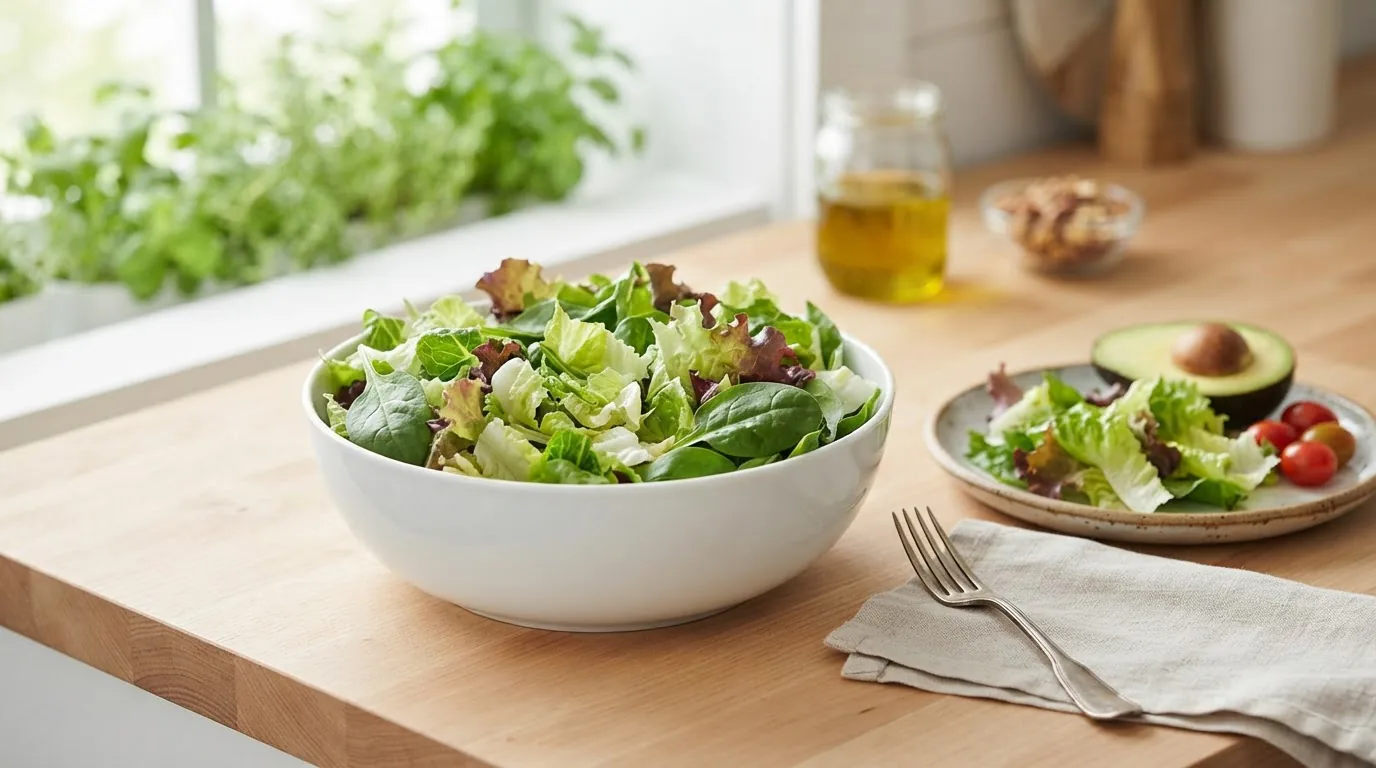
Common types include romaine (cos), crisphead (iceberg), butterhead (Boston/Bibb), and loose-leaf varieties (green leaf and red leaf). Each type varies in texture, water content, and—importantly—nutrient density. Romaine, for example, tends to be higher in vitamins A and K than iceberg, which is prized mainly for crunch and water density.
Gardeners often seed lettuce in early spring or late summer for cool-weather harvests; it’s a staple in household and commercial vegetable production because it matures quickly and tolerates partial shade. For tips on growing timing and requirements, see spring vegetables planting guide.
Lettuce is typically categorized under vegetable subgroups used in dietary guidance (leafy greens subgroup), which helps consumers meet vegetable subgroup recommendations. For an overview of how lettuce fits into the broader vegetable taxonomy, check vegetable subgroups explained, and for how lettuce contributes to general produce benefits see fresh fruits and vegetables benefits.
Transition: With a basic botanical and culinary perspective established, next we’ll break down the precise nutrient profile that defines lettuce’s dietary value.
Lettuce Nutrition Content Breakdown
Below is a concise nutrition chart for representative lettuce types (values rounded). These derive from the USDA FoodData Central nutrient profiles and are cited with dates for clarity. Nutrition values can vary by variety, growing conditions, and freshness—see the disclaimer at the end of this section.
| Nutrient (raw) | Romaine, per 100 g | Iceberg, per 100 g | Green leaf, per 100 g |
|---|---|---|---|
| Calories (kcal) | 17 | 14 | 15 |
| Water (%) | 95 | 95 | 95 |
| Protein (g) | 1.2 | 0.9 | 1.1 |
| Total carbs (g) | 3.3 | 3.0 | 2.9 |
| Dietary fiber (g) | 2.1 | 1.2 | 1.8 |
| Total fat (g) | 0.3 | 0.1 | 0.2 |
| Vitamin A (µg RAE) | 435 (≈7,700 IU) | 37 (≈615 IU) | 260 (≈4,600 IU) |
| Vitamin K (µg) | 102 | 24 | 86 |
| Folate (µg) | 136 | 28 | 71 |
| Vitamin C (mg) | 4.0 | 2.8 | 9.0 |
| Iron (mg) | 0.97 | 0.41 | 0.66 |
| Calcium (mg) | 33 | 18 | 36 |
Data source: According to the USDA FoodData Central (2025) nutrient database, typical raw values per 100 g for common lettuce types are shown above; values are rounded for clarity. For full entries consult USDA FoodData Central.
Explanatory notes:
- Calorie density: Lettuce is very low in calories because of its high water content—roughly 90–95% water by weight—making it a low-energy-density food useful for volume eating.
- Macronutrients: Lettuce provides minimal protein and fat. Most energy comes from small amounts of carbohydrates and fiber.
- Micronutrients: Leafier, darker varieties like romaine and green leaf deliver notably higher vitamins A, K, and folate than pale varieties like iceberg. For deeper context on vitamin sources see sources of vitamin A and K and nutritional benefits of green vegetables.
- Variability: Nutrient content varies by variety, soil fertility, harvest time, and storage. According to a 2024 agricultural survey, vitamin levels can vary by up to 30% between farms due to soil and postharvest handling (2024 industry survey).
Practical takeaway: If you want nutrients per bite, choose darker-leaf lettuces (romaine, green leaf) over iceberg. If your priority is bulk with minimal calories—such as filling a plate without many calories—iceberg remains useful.
Transition: Next we’ll convert these numbers into commonly used serving sizes and compare calories and portions with carrots and other typical vegetables so you can visualize portion planning.
Lettuce Serving Size Guide and Calorie Count
Understanding serving size is crucial for tracking calories and meeting dietary goals. Below is a practical serving-size table for lettuce and a side-by-side comparison with carrots and other common vegetables for portion context.
| Item | Typical Serving | Weight (g) | Calories | Protein (g) |
|---|---|---|---|---|
| Romaine, raw (1 cup, shredded) | 1 cup | 47 | 8 | 0.6 |
| Iceberg, raw (1 cup, shredded) | 1 cup | 72 | 10 | 0.6 |
| Green leaf, raw (1 cup) | 1 cup | 55 | 9 | 0.6 |
| Carrot, raw (1 medium) | 1 medium | 61 | 25 | 0.6 |
| Cooked spinach (1 cup) | 1 cup | 180 | 41 | 5.3 |
| Broccoli, raw (1 cup, chopped) | 1 cup | 91 | 31 | 2.5 |
Context and examples:
- One cup of raw romaine (~47 g) is roughly 8 calories. Eating three cups of romaine (typical large salad base) is still only ~24 calories from the lettuce alone.
- A single medium carrot (~61 g) contains about 25 calories—approximately three times the calories of the same-weight serving of romaine, demonstrating how root vegetables often concentrate more energy than leafy greens.
- If you’re counting calories, adding a cup of shredded iceberg adds only ~10 kcal, but adding dressings, toppings, protein, or oils quickly increases total meal calories.
Practical serving-size tips:
- Measure raw leaves by cups for meal prep; 2 cups packed leafy greens ≈ 1 typical salad serving in many dietary guidelines.
- If tracking grams, use 50 g as a quick estimate per cup of loose leafy greens.
- When building a plate, aim for 1–3 cups of raw lettuce depending on appetite and total calorie budget; a 2-cup salad base adds roughly 16–20 kcal from lettuce alone.
For a deep dive on carrots and their serving sizes, see Calories in Carrots: Comprehensive Fiber and Nutrition Guide.
Transition: With serving sizes and calorie equivalents clear, we’ll answer direct questions readers often ask about lettuce’s protein and calorie presence.
Does Lettuce Have Protein and Calories? Answering Common Questions
This Q&A section addresses the most common straightforward queries about lettuce’s macronutrient content and clarifies widespread myths.
Does lettuce have protein?
Yes—lettuce contains small amounts of protein. A typical cup of romaine (~47 g) supplies about 0.6 g of protein, so lettuce alone isn’t a significant protein source for most diets. For higher plant-protein choices, combine lettuce with beans, tofu, eggs, or lean meats.
Does lettuce have calories?
Yes—lettuce has calories, but very few. Most lettuce varieties provide roughly 5–20 kcal per cup depending on type and density. These low calories are due to ~90–95% water content; lettuce functions as a low-energy filler in meals.
How do carbohydrates in lettuce compare to fruits and other vegetables?
Lettuce has minimal carbohydrates—about 2–3 g per 100 g, including fiber. For a comparative look at produce carbohydrates, consult carbohydrate content in fruits.
Can lettuce meet daily protein needs?
No—because of low protein density, meeting daily protein requirements from lettuce alone would require impractically large volumes. Use lettuce as a low-calorie base while adding concentrated protein sources (legumes, dairy, meat, or plant-based protein) to meet needs.
Transition: Having answered those questions, next we’ll examine how lettuce’s specific nutritional traits translate into health benefits and dietary roles.
Health Benefits of Lettuce Based on Its Nutrition
Lettuce contributes to health primarily through low calorie density, hydration support, modest fiber, and as a source of fat-soluble vitamins in darker varieties. Health claims below are supported by reputable sources; where applicable, citations note year and source type.
- Hydration and satiety: High water content (~90–95%) helps with hydration and creates a sense of fullness with minimal calories (According to a 2024 dietetics review).
- Bone and blood-clotting support: Vitamin K in dark-leaf lettuces supports bone mineralization and normal blood clotting (According to the NIH Office of Dietary Supplements, 2024).
- Vision and immune support: Vitamin A (as provitamin A carotenoids) in romaine supports eye health and mucosal surfaces (According to the NIH Office of Dietary Supplements, 2024).
- Low-calorie meal patterning: Lettuce helps build voluminous, low-calorie meals—a strategy endorsed by registered dietitians for weight management (According to the Academy of Nutrition and Dietetics, 2024).
- Folate contribution: Some lettuce provides folate, important for DNA synthesis and cell division, especially relevant for preconception nutrition (According to a 2023 nutritional epidemiology study).
Bulleted benefits (practical):
- Low-calorie base for salads to reduce total meal energy density.
- Source of vitamin K and provitamin A in darker-leaf varieties.
- Provides modest dietary fiber to support digestion when eaten in larger portions or combined with fiber-rich toppings.
- Useful in blood-pressure-friendly diets as a low-sodium, high-water vegetable.
- Fits well into a green Mediterranean diet as a leafy green supporting plant-forward meals.
Comparisons and trade-offs: compared to nutrient-dense greens like spinach or kale, lettuce provides fewer minerals and B vitamins per 100 g but typically has a more neutral flavor and higher water content that some people prefer in raw salads. For avocado contrasts—an energy-dense produce—see nutritional benefits of avocado, which highlights how avocado supplies healthy fats and more calories per serving versus lettuce’s low-calorie profile.
Sources: Health claims above draw on authoritative references: Academy of Nutrition and Dietetics (2024 guidance) and NIH Office of Dietary Supplements (2024) for vitamin roles.
Transition: After benefits, practical measurement and daily-use tips make lettuce easier to apply in meal planning and calorie tracking.
How to Measure and Use Lettuce Serving Sizes in Daily Diets
Accurate portioning prevents under- or over-counting calories. The steps below guide measuring, prepping, and integrating lettuce into daily menus with real-world examples and storage pointers.
- Weigh once for a benchmark: Use a kitchen scale to measure 50 g per cup for loose leafy greens as a rule of thumb. Track this once so future portions can be estimated by eye.
- Use volume for convenience: 1 cup packed leafy greens ≈ 30–60 g depending on type. For tracking, treat 1 cup raw lettuce as ~10 kcal for mixed varieties.
- Log dressings and add-ons: When calorie-counting, record oils, cheese, nuts, and dressings separately—these typically contribute the bulk of salad calories.
- Build balanced meals: Combine 2 cups lettuce (≈16–20 kcal) + 3 oz grilled chicken (≈140 kcal) + 1 tbsp olive oil (≈120 kcal) + vegetables and grains to create a 400–600 kcal meal, depending on portions—real-life example for calorie-controlled meal planning.
- Batch prep: Wash, spin, and store greens in paper-lined containers to maintain crispness and reduce waste; for seasonal storage tips see seasonal produce storage tips.
- Adapt for dietary goals: For weight loss, prioritize larger salad bases and controlled calorie dressings; for muscle gain, increase concentrated protein toppings rather than relying on lettuce for protein.
Practical examples of plate-building (real-life):
- Light lunch: 3 cups mixed lettuce (≈24 kcal) + 4 oz canned tuna in water (≈100 kcal) + vinegar-based dressing (≈40 kcal) = ~164 kcal before any carb side.
- Filling dinner salad: 4 cups romaine + 3/4 cup quinoa + roasted vegetables + 2 tbsp hummus as dressing = balanced macros with lettuce adding minimal baseline calories while increasing volume.
Transition: Now compare lettuce side-by-side to other vegetables commonly used in meals to understand nutritional choices beyond calories.
Comparing Lettuce Nutrition to Other Vegetables
Below is a focused comparison between representative lettuce types, cabbage, spinach, and broccoli to illustrate nutrient density differences. Data rounded from USDA profiles (2025).
| Vegetable (raw) | Calories/100 g | Protein (g/100 g) | Fiber (g/100 g) | Notable strength |
|---|---|---|---|---|
| Romaine lettuce | 17 | 1.2 | 2.1 | High vitamin A & K for a lettuce |
| Iceberg lettuce | 14 | 0.9 | 1.2 | High water content, very low calories |
| Cabbage (green) | 25 | 1.3 | 2.5 | More fiber and slightly more calories than lettuce |
| Spinach | 23 | 2.9 | 2.2 | Higher iron and magnesium per 100 g |
| Broccoli | 34 | 2.8 | 2.6 | High in vitamin C and fiber |
For a focused comparison on cabbage calorie counts and how they line up against lettuce, see calorie content of cabbage.
Short analysis:
- Lettuce is lower in calories than most leafy or cruciferous vegetables on a weight basis due to greater water content.
- Spinach and broccoli provide more protein, iron, and vitamin C per 100 g than lettuce; include a mix of greens for nutrient coverage.
- For fiber and micronutrients, diversify beyond lettuce—use it as bulk and texture, not the sole green if you need concentrated nutrition.
Transition: Misconceptions about lettuce nutrition are common—next we tackle those in myth-versus-fact format.
Common Misconceptions About Lettuce Nutrition
Below are prevalent myths followed by concise facts to clear confusion.
Myth: Lettuce has no calories so it doesn’t count
Fact: Lettuce contains calories—typically 5–20 kcal per cup depending on type. While negligible relative to caloric foods, dressings and toppings are where calories accumulate.
Myth: Lettuce is a good protein source
Fact: Lettuce provides trace protein (≈0.6–1.2 g per cup depending on type); it cannot meet protein requirements alone—pair with legumes, eggs, dairy, or meat for adequate protein.
Myth: All lettuces have the same nutrients
Fact: Nutrient levels vary by variety; romaine and green leaf contain significantly higher vitamins A and K than iceberg. Growing conditions and harvest time further change content (agricultural variation report, 2024).
Myth: If it’s leafy, it’s always the healthiest choice
Fact: Many leafy greens are nutrient-rich, but varieties differ—spinach and kale are denser in iron and calcium than many lettuces. For classification parallels with other produce, see is celery a vegetable?.
Transition: To finish, practical takeaways summarize how to use lettuce effectively in real diets.
Conclusion: Summarizing Lettuce Nutrition Content and Practical Uses
Key takeaways: lettuce nutrition content is defined by very low calorie density, high water, modest fiber, and variable micronutrient levels dependent on variety. Use lettuce as a low-calorie meal base, select darker-leaf varieties for vitamins A and K, and combine with concentrated protein sources to meet macronutrient needs.
Practical CTA: Start by measuring one cup of your favorite lettuce to build a mental portion size; if you track calories, log dressings and add-ons separately. For personalized advice, consult a registered dietitian. Sources: USDA FoodData Central (2025) for nutrient data, NIH ODS (2024) for vitamin roles, and Academy of Nutrition and Dietetics guidance (2024) for dietary patterns.
Frequently Asked Questions
What is the nutritional content of lettuce per serving?
Per typical serving (1 cup raw, ~50 g), lettuce supplies roughly 5–10 kcal, 0.5–1.0 g protein, 1–2 g carbohydrates (including ~0.5–1 g fiber), and small amounts of vitamins A and K; values vary by variety (According to USDA FoodData Central, 2025).
How many calories are in a typical lettuce serving size?
One cup of raw lettuce usually contains about 5–20 calories depending on type and density: romaine ≈8 kcal/cup, iceberg ≈10 kcal/cup (According to USDA FoodData Central, 2025).
Is lettuce classified as a vegetable or something else?
Botanically lettuce is a plant species (Lactuca sativa), and culinarily it’s classified as a leafy vegetable because the edible portion is the leaf; dietary guides list it among leafy green vegetables (Dietary subgroup guidance, 2024).
How do I measure the correct lettuce serving size for my diet?
Use 1 cup raw leafy greens ≈ 30–60 g as a practical serving; weigh once with a kitchen scale to confirm your variety’s weight, then estimate by eye for future meals (Practical portion guidance, 2024).
Does lettuce provide a good source of protein?
No—lettuce offers only trace protein (≈0.5–1.2 g per cup). It should be paired with higher-protein foods like beans, eggs, or lean meats to meet daily protein targets (According to USDA nutrient profiles, 2025).
How does lettuce compare nutritionally to other leafy greens like spinach or cabbage?
Lettuce is lower in calories and generally lower in iron, calcium, and vitamins per 100 g than spinach or broccoli; cabbage has slightly more calories and fiber than many lettuces (Comparative USDA data, 2025).
Can eating too much lettuce cause any nutritional deficiencies or problems?
Relying solely on lettuce can underdeliver protein, iron, and some B vitamins; eating varied greens, legumes, and protein sources prevents nutrient gaps. Also monitor very high vitamin K intake if on anticoagulant medication (Nutrition safety guidance, 2024).
What is the best way to store lettuce to maintain its nutritional quality?
Store washed, spun leaves in a paper-lined airtight container in the refrigerator at ~1–4°C; consume within 3–7 days for best texture and nutrient retention. Avoid prolonged storage and freezer exposure (Produce storage recommendations, 2024).