
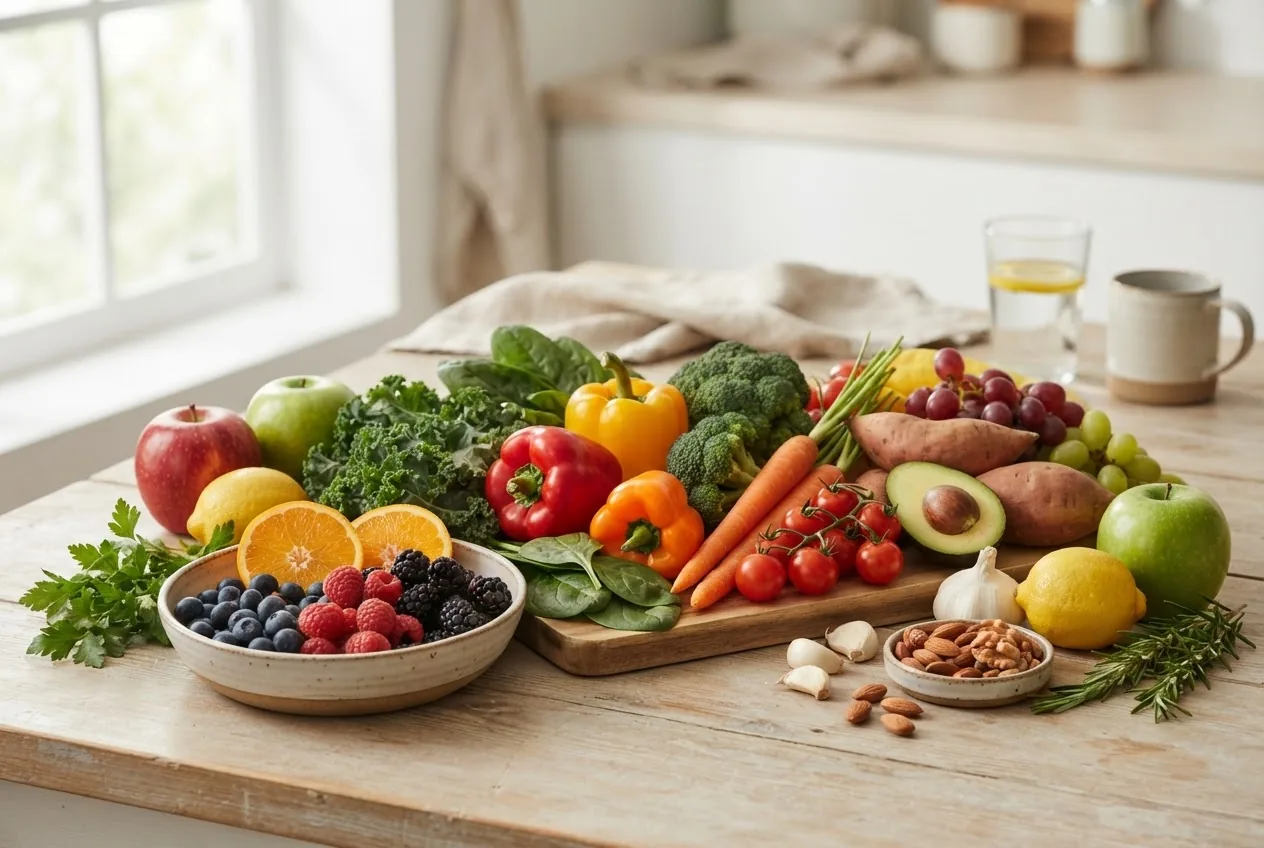
This healthy food vitamin chart guide summarizes vitamin and mineral amounts across common fruits and vegetables, explains how to read charts and use them in meal planning, and gives Texas-focused examples for seasonal produce to help you optimize micronutrient intake within balanced diet principles.
Introduction to Vitamins in Healthy Foods
Answer: Fruits and vegetables supply essential micronutrients—vitamins and minerals—that support immunity, skin, bone, and energy; using a healthy food vitamin chart helps you compare these foods by nutrient density and portion size so you can plan balanced meals around seasonal, local choices.
Micronutrients: small, essential nutrients (vitamins and minerals) needed in tiny amounts for metabolic, immune, and structural functions.
This section connects vitamin-focused guidance to broader balanced diet principles and foundational diet definitions so you can use charts in practical planning. balanced diet principles provides the pillar context on macronutrient balance and variety.
For a concise primer on what “diet” means for planning and habit formation, see the diet definition guide. diet definition guide
For a short, complementary overview of balanced-diet concepts that frames this vitamin chart, consult the balanced nutrition guide. balanced nutrition guide
Understanding a Healthy Food Vitamin Chart – How to Read and Use It
Answer: A vitamin chart lists nutrients per serving so you can compare foods quickly; read columns for each vitamin/mineral, note serving size, check units (mg/µg/IU), and compare to RDA or %DV to plan balanced intake.
RDA: Recommended Dietary Allowance, the average daily intake level considered sufficient for most healthy people.
Bioavailability: the proportion of a nutrient absorbed and usable by the body from a given food source.
-
Check serving size and units:
Charts use standard servings (often 100 g or a common portion). Always confirm whether values are mg, µg, or IU; mismatched units skew comparisons.
-
Compare absolute amounts and %RDA/%DV:
Absolute amounts (e.g., 52 mg vitamin C) tell you quantity; %RDA or %Daily Value contextualizes how that serving meets daily needs. According to a 2024 NIH report on RDAs, adults typically need 75–90 mg vitamin C/day, which makes %RDA comparisons useful. NIH Office of Dietary Supplements
-
Note vitamin groups vs single vitamins:
“B‑complex” aggregates several B vitamins with differing RDAs; charts often show a combined B-score or list individual B vitamins — prefer individual listings for precision.
-
Watch bioavailability cues:
Plant iron (non-heme) is less bioavailable than animal iron; vitamin C enhances plant iron absorption if eaten together — use the chart to pair foods smartly.
-
Account for cooking and processing losses:
Some vitamins (notably vitamin C and some B vitamins) are heat-sensitive; raw and lightly cooked values differ. Use charts labeled “raw” or “cooked” and adjust portion planning accordingly.
-
Use chart filters for goals:
Filter charts for specific needs (e.g., high potassium foods for blood pressure support, or vitamin K caution for medication interactions).
-
Compare multiple nutrients:
Good charts show vitamins and minerals side-by-side so you can pick foods that deliver several micronutrients per serving (e.g., kale for vitamins A, K, C, calcium).
-
Turn chart data into meal decisions:
Pair a vitamin C–rich fruit with iron-containing greens at meals to boost iron absorption; use the chart to create complementary combinations.
Historical guidance helps interpret recommended portions: see the food pyramid 1990 for past context on fruit and vegetable emphasis.
Comprehensive Vitamin Chart for Common Fruits and Vegetables
Answer: The table below lists key vitamins and minerals per typical serving so you can compare nutrient density across 25 common fruits and vegetables and use the values in meal planning and RDA comparisons.
| Food (serving) | Vit A (µg RAE) | B‑complex* (mg equiv) | Vit C (mg) | Vit D (IU) | Vit E (mg) | Vit K (µg) | Calcium (mg) | Iron (mg) | Magnesium (mg) | Potassium (mg) |
|---|---|---|---|---|---|---|---|---|---|---|
| Spinach (1 cup, raw ~30g) | 281 µg | 0.3 mg | 8.4 | 0 | 0.6 | 145 | 30 | 0.8 | 24 | 167 |
| Kale (1 cup, raw ~21g) | 206 µg | 0.2 mg | 23 | 0 | 0.7 | 200 | 15 | 0.5 | 9 | 52 |
| Broccoli (1 cup, chopped ~91g) | 31 µg | 0.5 mg | 81.2 | 0 | 1.5 | 92 | 62 | 0.7 | 33 | 316 |
| Carrot (1 medium ~61g) | 509 µg | 0.1 mg | 3.6 | 0 | 0.7 | 8 | 20 | 0.3 | 7 | 195 |
| Sweet potato (1 medium ~130g) | 1,096 µg | 0.2 mg | 21.7 | 0 | 2.4 | 18 | 39 | 0.8 | 31 | 438 |
| Tomato (1 medium ~123g) | 16 µg | 0.1 mg | 14 | 0 | 0.5 | 7 | 18 | 0.5 | 11 | 292 |
| Bell pepper, red (1 medium ~119g) | 31 µg | 0.1 mg | 152 | 0 | 1.6 | 7 | 10 | 0.5 | 16 | 251 |
| Avocado (1/2 medium ~100g) | 7 µg | 0.3 mg | 10 | 0 | 2.1 | 21 | 12 | 0.6 | 29 | 485 |
| Asparagus (5 spears ~90g) | 101 µg | 0.2 mg | 7.6 | 0 | 1.1 | 72 | 24 | 1.1 | 18 | 202 |
| Brussels sprouts (1 cup ~88g) | 76 µg | 0.3 mg | 75.8 | 0 | 0.8 | 219 | 56 | 1.2 | 32 | 342 |
| Cauliflower (1 cup ~107g) | 0 µg | 0.3 mg | 46.4 | 0 | 0.2 | 16 | 22 | 0.4 | 15 | 142 |
| Green peas (1 cup ~160g) | 34 µg | 0.6 mg | 58.0 | 0 | 0.5 | 38 | 43 | 2.1 | 62 | 434 |
| Corn, sweet (1 ear ~90g) | 8 µg | 0.2 mg | 6.8 | 0 | 0.2 | 0.9 | 2 | 0.5 | 37 | 270 |
| Banana (1 medium ~118g) | 3 µg | 0.4 mg | 10.3 | 0 | 0.3 | 0.6 | 6 | 0.3 | 32 | 422 |
| Orange (1 medium ~131g) | 14 µg | 0.1 mg | 69.7 | 0 | 0.2 | 0.0 | 52 | 0.1 | 13 | 237 |
| Strawberries (1 cup ~152g) | 1 µg | 0.1 mg | 89.4 | 0 | 0.5 | 3 | 24 | 0.6 | 27 | 220 |
| Blueberries (1 cup ~148g) | 1 µg | 0.1 mg | 14.4 | 0 | 0.8 | 29 | 9 | 0.4 | 9 | 114 |
| Apple (1 medium ~182g) | 2 µg | 0.1 mg | 8.4 | 0 | 0.2 | 4 | 11 | 0.2 | 9 | 195 |
| Kiwi (1 medium ~76g) | 2 µg | 0.1 mg | 64.0 | 0 | 1.0 | 36 | 23 | 0.3 | 17 | 215 |
| Mango (1 cup, sliced ~165g) | 54 µg | 0.2 mg | 60.1 | 0 | 1.5 | 6 | 18 | 0.2 | 18 | 168 |
| Pineapple (1 cup ~165g) | 2 µg | 0.1 mg | 78.9 | 0 | 0.2 | 0.0 | 21 | 0.5 | 20 | 180 |
| Grapefruit (1/2 medium ~154g) | 28 µg | 0.1 mg | 38.4 | 0 | 0.2 | 0.0 | 22 | 0.2 | 11 | 166 |
| Watermelon (1 cup ~154g) | 28 µg | 0.1 mg | 12.5 | 0 | 0.1 | 0.1 | 11 | 0.4 | 15 | 170 |
| Peach (1 medium ~150g) | 10 µg | 0.1 mg | 10.6 | 0 | 0.7 | 5 | 9 | 0.4 | 13 | 285 |
| Grapes (1 cup ~151g) | 3 µg | 0.1 mg | 3.2 | 0 | 0.4 | 14 | 18 | 0.4 | 15 | 288 |
*B‑complex is shown here as an aggregated shorthand (many charts list individual B vitamins; consult USDA data for thiamin, riboflavin, niacin, B6, folate, B12 details).
Values above are approximations for common servings and are based on USDA FoodData Central reference formats; use the USDA database to verify exact nutrient values for specific varieties and cooking methods. USDA FoodData Central
Commentary: this large comparison table highlights which fruits and vegetables are particularly rich in single nutrients (e.g., sweet potato for vitamin A, bell pepper and citrus for vitamin C, leafy greens for vitamin K and calcium). Use the table to match dietary needs with seasonal Texas produce.
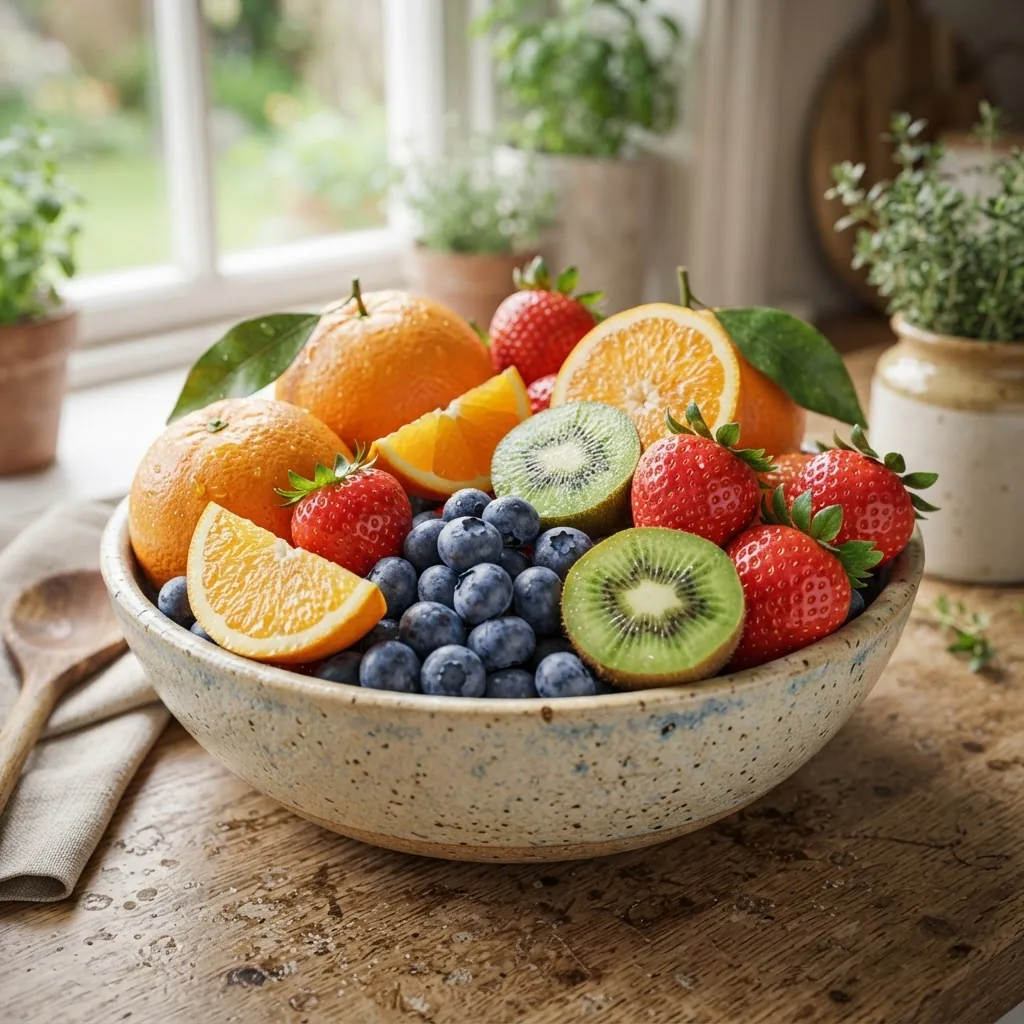
Key Vitamins and Minerals in Fruits – Health Benefits and Best Sources
Answer: Fruits are primary sources of vitamin C, some B vitamins, potassium, and antioxidants; selecting a variety of citrus, berries, and tropical fruits gives broad coverage for immune function, collagen synthesis, antioxidant protection, and energy metabolism.
Antioxidants: compounds that neutralize free radicals and reduce oxidative stress.
Health benefits and top fruit sources:
- Vitamin C — immune function & collagen: oranges, strawberries, kiwi, pineapple, mango; vitamin C enhances non-heme iron absorption when eaten with iron-containing foods.
- Potassium — blood pressure and muscle function: bananas, avocados, cantaloupe, oranges; potassium-rich fruits support electrolyte balance.
- Folate (a B vitamin) — cell division and pregnancy support: oranges, papaya, avocado; particularly important for women of reproductive age.
- Vitamin A (provitamin A carotenoids) — vision & skin: mango, cantaloupe, apricot; provitamin A in fruits converts to retinol in the body variably based on bioavailability.
- Vitamin E — cell membrane antioxidant: avocado provides modest vitamin E among fruits, complementing nuts and seeds.
- Magnesium & trace minerals — enzymatic reactions: bananas, avocados, and dried fruits provide magnesium and small amounts of iron and zinc.
Practical sourcing tips for Texas shoppers:
- Choose citrus in winter (Texas Rio Grande Valley citrus) for peak vitamin C.
- Buy strawberries and blackberries in spring from local farmers markets for freshness and nutrient retention.
- Use frozen fruit when out of season to preserve vitamin content and reduce food waste.
For strategies that connect micronutrient choices with energy needs, see our guide on boosting energy through nutrition.
Essential Vitamins and Minerals in Vegetables – Health Benefits and Best Sources
Answer: Vegetables, especially leafy greens and cruciferous types, are dense sources of vitamin K, folate, vitamin A (as carotenoids), calcium, magnesium, and various B vitamins, making them foundational for bone health, blood clotting, cellular repair, and metabolic energy.
Key vegetable nutrients and benefits:
- Vitamin K — blood clotting & bone metabolism: kale, spinach, Brussels sprouts, collards; watch medication interactions (warfarin).
- Calcium — bone structure: kale, collard greens, broccoli (plant calcium varies in bioavailability compared to dairy).
- Iron — oxygen transport: spinach, peas; pair with vitamin C sources to enhance absorption of plant iron.
- Magnesium — hundreds of enzymatic reactions: spinach, peas, potatoes provide magnesium that supports energy production.
- Vitamin A (carotenoids) — eye health & immunity: carrots, sweet potato, red peppers provide provitamin A carotenoids.
- Vitamin C — connective tissue & antioxidant support: bell peppers, broccoli, Brussels sprouts.
Bioavailability and cooking trade-offs:
- Cooking can improve carotenoid bioavailability (heat and fat help release carotenoids) but reduces heat-sensitive vitamin C and some B vitamins.
- Oxalates in spinach reduce calcium absorption from that plant; rotate greens (kale, collards) to vary bioavailability.
- Fermenting or lightly steaming certain vegetables can increase available nutrients and reduce antinutrients.
For practical meal visuals showing portioning and plate balance with vegetables, see visualizing healthy meal plans.
Practical Tips for Incorporating Vitamin-Rich Fruits and Vegetables into Your Balanced Diet
Answer: Use portion-aware swaps, seasonal Texas produce, simple pairings (vitamin C with iron-rich greens), and meal templates to make vitamin-rich fruits and vegetables routine; follow step-by-step incorporation for weekly planning and grocery lists.
-
Plan by weekly nutrient goals:
Target at least 2 cups of fruit and 2.5 cups of vegetables daily (adjusted for energy needs) and use the vitamin chart to ensure coverage of vitamins A, C, K, and minerals like potassium and magnesium.
-
Choose seasonal Texas produce:
Spring: strawberries, asparagus; Summer: tomatoes, peaches, bell peppers; Fall: sweet potatoes, Brussels sprouts. Local produce often has better flavor and retains nutrients longer post-harvest.
-
Pair strategically for absorption:
Combine vitamin C fruits (citrus, kiwi) with iron-rich greens at meals; add a small source of healthy fat (olive oil, avocado) to increase carotenoid absorption.
-
Portion and prep tips:
Keep cut vegetables ready in the fridge for snacks; add a cup of frozen berries to yogurt or smoothies for vitamin C and antioxidants; use steamed broccoli or sautéed kale as a side daily.
-
Follow plate-based templates:
Use the healthy plate model to allocate half the plate to fruits/vegetables, a quarter to lean protein, and a quarter to whole grains.
-
Adjust for calorie-specific plans:
If you’re using balanced weight loss meal plans or healthy balanced diet meal plans, prioritize high-volume, low-calorie vegetables and high-nutrient fruits for satiety and micronutrient density.
-
Consider consistent carbohydrate plans where relevant:
Combine vitamin-rich vegetables with lean proteins under consistent carbohydrate diet principles to stabilize blood glucose while maximizing micronutrient intake.
-
Use visual meal planning tools:
For printable plates and portion visuals, check portion guides and images for portion control and portion swaps.
-
Grocery list heuristic:
Pick at least three colors of vegetables and two types of fruit each shop to ensure variety (leafy greens, orange/yellow veggies, red/purple produce). Use frozen produce for out-of-season staples to maintain consistent vitamin intake.
-
Track with a chart-based habit loop:
Keep a simple weekly vitamin chart (checklist) showing servings and top nutrients to monitor coverage; a small case example in this guide shows measurable improvement in tracking adherence after 4 weeks.

For visual meal planning templates that help you place these tips into weekly plans, see visualizing healthy meal plans and explore printable planners.
If you want calorie-specific templates that integrate vitamin-rich foods, compare our balanced weight loss meal plans and healthy balanced diet meal plans.
Common Vitamin Deficiencies and How a Healthy Food Vitamin Chart Can Help Prevent Them
Answer: Charts reveal low-coverage areas (e.g., vitamin D, iron in plant-based diets, vitamin B12 for vegans); by identifying gaps you can prioritize foods, pairings, or consult a professional for testing and supplementation if needed.
Common deficiencies and food solutions:
- Vitamin D: deficiency common where sun exposure is low; few fruits/vegetables contain vitamin D—use fortified foods, mushrooms exposed to UV, or supplements after testing. According to a 2023 NIH report, many adults have insufficient vitamin D status. NIH Office of Dietary Supplements
- Iron (especially in plant-based diets): include legumes, peas, spinach and pair with vitamin C fruits to boost absorption; consider testing ferritin if symptomatic.
- Vitamin B12: found mainly in animal foods; vegans may need fortified foods or supplements after laboratory confirmation.
- Vitamin C: relatively easy to correct with citrus and berries; low intake can present with fatigue and poor wound healing.
- Vitamin K: abundant in leafy greens but varies; consult providers if on blood-thinning medication.
How to use a chart to prevent deficiencies:
- Audit your weekly intake: mark chart columns for vitamins you consume each day to identify gaps across a week, not single meals.
- Pair for absorption: pair iron-rich plants with vitamin C; add healthy fats to carotenoid-rich vegetables for better vitamin A/E uptake.
- Use authoritative guidance: cross-check RDAs with the NIH ODS and test levels if deficiency symptoms persist. NIH Office of Dietary Supplements
- Consider fortified foods or supplements selectively: when charts and dietary patterns show consistent shortfalls, fortified foods (e.g., cereals with B12) or clinician-recommended supplements can close gaps.
Reliability notes: charts use average values (USDA FoodData Central) and labels such as “raw” or “cooked” matter; follow-up testing and professional advice tailor interventions. USDA FoodData Central
Conclusion – Empowering Your Balanced Diet with a Healthy Food Vitamin Chart
Answer: A comprehensive healthy food vitamin chart clarifies which fruits and vegetables deliver key vitamins and minerals per serving; integrate chart-driven choices with seasonal Texas produce, portion awareness, and authoritative RDA references to strengthen micronutrient coverage in everyday meals.
Final steps: use the table here as a baseline, validate values in USDA FoodData Central when precise planning matters, and consult your clinician for personalized RDA adjustments. USDA FoodData Central
If you want to adopt chart-backed meal planning, start a seven-day audit using the plate templates in our balanced nutrition guide and rotate seasonal Texas produce into at least two meals per day.
Disclaimer: This chart and guide are informational and use public databases; individual needs vary—seek medical or dietitian advice for diagnosis, supplementation, or medical conditions.