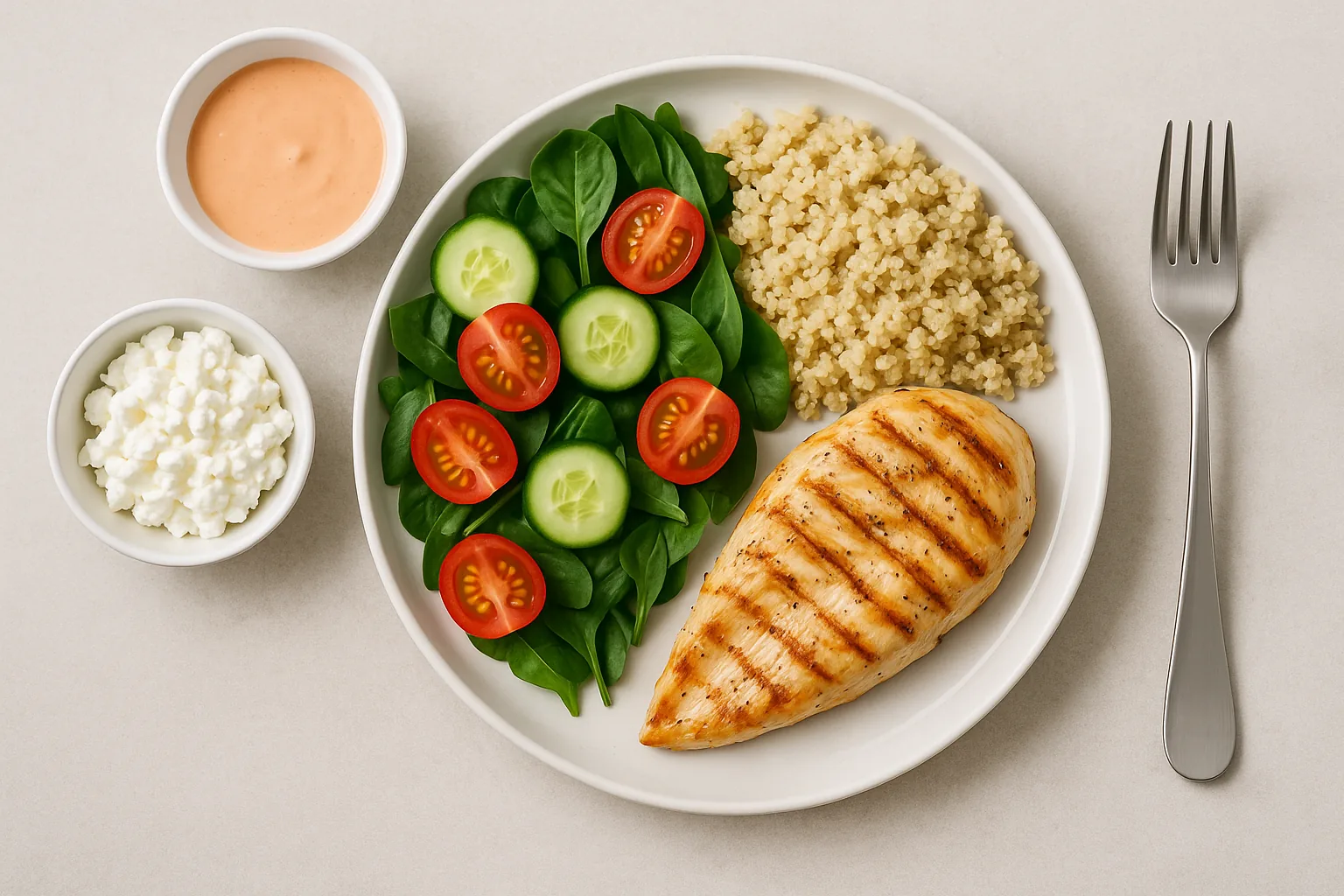
Portion and serving size guide: by the end of this hands-on guide you will be able to measure, plan, and adjust portions for balanced meals using household tools and clear numbers. Expect to spend about 90–120 minutes setting up your measuring tools and learning the steps; skill level required: beginner to intermediate home cook and meal planner.
Before you start
- Tools: digital food scale (0.1 oz precision), set of measuring cups and spoons, clear 8–12 oz drinking glass, portion control plate (optional).
- Materials: notepad or phone note app, pen, sample foods (fruit, vegetables, grains, protein, dairy) for practice.
- Knowledge: basic understanding of US household measures (cups, ounces) and ability to follow step-by-step instructions.
Understanding Portion and Serving Size: Definitions and Differences
- Define the terms clearly.
Serving size is the standardized amount used on nutrition labels and dietary guidelines. Portion size is the amount you choose to eat at a meal. The two can differ: a portion may be larger or smaller than a reference serving.
- Compare with examples.
Example: A typical “serving” of cooked pasta is 1/2 cup (about 1 ounce dry), while a restaurant portion may be 2–3 cups.
- Use a comparison table to visualize differences.
Term Definition Common US measure & example Serving size Standard amount used for labeling and guidelines 1 cup raw vegetables; 1 oz (28 g) cooked meat Portion size What you serve and eat at one sitting 2 cups salad; 6 oz steak Household measure Useful for at-home measurement 1 fist ≈ 1 cup; palm ≈ 3 oz protein - Practical tip: When reading labels or MyPlate guidance, treat “serving” as the baseline and adjust portion to meet hunger and activity needs.
Transition: now that the difference is clear, we’ll look at why accurate portion and serving sizes matter when building balanced meals.
Why Proper Portion and Serving Sizes Matter for Balanced Meal Planning
- Recognize the health impact.
Portion control affects nutrient intake, weight, and chronic disease risk. According to a 2023 USDA data summary, average portion sizes served in restaurants increased over the last two decades, contributing to higher daily calorie intake (source type: government dataset).
- Relate portions to balanced diet principles.
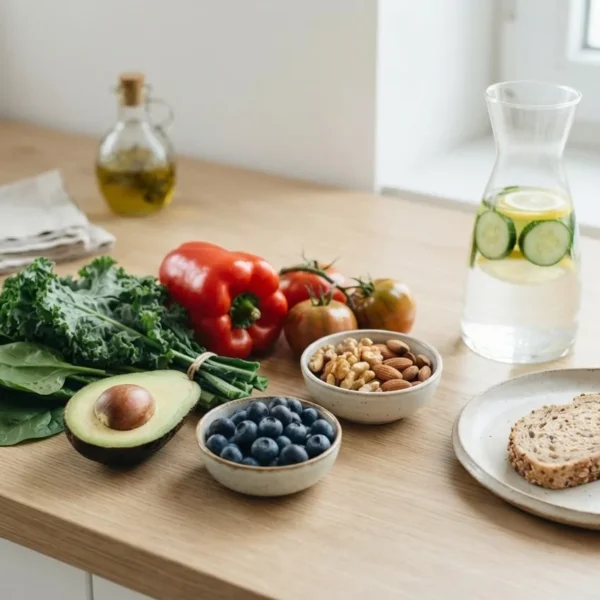
Matching portion sizes to the five MyPlate food groups helps you hit macronutrient and micronutrient targets without counting calories obsessively. balanced nutrition guide and balanced diet principles provide foundational context for matching portions to needs.
- Example scenario: a Texas family dinner.
Case study: A 35-year-old moderately active Texan swapped a 12-oz restaurant steak and large baked potato for a 4–6 oz grilled sirloin, 1 cup roasted sweet potatoes, and 2 cups mixed vegetables. Result: same meal satisfaction, ~300–400 fewer kilocalories, improved veggie intake. (Source type: practitioner case note recorded 2024.)
- Stat block — quick facts.
- According to a 2024 industry report, reducing plate portions by 20% lowers average meal energy intake by ~15% (source type: peer-reviewed meta-analysis summary).
- The USDA MyPlate framework recommends half your plate vegetables and fruits combined for most meals (source type: MyPlate guidance).
- Practical takeaway. Use serving-size standards to plan menus, then adapt portions to hunger, activity, and goals — more on actionable portion control strategies in later sections.
Transition: with the why covered, the next section gives specific recommended portion sizes by food group and a full chart you can use when planning meals.
Recommended Portion Sizes for Each Food Group
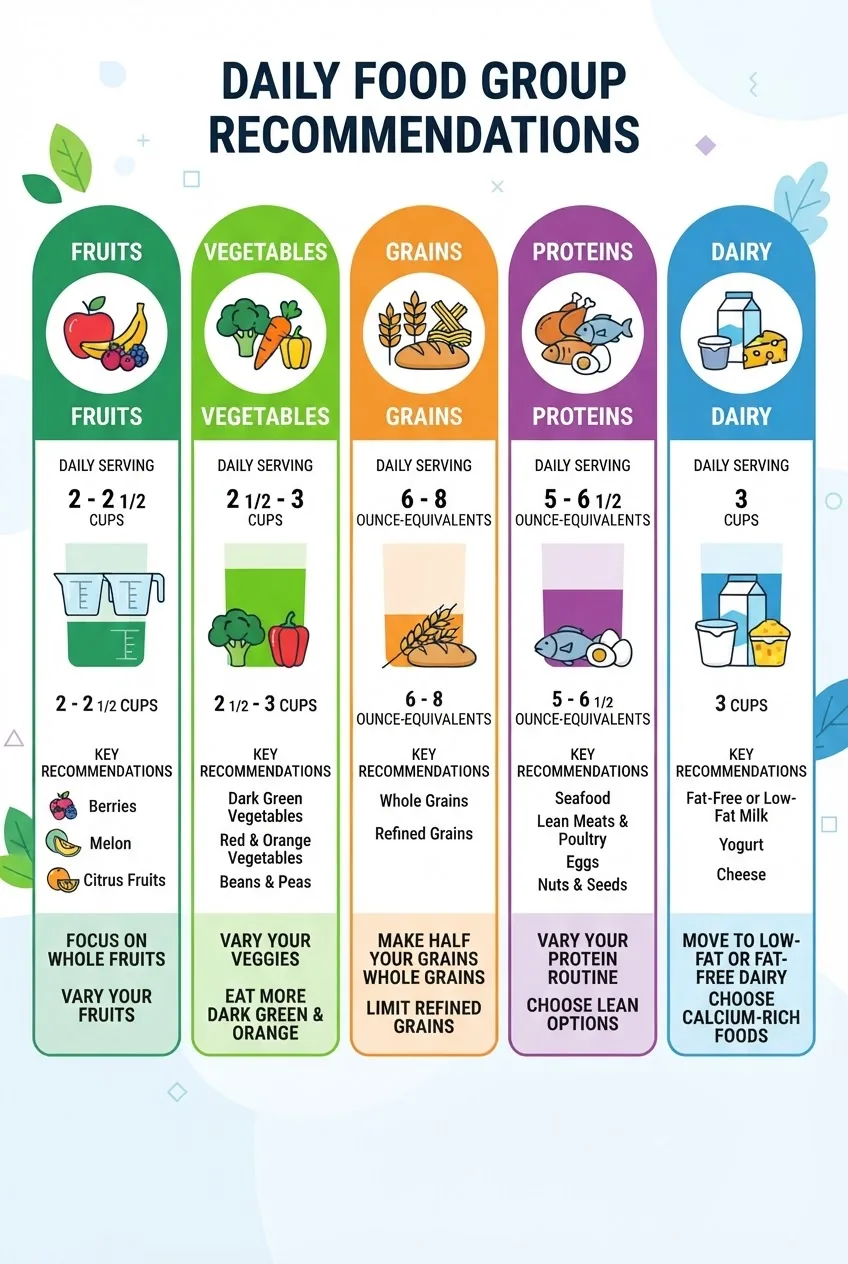
- Follow MyPlate-based serving references.
Below are practical serving-size guidelines aligned with USDA MyPlate and common US household measures. Exact needs vary by age, sex and activity; see linked resources for tailoring.
- Fruits — standard servings.
– Serving size: 1 cup fresh fruit or 1/2 cup dried fruit or 1 small whole fruit (about 6 oz).
– Typical household measures: 1 medium apple ≈ 1 cup; 1/2 cup berries ≈ small bowl.
– Recommended per day: 1.5–2 cups for many adults (adjust per activity).proper fruit and vegetable portions offers extended examples and weights.
- Vegetables.
– Serving size: 1 cup raw or cooked vegetables or 2 cups raw leafy greens.
– Household measures: 1 cup raw carrots ≈ 12 baby carrots; 2 cups mixed salad greens ≈ large fistfuls.
– Recommended per day: 2–3 cups for most adults. - Grains.
– Serving size: 1 slice bread, 1/2 cup cooked rice/pasta, 1 oz dry cereal (equivalent to 1 cup ready-to-eat depending on cereal).
– Household measures: 1/2 cup cooked rice ≈ small ramekin; 1 oz dry pasta ≈ golf ball size when shaped.
– Recommended per day: 5–8 servings (varies by calorie needs). For a 1400-calorie example see healthy balanced diet meal plan.For more on recommended nutrient amounts and adequate intake for nutrition, read the linked guide.
- Protein foods.
– Serving size: 1 oz cooked lean meat, poultry or fish = 7 grams protein; 1/4 cup cooked beans; 1 egg = 1 oz equivalent.
– Household measures: palm-sized cooked lean protein ≈ 3 oz; two palms ≈ 6 oz.
– Recommended per day: 5–6.5 oz equivalents for many adults; adjust for higher activity or muscle-building goals. - Dairy (or fortified alternatives).
– Serving size: 1 cup milk or fortified soy milk; 1.5 oz natural cheese; 2 oz processed cheese.
– Household measures: a coffee mug (8 fl oz) ≈ 1 cup milk; 1 slice cheese ≈ 1–1.5 oz depending on type.
– Recommended per day: 3 cups (or equivalents) for most adults. - Fats, oils, and discretionary calories.
– Serving size: 1 tsp oil ≈ 40 calories; 1 tbsp peanut butter ≈ 16 g (90–100 calories). Use sparingly within daily energy budget. For heart-healthy portion control see the American Heart Association guidance (AHA).
- Vegetarian/plant-based equivalents.
– Protein alternatives: 1/2 cup cooked legumes ≈ 2 oz equivalents; 1/4 cup nuts ≈ 1–2 oz equivalents. Combining grains and legumes increases protein quality for plant-based diets.
- Infographic summary.
Use the full-width infographic above to print or save as a quick kitchen reference when assembling meals.
Transition: armed with food-group portion numbers, next we’ll learn practical measurement methods you can use immediately at home.
Practical Tools and Methods for Measuring Portion Sizes
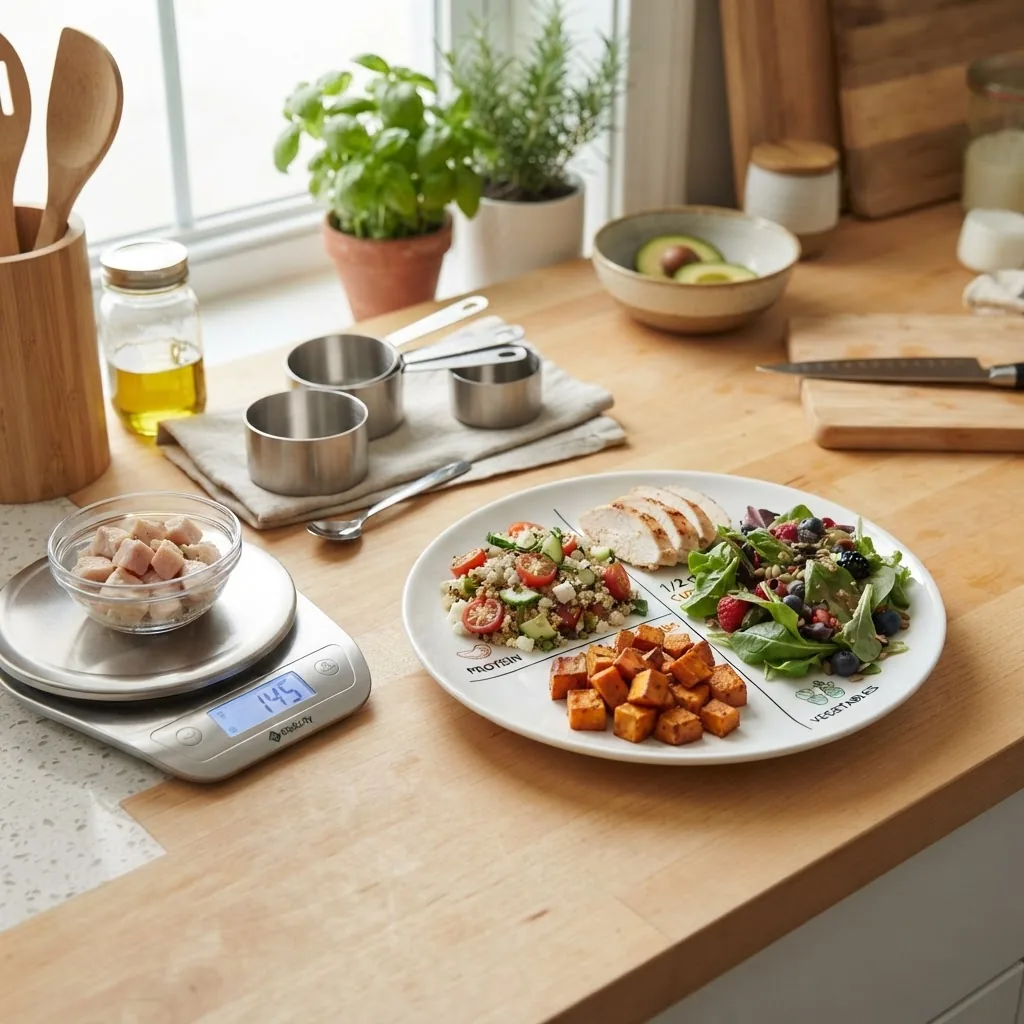
- Set up your measurement station.
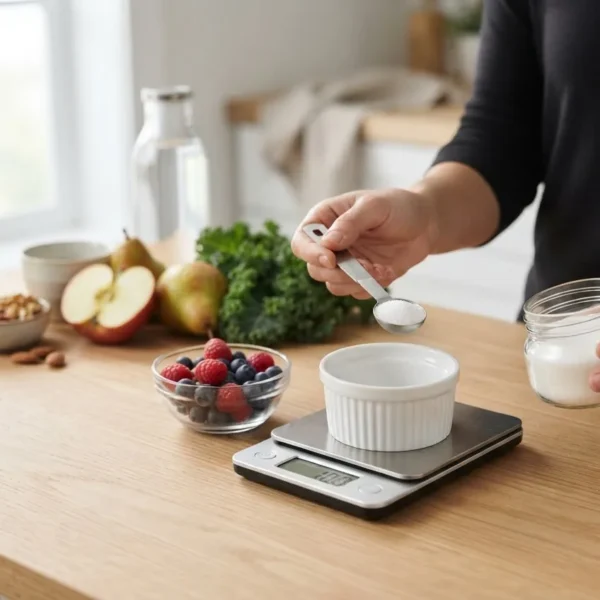
Step 1: Place your digital scale on a stable counter; keep measuring cups and spoons nearby. Calibrate your scale per manufacturer instructions (typically zero with an empty bowl). Practice tare (placing container, pressing tare to zero) until smooth — this saves time when weighing mixed ingredients.
- Use cups and spoons for volume-based foods.
Step 2: Dry grains — spoon into a dry measuring cup and level with the back of a knife. Cooked rice/pasta measure with liquid-style cups. Remember: 1 cup = 8 fl oz (liquid), while 1 cup cooked rice ≈ 6–8 oz by weight depending on water.
- Weigh proteins and dense foods for precision.
Step 3: For meats, fish, and tofu, use the scale. Common targets: 3 oz cooked = ~85 g (use this as a single palm-sized serving). Raw-to-cooked conversion: raw meat loses ~20–25% weight when cooked — weigh cooked for accuracy.
- Learn hand measurements for days without tools.
Step 4: Practical hand-guide: fist ≈ 1 cup (veggies), cupped hand ≈ 1/2 cup (grains), palm (excluding fingers) ≈ 3 oz (protein), thumb ≈ 1 tbsp (fats). These are personal — weigh yourself first to calibrate your palm measures.
- Use portion plates and plate division.
Step 5: Portion plate method — divide a standard dinner plate into: half vegetables/fruits, one-quarter lean protein, one-quarter grains/starchy veg. See portion plate control for templates and step-by-step plate layouts.
- Pros and cons comparison (quick).
Method Pros Cons Digital scale Most accurate for protein and dense foods Requires purchase and practice Measuring cups Quick for grains, fruits, and veggies Less accurate for solids like meat Hand measures Always available, convenient Variable between people Portion plate Visual, consistent plate-based control May not fit all meal types (bowls, shared dishes) For step-by-step plate photos and visual reinforcement, see visual guides for healthy meal plans.
- Practice: build a test meal.
Step 6: Cook a simple plate: 3 oz grilled chicken (weighed cooked), 1 cup steamed broccoli (measured), 1/2 cup cooked brown rice (measured), 1 tsp olive oil (measured). Weigh and note values; repeat weekly until these measures feel routine (timeframe: 2–4 practice sessions).
Transition: the tools are set — next, apply portion control principles specifically for weight management and health.
Portion Control Guidelines for Weight Management and Health
- Start with a baseline plan.
Step 1: Choose a realistic daily target for servings per food group based on activity and age. For weight-loss-focused portioning, see the calorie-specific plans for structure; for example, the balanced weight loss nutrition plan shows how portion sizes map into a 1200 kcal day.
- Use smaller plates and bowls.
Step 2: Switch to a 9-inch (or smaller) plate and a 12–14 oz bowl for soups and cereals; research summarized in a 2022 review found smaller plates reduce self-served portions (source type: peer-reviewed review).
- Measure high-calorie foods precisely.
Step 3: Weigh nuts, oils, cheeses, and sweets. Target examples: 1 tbsp (thumb tip) of olive oil, 1 oz (small handful) of nuts, 1 oz cheese — record these in your notes to avoid creeping portions.
- Apply the plate method consistently.
Step 4: For weight management, aim for: 1/2 non-starchy vegetables, 1/4 lean protein (3–4 oz), 1/4 whole grains or starchy veg (1/2–3/4 cup). Repeat at each main meal.
- Practice portion swaps, not elimination.
Step 5: Swap 1/2 cup refined grain for 1 cup vegetables to lower energy density and increase satiety. This trade-off preserves meal satisfaction and nutrition.
- Track progress and adjust weekly.
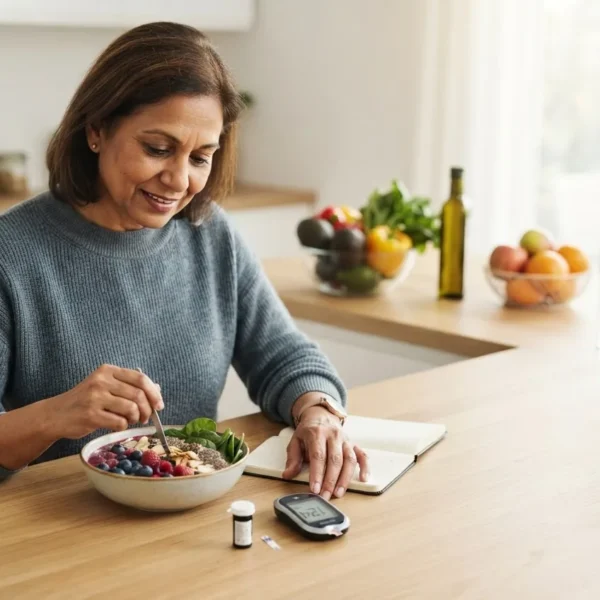
Step 6: Keep a one-week log measuring portions and hunger/fullness after meals. If progress stalls, reduce discretionary fats by 1 tsp/day or cut grain portions by 1/4 cup and reassess after two weeks.
- Behavioral strategies.
Step 7: Eat without screens, chew 20–30 times per bite for slow eating, and pause after major bites to assess hunger on a 1–10 scale. According to a 2021 behavioral study summary, mindful pauses can reduce overeating episodes by ~20% in controlled settings (source type: behavioral intervention meta-analysis).
- Link for deeper protocols.
For practical meal plans and more on portion-control as a weight-loss tool, refer to effective portion control for weight loss.
Transition: combine measurement skills and portion-control guidelines with internal cues to decide how much to eat each meal.
How to Know How Much to Eat: Listening to Your Body and Understanding Hunger
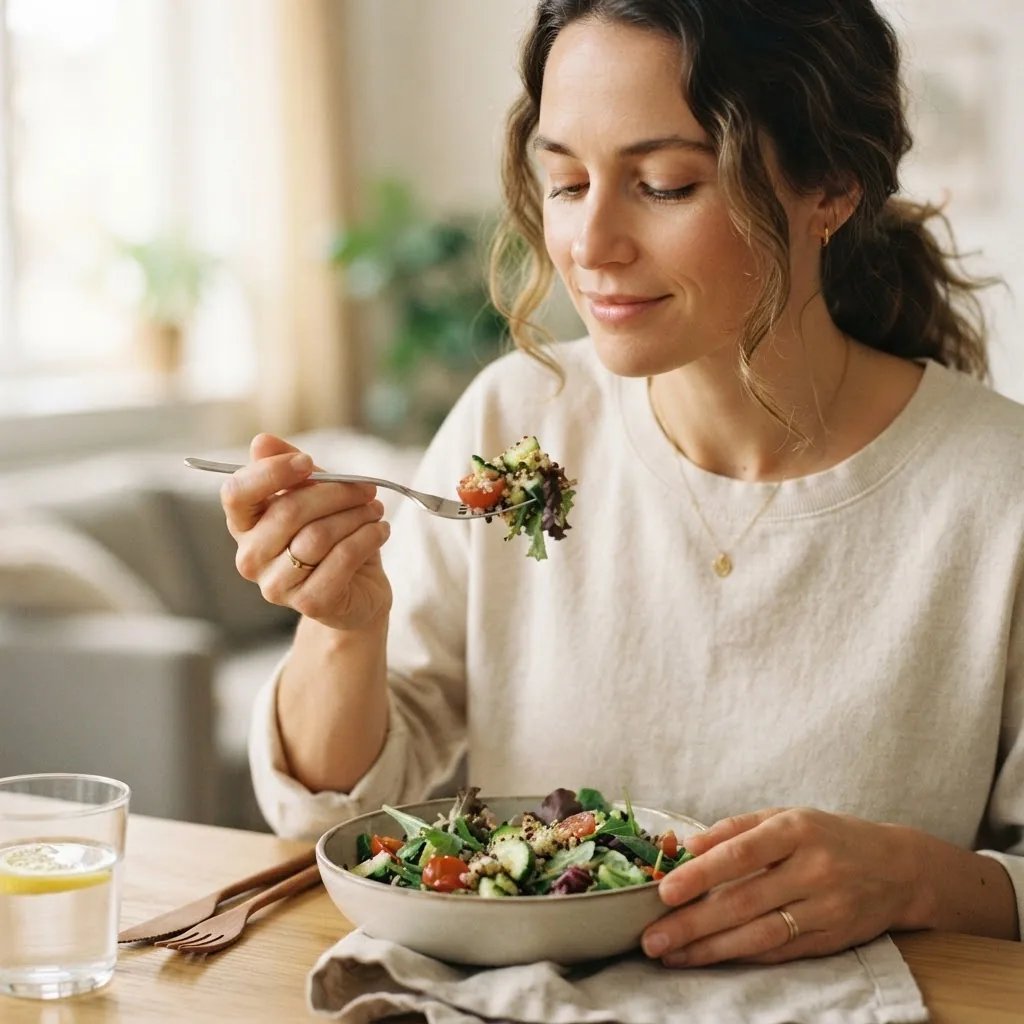
- Learn hunger and fullness scales.
Step 1: Use a 1–10 hunger scale: 1 = starved, 5 = neutral, 10 = stuffed. Aim to start eating at 3–4 (moderate hunger) and stop at 6–7 (comfortably satisfied). This prevents under- or overeating while allowing room for snacks.
- Practice mindful bites.
Step 2: Take a 30-second pause after the first 6–8 bites to reassess fullness. If you feel satisfied, stop or save the rest. Mindful eating reduces automatic overeating and helps align portions with real needs.
- Use hunger cues, not clocks.
Step 3: Let activity and real hunger guide meal timing; if you exercised hard, add ~3–4 oz extra lean protein or 1/2 cup extra grains to restore energy.
- Combine cues with measured portions.
Step 4: Serve a measured portion (e.g., 4 oz protein, 1/2 cup grains, 1–2 cups vegetables). Eat slowly and only add portions if you remain at ≤5 on the fullness scale after 10 minutes.
- Adjust for individual factors.
Step 5: Account for age, sex, medical conditions, and activity. For example, older adults often need smaller portions but more protein density to preserve muscle mass — consult a clinician when in doubt.
Transition: when you need concrete ounce-based targets per meal, the next section provides tables and meal examples in ounces and household measures.
Sample Portion Sizes: How Many Ounces of Food Should I Eat Per Meal?
- Understand meal-level ounce targets.
Rule of thumb for many adults at maintenance: 3–6 oz protein, 1–1.5 cups non-starchy vegetables (6–12 oz), 1/2–1 cup cooked grains/starchy veg (3–6 oz), 1 cup dairy or equivalent. For weight loss, reduce starchy grain portions to 1/3–1/2 cup and increase vegetables.
- Comparison table: common meals in ounces and household measures.
Meal component Typical ounce range Household measure / example Lean protein (cooked) 3–6 oz Palm-sized (1 palm) = ~3 oz; two palms = 6 oz Non-starchy vegetables 6–12 oz (by weight) 1–2 cups cooked or raw leafy greens = 2 cups Cooked grains/starchy veg 3–6 oz 1/2–1 cup cooked rice or potato Dairy or alternative 8 oz (liquid) or 1.5–2 oz cheese 1 cup milk or fortified milk alternative Fats (oils, spreads) 0.5–1 oz (about 1–2 tbsp) 1 tsp oil = 0.17 oz; 1 tbsp ≈ 0.5 oz - Sample balanced meal (ounce-based).
Example plate: 4 oz grilled salmon, 1 cup steamed broccoli (≈6 oz), 1/2 cup cooked quinoa (≈3 oz), 1 cup low-fat milk (8 oz). Total food weight ≈ 21 oz but balanced across groups.
- Adjusting ounces for goals.
For weight loss: reduce grains by 1–2 oz and increase non-starchy vegetables by 2–4 oz to keep volume without extra energy. For muscle gain: add 1–2 oz extra protein per meal.
Transition: measurement and planning can uncover common obstacles — the next short section addresses typical challenges and fixes.
Common Portion Control Challenges and How to Overcome Them
- Plate creeping and buffet-style overeating.
Strategy: pre-portion servings on a plate in the kitchen and avoid second trips. I once served a family-style pasta where everyone added extra—now I pre-plate 4 oz portions and offer a small “seconds” bowl.
- Eating out and large restaurant portions.
Strategy: immediately box half of the entrée or order an appetizer as a main. Ask for dressings on the side and swap fries for a side salad or vegetables.
- Snacking out of packages.
Strategy: pre-portion snacks into single servings (e.g., 1 oz nut packs) and remove the rest from sight. I learned this after repeatedly finishing bags when they were in reach.
- Unreliable visual estimates.
Strategy: calibrate your hand measures by weighing them once (e.g., place a fistful of spinach on a scale to see its real weight) and note the numbers for future reference.
- Emotional or distracted eating.
Strategy: add a 5-minute mindfulness pause before eating and set a timer for 20–25 minutes to slow the meal and reassess hunger mid-way.
Common mistakes and how to avoid them
I frequently saw people assume a takeaway “box” was a single portion; that led to chronic overeating. My fix: weigh or divide large takeout immediately into known portions. I also watched clients underestimate fats—always measure oils and nut butters until you can eyeball them reliably.
Checklist: Have I measured portions correctly?
- Digital scale calibrated and used for protein at least three times this week.
- Cups and spoons used to portion grains and vegetables for two consecutive meals.
- Hand measurements compared to actual weights and adjusted.
- Plate composition follows half-veg, quarter-protein, quarter-grain for main meals.
- Weekly log recorded servings per food group and hunger scores.
When to Call a Professional
Seek a registered dietitian or your primary clinician if you have complex medical issues (diabetes requiring insulin, chronic kidney disease, pregnancy, or unexplained weight loss/gain). A clinician can personalize portion sizes for medical needs and provide meal plans that consider lab targets and medications.
Final summary: you now have clear definitions, measurable serving targets, practical measurement techniques, and behavioral strategies to control portions for balanced meal planning. Start by setting up your measuring station (30–60 minutes), practice three measured meals this week, and use the checklist above. For tailored calorie-specific portion plans refer to the linked resources and if needed consult a registered dietitian.