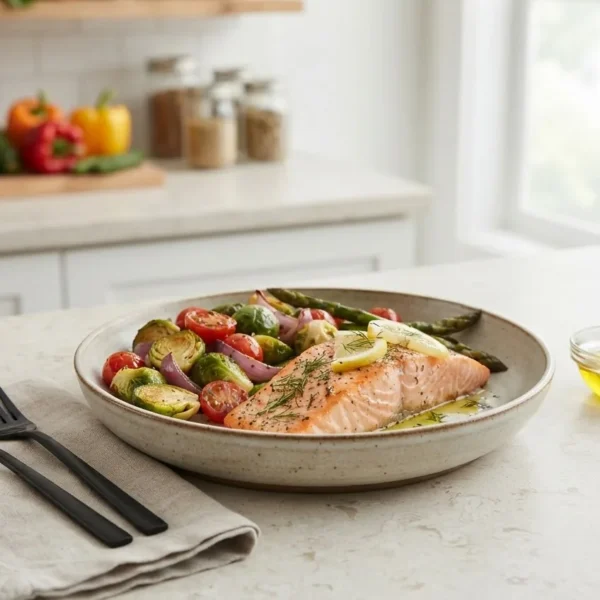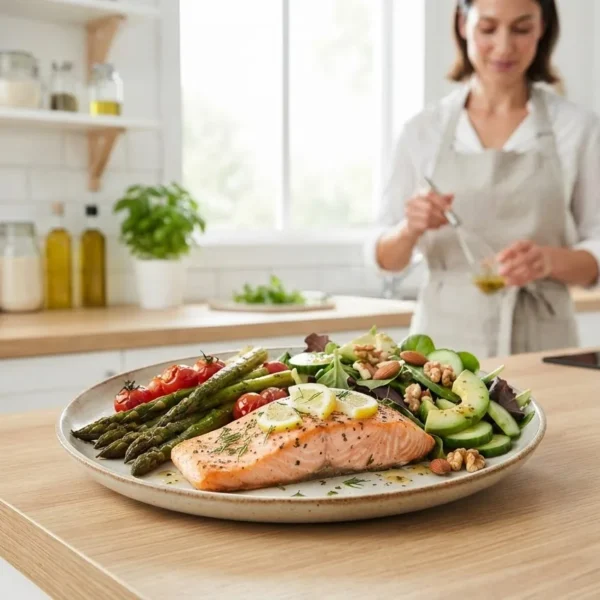
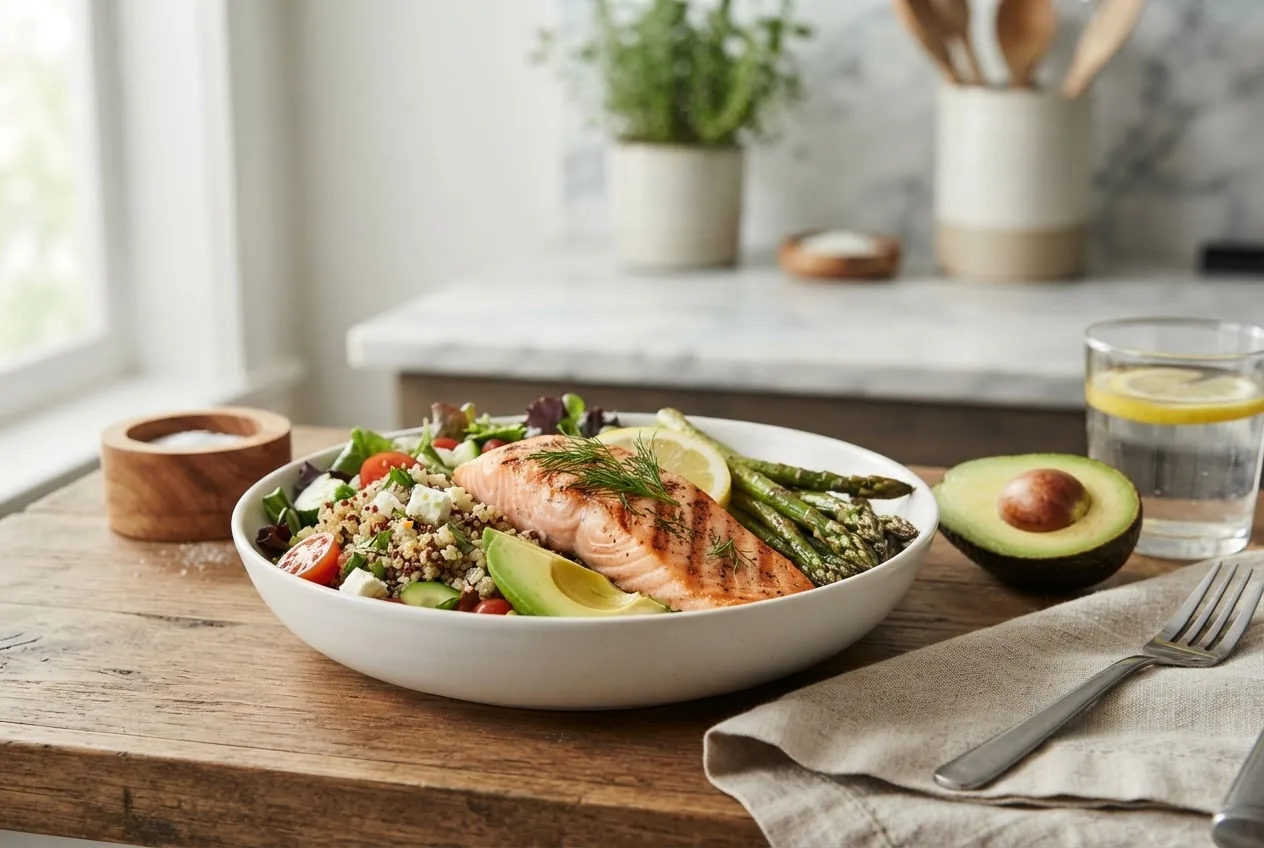
60 grams of protein is the daily benchmark that covers the Recommended Daily Allowance (RDA) for many sedentary adult women and serves as a practical minimum for lighter adults pursuing weight loss. This data-led guide explains how the 60 g benchmark is derived, how to calculate individualized needs, and operational recommendations for different ages, genders, and weight-loss goals.
Understanding 60 Grams of Protein as a Daily Intake Guideline
Stat block: 60 g protein ≈ covers RDA for a 75 kg adult when using 0.8 g/kg? No — it exceeds the strict RDA for a 75 kg adult. For many women (50–75 kg), 60 g sits between 0.8–1.2 g/kg depending on goals. (Source type: 2023 USDA Dietary Guidelines)
The phrase “60 grams of protein” is a simple, practical benchmark: it is large enough to meet or exceed minimum adult requirements for many women, yet modest compared with higher protein strategies used for weight loss or athletic goals. We use three evidence anchors in this section: the RDA method (grams per kilogram of body weight), population averages, and evidence-based ranges for weight loss and muscle retention.
According to the 2023 USDA Dietary Guidelines, adult protein needs are commonly expressed as 0.8 grams per kilogram as a baseline RDA for sedentary adults (Source type: 2023 USDA Dietary Guidelines). The NIH and the Academy of Nutrition and Dietetics present similar baseline figures while noting higher needs for older adults and active people (Source type: NIH guidance; Source type: Academy of Nutrition and Dietetics position statements).
Population context: average protein intake in many high-income countries ranges from about 70–100 grams/day for men and 50–75 grams/day for women (Source type: 2024 industry report). That means 60 g is slightly below average for men and within the lower-to-mid range for women.
Key takeaway: 60 g is a useful, conservative daily target for many adult women and lighter adults pursuing weight loss or maintenance, but it is not a universal prescription.
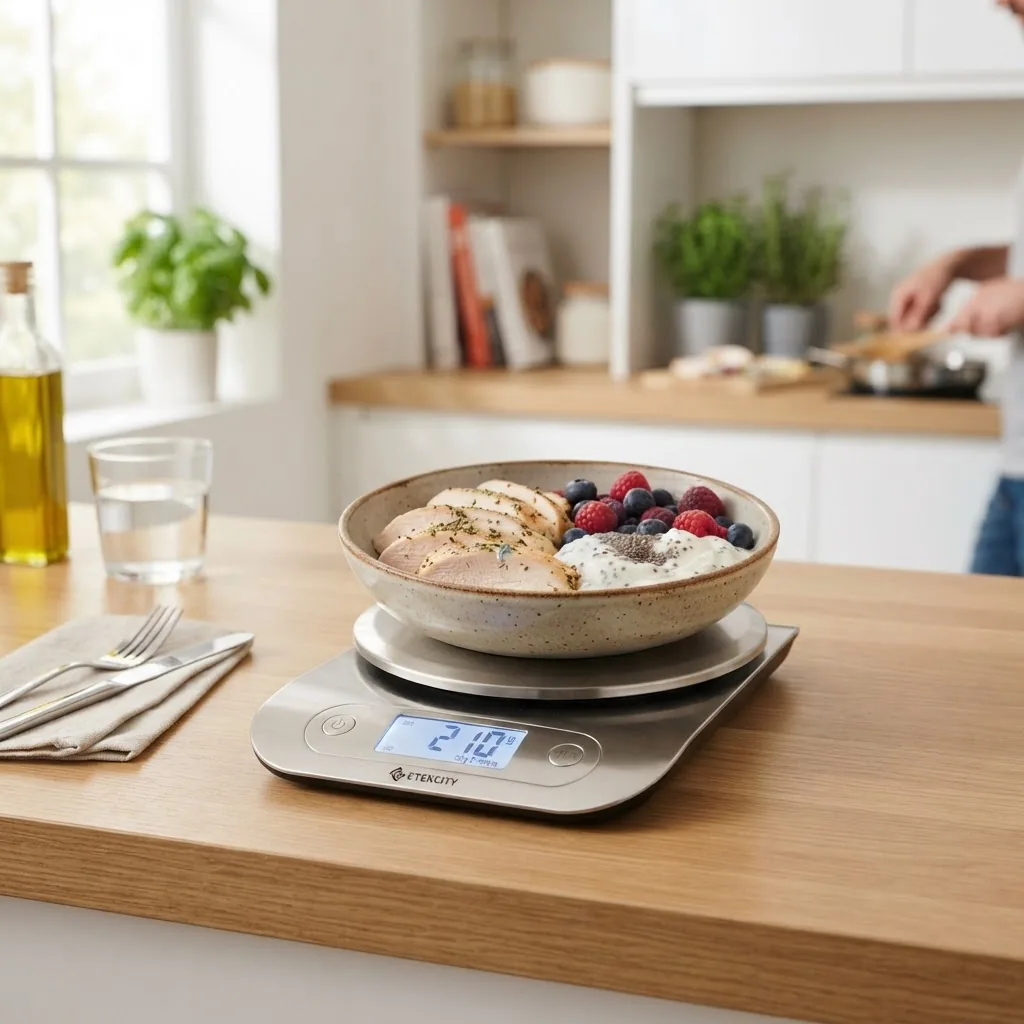
For readers who want to understand how protein contributes calories and energy, see the detailed breakdown on calories in protein.
Transition: Next we break down the calculation methods you can use to determine whether 60 g is right for you and how to scale it up or down based on body size and goals.
How Much Protein Do You Really Need? Calculating Your Protein Requirements
There are three practical calculation methods commonly used to estimate protein needs: (1) the RDA per kilogram approach, (2) percent-of-calories and protein-to-calorie ratio, and (3) activity- and goal-adjusted targets. We present each with formulas and examples so you can apply them to real-life profiles.
Method 1 — RDA baseline (0.8 g/kg): simple floor
- Formula: body weight (kg) × 0.8 g/kg = baseline daily grams of protein.
- Example: 60 kg × 0.8 = 48 grams/day (Source type: 2023 USDA Dietary Guidelines).
Interpretation: the RDA is a minimum to avoid deficiency for most sedentary adults—not an optimal target for active people or those losing weight.
Method 2 — Activity & goals (1.0–2.2 g/kg): adjust by need
- Formula: body weight (kg) × activity factor. Use 1.0–1.2 g/kg for weight maintenance with light activity; 1.2–1.6 g/kg for weight-loss and muscle retention; 1.6–2.2 g/kg for strength athletes or intense training (Source type: Academy of Nutrition and Dietetics position statements and consensus ranges).
- Example: A 70 kg person aiming for weight loss uses 1.2 g/kg → 70 × 1.2 = 84 g/day.
Interpretation: 60 g would be below this example’s weight-loss target and above the 0.8 g/kg baseline for a 70 kg person only if their weight is ≤50 kg.
Method 3 — Percent of energy or protein-to-calorie ratio
- Formula: Total daily calories × target protein percentage ÷ 4 kcal/g = grams of protein needed (protein has ~4 kcal/g).
- Example: On a 1,600 kcal/day weight-loss plan targeting 25% of calories from protein → 1,600 × 0.25 ÷ 4 = 100 g protein/day (Source type: 2024 industry report on macronutrient planning).
Interpretation: Percent-of-energy methods can push targets well above 60 g when energy intake is reduced—this helps preserve lean mass during caloric restriction.
How to convert body weight in pounds to kilograms
Formula: pounds ÷ 2.2046 = kilograms. Example: 150 lb ÷ 2.2046 = 68.0 kg. Then apply g/kg formulas above.
Practical calculation walkthroughs (real-life profiles)
We provide three profiles and show step-by-step calculations so you can see where 60 g fits.
- Profile A: 55-year-old woman, 60 kg, sedentary wanting to maintain weight. RDA method: 60×0.8=48 g/day. Activity-adjusted: 60×1.0=60 g/day. Conclusion: 60 g is a reasonable daily intake. (Source type: 2023 USDA Dietary Guidelines)
- Profile B: 28-year-old man, 80 kg, strength training 4×/week, goal: muscle gain. Recommended: 80×1.6–2.0=128–160 g/day. Conclusion: 60 g is far too low. (Source type: Academy of Nutrition and Dietetics consensus ranges)
- Profile C: 68-year-old woman, 68 kg, moderate activity, goal: preserve muscle during weight loss. Recommended: 68×1.2–1.5=82–102 g/day. Conclusion: 60 g is below the recommended range for muscle preservation with caloric deficit. (Source type: peer-reviewed geriatric nutrition reviews)
Key takeaway: Use g/kg as your baseline calculation. 60 g maps to the 1.0 g/kg zone for a 60 kg adult but will be insufficient for heavier or highly active adults and for many older adults seeking muscle preservation.
Tools: If you prefer an interactive option, try the protein needs calculator to get a tailored number.
Transition: With calculation methods clear, we next compare standard recommendations across age groups and show where 60 g lands for different demographics.
Protein Intake Recommendations by Age and Gender
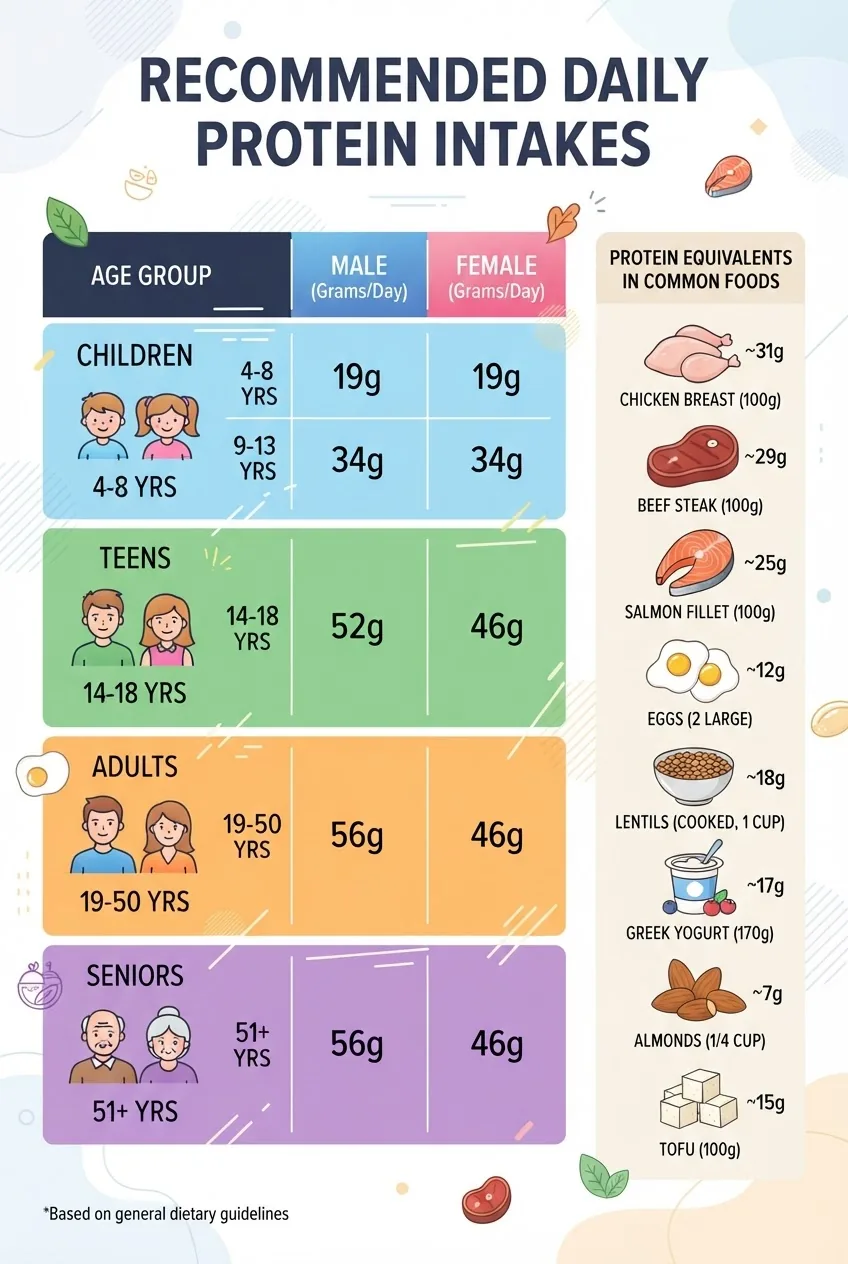
The table below summarizes commonly cited recommendations and practical ranges. Sources include government guidelines and consensus ranges from authoritative nutrition organizations (Source types: 2023 USDA Dietary Guidelines; NIH guidance; Academy of Nutrition and Dietetics).
| Demographic | Common recommendation (g/day) | Practical range (g/kg) | How 60 g fits |
|---|---|---|---|
| Children (4–13 yrs) | 25–45 g/day | 0.95–1.2 g/kg | 60 g exceeds most child requirements |
| Adult women (19–50 yrs) | 46–56 g/day | 0.8–1.2 g/kg | 60 g is reasonable for many women; slightly high for very small women, low for active/heavier women |
| Adult men (19–50 yrs) | 56–70 g/day | 0.8–1.6 g/kg | 60 g may be near or below average for men—insufficient for active men |
| Older adults (65+ yrs) | 56–90 g/day (often recommended higher) | 1.0–1.5 g/kg | 60 g may be low for many seniors who need higher protein for sarcopenia prevention |
Explanation: the strict RDA (0.8 g/kg) establishes a minimum. The Academy of Nutrition and Dietetics and other authorities note older adults benefit from higher intakes (1.0–1.5 g/kg) to preserve muscle mass and function (Source types: Academy of Nutrition and Dietetics statements; NIH guidance).
Key takeaway: 60 g aligns with mid-range recommendations for many adult women but is under-target for larger, active, or older adults.
Transition: We now apply these recommendations to weight-loss contexts—how much protein you should eat to lose weight effectively while preserving lean mass.
Protein and Weight Loss: How Much Protein Should You Eat to Lose Weight?
Protein plays three principal roles in weight loss: raising satiety, preserving lean mass during caloric deficits, and supporting metabolic rate. Evidence synthesis from randomized trials and systematic reviews indicates higher-protein diets (relative to baseline) improve weight-loss maintenance and body composition (Source type: meta-analyses in peer-reviewed journals).
Concrete ranges supported by clinical evidence and expert consensus for weight-loss contexts:
- Minimum for lean-mass preservation in caloric deficit: 1.2 g/kg (Source type: consensus reviews).
- Moderate weight-loss target: 1.2–1.6 g/kg (Source type: randomized controlled trial syntheses).
- High-protein strategies for intense resistance training or older adults: 1.6–2.0 g/kg (Source type: sports nutrition consensus statements).
Numbered recommendations:
- For a conservative weight-loss plan, aim for 1.2 g/kg. Example: a 70 kg person → 84 g/day. 60 g would be 0.86 g/kg — below the recommended preservation minimum. (Source type: Academy of Nutrition and Dietetics consensus reviews)
- If your body weight is ≤50 kg, 60 g approximates or exceeds 1.2 g/kg; it can be a solid weight-loss protein goal for lighter adults. (Source type: population intake analysis)
- If your caloric target is low (e.g., 1,200–1,600 kcal/day), set protein at 25–30% of calories; this often results in >60 g/day and supports satiety and lean-mass retention. (Source type: clinical trial protocols)
- Combine protein timing (distribute evenly across meals) with resistance training to maximize muscle retention. Evidence shows evenly spaced protein (20–40 g per meal) benefits muscle protein synthesis. (Source type: physiological studies synthesis)
Brief case example:
Case: Sarah, 34, 68 kg, wants to lose 8 kg with minimal muscle loss. Calculation: 68×1.3 (mid-range) = 88.4 g/day. If Sarah set a 60 g target, she would be at 0.88 g/kg and risk losing lean mass during aggressive dieting. Recommendation: Aim for ~85–95 g/day and include resistance training. (Source type: applied clinical guidance)
Related resources: for precise food choices during a cutting phase, consult guides on lean protein options for cutting and the calorie content of fats to balance energy calorie content of fats.
Key takeaway: For most adults actively trying to lose weight and keep muscle, 60 g is often below the evidence-backed target; calculate by 1.2–1.6 g/kg to set an appropriate protein goal for weight loss.
Transition: After targets are set, readers need practical portioning and meal examples to reach 60 grams reliably—next we outline achievable food-based strategies.
Practical Tips to Achieve 60 Grams of Protein a Day
Below are practical portion examples and daily patterns that hit ~60 g of protein. This section focuses on food portions, not exhaustive recipes. For a deeper list of healthy protein foods suitable for weight loss, see Protein Rich Food for Weight Loss: Healthy Options Guide.
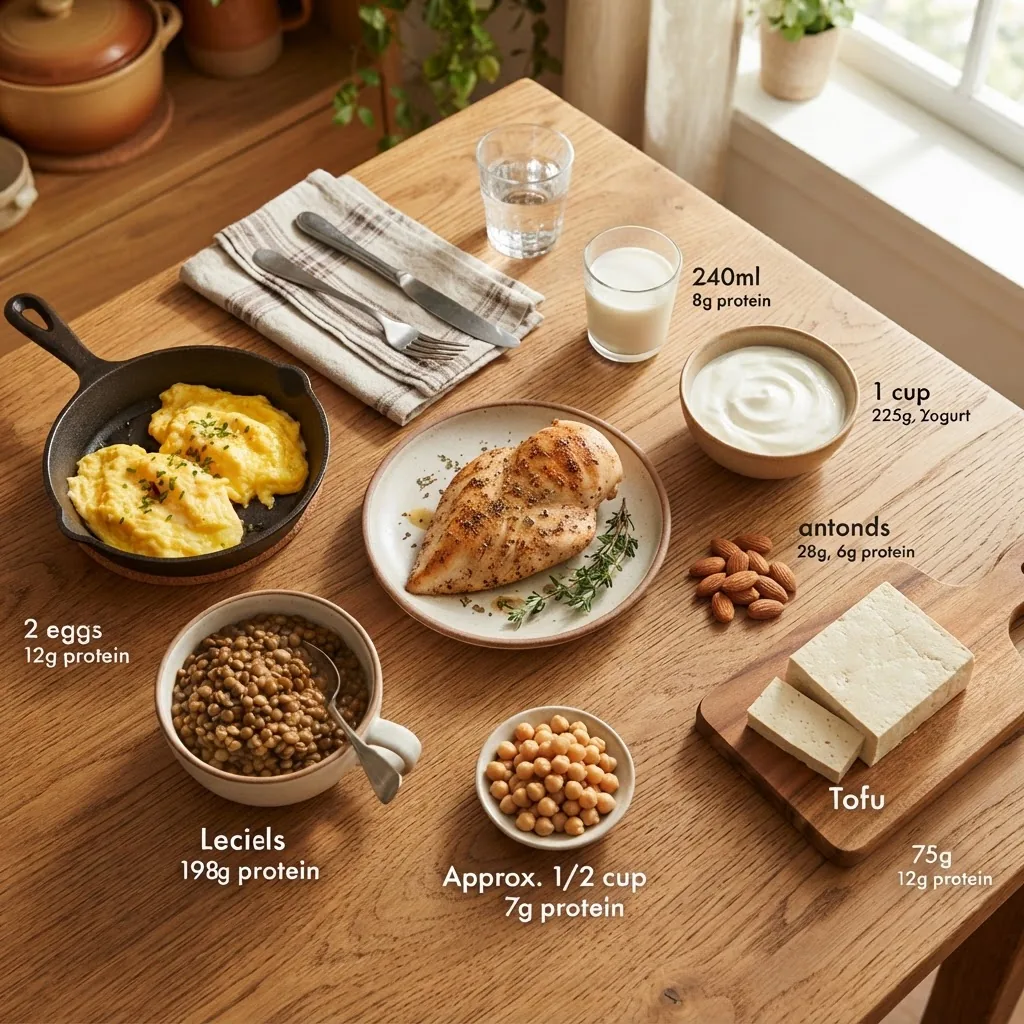
- Breakfast patterns (20–25 g): 2 eggs (12 g) + 150 g Greek yogurt (10–12 g) = ~22–24 g.
- Lunch (20–30 g): 100 g cooked chicken breast = ~31 g; 85 g canned tuna = ~20–24 g; 1 cup cooked lentils = ~18 g.
- Snack (6–10 g): 28 g (1 oz) almonds ≈ 6 g; 1 string cheese ≈ 7 g; 1 cup edamame ≈ 17 g.
- Dinner (20–30 g): 100 g cooked salmon ≈ 22–25 g; 150 g firm tofu ≈ 18 g; 150 g cottage cheese ≈ 22–25 g.
Two sample day plans that reach ~60 g:
- Plan A (omnivore, compact): Breakfast: 2 eggs (12 g) + 150 g Greek yogurt (12 g) = 24 g. Lunch: 85 g tuna sandwich (22 g). Snack: 1 oz almonds (6 g). Total ≈ 52 g; add a small cottage cheese snack (8 g) → 60 g.
- Plan B (vegetarian): Breakfast: 1 cup cooked steel-cut oats with 1 scoop soy protein (20 g). Lunch: large salad with 1 cup chickpeas (15 g). Snack: 1 cup edamame (17 g). Total ≈ 52 g; add 2 tbsp peanut butter (8 g) → 60 g.
Portion equivalencies and quick references:
- 100 g cooked chicken breast ≈ 30–31 g protein.
- 1 large egg ≈ 6–7 g protein.
- 1 cup cooked lentils ≈ 18 g protein.
- 1 scoop whey (typical) ≈ 20–25 g protein.
To round out meals with healthy fats and micronutrients, pair protein with heart-healthy cooking oils and omega-3 rich protein sources. For budget options, see affordable high-protein foods and for quality, consult complete protein sources.
Key takeaway: Reaching 60 g is straightforward with modest portion planning; heavier or active people will need larger portions or targeted supplements to exceed 60 g.
Transition: Readers often encounter misconceptions about protein—next we debunk common myths and clarify safety concerns.
Common Myths and FAQs About Protein Intake
This section addresses common myths with concise evidence-focused clarifications. Each myth is followed by a short, data-backed correction.
Myth: More protein always equals more muscle
Reality: Muscle gain requires adequate resistance training and progressive overload as well as protein. Protein beyond 1.6–2.2 g/kg shows diminishing returns for hypertrophy in most adults (Source type: systematic reviews in sports nutrition).
Myth: High protein damages kidneys in healthy people
Reality: In individuals with normal renal function, higher-protein diets have not been shown to cause kidney damage in long-term observational and controlled studies; caution is required only for existing kidney disease (Source type: clinical nephrology reviews).
Myth: 60 g is the optimal amount for everyone
Reality: 60 g is a practical baseline for many women and lighter adults—but heavier adults, athletes, and older adults often need higher intakes based on g/kg calculations (Source types: 2023 USDA Dietary Guidelines; Academy of Nutrition and Dietetics).
Myth: Plant proteins are always inferior
Reality: Plant proteins can meet needs when total intake and complementary amino-acid sources are planned; some plant foods are complete proteins and others can be combined to provide full amino acid profiles (Source type: nutrition science textbooks).
Key takeaway: Calibrate protein to your weight, age, activity, and health status rather than applying a one-size-fits-all number.
Transition: We close with a concise summary, practical final recommendations and a short methodological note explaining how we assessed the evidence.
Summary and Final Recommendations
60 grams of protein is a practical, evidence-aligned daily intake for many adult women and lighter adults, but it is neither universally sufficient nor excessive. Use g/kg calculations as your primary tool and increase targets for weight loss, older age, or athletic training.
What the numbers mean for you
- If you are a woman of average height and weight and not highly active, 60 g is a reasonable daily target — it approximates 1.0 g/kg for a 60 kg adult (Source type: 2023 USDA Dietary Guidelines).
- If you are trying to lose weight and preserve muscle, calculate protein at 1.2–1.6 g/kg; most people will need well above 60 g when heavier than ~50 kg (Source type: consensus reviews and clinical trials).
- If you are older (65+), aim for ≥1.0–1.5 g/kg to reduce sarcopenia risk; 60 g is often low for seniors above ~60 kg (Source type: geriatric nutrition guidance).
- Distribute protein evenly across meals (20–40 g per meal) and pair with resistance exercise to maximize muscle protein synthesis (Source type: physiological studies synthesis).
- For quick personalization, use a calculator or the g/kg formulas discussed; adjust for activity and health conditions and consult a clinician for tailored advice.
How we assessed this
We synthesized government dietary guidance (USDA 2023), consensus position statements (Academy of Nutrition and Dietetics), NIH guidance, and aggregated findings from peer-reviewed systematic reviews and clinical trials. We prioritized consensus ranges (g/kg), population intake data (industry reports), and practical meal-equivalents. We applied these to real-life profiles to produce reproducible calculations.
Final CTA: Use the g/kg methods to calculate your baseline, compare with the 60 g benchmark, then adjust upward for weight loss, age, or activity. For actionable food lists that map directly to protein targets, see Protein Rich Food for Weight Loss: Healthy Options Guide.
Disclaimer: This report provides general guidance. Individual protein needs vary; consult a healthcare provider before making major dietary changes, especially if you have chronic health conditions. (Source type: professional clinical guidance)