

Nutrition standards are the measurable nutrient targets and labeling rules set by federal and state authorities to protect public health, guide consumer choices, and regulate food programs; they specify required nutrients, daily values, labeling formats, and program-specific limits for schools, WIC, and commercial foods in Texas and the U.S.
What are nutrition standards and who uses them?
Answer: Nutrition standards are defined nutrient targets and rules used by regulators, food manufacturers, institutions, and health professionals to ensure foods meet safety, labeling, and dietary needs.
Nutrition standards set quantitative and qualitative criteria for nutrients (e.g., limits on sodium, thresholds for whole grain content, required vitamins) and procedural rules for labeling, recordkeeping, and program eligibility.
Term: nutrition standards: formal specifications for nutrient amounts, labeling, and product claims established by regulatory or program authorities.
Users include:
- Regulatory agencies enforcing public health law.
- Food manufacturers designing recipes and labels.
- Institutions (schools, hospitals) applying procurement rules.
- Dietitians and clinicians advising clients based on program-specific targets.
Which agencies set nutrition standards in the United States and Texas?
Answer: Federal agencies — primarily FDA and USDA — set national nutrition labeling and program standards; Texas state agencies implement program rules and licensing under federal frameworks.
Term: FDA: the U.S. Food and Drug Administration, overseeing food labeling and safety for most packaged foods.
Term: USDA: the U.S. Department of Agriculture, responsible for school meal standards, SNAP, and some meat/commodity programs.
Term: TDA: Texas Department of Agriculture, which administers federal programs like school meals and SNAP implementation at the state level.
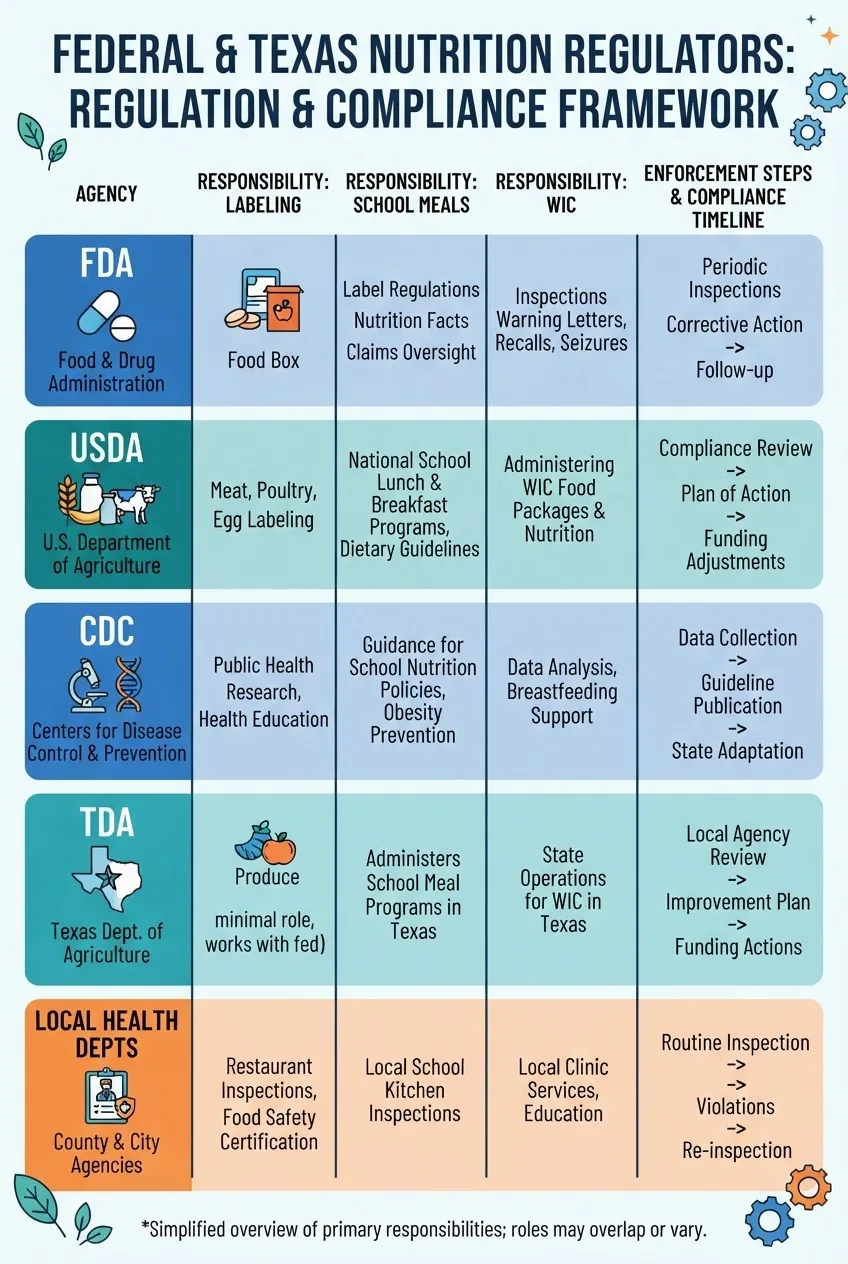
Federal roles summarized:
- FDA: Nutrition Facts Panel formats, nutrient definitions, labeling claims, ingredient listing, and enforcement for most packaged foods.
- USDA Food and Nutrition Service (FNS): Nutrient standards for National School Lunch Program (NSLP), School Breakfast Program (SBP), WIC (in partnership with states), and SNAP policies.
- CDC and state health departments: surveillance, guidance on public health nutrition, outbreaks, and community programs.
Texas roles summarized:
- TDA: enforces USDA program rules for schools, distributes state-level guidance, and certifies vendors for school contracts.
- Texas Department of State Health Services (DSHS): inspects food establishments, enforces sanitation policies that interact with labeling and claims.
What must a Nutrition Facts label include to meet nutrition standards?
Answer: A compliant Nutrition Facts label must include serving size, calories, macronutrients, specified micronutrients, and percentage Daily Values in the FDA-prescribed format unless exempt.
Term: Nutrition Facts Panel: the standardized label format mandated by FDA that reports serving size, energy, key nutrients, and % Daily Value per serving.
Required elements (general):
- Serving size and servings per container.
- Calories per serving.
- Total fat, saturated fat, trans fat, cholesterol, sodium.
- Total carbohydrates, dietary fiber, total sugars, added sugars.
- Protein.
- Vitamin D, calcium, iron, potassium (required micronutrients).
- Percent Daily Value (%DV) based on reference amounts.
Exceptions and special cases include small businesses, single-ingredient products, and foods sold in certain retail settings; manufacturers must check FDA guidance for exemptions and format variations.
How are Daily Values and nutrient targets determined?
Answer: Daily Values (DVs) are population-level reference numbers derived from the FDA’s interpretation of DRI reports and federal nutrient recommendations; program-specific targets may use RDA, AI, or upper limits (UL) from authoritative bodies.
Term: Daily Value (DV): a single set of nutrient reference numbers used on labels to show the percentage of a nutrient provided by a serving relative to general dietary needs.
Term: DRI: Dietary Reference Intake, a set of nutrient reference values (including RDA, AI, and UL) developed by the Institute of Medicine (now National Academies).
DVs are intended for the general public and are not age- or condition-specific; program-level standards (e.g., school meals) translate DVs and DRIs into meal-level nutrient targets by age group and calorie-range.
Key principles for setting targets:
- Use authoritative scientific reviews (DRI, National Academies) as a baseline.
- Adjust for population group needs (children, pregnant women, older adults) when defining program standards.
- Cap nutrients with toxicity risk (e.g., sodium, saturated fat) using public health risk thresholds.
- Balance nutrient density against caloric targets for specific meal programs.
What nutrition regulations apply to Texas school meals, WIC, and childcare programs?
Answer: Texas school meals follow USDA NSLP/SBP nutrition standards; WIC foods are defined by USDA FNS with state-level formulations; childcare nutrition programs follow federal CACFP rules administered by Texas agencies.
Term: NSLP: National School Lunch Program, a USDA program with meal nutrition standards for calories, saturated fat, sodium, and food components.
Term: WIC: Special Supplemental Nutrition Program for Women, Infants, and Children, which prescribes approved food packages and nutrient quantities.
Term: CACFP: Child and Adult Care Food Program, federal program with meal component and nutrition requirements for licensed childcare providers.
Specifics for each:
- NSLP/SBP: meals must meet calorie ranges, ≤10% saturated fat over a week, sodium limits phased in, required fruits/vegetables, and whole grain-rich criteria.
- WIC: lists allowed food types and package sizes (e.g., amount of iron-fortified cereal, milk), with state flexibility for substitutions.
- CACFP: specifies meal components by age group (milk, grains, fruits/vegetables, meat/meat alternate) and portion sizes to meet nutrition standards.
Texas school districts must follow TDA guidance to implement USDA standards and maintain documentation such as production records and procurement contracts to demonstrate compliance during reviews.
How do manufacturers demonstrate compliance with nutrition standards?
Answer: Manufacturers demonstrate compliance via accurate nutrition analysis, approved label format, documentation (formulas, batch records), and third-party lab testing when required.
Term: Nutrition analysis: laboratory testing or validated software calculation that quantifies nutrients per serving based on formulation and ingredients.
Documentation and verification steps include:
- Maintain product formula and ingredient specifications with supplier Certificates of Analysis (COAs).
- Calculate nutrient values using nutrient analysis software validated to FDA methods or perform laboratory assays for critical nutrients.
- Create a compliant Nutrition Facts Panel and ingredient list per FDA rules.
- Retain batch records, sample retention, and COAs for audit periods (commonly 2 years for labels, longer for safety records).
- Use third-party certification (e.g., SQF, BRC) or independent lab reports for export, institutional procurement, or retailer requirements.
Common lab tests: proximate analysis (moisture, fat, protein, ash), sodium, dietary fiber, and vitamin assays where required by program standards.
What enforcement actions occur for noncompliance and how are penalties applied?
Answer: Enforcement ranges from warning letters and mandatory recalls to monetary penalties and program disqualification; agencies use inspections, label reviews, and audits to detect noncompliance.
Enforcement tools and examples:
- FDA: warning letters, mandatory recalls (under certain conditions), seizures, injunctions, and civil monetary penalties for misbranding or adulteration.
- USDA/TDA: disallowances, corrective action plans, termination from federal programs (e.g., NSLP), and fines related to reimbursement fraud or procurement violations.
- Local health departments: temporary closure, license suspension, or civil penalties for food safety violations that affect nutrition program operations.
Penalties depend on severity, prior history, and risk to public health; food businesses typically receive an opportunity to correct minor labeling errors before escalated enforcement.
How do you calculate nutrients and create a Nutrition Facts Panel for a new product (worked example)?
Answer: Calculate nutrients by summing nutrient contributions from each ingredient per batch, dividing by servings, and rounding per FDA rules; document inputs, calculations, and rounding logic to create the Nutrition Facts Panel.
Worked example: formulate a 12-serving granola bar recipe and produce per-serving nutrient values.
Step-by-step procedure:
- List all ingredients by weight per batch (grams) and their nutrient composition per 100 g from supplier or USDA database.
- Multiply each ingredient’s weight by nutrient per-gram values to get batch totals for calories, macronutrients, sodium, fiber, and sugars.
- Sum batch nutrient totals and divide by the number of servings to get per-serving values.
- Apply FDA rounding rules (e.g., calories rounded to nearest whole number, %DV rounding for vitamins/minerals).
- Prepare the label layout with serving size, calories, nutrient amounts, and %DV using current FDA reference DVs.
| Ingredient | Weight (g) | Calories/100g | Calc cals (batch) |
|---|---|---|---|
| Rolled oats | 600 | 389 | 2334 |
| Honey | 200 | 304 | 608 |
| Almonds | 150 | 579 | 868.5 |
| Dried fruit | 100 | 300 | 300 |
| Total (approx) | 1050 | — | 4110.5 |
| Per serving (12) | 87.5 | — | 342.5 |
Interpretation: this simplified calculation yields ~343 calories per bar; repeat the same math for grams carbohydrate, protein, fat, sodium, fiber, sugars, and micronutrients, then apply rounding and %DV calculations for the Panel.
Documentation note: include ingredient lot numbers, supplier COAs, software export or lab certificates that support each nutrient value claimed.
What are typical costs and timelines for testing, label preparation, and compliance?
Answer: Costs and timelines vary by scope: label creation and basic analysis can take 1–4 weeks and $500–$3,000; full laboratory nutrient panels and certification can take 2–8 weeks and $1,500–$10,000 depending on tests and volumes.
| Service | Typical cost (USD) | Typical timeline |
|---|---|---|
| Nutrition analysis (software, internal) | $0–$500 (software fees) | 1–7 days |
| Third-party lab panel (macros, sodium, fiber) | $200–$1,500 per product | 1–4 weeks |
| Vitamin/mineral assays | $500–$5,000+ | 2–8 weeks |
| Label artwork and legal review | $300–$2,000 | 3–14 days |
| Third-party certification (SQF/BRC) | $5,000–$25,000+ (scale dependent) | 6–12 months |
Budget planning tips:
- Start with validated ingredient-level analysis to reduce expensive lab tests where possible.
- Prioritize tests required by purchasing customers or programs (e.g., sodium for school procurement).
- Allow buffer time for supplier COA retrieval and label iteration following legal review.
How do nutrition standards differ between consumer labels and institutional programs?
Answer: Consumer labels use universal DVs and standard panels for retail transparency; institutional programs translate nutrient targets into age/calorie-based meal specifications and procurement criteria focused on public health goals.
Key differences:
- Audience: labels target individual consumers; programs target population subgroups (children, low-income households).
- Metric: labels show per-serving nutrient amounts and %DV; programs specify meal-level calories, component servings (e.g., cups of vegetables), and nutrient ranges per age group.
- Enforceability: labels are regulated for truthful presentation; program compliance involves menu reviews, production records, and reimbursement controls.
| Feature | Retail Label | Institutional Program |
|---|---|---|
| Primary metric | Per-serving nutrients, %DV | Meal-level nutrients, components, calorie ranges |
| Audience | General consumers | Children, beneficiaries, institutional diners |
| Verification | Label review, random inspections | Menu review, production records, audits |
How should small Texas food businesses prepare for nutrition regulation compliance?
Answer: Small businesses should document formulations, obtain supplier COAs, use validated nutrition analysis, create compliant labels, and register with relevant state programs early to avoid delays.
Practical checklist:
- Collect ingredient specifications and COAs from suppliers before launch.
- Decide whether to run internal calculations or contract a lab for a baseline nutrient panel.
- Create label mockups and run them by a legal reviewer or consultant familiar with FDA/TDA rules.
- Maintain a permanent sample of each production lot for potential testing.
- Register with Texas regulatory portals if participating in NSLP/CACFP or selling to institutional customers.
Local resources include Small Business Development Centers, Texas Department of Agriculture guidance, and university extension services that often provide low-cost lab testing or referral lists.
How do nutrition standards interact with claims like “low sodium” or “high in fiber”?
Answer: Nutrition claims are authorized by FDA and depend on meeting precise nutrient thresholds and wording rules; a product must meet the numeric definition to use a claim like “low sodium” or “excellent source of.”
Term: Nutrition claim: a regulated statement on packaging that characterizes the level of a nutrient (e.g., “low fat,” “good source”) and must meet FDA definitions.
Common claim rules:
- “Low sodium” means ≤140 mg sodium per serving (subject to product class rules).
- “Low fat” means ≤3 g total fat per serving and ≤30% of calories from fat for meals and main dishes.
- “Good source” or “Excellent source” claims require specific %DV thresholds (e.g., good source = 10–19% DV, excellent source = ≥20% DV).
- “Reduced” requires a nutrient level at least 25% lower than the reference product.
Label reviewers will check the basis of the claim (formula, analysis, or comparative data) and require documentation; misuse can trigger enforcement actions for misleading claims.
How should procurement officers compare products to nutrition standards for school or institutional contracts?
Answer: Procurement officers should use a standardized checklist mapping required nutrient ranges, serving sizes, component criteria, and label verification to objectively score vendor products during bidding.
Procurement comparison steps:
- Define mandatory nutrition criteria from program rules (e.g., sodium limits, whole grain content, calorie caps).
- Request documentation: Nutrition Facts Panel, product formulation sheet, allergen statement, and COAs if available.
- Score offers against each criterion and require corrective action plans for conditional approvals.
- Include contractual audit rights and sample testing clauses to enforce long-term compliance.
Use a tabular evaluation matrix when comparing vendors to ensure transparent, defensible decisions during audits or protests.
What are best practices for staying current with changes in nutrition regulation?
Answer: Best practices include subscribing to FDA/USDA regulatory alerts, attending state trainings (TDA), maintaining relationships with legal/regulatory consultants, and scheduling periodic label reviews.
Actionable steps:
- Subscribe to FDA and USDA/FNS rulemaking email lists and RSS feeds.
- Follow TDA and Texas DSHS announcements for state-specific changes and trainings.
- Set a 12-month calendar for label review to address new DVs, claim guidance, or format updates.
- Budget for periodic third-party lab verification when formulas or suppliers change.
Internal governance: assign a responsible person for regulatory watch and retain documentation of when and how updates were implemented for audit trails.
Where can Texas businesses and dietitians get local assistance and tools?
Answer: Use Texas Department of Agriculture resources, university extension services, local health department guidance, Small Business Development Centers, and established online tools for label creation and nutrient analysis.
Key resources and links:
- Nutritionally Complete Meal Guide — guidance on balanced meals and target nutrients for program menus.
- Nutrition Facts Label Guide — step-by-step label interpretation and examples.
- Food Labels Guide — additional detail on ingredient lists and claims.
Other practical local options include university food science departments for pilot testing, state-sponsored trainings for school food authorities, and private consultants specializing in FDA/USDA compliance.
How do nutrition standards influence consumer advice and public health messaging?
Answer: Nutrition standards provide the objective metrics (DVs, limits, required components) that underpin public health guidance, allowing professionals to translate regulatory thresholds into actionable diet advice for populations.
Examples of influence:
- Public messages about reducing sodium rely on program sodium targets and epidemiological evidence adopted into DVs.
- School nutrition education uses meal component criteria to teach recommended food group portions.
- Dietitians use label %DVs to counsel clients on portion control and nutrient adequacy relative to individual needs.
When providing advice, clinicians must translate population-level DVs to individualized recommendations using DRIs and clinical judgment, especially for patients with special nutrition needs.
How should disputes or ambiguous cases be handled when interpreting nutrition standards?
Answer: Resolve disputes by consulting the primary regulatory text (FDA/USDA guidance), obtaining independent laboratory verification, and seeking written interpretations from the enforcing agency or legal counsel when precedent is unclear.
Recommended dispute workflow:
- Review the exact regulatory citation and any agency guidance documents that clarify intent.
- Collect objective evidence: formulations, supplier data, lab results, and label proofs.
- Request informal clarification from the relevant agency; if insufficient, ask for a formal determination or legal review.
- Document communications and corrective steps taken to demonstrate good-faith compliance efforts.
For procurement or program disputes, use contract clauses that define resolution paths, including independent testing and mediation.
Frequently Asked Questions
What is the difference between Daily Value and Recommended Daily Allowance?
Daily Value (DV) is the label reference number used to express %DV on Nutrition Facts panels for the general public; Recommended Dietary Allowance (RDA) is an age- and sex-specific intake level from DRI reports used in clinical nutrition and some program calculations, not directly shown on retail labels.
Do all packaged foods sold in Texas need a Nutrition Facts label?
Most packaged foods sold at retail in Texas must carry a Nutrition Facts label unless they qualify for FDA exemptions (e.g., certain small businesses, single-ingredient products, or foods sold directly by the producer at farmer’s markets); verify specific exemptions in current FDA guidance.
How often must a manufacturer retest product nutrient values?
There is no mandatory periodic retest schedule from FDA, but best practice is to retest after formulation or supplier changes and at least every 1–3 years for quality assurance; institutional buyers or certification programs may impose stricter retest intervals.
Can a product use “low sodium” if it meets school program limits?
Meeting school program sodium limits does not automatically permit the “low sodium” claim; use of “low sodium” requires meeting FDA numeric thresholds for that claim per serving and should follow claim-specific rules in addition to program compliance.
What records should schools keep to prove meal standard compliance?
Schools should retain production records, menus with portion sizes, procurement invoices, CN (Child Nutrition) labels or product documentation, nutrition analysis, and staff training records for reviews and audits as specified by USDA and TDA guidance.
How long does it take to update labels when FDA changes Daily Values?
Label update timelines depend on the specific FDA rule; historically, manufacturers were given transition periods (months to years) to comply with major changes, but businesses should follow the effective date in the final rule and plan updates well before that date.
Which Texas agency enforces school meal nutrition standards locally?
The Texas Department of Agriculture (TDA) administers USDA-funded school meal programs in Texas, provides policy guidance, and conducts reviews to ensure local education agencies comply with federal nutrition standards and procurement rules.
When should I hire a nutrition regulatory consultant?
Engage a consultant when launching products intended for institutional programs, when making complex claims, when navigating export or state-specific rules, or if internal expertise is insufficient to ensure accurate labeling and program compliance.