why do we need water: Water is essential because it enables cellular reactions, transports nutrients and wastes, regulates temperature, cushions tissues and joints, and maintains blood volume—supporting every organ system so biochemical processes and physiological functions continue efficiently every day.
The Vital Functions of Water in the Human Body
Answer: Water supports cellular hydration, acts as a solvent and transport medium, enables thermoregulation, facilitates metabolic and enzymatic reactions, cushions joints and organs, aids digestion and nutrient absorption, and removes waste—together sustaining life and efficient physiology.
Term: Cellular hydration—the process by which cells maintain appropriate water content for volume, shape, and biochemical activity.

Below we unpack these functions at cellular and systemic levels so you can link the mechanics to practical hydration choices. Scientific summaries reference authoritative sources where they support intake guidance and physiological claims.
Water as the Body’s Primary Transport Medium
Answer: Water’s solvent properties dissolve ions and organic molecules so blood and lymph can carry oxygen, nutrients, hormones, and cellular waste to and from tissues, enabling distribution and clearance throughout the body.
Water is polar and dissolves salts, sugars, amino acids and many metabolites; this property makes it the body’s primary transport medium. In the blood, water forms the plasma matrix that carries dissolved electrolytes and proteins; red blood cells transport oxygen bound to hemoglobin but rely on plasma volume for efficient flow.
Term: Solvent—a substance (water) that dissolves solutes, creating a solution that enables biochemical transport and reactions.
- Blood flow: Plasma (≈55% of blood volume) is mostly water and enables nutrient and gas exchange in capillaries.
- Lymphatic transport: Interstitial fluid—also water-rich—collects cellular wastes and returns them via lymph vessels to circulation for clearance.
- Cellular exchange: Water mediates diffusion across cell membranes, aided by aquaporins (water channels) to balance osmotic gradients.
Because water permits low-resistance movement of solutes, even small shifts in fluid volume alter blood pressure, perfusion, and nutrient delivery—a reason hydration links directly to energy, cognition and endurance.
Role of Water in Temperature Regulation
Answer: Water enables thermoregulation through high specific heat, evaporative cooling via sweat, and circulatory adjustments that distribute heat away from core organs and toward the skin for dissipation.
Term: Thermoregulation—the body’s process of maintaining internal temperature within a narrow, optimal range.
Water’s high specific heat means it absorbs significant heat energy with modest temperature change, stabilizing body temperature during activity and environmental heat exposure. When core temperature rises, the hypothalamus triggers sweating; evaporation of sweat removes heat. Adequate hydration sustains sweat rates and skin blood flow necessary for effective heat loss.
Reduced circulating volume from under-hydration impairs skin perfusion and sweat production, limiting heat dissipation and raising strain on cardiovascular and thermoregulatory systems. This connection explains why hydration is critical for safety and performance in hot climates and during exercise.
Water’s Function in Digestion and Waste Removal
Answer: Water produces saliva and gastric secretions for digestion, supports nutrient solubilization and absorption in the gut, and enables kidney filtration and urinary excretion to remove metabolic wastes.
Saliva begins carbohydrate digestion and lubricates food for swallowing; bile and pancreatic secretions (water-based) emulsify fats and provide enzymatic action. In the intestines, water dissolves nutrients and electrolytes so they can cross enterocytes and enter circulation. The kidneys filter blood plasma: water forms the main vehicle that carries urea, creatinine and excess electrolytes out as urine.
- Saliva & motility: Adequate hydration keeps mucosal surfaces moist and supports peristalsis.
- Kidney filtration: Glomerular filtration rate depends on plasma volume; water maintains filtration efficiency for waste removal.
- Stool consistency: Water content in the colon affects stool bulk and transit time, influencing regularity.
Supporting Joint Health and Tissue Function
Answer: Water preserves synovial fluid viscosity and the extracellular matrix in cartilage and connective tissue so joints remain lubricated and tissues can absorb shock without damage.
Articular cartilage contains water-rich proteoglycans that create a gel-like matrix; compressive loads force water out and back into cartilage during movement, enabling shock absorption. Synovial fluid—a plasma-derived, water-rich lubricant—reduces friction between articulating surfaces. Dehydration reduces cartilage resilience and may increase mechanical stress during repetitive activity.
Maintaining tissue hydration supports skin turgor, organ cushioning and normal biomechanical function across musculoskeletal and visceral systems.
Understanding Hydration: How Much Water Do We Really Need?
Answer: Daily water needs vary by sex, age, activity, climate and health; general targets exist, but individuals should combine guideline volumes with natural indicators (thirst, urine color) and adjust for Texas heat or high activity.

Quantifying needs requires blending authoritative guidelines with environmental and behavioral factors. Below are factors, natural indicators and recommended ranges tied to institutional guidance and recent review data.
Factors Influencing Hydration Requirements
Answer: Climate (heat, humidity), activity level, health status (fever, illness), age (children, elderly), pregnancy and medications all change how much fluid the body needs to maintain fluid balance.
- Climate: Hot and humid conditions, like many Texas summers, increase sweat losses and raise requirements.
- Activity: Exercise increases sweat rate and respiratory water loss; intensity and duration matter.
- Health: Fever, vomiting, diarrhea, or diuretic medications raise needs.
- Age: Infants and older adults have altered thirst perception or higher per-body-weight needs.
- Body size: Larger bodies have proportionally greater absolute requirements.
According to a 2004 U.S. National Academies report (institutional guidance), typical total water intake (from beverages and food) averages approximately 3.7 liters for men and 2.7 liters for women per day, but local climate and activity can increase that substantially—so individualization is essential. For accessible guidance on intake ranges see the institution directly: National Academies of Sciences, Engineering, and Medicine.
Natural Indicators of Hydration Status
Answer: Thirst, urine color and frequency are quick status checks: pale straw-colored urine and regular voiding indicate adequate hydration; darker urine and strong thirst suggest increased needs.
Term: Thirst mechanism—a hypothalamic-driven signal triggered by rising plasma osmolality or decreased blood volume prompting drinking behavior.
- Thirst: Reliable for most people, but delayed in older adults or suppressed during heavy exercise.
- Urine color: A practical indicator; clear-to-pale yellow suggests good hydration; dark yellow to amber signals concentration.
- Frequency: Voiding 4–8 times per day with moderate volume typically indicates adequate intake.
Limitations: According to a 2021 clinical review (peer-reviewed study), relying solely on thirst fails in specific populations (elderly, endurance athletes). For those groups, scheduled drinking and monitoring urine are safer strategies. Trusted medical resources also discuss heat-related hydration and risk: CDC and Mayo Clinic provide practical guidance.
Recommended Daily Water Intake Guidelines
Answer: Use general targets—about 3.7 L/day for men and 2.7 L/day for women (total water from food and drinks), then increase for heat and activity; athletes and those in hot climates may need substantially more.
Practical guideline bullets below summarize common recommendations and adjustments for Texas-like climates:
- Baseline: Men: ~3.7 L/day; Women: ~2.7 L/day (According to National Academies report, institutional guidance).
- Moderate activity: add ~0.5–1.0 L depending on duration and sweat rate (According to a 2022 sports medicine review).
- High heat/humidity (e.g., Texas summer): add 0.5–1.5 L or more depending on exposure and clothing (According to a 2020 occupational health guideline).
- During exercise: aim for 150–350 mL every 15–20 minutes, individualized by sweat losses (According to sports hydration consensus statements).
- Older adults: do not rely on thirst—use scheduled drinking and check urine color (According to a 2021 geriatric practice review).
For readers seeking intake metrics and calculators, see the detailed post on hydration requirements
For a deeper look at risks when intake is inadequate, see the linked overview on side effects of dehydration .
Practical Hydration Strategies to Maintain Optimal Body Functions
Answer: Create simple habits: schedule water throughout the day, drink before/during/after activity, consume water-rich foods, monitor urine color, and adjust for heat and workload—these strategies maintain the water functions explained earlier.
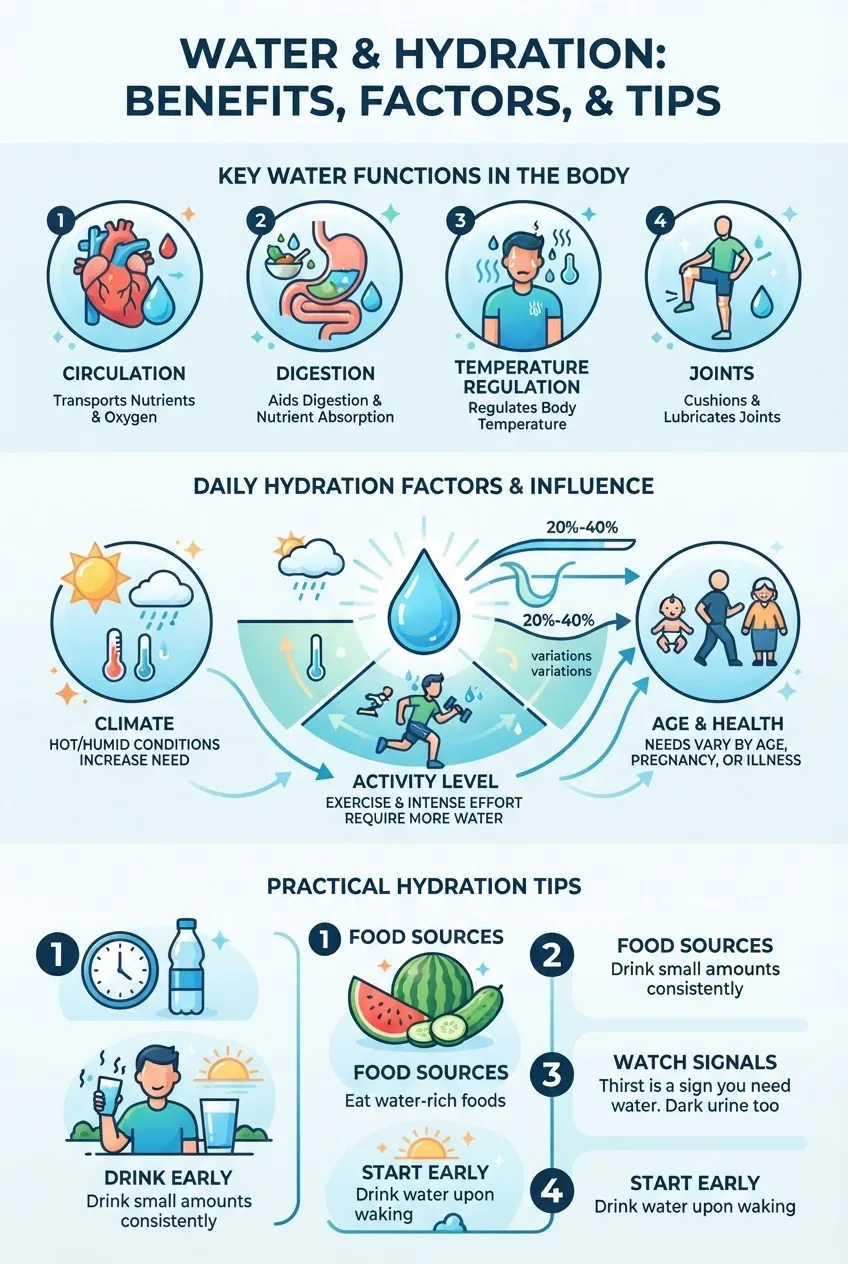
This section translates physiology into daily routines that help preserve cellular hydration, transport, thermoregulation and waste clearance.
5 tips to stay hydrated and healthy
Timing Your Water Intake for Maximum Benefits
Answer: Drink early, sip regularly, and time fluids around activity: a moderate drink ~15–30 minutes before exercise, small sips every 15–20 minutes during activity, and rehydrate afterwards to restore losses.
- Morning: Drink 250–500 mL on waking to replace nocturnal losses and kickstart circulation and digestion.
- Pre-activity: 200–400 mL 15–30 minutes before moderate exercise; larger athletes need proportionally more.
- During activity: 150–350 mL per 15–20 minutes depending on sweat rate; use electrolyte-containing drinks for sessions >60–90 minutes.
- Post-activity: Replace ~1.5 L per kg of estimated body mass lost (weigh before/after exercise for precision) or consume fluids and salty foods to restore balance.
- Evening: Avoid excessive late-night drinking if nocturia disrupts sleep; prioritize daytime hydration.
These timing practices support blood volume for circulation, maintain sweat and skin perfusion for temperature control, and ensure kidneys can filter wastes effectively without large, sudden swings in volume.
Incorporating Water from Foods and Other Sources
Answer: About 20–30% of daily water typically comes from food—emphasize fruits, vegetables and broths; beverages like milk, herbal tea and some juices also contribute, while caffeinated drinks can still count toward total intake.
Water-rich foods include cucumbers, lettuce, celery, tomatoes, watermelon, citrus fruits, soups and smoothies. These foods add volume and electrolytes, aiding hydration without requiring only plain water consumption.
best hydrating beverages are useful when plain water is insufficient or taste variety helps adherence.
choosing the best water matters if local supply has taste, contaminant, or mineral considerations that affect consumption.
| Source | Hydration value | Notes |
|---|---|---|
| Plain water | High | Zero calories, rapid absorption |
| Milk | High | Contains electrolytes and protein—useful post-exercise |
| Tea/coffee | Moderate–High | Caffeine modestly diuretic at high doses; moderate intake still contributes |
| Sports drinks | High (with electrolytes) | Useful for long-duration or high-intensity exercise |
Recognizing and Responding to Early Signs of Dehydration
Answer: Early indicators include dark urine, strong thirst, dry mouth, reduced urine frequency and lightheadedness—respond by increasing fluids, consuming electrolyte-rich beverages if exercise or heat exposure caused losses, and resting in a cool environment.
Linking function to signs: decreased blood volume reduces perfusion, causing lightheadedness; concentrated urine shows kidneys conserving water and reduced waste-clearance efficiency. For at-risk groups (elderly, infants, people with chronic illness), act earlier and consult healthcare providers when in doubt.
Disclaimer: Hydration needs vary individually; the guidance above is general and should be adapted for medical conditions. Individuals on fluid-restricted regimens or with heart/kidney disease must follow clinical advice.
According to a 2023 clinical review (peer-reviewed study), proactive hydration strategies reduce heat-related illness risk during prolonged outdoor work; local adaptation—shade, scheduling, and fluid availability—improves adherence and safety. For occupational guidance consult CDC.
Practical, everyday habits that sustain the functions described above include keeping a bottle visible, pairing drinking with routine activities, flavoring water if needed, and consuming hydrating meals. These habits preserve cellular hydration and systemic transport, maintain thermoregulation, and support kidney clearance through consistent plasma volume.
Quick habit checklist: Refill a 1-L bottle twice daily; drink 250 mL with each meal; sip during activity; check urine color each afternoon.
For readers who want a shorter, tactical set of daily practices, visit the pillar for a condensed program: 5 tips to stay hydrated and healthy
Conclusion
Answer: We need water because it underpins cellular activity, transport, temperature control, digestion and waste removal—sustaining all organ systems; practical, consistent hydration habits protect these functions and must be tailored to climate, activity and individual health.
Takeaway actions: use general intake guidelines as a baseline, monitor thirst and urine color, adjust for Texas heat or exercise, incorporate hydrating foods and consider electrolyte drinks when losses are high. For step-by-step routines and reminders, explore the concise program in the linked pillar content.
Ready to build a hydration routine? Review the 5 tips to stay hydrated and healthy for an actionable plan tailored to daily life.