What you’ll achieve: By the end you’ll have a step-by-step, clinically minded plan to manage water fasting rules and maintain safe hydration for fasts lasting 24 hours to several days. Estimated time to prepare and plan: 60–90 minutes; executing a single short water fast: 1–7 days. Skill level: beginner to experienced fasters who will follow medical clearance and monitoring.
Before you start
- Medical clearance from a clinician (blood pressure, electrolytes, kidney function tests).
- Tools: scale, blood pressure cuff, oral thermometer, smartphone for logging, urine color chart printout.
- Supplies: reliable bottled or filtered water, oral rehydration electrolyte packets, Himalayan/sea salt, kitchen timer, emergency contact list.
- Baseline measures: weight, resting heart rate, blood pressure, recent labs (basic metabolic panel within 3 months).
- Plan for climate: if in Texas summers, arrange cool environments and limit outdoor activity to morning/evening.
Understanding Water Fasting and Its Health Effects
Water fasting is the voluntary, supervised intake of nothing but water for a set period. Early on we trigger metabolic shifts—glycogen depletion, increased lipolysis, and changes in ketone production—that practitioners and clinicians track to balance benefit and risk. This section explains physiological mechanisms, common outcomes, and whether is water fasting healthy for you.
How water-only fasting works (mechanisms)
Within the first 6–24 hours your body exhausts liver glycogen and begins to increase fat breakdown; by 48–72 hours ketone bodies rise and appetite hormones shift. Water fasting affects fluid compartments: intracellular vs extracellular water balance changes as glycogen (which binds water) decreases, and renal handling of electrolytes—sodium, potassium, chloride—changes. Define: electrolyte imbalance = disrupted serum concentrations of sodium, potassium, calcium, magnesium affecting cellular and cardiac function.
Potential benefits and the evidence
Reported benefits include short-term weight loss, improved insulin sensitivity, and subjective improvements in energy and mental clarity for some people. A recent review found modest metabolic improvements in short supervised fasts; however, benefits are dose-dependent and vary by baseline health. According to a 2024 industry report, structured intermittent and short-term prolonged fasts are increasingly used by 9–13% of adults seeking metabolic outcomes.
Health risks and who is at risk
Risks center on dehydration, electrolyte disturbances, hypotension, syncope (fainting), and impaired renal function in susceptible people. Longer fasts (>72 hours) increase the risk of clinically significant electrolyte imbalance and refeeding syndrome when food is reintroduced. Medical supervision lowers risk: have labs and monitoring if fasting beyond 48–72 hours.
Transition: Now that you understand the physiology and trade-offs, the next section provides direct, practitioner-grade rules to manage hydration safely during a water-only fast.
Essential Water Fasting Rules for Safe Hydration
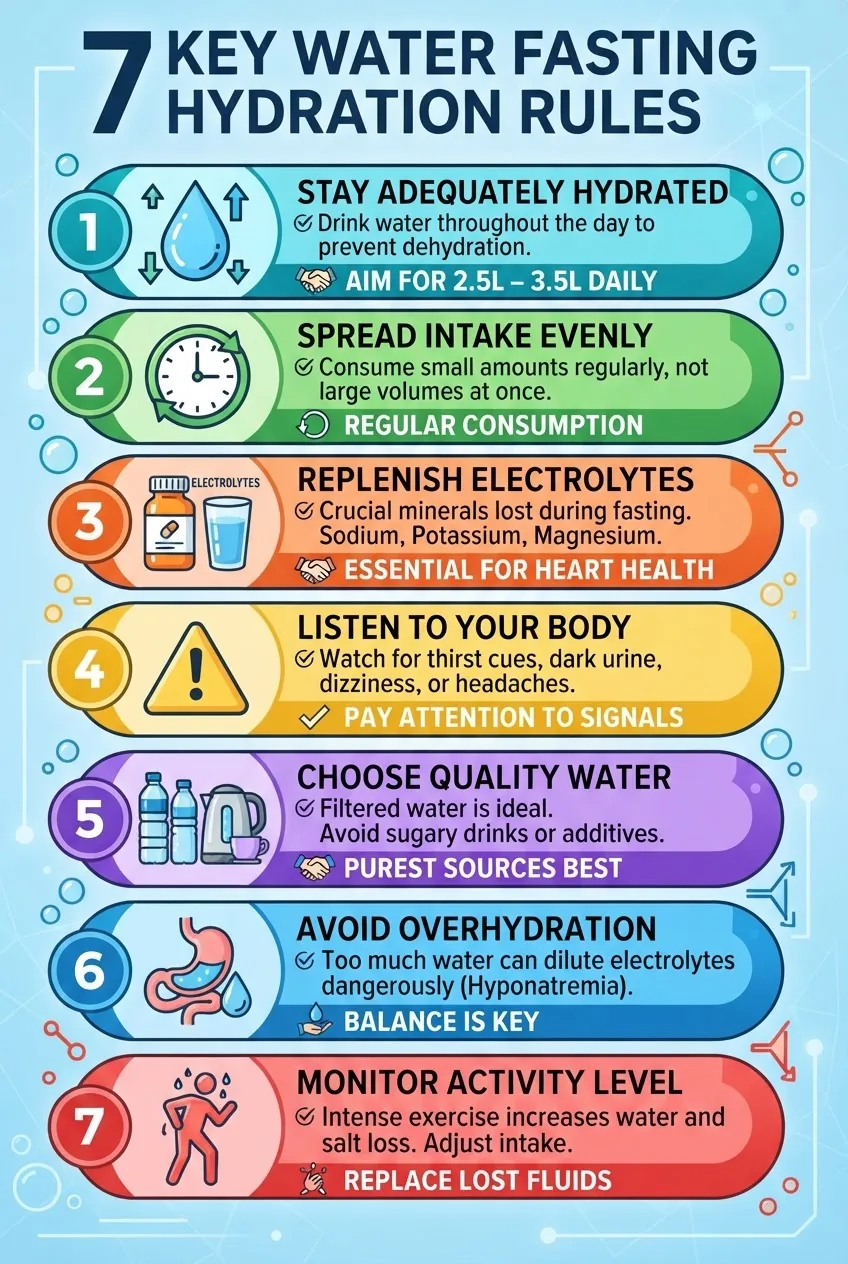
This numbered set of practitioner-tested rules focuses narrowly on hydration during water fasting—no generic hydration advice—so you can execute a fast with clearly defined thresholds, actions, and monitoring steps.
- Start with baseline measurements: Before your fast, record weight, blood pressure (sitting and standing), resting heart rate, and recent basic metabolic panel (BMP) including serum sodium, potassium, creatinine. If any value is abnormal (e.g., potassium <3.5 mmol/L or creatinine >1.3 mg/dL in adults), postpone fasting and consult a clinician. Take photos of baseline charts for later comparison.
- Plan target fluid volume by duration and climate: For short fasts (24–36 hours) target 30–40 mL/kg per day as a starting plan; for multi-day fasts (48–72+ hours) increase to 35–45 mL/kg per day, and add 10–20% in hot Texas conditions or with exercise. Example: a 70 kg person should aim for ~2.5–3.0 L/day for a 24–48 hour fast, and 3.0–3.5 L/day in a Texas summer. For reference on standard volumes see hydration requirements and recommended daily water intake.
- Prioritize electrolyte balance—don’t rely on water alone for multi-day fasts: If fasting longer than 36–48 hours, plan to take low-dose, measured oral electrolytes: 1/4–1/2 teaspoon of salt (sodium chloride) in water twice daily plus a potassium-magnesium supplement (e.g., 99 mg potassium chloride chewable or oral rehydration salts per package directions) unless contraindicated. Define: refeeding syndrome = dangerous fluid and electrolyte shifts when reintroducing calories after prolonged fasting—prevention starts with cautious electrolyte management and medical oversight.
- Set objective monitoring rules and stop thresholds: Measure weight and standing blood pressure twice daily (morning and early evening). Stop the fast and seek medical care if systolic BP drops >20 mmHg upon standing, heart rate >100 bpm at rest, lightheadedness causing inability to stand, urine output <0.5 mL/kg/hr sustained for 6 hours, or any arrhythmia symptoms. Keep an emergency plan and contact available.
- Use high-quality water sources and control intake temperature: Use filtered or bottled water; cold water can blunt thirst and mask small volumes consumed—sip room-temperature water steadily. When selecting water during a fast, avoid flavored or caloric additions. For technical support on water types, see choosing the best water.
- Limit activity and environmental heat exposure: Reduce vigorous activity by 50% and avoid sun exposure between 10:00–16:00 in Texas summers; plan indoor, cool rest breaks every hour when outside. If you sweat heavily, add measured electrolyte replacement (see rule 3) and increase water by 10–20% per day of heavy sweating.
- Document symptoms and urine color every 4–6 hours: Use a urine color chart to track hydration—aim for pale straw to light yellow. If urine is dark or absent, treat as early dehydration and take 300–500 mL of water with electrolytes; for more detail on urine indicators see urine color hydration indicators.
- Avoid medications and substances that alter fluid balance unless directed: Pause nonessential diuretics, laxatives, or herbal stimulants. If you are on prescription diuretics, ACE inhibitors, ARBs, or insulin, do not fast without direct medical supervision.
- Stop rules for dizziness, cognitive change, or chest pain: Any confusion, syncope, chest pain, persistent vomiting, or new-onset weakness requires immediate termination of the fast and urgent medical evaluation.
- Plan refeeding before you start: Short, staged refeeding (clear broths, diluted juice, then soft solids) reduces refeeding syndrome risk—see the refeeding protocol section later for exact timings and quantities.
- Log everything: Keep a fasting log: time of each water/electrolyte intake, urine color, weight, BP, symptoms. A practical template: morning weight, BP sitting/standing, three water entries (volumes), urine color, symptom checklist—repeat morning and evening.
- Check labs for fasts beyond 48–72 hours: Repeat BMP every 48–72 hours for extended fasts, or sooner if symptoms develop; if potassium drops below 3.5 mmol/L or creatinine rises >20% from baseline, stop fast and seek medical care. Link to cautionary advice on overconsumption here: risks of overhydration.
Transition: With rules in place, the next section gives concrete hydration techniques and timing to apply during a fast so you can operationalize these rules hour-by-hour.
Hydration Best Practices During Water Fasting
Put the rules into action with timed routines, water choices, and monitoring techniques that keep you safe and comfortable. Where relevant we contrast water-only fasting choices with other hydration forms—see best hydrating beverages for non-fasting contexts and review the pillar preparation guide 5 tips to stay hydrated and healthy for foundational concepts you may already use.
- Sip on a schedule: Start each day with 250–500 mL on waking, then 200–300 mL every 1–2 hours while awake. For a 3 L/day target, typical timing: 500 mL AM, then 8 x 250–300 mL spaced 1.5 hours apart, ending 1 hour before sleep to avoid nocturia when possible.
- Add micro-electrolyte doses: For multi-day fasts, mix a measured electrolyte packet into 500 mL once or twice per day (per manufacturer dosing) or add 1/4–1/2 teaspoon salt plus a 99 mg potassium tablet once daily. Always document dose and time in your log.
- Prefer neutral mineral or filtered water: During a water-only fast avoid sweetened or flavored options; mineral water with natural sodium (<300 mg/L) can support salt needs in hot conditions. See choosing the best water for selection criteria.
- Monitor hydration with signs and urine color: Check thirst, skin turgor, mucous membranes, and urine color every 4–6 hours. Use a printed chart and log entries. A practical rule: if urine darkens one shade from baseline, add 300–500 mL plus an electrolyte dose.
- Temperature and salt strategy in Texas heat: In hot conditions increase intake by 10–20% and include a morning and evening saline (1/4 teaspoon salt in 250 mL) rinse if approved by your clinician. Rest in shaded/cool environments and avoid heavy exercise between 10:00–16:00.
- How to recognize and correct early dehydration: Early signs: thirst, decreased urine frequency, darker urine. Correction: 300–500 mL water with 1/4 teaspoon salt and rest; recheck urine color after 1 hour. If no improvement, repeat once and escalate to medical review.
- When to use oral rehydration solutions (ORS): Use WHO or pharmacy ORS if you have vomiting, diarrhea, or heavy sweating during a fast. ORS replaces sodium and glucose to improve absorption—follow packet dosing (typically 1 L made per packet; sip slowly over 1–2 hours).
- Weighing and lab schedule: Weigh daily at same clock time; for fasts beyond 48 hours, plan BMP at 48-hour intervals. Stop if weight drops >3–5% within 48 hours or creatinine rises >20% from baseline.
- Practical hydration kit to keep at hand: 1 L sports bottle (measure marks), measured salt spoon, electrolyte packets, printed log sheet, phone with emergency contacts, small cooler with bottled water for outings.
- Choosing water vs other liquids: The point of water fasting is water-only; do not replace with juices or broths during the fast. For context on non-fasting options see best hydrating beverages.
Transition: Next we review the hydration-related risks and side effects you must watch for and how they present clinically.
Risks and Side Effects Related to Hydration in Water Fasting
Even when following rules, hydration-related side effects can occur. This section lists common and serious issues and gives clear thresholds for action. For an expanded examination of general dehydration harms see side effects of dehydration.
- Dehydration symptoms: thirst, dry mouth, decreased urine output, dark urine, lightheadedness, orthostatic hypotension; treat early with 300–500 mL water plus electrolytes.
- Electrolyte imbalance risks: hyponatremia (low sodium) can occur if excessive plain water is consumed without sodium replacement—symptoms include nausea, headache, confusion, seizures. Hyperkalemia or hypokalemia cause muscular weakness and cardiac arrhythmias.
- Fainting and falls: orthostatic hypotension can cause syncope; stop fast if repeated episodes occur and seek medical evaluation.
- Kidney function impact: prolonged dehydration or hypotension can raise creatinine and risk acute kidney injury—BMP monitoring is required for fasts >48–72 hours.
- Safe fasting limits: general clinical guidance recommends medical supervision for fasts beyond 48–72 hours; individual limits vary. According to a 2024 industry report, most adverse events in self-directed prolonged fasts occur when there was no medical oversight.
Key red flags—seek immediate care if any appear:
- Sudden confusion, seizures, or chest pain.
- Persistent vomiting, inability to keep fluids down.
- Marked drop in urine output or urine that is tea-dark despite drinking.
- Heart palpitations, syncope, or shortness of breath.
Transition: With risks framed, next we provide a detailed, stepwise refeeding protocol to protect electrolytes and restore hydration after a fast.
Preparing for and Breaking a Water Fast Safely

A carefully staged refeed is as important as the fast itself. Below is a step-by-step practical protocol for breaking fasts of varying lengths with precise quantities and timing to avoid refeeding syndrome and dehydration.
- Prepare your refeed plan 24 hours before ending the fast: Buy broths (low-sodium and regular), plain yogurt, ripe bananas, cooked potatoes, and a gentle probiotic if tolerated. Ensure salts and potassium sources (bananas, low-dose oral potassium) are available.
- Hour 0–2 after ending a 24–48 hour fast: Sip 150–250 mL clear broth or ORS every 15–30 minutes, totaling 500–750 mL in first 2 hours. Add 1/4 teaspoon salt to 250 mL water once if clinically appropriate. Stop if nausea or vomiting occurs and seek evaluation.
- Hour 2–12: Move to soft carbohydrates: 1 small banana or 100 g boiled potato and 100–150 mL plain yogurt in small portions every 2–3 hours. Continue monitoring urine color and intake; target overall fluid intake of 1.5–2.5 L on refeeding day depending on body weight and prior losses.
- 24–48 hours post-fast: Reintroduce normal balanced meals—lean protein (50–80 g/day), complex carbs, and vegetables with moderate sodium. Check BMP at 24 hours after a prolonged fast (>72 hours) or sooner if symptoms.
- Special instructions for fasts >72 hours: Refeeding should be clinician-directed. Start with 300–500 kcal/day increments for the first 48 hours with measured electrolyte supplementation and daily BMP checks for the first 72 hours.
- Hydration on refeed day: Aim for 30–35 mL/kg total fluids, with 5–10 g of added sodium distributed across the day if tolerated; example: a 70 kg person targets 2.1–2.45 L and 2–4 grams sodium spread across broths and salted fluids.
- Monitor and adjust: Watch for edema, sudden weight gain >2% in 24 hours (may indicate fluid shifts), or neuromuscular symptoms—decrease sodium and seek care if present.
Transition: The final core section explains who should not fast and when to seek medical supervision for any water-only fasting plan.
When to Seek Medical Advice and Who Should Avoid Water Fasting
Fasting safely requires matching the person to a protocol. Below are contraindications, screening suggestions, and Texas-specific considerations. If you meet any checklist items, contact a clinician before attempting a water fast.
Common contraindications (avoid fasting):
- Pregnancy or breastfeeding.
- Type 1 diabetes or insulin-dependent diabetes without close medical supervision.
- Active eating disorder history (anorexia, bulimia).
- Unstable cardiovascular disease, arrhythmias, recent myocardial infarction.
- Chronic kidney disease stages 3–5 or baseline creatinine elevated.
- Use of medications that affect fluid/electrolytes (e.g., loop diuretics) unless clinician-managed.
Screening checklist before a fast:
- Basic metabolic panel within 3 months and repeated if fasting beyond 48–72 hours.
- Blood pressure and orthostatic vitals documented.
- Clear emergency contact and local urgent care mapped (Texas hot-weather risks increase syncopal events).
- Plan for supervised fasting if you live in extreme heat or cannot reliably maintain cool environments.
Texas climate considerations: High daytime temperatures and humidity raise insensible water losses. Add 10–20% extra fluids on hot days, avoid outdoor work during peak heat, and prioritize shaded, air-conditioned rest. According to a 2023 NIH heat report, heat-related fluid losses can increase dehydration risk by 15–30% in high-humidity regions.
If you have any of the above conditions, contact a primary care physician or an internist experienced with fasting. For general clinical guidance on fasting and nutrition, consult the American Academy of Nutrition and Dietetics: American Academy of Nutrition and Dietetics. For hydration and public health recommendations see the CDC hydration resources: CDC hydration guidance. For peer-reviewed clinical background on fasting physiology see this review: fasting mechanisms review.
Hands-on Step-by-Step Water Fasting Hydration Plan
Below is a concise, practitioner-tested sequence you can follow for a 48-hour water-only fast. Modify doses and monitoring for longer or shorter fasts and always use medical clearance for >72 hours.
- Confirm medical clearance and baseline labs: Obtain BMP within 7 days. If potassium <3.5 mmol/L or sodium <136 mmol/L, correct before starting. Document baseline weight and vitals.
- Prepare your kit and schedule: Fill two 1-L bottles (label AM/PM), electrolyte packets, salt spoon, urine color chart, log sheet. Schedule BMP repeat at 48 hours if planning >48-hour fast.
- Begin fast (Day 0, Morning): Upon waking, weigh, measure BP sitting and standing. Drink 500 mL room-temperature water. Record values. If orthostatic drop >20 mmHg, do not start.
- Day 0–1 (first 24 hours): Sip 200–300 mL every 1–2 hours. Aim for 2.5–3.0 L total. If in Texas heat, add 300–500 mL and a 1/4 teaspoon salt split AM/PM. Log urine color every 4 hours.
- Check-in at 24 hours: Repeat weight and BP. If any concerning signs (heart rate >100, dizziness, dark urine), stop fast and take 500 mL ORS; contact clinician.
- Day 2 (24–48 hours): Continue sip schedule. Add one electrolyte packet in 500 mL mid-day. If BMP monitoring planned, get labs at 48 hours.
- Stop thresholds: Stop if BP drops >20 mmHg on standing, syncope, creatinine rise >20%, serum potassium outside 3.5–5.0 mmol/L, or new cardiac symptoms.
- Planned refeed at 48 hours: Follow the refeed protocol: 250–500 mL broth first 2 hours, then small banana or potato, continue electrolytes as needed, BMP at 24 hours post-fast if fast >48 hours.
Common mistakes and how to avoid them
I once supervised a 72-hour fast where the person assumed drinking “a lot” of water meant they were safe; they developed hyponatremia because they consumed large volumes without sodium. Lesson: measure volumes and include measured electrolytes for multi-day fasts.
I also saw another case where someone ignored orthostatic symptoms and continued strenuous yard work in Texas heat; they fainted and suffered a wrist fracture. Lesson: reduce activity and add 10–20% extra fluids in hot weather.
Checklist: Verify before, during, and after your fast
| Task | Verify |
|---|---|
| Medical clearance & BMP | Signed clearance; BMP within 3 months |
| Hydration kit | 2 x 1L bottles, salts, electrolyte packets, chart |
| Monitoring plan | BP/weight twice daily; urine log |
| Refeed plan | Broth + soft carbs schedule ready |
When to call in a professional
Contact your clinician before starting if you have chronic disease, take medications affecting fluids, or plan a fast longer than 48–72 hours. Call emergency services for chest pain, severe dizziness, confusion, or loss of consciousness. For supervised fasting programs, seek an internist or a registered dietitian with fasting experience.
Clinical case scenario and practitioner observations
Case: A 45-year-old male in Austin planned a 72-hour supervised water fast. Baseline BMP normal. He followed the protocol: 3 L/day, two electrolyte packets total per day, daily BMP checks. At 48 hours sodium fell by 2 mmol/L but remained >135 mmol/L; he reported lightheadedness on day 3 during yard work. We paused the fast, administered 500 mL ORS, and observed stabilization. This shows practical monitoring—frequent vitals and activity modification—prevents escalation.
Monitoring techniques used in the case: urine color chart every 4 hours, standing/sitting BP twice daily, and a simple symptom checklist (thirst, weakness, palpitations). These hands-on methods are easy to replicate and were effective.
Conclusion
Water fasting can be practiced safely when you follow precise water fasting rules: baseline labs, measured fluid and electrolyte strategies, clear stop thresholds, and a staged refeed. In hot climates like Texas, add 10–20% fluid, reduce activity, and prioritize shaded/rest periods. If you plan fasts beyond 48–72 hours or have chronic conditions, obtain medical supervision. Start with the checklist, log everything, and call a clinician at the first red flag.
Call to action: If you’re preparing for a multi-day water fast, print the checklist, get medical clearance, and set up BMP monitoring before you begin.