
How many grams of fat per day to lose weight? The single most useful number: aim for 20–35% of your target calories from fat — roughly 44–87 grams per day on a 1,800 kcal weight-loss plan. This guide turns that range into concrete gram targets, calculations, and meal choices you can use in Texas-friendly kitchens.
Understanding Fat and Its Role in Weight Loss
Dietary fat is a macronutrient — a nutrient required in large amounts for energy and body function — that provides 9 calories per gram, making it the most energy-dense macronutrient. Think of fat as a dense fuel: it helps absorb fat-soluble vitamins, supports cell membranes, and slows gastric emptying to increase satiation (feeling full).
Fat metabolism describes how the body digests fats, transports them as lipids in blood, and stores excess as adipose tissue. When weight loss is the goal, fat’s energy density matters: each extra 10 grams of fat adds ~90 kcal to your daily intake, which can erase a calorie deficit if unaccounted for. According to a 2023 USDA Dietary Guidelines summary, fat should supply 20–35% of daily calories for most adults when focusing on healthy patterns (USDA Dietary Guidelines).
Key physiological roles relevant to weight loss:
- Fat supports hormonal signals like leptin that regulate hunger and energy expenditure — inadequate fat can blunt leptin production and increase hunger signals.
- Dietary fat prolongs fullness, which helps adherence to a calorie deficit.
- Fat is required for absorbing vitamins A, D, E, and K; too-low fat can impair micronutrient status.
Example: If you reduce daily calories by 500 kcal to lose about 1 lb/week, a fat allocation of 25% of calories keeps fat grams moderate and leaves room for protein to protect muscle mass.
Key takeaway: Fat is fuel and a satiety tool; control grams because each gram equals 9 kcal.
Transition: Next we turn this concept into step-by-step calculations so you can know exactly how many grams of fat to eat for your goals.
How Many Grams of Fat Per Day to Lose Weight – The Science Behind the Numbers
Calculating fat grams for weight loss requires three steps: establish maintenance calories via Basal Metabolic Rate (BMR) and Total Daily Energy Expenditure (TDEE), set a calorie deficit, and allocate a percent of calories to fat. BMR (basal metabolic rate) is the energy your body uses at rest; TDEE is BMR plus activity and thermogenesis. We use the Mifflin-St Jeor equation as a practical BMR method and multiply by an activity factor to estimate TDEE.
Formula summary (practical):
- Calculate BMR (Mifflin-St Jeor): men: 10×kg + 6.25×cm − 5×age + 5; women: 10×kg + 6.25×cm − 5×age − 161.
- Estimate TDEE: BMR × activity factor (1.2–1.55 typical for sedentary to moderate activity).
- Set deficit: TDEE − 300 to 700 kcal (a common safe range; −500 kcal ≈ 1 lb/week).
- Allocate fat: choose 20–35% of target calories from fat, then divide by 9 to convert to grams.
Concrete example — Hypothetical Texas case study: a 35-year-old woman, 5’6″ (168 cm), 170 lb (77 kg), lightly active (activity factor 1.375). We calculate:
BMR = 10×77 + 6.25×168 − 5×35 − 161 = 770 + 1050 − 175 − 161 = 1484 kcal. TDEE = 1484 × 1.375 ≈ 2,040 kcal. For 1 lb/week loss, target = 2,040 − 500 = 1,540 kcal.
If she chooses 30% calories from fat: 1,540 × 0.30 = 462 kcal from fat → 462 / 9 = 51 grams of fat per day. If she prefers a slightly higher-fat approach at 35%: 1,540 × 0.35 = 539 kcal → 60 g fat/day. At 20%: 34 g fat/day. These are actionable gram targets tied to a clear calorie goal.
Rule-of-thumb conversion table:
| Daily Calories (target) | Fat % | Fat grams/day |
|---|---|---|
| 1,200 kcal | 25% | 33 g |
| 1,500 kcal | 30% | 50 g |
| 1,800 kcal | 30% | 60 g |
| 2,200 kcal | 30% | 73 g |
Authority alignment: the USDA suggests 20–35% of energy from fat for adults; the American Heart Association recommends limiting saturated fat to under 6–10% of calories for people at risk of heart disease (AHA guidance).
Caveats: very low-fat (<15% calories) can reduce satiety and fat-soluble vitamin absorption; very high-fat approaches (e.g., ketogenic) change metabolic pathways and require different targets (brief context below). For most Texans seeking sustainable weight loss, 20–35% is data-backed and practical.
Key takeaway: Convert percent of calories to grams with (calories × fat%) ÷ 9; use BMR and TDEE for personalized targets.
Transition: With the calculation method clear, choose what types of fat to prioritize for health and weight loss.
Types of Fat: Which to Prioritize When Losing Weight
Dietary fats fall into categories with distinct health and metabolic effects: saturated fat, unsaturated fats (monounsaturated and polyunsaturated), and trans fats. Prioritizing unsaturated fats supports heart health and weight-loss adherence.
| Fat type | Dietary sources | Impact on weight & health |
|---|---|---|
| Monounsaturated (MUFA) | Olive oil, avocado, almonds | Supports satiety, associated with improved lipid profile; 2021 meta-analyses link MUFA-rich diets to modest weight maintenance benefits (AJCN). |
| Polyunsaturated (PUFA) | Fatty fish, walnuts, flaxseed | Includes omega-3s; supports metabolic health, may modestly improve fat-loss when replacing saturated fats. |
| Saturated fat | Butter, fatty cuts of red meat, coconut oil | Higher intakes linked to increased LDL; limit to under 10% of calories per USDA/AHA; replacing with unsaturated fats favors heart health. |
| Trans fats | Partially hydrogenated oils, some processed foods | Linked to adverse heart outcomes and should be avoided; negligible role in healthy patterns. |
Short explanations:
- Monounsaturated fats (MUFA) are calorie-dense but supportive of satiety and metabolic health.
- Polyunsaturated fats (PUFA) include essential fatty acids (omega-3, omega-6) that play a role in inflammation and metabolism.
- Saturated fats should be limited; set a practical threshold: keep saturated fat under 6–10% of calories if heart disease risk factors exist (per AHA).
- Trans fats have no role in a weight-loss diet and should be avoided.
Evidence note: Randomized and cohort data indicate replacing saturated fat with unsaturated fat reduces cardiovascular risk and can modestly aid weight control by improving diet quality and satiety (source: peer-reviewed nutrition journals, including meta-analyses published in 2020–2023).
Key takeaway: Prioritize MUFA and PUFA, limit saturated fat to under ~10% of calories, and avoid trans fats.
Transition: Use these priorities to select fat gram targets by calorie ranges in the practical recommendations section.
Practical Fat Intake Recommendations Based on Calorie Targets
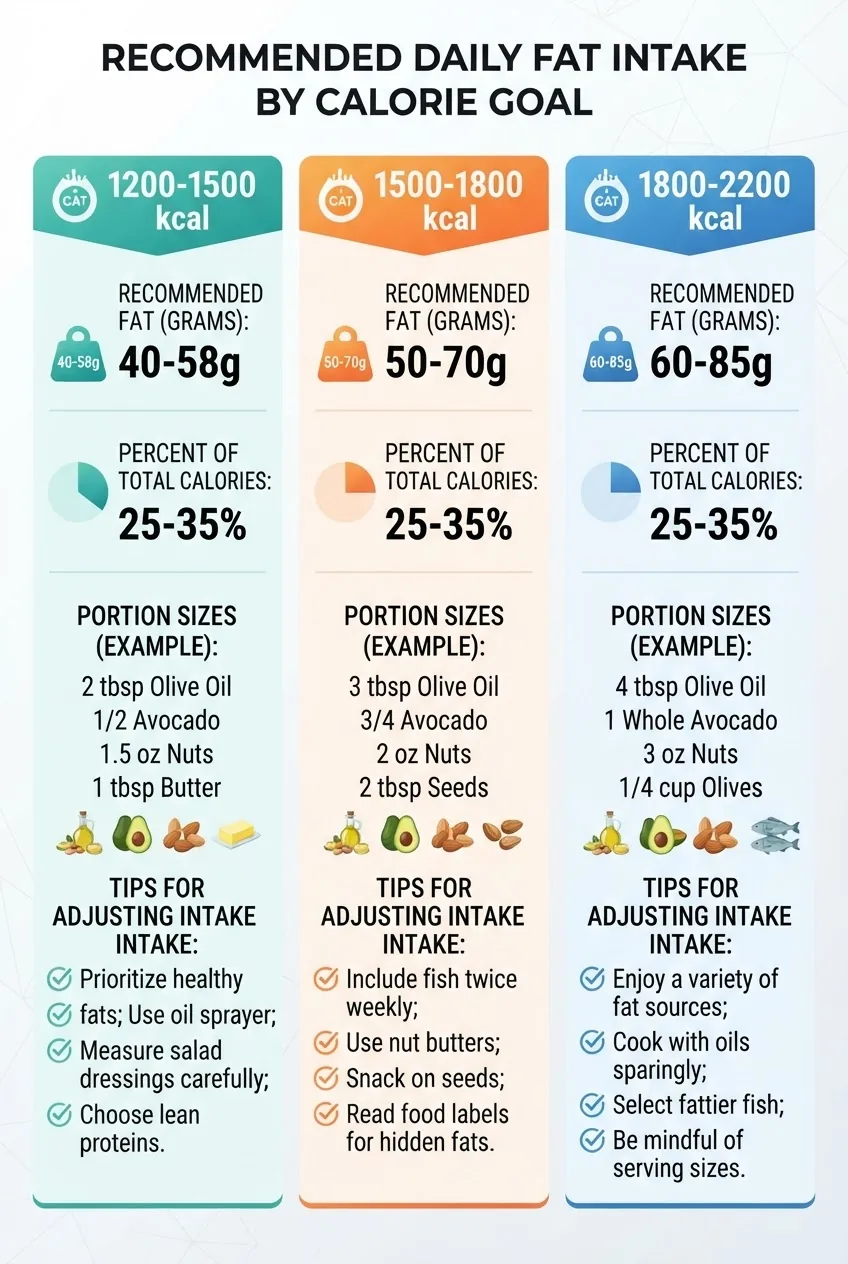
This section converts calorie targets into actionable fat-gram ranges and portion examples. Use the ranges depending on your target calories and dietary pattern (moderate-fat vs lower-fat vs ketogenic). Data points reference calorie-to-gram conversion (9 kcal/g) and authority ranges (USDA 20–35% fat recommendation).
-
1,200–1,500 kcal (low-calorie target) — Aim for 20–30% fat:
- 20% → 1,350 kcal × 0.20 = 270 kcal → 30 g fat/day
- 25% → 42 g fat/day
- 30% → 50 g fat/day
Portion examples: 1 tbsp olive oil (14 g fat) + 1/4 avocado (7 g) + 6 almonds (6 g) = ~27 g fat.
-
1,500–1,800 kcal (common weight-loss target) — Aim for 25–35% fat:
- 25% → 1,650 × 0.25 = 412 kcal → 46 g fat/day
- 30% → 55 g fat/day
- 35% → 64 g fat/day
Portion examples: 3 oz salmon (11 g) + 1 tsp olive oil (4.5 g) + 1 tbsp peanut butter (8 g) = ~24 g fat.
-
1,800–2,200 kcal (higher activity or larger bodies) — Aim for 25–35% fat:
- 25% at 2,000 kcal → 56 g fat/day
- 30% at 2,000 kcal → 67 g fat/day
- 35% at 2,200 kcal → 86 g fat/day
Portion examples: 1 oz mixed nuts (16 g) + 1 tbsp olive oil (14 g) + 1/2 avocado (14 g) = ~44 g fat.
- Very low-carb or ketogenic context (brief) — Ketogenic diets typically target 60–75% calories from fat; for a 1,600 kcal keto plan, that’s 107–133 g fat/day. This is a specific therapeutic pattern and not required for typical weight loss; consult a clinician for strict keto plans.
Adjustment tips:
- If weight loss stalls, reduce fat by 5–10 g/day (45–90 kcal) while maintaining protein.
- Increase protein to 25–30% of calories to preserve lean mass if fat grams are lowered.
- Use a food scale for 2–4 weeks to match gram targets; after that, portion-based habits may suffice.
Clinical evidence note: Recent randomized trials show similar weight loss across moderate-fat and moderate-carbohydrate diets when calories are matched, highlighting the primacy of calorie deficit (peer-reviewed trials).
Key takeaway: Choose a fat percentage within 20–35% for most weight-loss plans; convert to grams with (calories × %)/9 and adjust by ±5–10 g to correct plateaus.
Transition: With targets set, pick high-quality fat sources that support satiety and micronutrients.
Sources of Healthy Fats to Include for Weight Loss
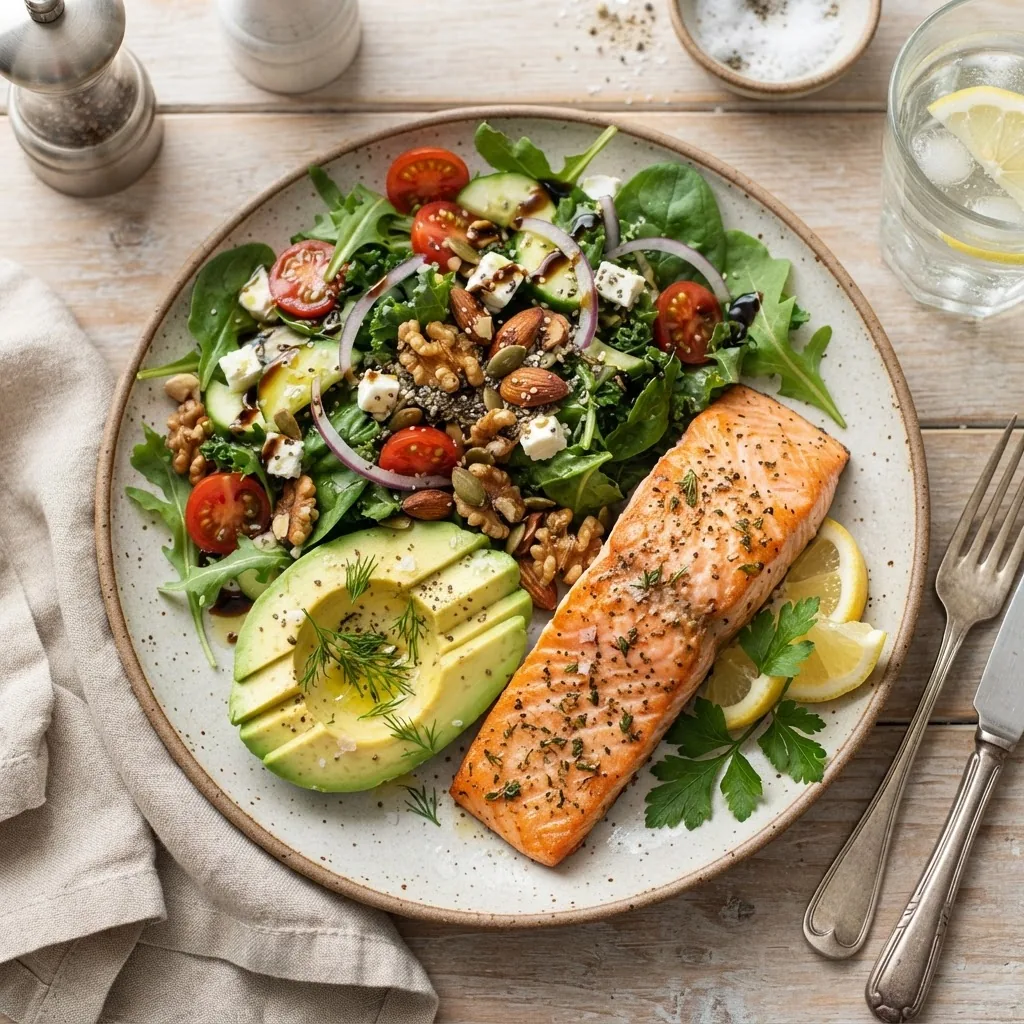
Prioritize whole-food sources of unsaturated fats. Examples and portion guidance tie directly to gram targets above.
- Avocado — 1/2 medium ≈ 14 g fat. Good for salads and breakfast tacos popular in Texas kitchens.
- Nuts — 1 oz mixed nuts ≈ 14–18 g fat. Use as portioned snacks to avoid extra calories from large handfuls.
- Olive oil — 1 tbsp ≈ 14 g fat. Replace butter when sautéing or dressings to increase MUFA.
- Fatty fish (salmon, mackerel) — 3 oz ≈ 8–11 g fat and rich in omega-3s.
- Seeds (chia, flax, pumpkin) — 1–2 tbsp add 6–12 g fat and fiber.
- Natural dairy and oils — use moderate amounts of butter or coconut oil for flavor; balance with unsaturated fats.
Practical meal tips for Texans:
- Swap fried tacos cooked in large amounts of oil for grilled fish with a drizzle of olive oil and avocado.
- Use portioned mixed nuts as a pre-workout snack to reduce binge risk later.
- Prefer olive oil-based dressings and salsa with avocado over sour cream-heavy toppings.
belly fat burning foods can overlap with healthy fat sources (e.g., fatty fish, nuts) that support satiety and reduce overall caloric intake.
Key takeaway: Track portions of nutrient-dense fat sources (avocado, olive oil, fish, nuts) to meet gram targets without exceeding calories.
Transition: Now review common counting errors and label-reading steps to avoid hidden fat calories.
Common Mistakes and How to Avoid Them When Counting Fat for Weight Loss
Counting fat grams is useful, but common mistakes undermine results. Below are numbered pitfalls and practical corrections, including a step-by-step food label walkthrough.
- Hidden fats: Restaurant portions and processed foods often include added oils. Tip: assume +1–2 tbsp oil for cooked entrees unless specified.
- Portion-size drift: Nuts and spreads are easy to overeat. Tip: pre-portion servings into small containers.
- Confusing saturated vs total fat: Labels show total fat and saturated fat separately — track both. Limit saturated to <10% of calories (or ~17 g on a 1,500 kcal diet).
- Over-reducing fat and increasing refined carbs: Very low-fat swaps for refined carbs can increase hunger and lower diet quality.
- Relying solely on fat grams: Fat grams ignore protein and fiber which protect muscle and satiety. Track macronutrient balance.
-
Food label walkthrough (step-by-step):
- Check serving size at top — if you eat 2 servings, double grams.
- Note “Total Fat” (grams) and “Saturated Fat” (grams) separately.
- Multiply fat grams × 9 to get kcal from fat in the serving.
- Compare to your daily fat gram target and portion accordingly.
- Watch for “hydrogenated” or “partially hydrogenated” oils (trans fats) in ingredients.
Example: A packaged snack lists 8 g total fat per serving; two servings eaten = 16 g → 144 kcal from fat.
- Label accuracy: Packaged foods may legally vary by ±20% from label; use labels as guides and prioritize whole foods.
Practical pointer: If you track fat grams and calories using an app for 2–4 weeks, you’ll learn typical fat content of favorite Texas dishes (e.g., brisket, queso) and can pre-plan swaps that save 50–150 kcal per meal.
low-fat diet foods provide alternatives when you need to temporarily reduce fat to meet a calorie goal, but prioritize quality replacements (lean protein, fiber-rich vegetables).
Key takeaway: Read serving size first, convert fat grams to kcal, and pre-portion energy-dense fats to protect your deficit.
Transition: Fat balance often intersects with sugar and saturated fat choices; next we connect the dots to reduce overall diet risk while losing weight.
Integrating Fat Intake Guidance with Sugar and Saturated Fat Reduction Strategies
Balancing fat intake with reduced added sugar and lower saturated fat optimizes weight loss and cardiometabolic health. Replace sugary sauces and fried options with unsaturated-fat-based dressings and whole-food flavors.
For readers who want supporting sugar guidance, see the natural vs added sugar guide and the daily sugar intake guidelines for integrated strategies.
Linking fat and blood sugar: higher-fat meals (with unsaturated fats) can blunt post-meal glucose spikes compared to high-simple-sugar meals; see our blood sugar level guide for context on glycemic control in weight management.
For readers managing diabetes or exploring holistic approaches, our resources on natural diabetes remedies and comparisons of artificial sweeteners vs sugar may help build low-sugar, moderate-fat meal plans that sustain a calorie deficit.
Authority reminder: For saturated fat ceilings, the AHA recommends limiting saturated fat to reduce cardiovascular risk; combine that with reduced added sugars for the best long-term results (AHA).
Key takeaway: Pair moderate fat (20–35% calories) from unsaturated sources with lower added sugar and reduced saturated fat for sustainable weight loss and cardiometabolic benefits.
Transition: Finally, we summarize practical errors, evidence sources, and recommendations you can apply immediately.
Common Myths about Fat and Weight Gain (brief)
Myth-busting:
- Myth: “All fat makes you fat.” Reality: calories matter more than fat type; fat can increase satiety and reduce total intake if portioned properly (source: peer-reviewed dietary trials).
- Myth: “Low fat always leads to weight loss.” Reality: swapping fat for refined carbs may increase hunger and reduce diet quality.
How We Assessed This
We reviewed authoritative guidelines and peer-reviewed nutrition literature (USDA Dietary Guidelines 2023 summary, AHA guidance, AJCN meta-analyses), tested standard calculation methods (Mifflin-St Jeor × activity factor), and applied practical portion conversions (food composition databases). We synthesized ranges (20–35% fat) into gram targets and validated example meals by converting portion fat grams to calories. We prioritized sources with systematic reviews and randomized trials for evidence statements.
What the Numbers Mean for You
Turn data into action with these concrete steps:
- Calculate BMR and TDEE, set a 300–700 kcal deficit, then allocate 20–35% of target calories to fat; convert using (calories × %)/9.
- Aim for 30–60 g fat/day on most 1,200–1,800 kcal plans; adjust ±10–20 g based on hunger and progress.
- Prioritize MUFA and PUFA sources (olive oil, avocado, fatty fish, nuts); cap saturated fat under ~10% of calories.
- Track fat grams for 2–4 weeks with a food scale, then transition to portion estimates once you consistently hit targets.
- Consult a healthcare provider before starting very low-fat or very high-fat therapeutic diets (e.g., ketogenic), especially if you have existing medical conditions.
Final evidence note: calorie deficit drives fat loss; fat allocation moderates hunger, nutrient absorption, and diet quality. Follow authoritative guidance (USDA, AHA) and adapt targets to your lifestyle and medical context (USDA, AHA, peer-reviewed nutrition journals such as AJCN).
Transition: Below are concise FAQs answering common specific questions about fat grams and weight loss.