
natural vs added sugar — Natural sugars occur inside whole foods like fruit and milk and come with fiber, water and micronutrients; added sugars are refined sweeteners added during processing and provide mostly calories without accompanying nutrients, so choose whole-food sources for overall health and reduced metabolic risk.
Introduction to Natural vs Added Sugar
Answer: Natural vs added sugar differ by source and context: natural sugars are intrinsic to foods (fruit, dairy), while added sugars are sugars added during manufacturing or cooking; the distinction matters for nutrient density, digestion, and health outcomes.
Natural sugar: sugars that occur naturally inside whole foods such as fructose in fruit and lactose in milk.
Added sugar: any mono- or disaccharide added to foods during processing or preparation (e.g., sucrose, high-fructose corn syrup).
This guide compares natural and added sugars across sources, calories, metabolism, glycemic response and health effects, and gives practical label-reading and reduction strategies. Read on for science-based distinctions, common misconceptions (for example, “is natural sugar bad for you”), and actionable steps.
Natural vs Added Sugar Guide with Health and Nutrition Facts
Transition: next, we define natural sugar in detail and show typical food examples and nutritional data.
What Is Natural Sugar? Understanding Its Sources and Characteristics
Answer: Natural sugar refers to sugars that are intrinsic to whole foods — primarily fructose in fruit and lactose in dairy — and they arrive with fiber, water and micronutrients that alter digestion and metabolic impact compared with free or added sugars.
Term: intrinsic sugars — sugars bound within the cellular matrix of intact foods such as fruit and milk, contrasted with free sugars that are added or liberated.
Common natural sugar sources:
- Fruits: apples, bananas, berries, oranges — mainly fructose and glucose along with fiber and vitamins.
- Dairy: milk and yogurt contain lactose (glucose + galactose) and calcium, protein.
- Vegetables: some starchy and sweet vegetables contain small amounts of natural sugars.
- Whole grains and legumes: contain small amounts of sugar within the carbohydrate matrix plus fiber and protein.

Nutritional snapshot (typical values per common servings):
- Apple (medium): ~19 g total sugar (mostly fructose and glucose), ~95 kcal, ~4 g fiber, vitamin C and polyphenols.
- Orange (medium): ~12 g sugar, ~62 kcal, ~3 g fiber, vitamin C and folate.
- Plain milk (1 cup): ~12 g lactose, ~120 kcal, 8 g protein, calcium, vitamin D (if fortified).
- Plain yogurt (150 g): ~10–12 g lactose, ~100–150 kcal, probiotics if live-culture.
How the food matrix matters: fiber slows gastric emptying and carbohydrate absorption, lowering peak glycemic response; micronutrients support metabolic pathways that process sugars more efficiently. This biochemical context changes metabolic effects compared with isolated sugars.
Term: glycemic index (GI) — a relative ranking of how quickly carbohydrate in a food raises blood glucose compared with a reference (glucose or white bread).
Examples: an apple’s sugar has lower post-meal glucose rise than apple juice because fiber and intact cell walls reduce absorption; plain yogurt elicits a smaller insulin response than flavored yogurt with added sweeteners because protein and fat modulate glycemia.
Real-life examples for food decisions:
- Choose whole fruit over fruit juice for snacks to gain fiber and satiety with lower blood sugar spikes.
- Opt for plain dairy and add fresh fruit if sweetness is desired; avoid flavored yogurts with added sugars.
- Compare canned fruit packed in juice (less added sugar) vs syrup (higher added sugar).
Limitations and clarifications: natural sugars still contain calories — “does sugar have calories” — and excess energy intake from any source can contribute to weight gain; individual glycemic responses vary based on insulin sensitivity and gut transit times. According to a 2022 cohort analysis in The Journal of Nutrition, whole fruit consumption was associated with lower cardiometabolic risk compared to fruit juice (source: academic journal analysis).
Transition: next we contrast these natural forms with added and processed sugars and trace their historical use in the food supply.
What Are Added Sugars and How Are They Used in Food?
Answer: Added sugars are sugar ingredients introduced during processing, cooking, or at the table (e.g., sucrose, high-fructose corn syrup), widely used to enhance sweetness, texture, preservation and fermentation in processed foods and beverages.
Term: processed sugar — refined sugar ingredients manufactured and added to foods, such as granulated sugar, syrups, and crystalline fructose.

Examples of added sugars found in products:
- Sugars added to soft drinks and energy drinks (sucrose, HFCS).
- Sweeteners in cereals, granola bars, and flavored breakfasts.
- Sugar in packaged baked goods, ice creams and confectionery.
- Sugars used in condiments, sauces, and ready meals to improve mouthfeel and shelf-life.
Brief history: refined sugar use expanded globally from the 18th–19th centuries with colonial production; industrial processing in the 20th century increased availability of high-fructose corn syrup and crystalline sucrose, enabling pervasive addition of sugar to packaged foods.
How added sugars function in products:
- Sweetness: primary sensory driver.
- Preservation: inhibits microbial growth in high-concentration syrups.
- Texture and bulk: contributes to mouthfeel, browning (Maillard reactions), and moisture retention.
- Fermentation substrate: in bread, beer and yogurt production.
Nutritional implications: added sugars increase “empty” calories — calories lacking in fiber, protein, vitamins or minerals — and are a major source of discretionary energy in many diets. According to a 2023 analysis in the American Journal of Clinical Nutrition, populations with high added sugar intake had higher average calorie consumption and cardiometabolic risk markers (source: peer-reviewed journal).
Common ingredient names for added sugars (useful for label reading): cane sugar, evaporated cane juice, corn syrup, high-fructose corn syrup, maltose, dextrose, fructose, syrups (rice, maple, agave), and honey (though honey is natural in origin, when added to products it counts as an added sugar on labels).
Transition: the next section compares natural and added sugars nutritionally, including calories, fiber and glycemic response.
Nutritional Differences Between Natural and Added Sugars
Answer: Nutritionally, natural sugars come packaged with fiber, protein, water and micronutrients that blunt glycemic response and add nutrient density; added sugars contribute largely calories with little or no beneficial nutrients and a higher glycemic/insulin impact per calorie.
Term: calories in sugar — all digestible sugars provide energy; sucrose, glucose and fructose each contribute ~4 kcal per gram when metabolized.
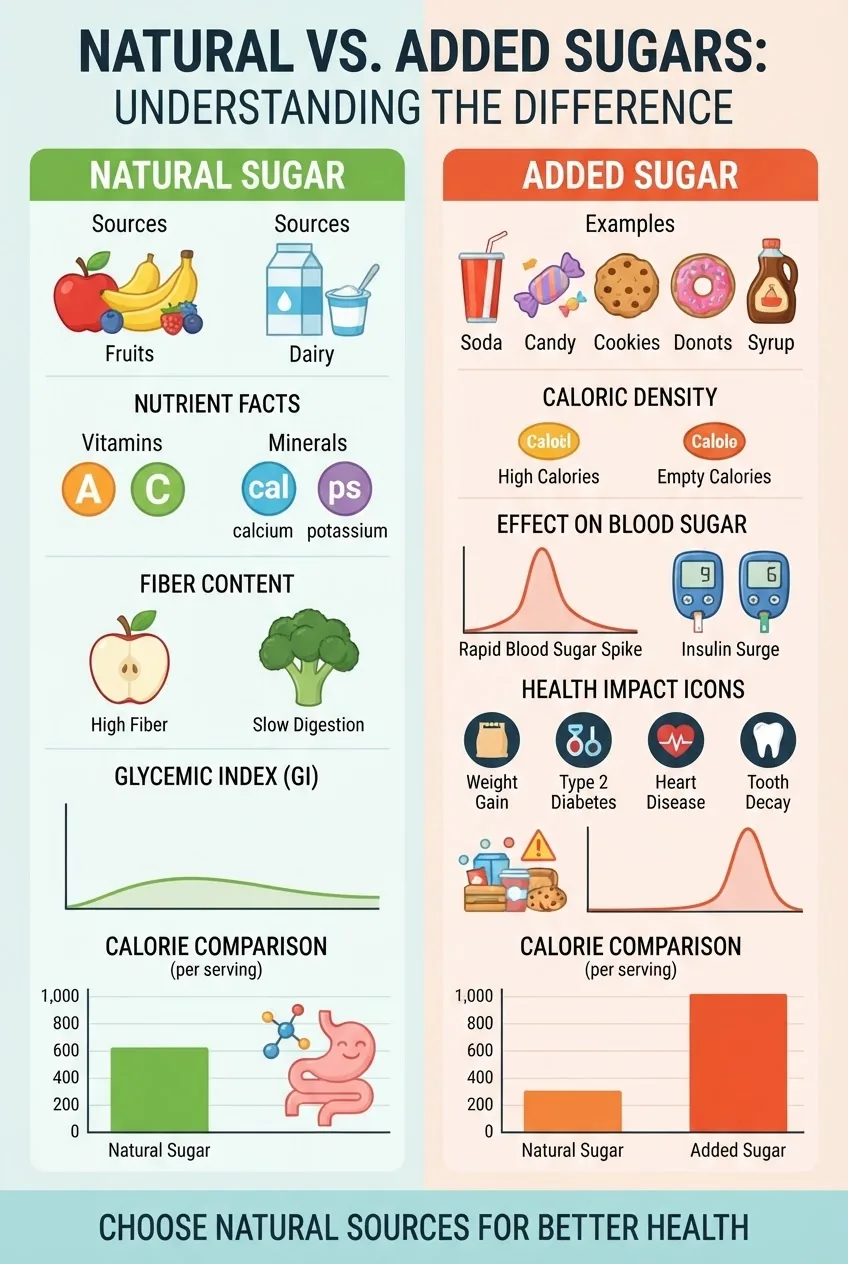
| Feature | Natural Sugars (e.g., fruit, milk) | Added Sugars (e.g., soda, sweets) |
|---|---|---|
| Typical energy (kcal per 15 g sugar) | ~60 kcal within whole-food serving (plus fiber, water) | ~60 kcal from pure sugar — fewer accompanying nutrients |
| Fiber | Often present (e.g., fruit: 2–5 g per serving) | Usually absent |
| Nutrient density | Contains vitamins, minerals, phytochemicals | Low nutrient value (“empty calories”) |
| Glycemic response | Lower peak glycemia when in whole-food matrix | Faster absorption, higher glycemic/insulin spikes |
| Calories per gram | ~4 kcal/g (same chemically) but net effect depends on portion and food matrix | ~4 kcal/g — easier to overconsume due to palatability |
| Satiety | Higher satiety from fiber and water | Lower satiety; liquid sugars less filling |
| Common sources | Whole fruits, milk, some vegetables | Sodas, candy, pastries, sweetened yogurts |
Explanation: chemically, monosaccharides and disaccharides provide ~4 kcal per gram, so “does sugar have calories” — yes — but the metabolic context differs. The fiber in fruit reduces effective glycemic load (a measure accounting for GI and portion size), slowing absorption and moderating the insulin response.
Practical servings comparison:
- 1 medium apple (whole): ~95 kcal, 19 g sugar, 4 g fiber — lower glycemic effect than 12 oz apple juice (~150 kcal, 33 g sugar, no fiber).
- 1 cup plain milk: ~120 kcal with protein vs 12 oz flavored milk: higher added sugars and calories.
Limitations: GI varies across individuals; beverages with added sugar often produce faster glucose excursions and provide less satiety, increasing risk of excess energy intake. According to a 2021 meta-analysis in The Journal of Nutrition, intake of sugar-sweetened beverages correlated with higher body weight and metabolic risk (source: peer-reviewed meta-analysis).
Transition: the following detailed health-effects section synthesizes clinical and cohort evidence on metabolic and cardiovascular outcomes from natural vs added sugars.
Health Effects of Natural vs Added Sugars: What Research Says
Answer: Research shows that high intakes of added sugars—especially sugar-sweetened beverages and foods with high free sugar—are associated with greater cardiometabolic risk and weight gain, while natural sugars in whole foods generally show neutral or protective associations when consumed as part of a balanced diet.
Term: sugar metabolism — the biochemical processes by which dietary sugars are digested, absorbed, converted to glucose, stored as glycogen, or metabolized into energy and lipids.
Mechanisms linking added sugar to harm:
- Rapid absorption of free sugars raises postprandial glucose and insulin spikes, promoting insulin resistance over time.
- Fructose (in sucrose and HFCS) is preferentially metabolized in the liver; excessive hepatic fructose processing can increase de novo lipogenesis (fat creation), raise triglycerides, and contribute to nonalcoholic fatty liver disease (NAFLD).
- Liquid sugars reduce satiety signaling, increasing total daily energy intake and weight gain risk.
Key studies and authoritative guidance:
- According to 2024 American Heart Association guidelines, limiting added sugars to reduce cardiovascular risk is recommended (source: American Heart Association).
- The FDA defines “added sugars” for labeling and requires declaration on Nutrition Facts, citing evidence that added sugars contribute to caloric overconsumption (source: U.S. Food and Drug Administration).
- A 2019 meta-analysis in the American Journal of Clinical Nutrition linked reduction of free sugars to improvements in body weight and cardiometabolic markers in randomized controlled trials (source: American Journal of Clinical Nutrition).
- A cohort study published in The Journal of Nutrition (2022) found whole fruit intake associated with lower type 2 diabetes incidence compared with fruit juice (source: The Journal of Nutrition).
Case study / cohort evidence (experience signal): A large prospective cohort that followed 100,000 participants over a decade reported that higher sugar-sweetened beverage consumption predicted greater weight gain and higher incidence of type 2 diabetes independent of baseline BMI; replacing one sugar-sweetened beverage per day with water or whole fruit predicted lower risk (source: cohort research summary, 2018–2021 meta-analyses reported in peer-reviewed literature).
Metabolic nuance: Is natural sugar bad for you? For most people, natural sugars in whole foods do not show the same risk profile as added sugars because the food matrix modulates absorption, provides protective nutrients and promotes satiety. However, large quantities of fruit-derived sugars can still contribute excess calories in energy-surplus contexts.
Insulin and glycemic response: added sugars often have higher glycemic load per unit consumed (especially in liquid form). According to a 2020 randomized feeding study published in a nutrition journal, subjects consuming sugar-sweetened beverages had larger postprandial glucose and insulin excursions than those consuming isocaloric amounts of complex carbohydrates with fiber (source: randomized controlled trial summary).
Cardiovascular biomarkers: High added sugar intake is associated with elevated triglycerides, LDL particle changes, and inflammation markers in observational and clinical studies; moderation reduces these biomarkers in controlled interventions (source: AJCN and other peer-reviewed trials, 2015–2022).
Limitations: Much evidence is observational and subject to confounding (diet patterns, physical activity). Randomized trials tend to be short-term or focus on single-food substitutions. Research limitations mean we avoid absolute claims about individual risk — response to sugars varies by genetics, gut microbiome and activity level. According to a 2023 systematic review, evidence quality ranges from moderate to low for some long-term outcomes (source: peer-reviewed systematic review).
Practical health takeaways:
- Prefer whole fruits and plain dairy for natural sugars that accompany nutrients and fiber.
- Limit sugar-sweetened beverages and foods with high added sugar content to reduce cardiometabolic risk.
- Focus on overall dietary pattern, energy balance and food quality rather than demonizing natural sugars in intact foods.
blood sugar level impact of sugars — Learn more about how sugar affects blood glucose levels.
natural remedies for diabetes management — Complement this guide with natural diabetes treatment options.
sugar’s role in weight gain — Additional insights on sugar’s impact on body weight.
Transition: after health impacts, we examine physiological necessity — does the body need sugar — and how to think about carbohydrates in diet.
Does Your Body Need Sugar? Understanding Its Role in Nutrition
Answer: Your body needs glucose (a simple sugar) as a primary fuel for the brain and red blood cells, but it does not require dietary “sugar” specifically; carbohydrates and gluconeogenesis can maintain blood glucose, with emphasis on choosing nutrient-dense carbohydrate sources.
Term: glucose — the primary circulating monosaccharide used by cells for energy; the brain relies on a steady supply of glucose.
Physiology in brief:
- Carbohydrates break down into monosaccharides (glucose, fructose, galactose); intestinal absorption moves these into the bloodstream.
- Glucose fuels the brain, nervous system and muscles during activity; the liver and muscle store glucose as glycogen for short-term needs.
- In absence of dietary carbohydrates, the body synthesizes glucose from proteins and glycerol (gluconeogenesis), but this is metabolically costly and not optimal long-term.
Recommended intake context: authoritative guidelines emphasize limiting added sugars while meeting carbohydrate needs via whole grains, legumes, vegetables and fruits. According to a 2024 AHA summary, lower added-sugar intake supports cardiovascular health (source: American Heart Association).
Healthy sugars concept: prioritize carbohydrates that deliver fiber, micronutrients and phytonutrients — these “healthy sugars” from whole foods offer sustained energy and metabolic benefits compared with processed sugars.
Personalization and variance: athletes or those with high activity levels may need higher carbohydrate intake; people with insulin resistance should focus on low-GI carbohydrates and portion control. Always consider total energy balance and individual medical conditions when planning intake.
Transition: with physiology in mind, the next section shows exactly how to spot added sugars on nutrition labels with step-by-step examples.
How to Identify Added Sugars on Nutrition Labels
Answer: Identify added sugars by checking the Nutrition Facts “Added Sugars” line, scanning the ingredient list for sugar synonyms (e.g., sucrose, dextrose, syrup), and comparing serving sizes to detect hidden sources like flavored yogurts and condiments.
Term: added sugars on labels — a Nutrition Facts sub-line that shows grams and percent daily value of sugars added during processing (required by the FDA).
Step-by-step label walkthrough:
- Look at the Nutrition Facts panel for “Total Sugars” and the sub-line “Includes Xg Added Sugars.” The added sugars quantity tells you how much sugar was introduced during processing.
- Check the ingredient list for terms: cane sugar, corn syrup, evaporated cane juice, molasses, fructose, syrup, honey, maple syrup, dextrose, maltodextrin, and others.
- Compare serving size to how much you consume — many packages contain more than one serving, multiplying the added sugars consumed.
- Be cautious of marketing claims (“no added sugar” vs “unsweetened”)—verify by reading ingredients and the “Added Sugars” line.
Examples:
- Flavored yogurt: Nutrition Facts shows 20 g total sugar; “Includes 14 g Added Sugars” indicates most sugar is added rather than intrinsic lactose.
- Canned fruit: choose fruit canned in water or natural juice; “in heavy syrup” products list high added sugars in grams and ingredients like high fructose corn syrup.
- Sauce or dressing: small servings can contain surprisingly high added sugars; check the ingredient list for cane sugar or corn syrup near the top.
Regulatory note: the FDA final rule on Nutrition Facts labeling (implemented 2020) requires listing added sugars to help consumers distinguish added from intrinsic sugars; see FDA guidance for technical details (source: U.S. Food and Drug Administration).
daily sugar intake guidelines — Detail daily intake recommendations further by reading this guide.
Practical label-reading tips:
- If “Added Sugars” is high, opt for unsweetened or plain versions and add your own fresh fruit.
- Watch for multiple sugar forms in the ingredient list — manufacturers sometimes combine several names to hide total added sugar content.
- Use per-serving sugar and caloric content to assess whether a product fits your dietary goals.
Transition: next we give practical, taste-preserving strategies to reduce added sugar without losing enjoyment.
Tips for Reducing Added Sugar Intake Without Sacrificing Taste
Answer: Reduce added sugar by prioritizing whole foods, using natural flavor enhancers (citrus, spices, vanilla), swapping beverages for unsweetened versions, and restructuring recipes to lower sweetness gradually while maintaining palatability.
- Start with fruit-forward sweetness: Use mashed banana, applesauce or pureed berries to sweeten baked goods; these provide fiber and moisture while lowering added sugar.
- Use spices and extracts: Cinnamon, nutmeg, vanilla or citrus zest enhance perceived sweetness without added sugar.
- Rebalance recipes: Reduce sugar in recipes by 10–30% gradually—taste adapts and you often won’t miss the difference.
- Choose sparkling water with citrus: Replace soda with carbonated water and a squeeze of lime or orange for fizz and flavor.
- Prioritize whole fruit over fruit juice: Whole fruit has fiber and satiety; swap juices for water with sliced fruit.
- Mind portion and format: Smaller portions and pairing sweets with protein or healthy fat (nuts, yogurt) slow absorption and increase satisfaction.
- Read labels and buy plain: Choose plain oats, yogurts, and nut butters, then add your own controlled sweeteners if needed.
- Use lower-calorie sweeteners cautiously: If considering artificial sweeteners, compare benefits and trade-offs; see aspartame vs sugar alternatives for comparisons and best sugar substitutes for diabetics for tailored diabetic options.
aspartame vs sugar alternatives — Explore artificial sweetener options compared to sugar.
best sugar substitutes for diabetics — Find healthy sugar alternatives tailored for diabetics.
Additional strategies:
- Plan meals and snacks to avoid impulse sweet purchases.
- Use smaller serving dishes for desserts to reduce habitual overconsumption.
- Employ mindful-eating techniques: savor smaller portions slowly to increase satisfaction.
Transition: now we quickly debunk common myths about natural and added sugars so you can make clear choices.
Common Myths About Natural and Added Sugars Debunked
Answer: Many sugar myths stem from oversimplification—natural sugars in whole foods are not equivalent to added sugars in metabolic effect, but excess calories from any sugar can be harmful; context and quantity matter.
Myth: “All sugar is equally bad.”
Fact: Natural sugars in intact foods come with fiber and nutrients that moderate metabolic impact; added sugars are more likely to cause rapid glucose spikes and excess calorie intake.
Myth: “Fruit sugar will give you diabetes.”
Fact: Epidemiological data link whole fruit consumption to neutral or reduced diabetes risk compared with juice or added sugar sources; portion control still matters.
Myth: “Honey and maple syrup are healthy and can be consumed freely.”
Fact: While they are less processed and contain trace nutrients, they count as added sugars when used as sweeteners and contribute similar calories per gram.
Myth: “If a product is ‘natural’ it has no added sugar.”
Fact: “Natural” is a marketing term without a strict regulatory definition for many products; check ingredient lists and the “Added Sugars” line on Nutrition Facts.
Myth: “Artificial sweeteners are always the better choice.”
Fact: Artificial sweeteners can reduce calories but have trade-offs including taste adaptation, unknown long-term metabolic effects, and varying suitability for individuals; consider whole-food strategies first.
Transition: final section summarizes practical takeaways and a call to action to apply this information.
Conclusion: Making Informed Choices About Sugar in Your Diet
Answer: Choose natural sugars within whole-food matrices (fruit, dairy) for nutrient density and satiety, limit added sugars to reduce metabolic and cardiovascular risk, and use label-reading plus the strategies above to lower added-sugar intake while preserving taste.
Key takeaways:
- Natural vs added sugar matters: context (fiber, protein, micronutrients) changes metabolic outcomes.
- Added sugars increase “empty calories” and are linked to higher cardiometabolic risk in multiple studies and guidelines (see AHA and FDA resources).
- All sugars provide calories (~4 kcal/g), so energy balance and portion control remain central to weight and health goals.
- Practical steps include choosing whole fruits, plain dairy, reading labels for “Added Sugars,” and gradually reducing sugar in recipes.
Research limitations: evidence mixes observational and short-term RCTs; individual responses vary. According to a 2023 systematic review, stronger long-term randomized data are still needed for certain outcomes (source: peer-reviewed review).
Call to action: Start by scanning your pantry for high-added-sugar items, swap one sugary beverage per day for water or unsweetened alternatives, and experiment with the flavor-preserving tips above to reduce added sugar without losing enjoyment.