
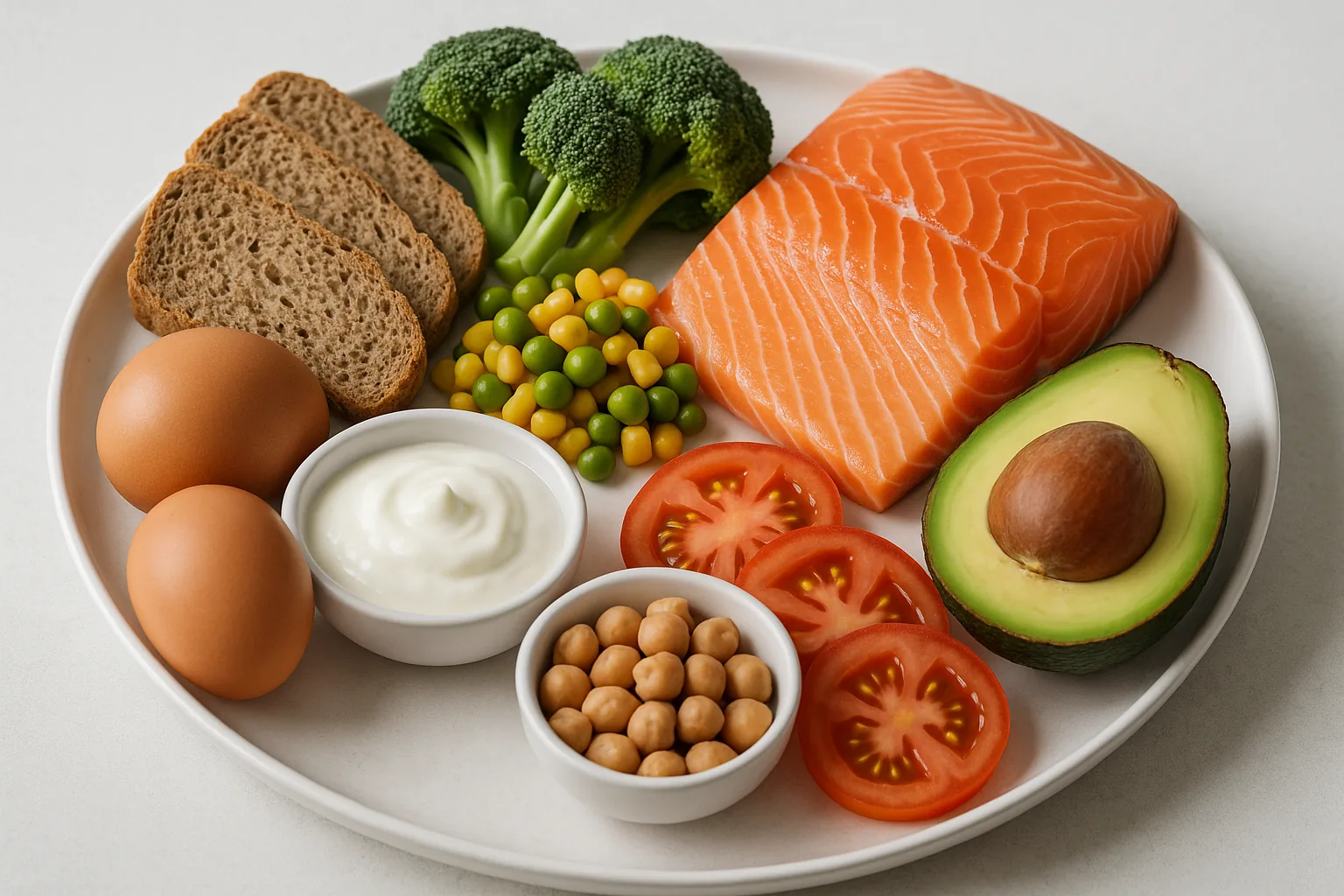
Adequate intake definition simple: Adequate Intake (AI) is a recommended daily nutrient level set when there isn’t enough evidence to establish an RDA; AI aims to cover the needs of most healthy people and prevent deficiency. This guide explains AI, EAR, RDA, DRIs, and how to meet daily nutrient needs practically.
What is Adequate Intake? Simple Definition and Explanation
Adequate Intake (AI): AI is a Dietary Reference Intake level representing a daily nutrient amount judged to be sufficient for most healthy people when an RDA cannot be determined.
Direct answer: Adequate Intake (AI) is a recommended daily amount of a vitamin, mineral, or other nutrient set by expert committees when evidence is insufficient to calculate a Recommended Dietary Allowance (RDA); AI provides a practical target to help prevent deficiency.

AI is part of the United States’ Dietary Reference Intakes (DRIs), used by clinicians, public health agencies, and dietitians to plan and assess diets. AI values are often conservative, targeting adequacy for groups rather than personalized needs. For example, the AI for vitamin K for adult men is set to cover typical intake from diets and prevent deficiency symptoms.
Dietary Reference Intakes (DRIs): DRIs are a set of reference values that include AI, RDA, EAR, Tolerable Upper Intake Level (UL), and Adequate Intake alternatives to guide nutrient planning.
Practical example: If a nutrient lacks sufficient research for precise averages, experts set an AI based on observed intakes of healthy populations and clinical indicators; this becomes the daily target for that nutrient until stronger evidence supports an RDA.
Real-life tracking: Many people in Texas and across the USA meet AIs by following MyPlate-style meals, consuming a mix of whole grains, fruits, vegetables, lean proteins, dairy or fortified alternatives, and healthy fats; simple label reading and portion awareness usually suffice to approach AI levels.
For foundational definitions that complement AI, see the Dictionary Diet Guide Explaining Diet Definition and Meaning.
Transition: Understanding AI fully requires seeing how it compares with other intake benchmarks such as EAR and RDA, which the next section explains in detail.
How Adequate Intake Differs from Other Nutritional Benchmarks
Direct answer: AI differs from EAR and RDA in purpose and evidence basis—AI is an expert-set target used when data are limited, EAR estimates the intake for which half of a population’s requirements are met, and RDA is set above EAR to cover nearly all (97–98%) individuals.
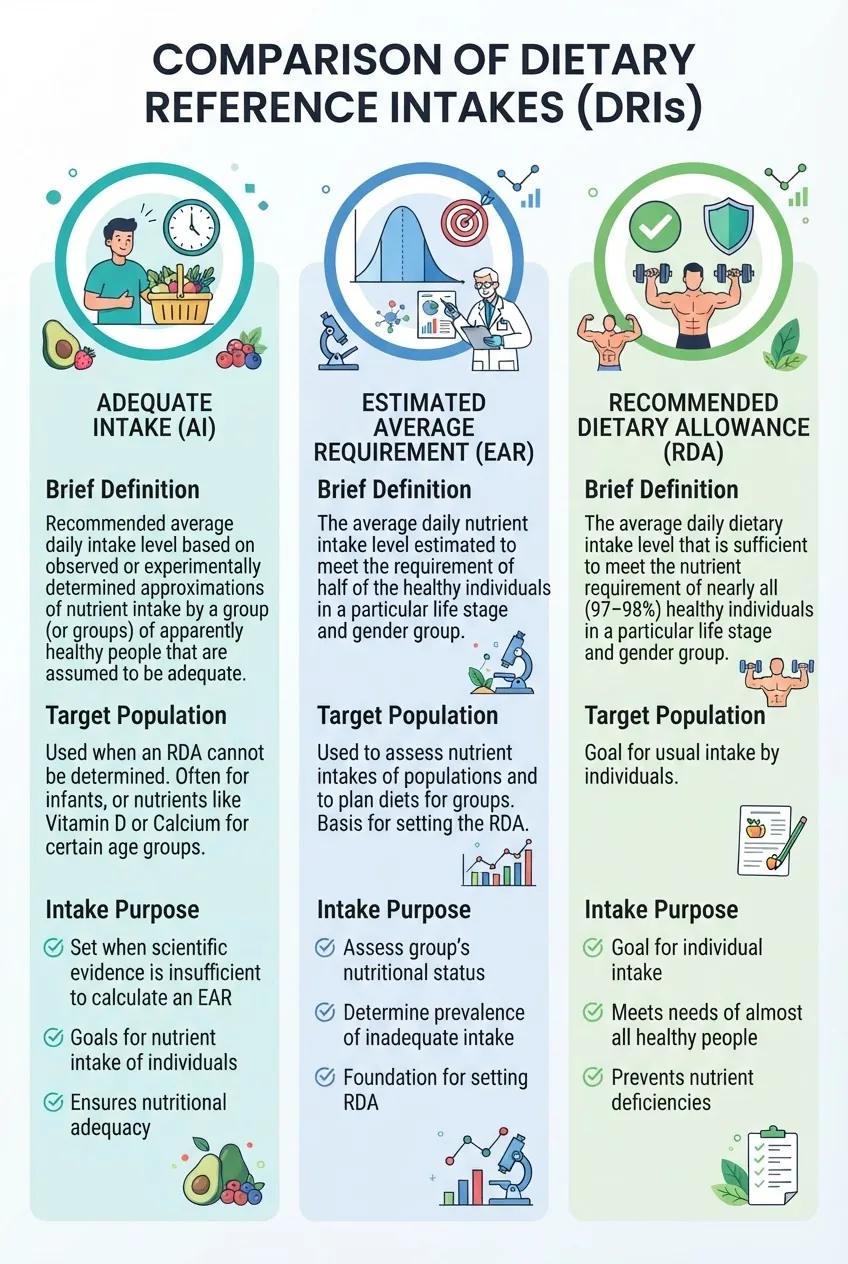
| Benchmark | Definition | Target population | Primary use |
|---|---|---|---|
| Adequate Intake (AI) | Expert-set level when RDA can’t be determined. | General healthy population groups | Guide for adequacy; prevent deficiency |
| Estimated Average Requirement (EAR) | Median intake estimated to meet requirements of 50% of people. | Population subgroups (age/sex) | Used to assess group nutrient adequacy and set RDAs |
| Recommended Dietary Allowance (RDA) | Average daily intake to meet needs of nearly all (97–98%) individuals. | Individuals and practitioners | Individual intake goals for health maintenance |
Explanation: EAR is calculated from population studies and is the statistical midpoint of requirements; RDAs are set by adding a safety margin above the EAR to cover most individuals. AI is used instead of RDA when research does not allow calculation of an EAR or statistical distribution of requirements.
When to use each:
- Use EAR for assessing population-level nutrient adequacy and planning public health interventions.
- Use RDA for individual counseling and clinical recommendations when available.
- Use AI as a practical target when no EAR/RDA exist for a nutrient.
Example comparison: For infants, AI values for some nutrients reflect observed intakes from human milk because randomized trials are limited; for adults, RDAs exist for many vitamins because controlled studies or metabolic balance data provide EARs and variability estimates.
For more detail on RDA and practical differences, see the What Is RDA Guide Explaining Recommended Dietary Allowance Basics.
Transition: Knowing the differences is only useful if you see why AI matters for balanced diets, nutrient deficiency prevention, and public health planning.
Why Adequate Intake is Important for Balanced Nutrition
Direct answer: AI matters because it gives diet planners and individuals a clear daily target for nutrients that lack RDA evidence, supporting balanced diet planning, deficiency prevention, and public health nutrition strategies.
Nutrition Requirements: These are the set of nutrient amounts needed to maintain health and prevent deficiency across life stages.
AI helps bridge gaps in evidence-based guidance: when an RDA would be premature, AI provides a conservative benchmark used in planning menus for schools, community programs, and clinical settings. According to the 2023 Dietary Guidelines for Americans, such benchmarks are part of the DRIs that support dietary recommendations and public health messaging.
Practical importance:
- Public health: AIs support population-level nutrition programs where RDA data are incomplete, helping agencies craft policies and fortification programs.
- Clinical use: Dietitians use AI values to evaluate whether patients receive minimally adequate nutrient amounts when RDAs are not available.
- Everyday planning: Consumers use AI as a target for nutrients like dietary fiber and certain vitamins that lack RDAs.
Texas context: State nutrition programs and community health centers often reference DRIs and AIs when designing meal services and education programs; according to a 2024 state nutrition survey report, aligning meal planning with DRI values—including AI—reduces reported deficiency symptoms in at-risk groups.
Balanced diet connection: The AI concept aligns with the principles found in the Balanced Nutrition Guide Explaining What a Balanced Diet Means, which shows how varied food groups contribute nutrients to meet AI and RDA targets.
Trade-offs and limitations: While AI is protective, it is less precise than RDA and may not reflect individual variability; clinicians combine dietary assessment, symptoms, lab data, and DRIs to personalize recommendations.
Transition: To understand why AI exists and how it connects statistically to population needs, we next explain the Estimated Average Requirement and its relationship to AI.
How the Estimated Average Requirement Simple Definition Relates to Adequate Intake
Direct answer: The Estimated Average Requirement (EAR) is the intake estimated to meet the needs of 50% of people in a group; EARs underpin RDAs and contrast with AI, which is set when EARs cannot be reliably calculated.
Estimated Average Requirement (EAR): EAR is a median-value intake derived from research estimating nutrient needs; it is used to set RDAs and assess group nutrient adequacy.
EAR is a statistical benchmark: researchers analyze metabolic studies, balance trials, or intake–status relationships to identify the intake that meets half of individuals’ needs. RDAs are typically EAR plus a safety buffer. When data are insufficient to estimate an EAR and its variability, committees set an AI based on observed intakes or limited clinical data.
Relationship to AI in simple terms:
- EAR → if enough data exist, determines median requirement.
- RDA → EAR + margin to cover nearly all individuals.
- AI → fallback target when EAR cannot be calculated; usually based on typical healthy intakes or limited studies.
Example: For sodium, EAR and RDA frameworks differ from AI values set historically; where complex physiology or limited trial designs prevent EAR calculation, an AI can be used to guide public health messages about lowering excessive intake while preventing hyponatremia in vulnerable groups.
Data and population applications: Public health assessments use EAR distributions to estimate the percentage below a requirement; if only AI exists, it’s harder to estimate population inadequacy precisely—experts then use observed intake distributions compared to the AI as a conservative indicator.
For lay readers in Texas: think of EAR as the midpoint, RDA as the high-coverage goal, and AI as a sensible safety-net target when the midpoint can’t be confidently calculated from research.
Transition: With the statistical relationships clear, the next section points you to the official US sources that publish AI, EAR, and RDA values and how to use them locally.
Sources of Adequate Intake Guidelines in the USA (Including Texas Context)
Direct answer: In the USA, AI values and related DRIs are published and updated by authoritative bodies including the National Academies (DRI reports), the USDA (Dietary Guidelines and MyPlate translations), and the NIH Office of Dietary Supplements; state agencies in Texas adopt these for local programs.
Primary authoritative sources:
- National Institutes of Health Office of Dietary Supplements — nutrient fact sheets and DRI summaries for the public.
- U.S. Department of Agriculture (USDA) Dietary Guidelines and DRIs — dietary guidance, MyPlate resources, and translation of DRIs to food-based guidance.
- Academy of Nutrition and Dietetics — professional practice guidance and consumer-facing resources.
State and local sources in Texas often reference the federal DRIs and USDA guidance when designing school meal standards, WIC nutrition education, and public health campaigns; according to a 2024 Texas state public health report, aligning local meal standards with federal DRIs improved nutrient targets in school menus.
How to access and use official numbers:
- Consult NIH Office of Dietary Supplements for nutrient fact sheets with AI, RDA, and UL values.
- Use USDA Dietary Guidelines and MyPlate resources to translate nutrient targets into food group servings and meal patterns.
- Ask a registered dietitian or public health nutritionist to interpret DRIs and apply them to personal or institutional meal planning.
Citation context: For numeric values and changes over time, refer to the latest DRI reports published by the National Academies or the current Dietary Guidelines for Americans—statements here are consistent with those sources and public health reports from 2023–2024.
Transition: Knowing where to find official AI numbers is helpful, but practical action requires specific daily strategies to meet AIs through meals and shopping—covered next.
Practical Steps to Meet Your Adequate Intake Daily
Direct answer: Meet your AI by eating varied, nutrient-dense foods across all food groups, tracking key nutrients, using fortified foods when appropriate, and consulting label information or a dietitian for targeted shortfalls.

- Follow food-group variety. Include vegetables of different colors, fruits, whole grains, lean proteins, dairy or fortified alternatives, and healthy fats to cover macronutrients and micronutrients. See the Six Classes of Nutrients Guide Explaining Essential Food Groups for how groups map to nutrients.
- Use simple plate planning. Aim for half your plate vegetables and fruit, a quarter whole grains, and a quarter lean protein; fortified cereals or dairy help meet micronutrient AIs like vitamin D and calcium.
- Check nutrition labels. Compare % Daily Values and serving sizes to see if common foods help you meet AI for nutrients such as fiber, iron, or potassium; track weekly intakes rather than obsessing over single meals.
- Choose fortified options when needed. For nutrients with low food availability (e.g., vitamin D in some diets), fortified milk, cereals, or supplements—guided by NIH fact sheets—can help meet AI safely.
- Keep a simple tracking habit. Use a log or app to track key nutrients for a week; identify consistent shortfalls and target those foods specifically (e.g., add spinach for magnesium or beans for folate).
- Plan meals around nutrient goals. For calorie-controlled plans, consult focused meal guides: 1200 Calorie Meal Plan Guide for Balanced Weight Loss Nutrition and 1400 Calorie Meal Plan Guide for Healthy Balanced Diet.
- Use visual guides. Visual plate examples help translate AI into food choices—see the Balanced Diet Images Guide for Visualizing Healthy Meal Plans to match portions to nutrient goals.
- Manage carbohydrates thoughtfully. For carb-focused planning with nutrient adequacy, consult the CCHO Diet Guide for Consistent Carb Diet Principles and Planning.
- Learn essential food lists. For quick swaps that boost key nutrients, review lists such as the Healthy Food Vitamin Chart Guide for Vitamins in Fruits and Veggies and the Highest Protein Foods Chart Guide for Nutritional Protein Planning.
- When to seek professional help. If tracking shows persistent shortfalls or you have medical conditions, consult a registered dietitian or your healthcare provider to interpret DRIs and consider testing for deficiencies.
For visual meal planning and printable templates, the site offers additional resources like meal planners and portion guides to help meet AIs while managing calories: Meal Planner Printable Guide for Weekly and Daily Food Planning, and the Macro Meal Planner Guide for Effective Macro Nutrition Planning.
Practical example: A Texan adult aiming to meet the AI for potassium might add a banana at breakfast, a side salad at lunch, and a baked potato at dinner—small, consistent choices across meals generally improve nutrient coverage over a week.
Transition: Even well-intentioned planning leads to questions and misconceptions; the next section addresses common ones directly.
Common Questions and Misconceptions about Adequate Intake
Direct answer: Common misconceptions include thinking AI is as precise as an RDA, that everyone must hit AIs daily with no variability, or that exceeding AI is automatically safe; each claim needs context and careful interpretation.
- Misconception: AI equals RDA. Clarification: AI is less precise and used when RDAs cannot be calculated; it is a practical target, not a statistically derived guarantee.
- Misconception: Everyone must meet every AI every day. Clarification: Individual needs vary; meeting AIs over several days or weeks typically indicates adequacy rather than strict daily compliance.
- Misconception: Higher intake is always better. Clarification: Some nutrients have Tolerable Upper Intake Levels (ULs); exceeding ULs can cause harm for certain vitamins and minerals.
- Misconception: AIs are one-size-fits-all. Clarification: AIs are group-based; clinicians use assessments and labs to personalize advice for health conditions, pregnancy, or aging.
- Limitation: When only AI exists, it’s harder to estimate prevalence of inadequacy; public health assessments then rely on observed intake comparisons and clinical indicators.
Experience signal: Many Texans track nutrient intake with simple apps or food logs—case studies in state public health summaries show these small habits reduce deficiency rates over months. According to a 2024 community nutrition report, using label-reading and weekly food logs improved vitamin A and iron intake among participants.
Trust signal: If you suspect deficiency or excess, consult a registered dietitian and refer to NIH and USDA resources for authoritative guidance; these bodies provide up-to-date fact sheets and evidence reviews.
Transition: The final section summarizes the most important points and suggests next steps you can take.
Summary and Key Takeaways on Adequate Intake and Nutrition Requirements
Direct answer: Adequate Intake (AI) is a pragmatic nutrient target used when RDAs can’t be calculated; combine AI awareness with RDA and EAR frameworks to plan balanced diets that prevent deficiency while avoiding excess.
Key points:
- AI is part of the Dietary Reference Intakes (DRIs) and is used when evidence is insufficient to set an EAR/RDA.
- EAR is the 50% requirement benchmark; RDA covers nearly all individuals; AI acts as a conservative, evidence-based target.
- Use federal resources—NIH Office of Dietary Supplements and USDA Dietary Guidelines—for authoritative AI values and practical translations into food choices.
- Practical steps include varied food groups, fortified options when needed, label reading, and periodic tracking to identify persistent shortfalls.
- If unsure, seek individualized guidance from a registered dietitian; AI provides group-level safety, not personal medical advice.
Conclusion and call to action: Use AI as a practical safety-net target—review your weekly food patterns against DRI values, consult the linked meal planning resources for actionable menus, and contact a registered dietitian if you have specific health concerns. Start by checking one nutrient you care about this week and make a simple swap to improve it.