water 2 liters — Drinking two liters of water daily is a general, easy-to-remember guideline that covers basic fluid needs for many adults but is not universal; individual needs vary with body size, climate, activity, and health. This guide explains the science, Texas context, and practical steps to meet that goal safely.
Understanding the 2 Liters Water Guideline
Answer: Two liters of water daily is a broad public-health heuristic representing roughly the plain-water portion of typical adult fluid needs; it simplifies guidance so most people meet baseline hydration without complex calculations.
Term: Hydration — the state of having adequate water in body tissues to support cellular, circulatory and metabolic functions.
The “2 liters” figure (about 67.6 US fluid ounces) originates from packaged public guidance and simplified translations of dietary recommendations that combine water from beverages and food. It is a practical shorthand rather than a one-size-fits-all medical prescription. According to a 2023 National Academies report, adequate daily total water intake (from all beverages and foods) varies by age and sex, typically ranging from 2.7 L/day for adult women to 3.7 L/day for adult men when including food water; the 2 L benchmark aims narrowly at plain drinking water to encourage consistent sipping.
Why use plain-water targets? Plain water provides hydration without calories, caffeine or alcohol, and counting a visible volume (2 L) helps form habits. Public-facing advice often reduces recommended ranges to a single memorable number for behavior change: easier to track than a kilojoule-based or per-kilogram formula.
For readers wanting imperial-context conversion, see understanding 32 oz water intake, which clarifies common bottle sizes and glass volumes.
Limitations: the 2 L guideline omits water from food (~20–30% for many diets) and other beverages; it also does not factor heavy sweating, fever, breastfeeding, or kidney conditions where individualized guidance is required. Always adjust with clinical advice when you have health conditions affecting fluid balance.
Transition: The next section breaks down the physiological science that underpins why a baseline like 2 liters is useful for many adults, and where it falls short.
Why 2 Liters? The Science Behind Hydration Needs
Answer: The 2‑liter rule is a simplified translation of physiological needs: it aims to replace routine insensible and measurable fluid losses to support blood volume, temperature regulation, renal clearance, and cellular metabolism under average conditions.
Term: Metabolism — the set of chemical reactions in cells that convert nutrients and water into energy and building blocks for the body.
Water balance in humans is the net result of intake and losses. Daily losses occur via urine, feces, sweat, and insensible losses (skin and respiration). Kidneys regulate plasma osmolality and sodium primarily via antidiuretic hormone (ADH) and thirst mechanisms to keep serum osmolality in a narrow range. According to a 2021 renal physiology review in a peer‑reviewed journal (clinical review), kidneys can concentrate urine to conserve water or dilute it to excrete excess, a process that sets individual minimum and maximum water needs.
Typical measurable losses: average urine volume in adults is 1–2 liters/day under normal diets and climates, while insensible losses commonly add 0.5–1 L/day; food may supply 0.5–1 L. Thus, aiming for ~2 L of plain drinking water helps cover the drinking component of total intake for many adults. According to a 2023 National Academies report, total water intake recommendations (including food) are higher: approximately 2.7 L/day for women and 3.7 L/day for men, which clarifies how 2 L of drinking water fits into larger totals.
Physiological drivers that set water needs:
- Plasma osmolality control: the body maintains solute concentration; small changes trigger thirst or ADH release to alter intake and renal water conservation.
- Thermoregulation: sweating during heat or exercise increases fluid losses and raises replacement needs rapidly.
- Renal solute load: higher protein or salt intake requires more water to excrete solutes safely.
- Volume status: blood loss, diuretics, or illness alter extracellular volume demands.
Comparing baseline guidance and extremes: a low-activity adult in a temperate climate may find 2 L of drinking water adequate; by contrast, an athlete or outdoor worker in Texas summer can lose several liters per hour of activity. See practitioner and guideline-level advice: National Academies and clinical advisories from Mayo Clinic outline ranges and special circumstances.
Research highlights: A 2022 clinical trial in adults showed modest cognitive benefits (improved short-term memory) when mild dehydration (~1–2% body weight loss) was corrected with 500–1000 mL of water, indicating small changes in hydration can affect function (according to a 2022 peer‑reviewed study). Another population survey (2024 industry report) found many adults underestimate fluid losses in hot climates, reinforcing that baseline targets must be adjusted locally.
Practical comparison: for readers curious about higher-intake approaches, consider the debate on drinking a gallon a day; scientific and clinical evidence does not support a universal need for a gallon (3.8 L) for everyone and highlights overhydration risks in some cases.
Transition: With that physiology, individual factors determine how to tailor 2 L to your life — the next section lists those modifiers explicitly, with Texas-specific context.
Individual Factors That Affect Your Water Intake Requirements
Answer: Age, body size, activity, climate, health status, and diet all change how much water you need; these factors explain why two liters suits many but not everyone.
Term: Body water balance — the equilibrium between fluid intake and all forms of fluid loss across compartments (intracellular and extracellular).
- Body weight and composition: Larger or more muscular people have greater total body water and often higher fluid needs; scale intake to mass rather than a flat number. For personalized quantities see recommended daily water intake.
- Age: Older adults have a reduced thirst sensation and lower total body water percentage; they require active reminders and monitoring because thirst is less reliable.
- Climate and season (Texas relevance): Hot, humid or arid weather increases sweat losses. In Texas summers, casual outdoor exposure can double baseline losses; workers or gardeners should add 0.5–1 L/hour depending on exertion and clothing. According to a 2024 industry heat-stress guidance summary, heat-index conditions markedly raise recommended replacement volumes.
- Activity level: Exercise increases sweat rate; moderate exercise (30–60 minutes) may require 500–1000 mL extra water depending on intensity. Endurance or repetitive labor can demand multiple liters more per day, and electrolyte replacement may be necessary.
- Diet and beverages: High-protein, high-fiber, or high-sodium diets increase water needs; caffeinated drinks have mild diuretic effects but still contribute net water. See the guidance on beverage choices in the practical section.
- Health conditions and medications: Fever, vomiting, diarrhea, diuretic medications, and kidney disorders alter safe intake ranges. Clinical guidance from healthcare providers should override generic rules for these populations. See clinical advisories at CDC.
- Pregnancy and breastfeeding: Pregnant and lactating people need higher total water intake to support fetal and milk production; adding 0.3–0.7 L/day is commonly recommended depending on output and clinical advice.
- Individual sweat rate: Sweat rates vary widely; one practical method is to weigh before and after exercise (1 kg weight lost ≈ 1 L sweat) to tailor replacement planning for consistent activities.

Transition: After identifying your modifiers, the next section provides clear, actionable strategies to reach or adjust a 2-liter drinking target safely for Texas lifestyles.
How to Effectively Meet Your 2 Liters Daily Water Intake
Answer: Use practical strategies—carry a marked bottle, set timed sips, drink with meals and snacks, include hydrating foods, and use reminders—to reliably consume two liters of water while tailoring for activity and climate.
Term: Hydration strategies — deliberate behaviors and tools used to ensure adequate fluid intake across a day.
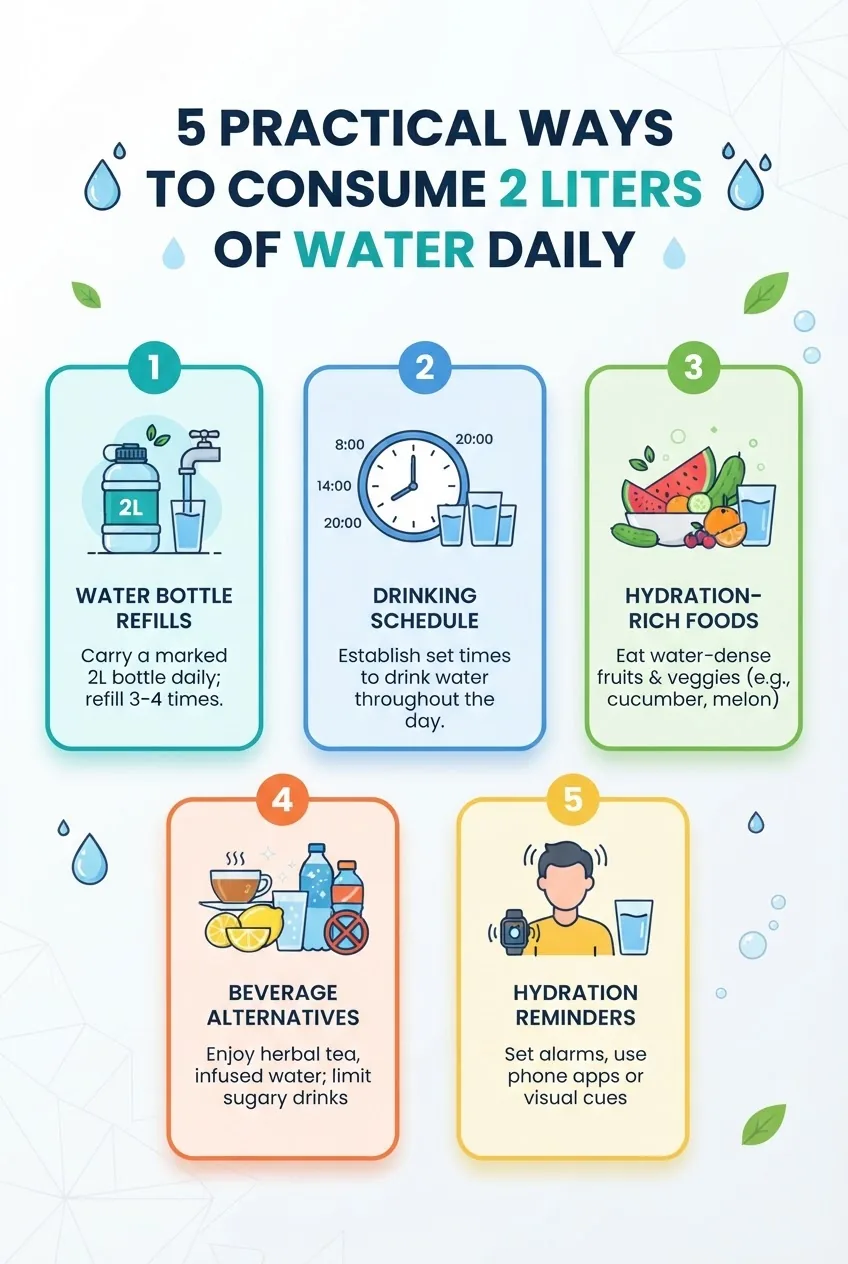
Step-by-step actionable plan:
- Choose a primary bottle size: Select a bottle with volume markings (e.g., 1 L or 32 oz). Refill it twice for 2 L. If you prefer imperial sizing, see guides on bottle ounces for precise counting. how many ounces a water bottle holds
- Schedule and anchor sips: Drink set amounts at anchor times (e.g., 300 mL on waking, 300 mL with breakfast, and 300 mL every 2–3 hours). Use smartphone timers or wearables for reminders if you’re busy in Texas heat.
- Include hydrating foods: Add fruits and vegetables with high water content—cucumbers, watermelon, oranges—to contribute roughly 0.3–1 L/day depending on servings.
- Use beverage alternatives thoughtfully: Plain water is primary, but dairy, low-sugar sports drinks, and herbal teas contribute to fluid balance. For guidance on substitutes, consult the best hydrating beverages and balance added electrolytes during heavy sweating.
- Monitor and adapt for activity/heat: Add 250–500 mL per 30 minutes of moderate exercise, and more if you profusely sweat; include sodium-containing fluids for multi-hour sweating to avoid hyponatremia during prolonged replacement.
- Quality and safety: Prefer potable sources and treat water if needed. See guidance on choosing the best water for mineral balance and contaminants.
- Behavioral nudges: Place bottles within sight, use flavored slices (citrus, cucumber) to increase appeal, or buddy up for hydration checks during outdoor tasks common in Texas communities.
Examples tailored for Texas lifestyle:
- Office worker in Austin: 1‑L bottle on desk, refill midday, 250–500 mL before and after a 30‑minute midday walk.
- Landscaping crew: scheduled 15‑minute hydration breaks every hour, with electrolyte-containing beverages during long shifts in high heat.
- Parent with small children: set family water breaks and provide water-rich snacks to boost household intake.
Transition: Next we clear up common myths and risks so you understand what the 2‑liter rule does and doesn’t imply.
Common Misconceptions About Drinking 2 Liters of Water Daily
Answer: Key misconceptions include that 2 L is mandatory for all, that more is always better, or that caffeinated beverages don’t count; each claim requires nuance—some are partly true, others false and potentially harmful.
Term: Overhydration — a condition where excess water dilutes blood sodium (hyponatremia), which can impair cellular function and, in severe cases, be life‑threatening.
| Myth | Fact |
|---|---|
| Everyone must drink exactly 2 L/day | No — needs vary by weight, activity, and climate; 2 L is a practical baseline. |
| More water is always healthier | No — excessive intake without electrolyte replacement can cause hyponatremia; clinical cases are documented in endurance contexts (according to a 2020 case series). |
| Caffeine cancels out hydration | Partly false — moderate caffeine adds net fluid but may increase urine output slightly; overall contribution counts toward total fluid balance (see does coffee count as water?). |
| You must drink before you feel thirsty | Partly true for older adults and athletes—thirst lags in some groups, so scheduled drinking can help; however, thirst works well for many people. |
| Two liters prevents all dehydration | No — during heavy sweat, illness or infant care, more targeted replacement is essential. |
For detailed discussion on risks of excessive intake, see the clinical overview can you drink too much water?, which examines hyponatremia and safe upper limits.
Transition: Knowing myths helps you monitor real signs of hydration and decide when to adjust intake—covered next.
Recognizing Signs of Proper Hydration and When to Adjust Intake
Answer: Proper hydration usually shows as light-yellow urine, normal energy, stable heart rate and no dizziness; adjust intake if urine is dark, you’re thirsty, dizzy, or experiencing other dehydration symptoms or signs of overhydration.
Term: Urine color — a simple, practical proxy for hydration reflecting urine concentration; darker colors usually indicate higher concentration and potential underhydration.
Simple checklist to monitor hydration status:
- Urine color: pale straw to light yellow indicates likely adequate hydration; dark yellow or amber suggests increase fluids.
- Thirst: persistent thirst despite drinking may indicate ongoing losses or inability to retain fluids (seek clinical evaluation if persistent).
- Performance and cognition: fatigue, headache, or impaired concentration can accompany mild dehydration.
- Cardiovascular signs: lightheadedness or rapid heart rate on standing suggests inadequate volume.
- Overhydration signs: persistent clear urine, swelling, nausea, headache and confusion—seek immediate medical care if severe.
For clinical lists of symptoms and longer-term consequences, review the side effects of dehydration and the diagnostic reference on urine color hydration indicators.
When to seek medical attention: persistent vomiting/diarrhea, fainting, severe confusion, or inability to keep fluids down require urgent evaluation (per CDC public health guidance).
Transition: After recognizing signs, the final content block highlights consistent benefits of maintaining adequate hydration near a 2‑liter drinking target.
Benefits of Consistent Hydration at 2 Liters Daily for Health and Well-being
Answer: Regularly meeting a 2-liter drinking-water habit supports kidney function, cognitive performance, digestive regularity, skin turgor and exercise capacity, though benefits scale with how close intake is to individual optimal fluid targets.
Term: Cognitive benefits — improvements in attention, short-term memory and mood associated with correcting mild dehydration.
| Benefit | Research highlight & practical note |
|---|---|
| Kidney function | Regular intake reduces risk of kidney stones and aids clearance; observational studies indicate lower stone risk with higher fluid intake (according to a 2022 epidemiological review). |
| Cognitive performance | Small RCTs show improved short-term memory and mood after correcting mild dehydration with 500–1000 mL water (according to a 2022 clinical trial). |
| Physical performance | Hydration supports endurance and thermoregulation; losses of 2% body weight can impair performance substantially (sports physiology review, 2021). |
| Digestive and metabolic health | Adequate fluids assist bowel regularity and nutrient transport; evidence supports modest benefits for satiety and metabolic rate when combined with dietary measures (clinical nutrition summary, 2023). |
For a concise scientific primer on why water matters to cell and organ function, see why water is essential. Clinical sources like Mayo Clinic and public health recommendations from CDC reinforce these functional benefits.
Practical takeaway: a 2‑liter drinking habit is a useful, achievable behavior for many adults that supports daily function—adjust for your size, activity, and Texas heat.
Transition to wrap up: the concluding summary below consolidates practical next steps and offers a call to action for personalized planning.