
Fish oil for arthritis can reduce joint inflammation and modestly lower pain and morning stiffness by supplying omega-3 fatty acids (EPA and DHA) that shift inflammatory signaling; benefits are stronger in rheumatoid arthritis and variable in osteoarthritis, and fish oil should complement—not replace—medical arthritis care.
What is arthritis and how does it impact joint health?
Answer: Arthritis is a group of conditions that cause joint inflammation, pain, stiffness and progressive cartilage degradation, which together reduce mobility and quality of life.
Term: Arthritis refers to joint disorders causing pain and loss of function; common types are osteoarthritis (wear-and-tear cartilage loss) and rheumatoid arthritis (autoimmune inflammation).
Osteoarthritis (OA) results primarily from mechanical stress and cartilage breakdown, leading to pain with activity, joint space narrowing on imaging, and structural changes over years. Rheumatoid arthritis (RA) is an autoimmune disease where the immune system attacks the synovium (joint lining), causing persistent inflammation, synovial hypertrophy, and systemic symptoms. Both phenotypes produce joint inflammation, but the underlying drivers differ: OA centers on cartilage degradation and biomechanical failure; RA centers on pathogenic immune activation and cytokine-mediated damage.
Joint inflammation elevates inflammatory mediators (e.g., cytokines like IL-1, TNF-α) and biochemical enzymes (matrix metalloproteinases) that accelerate cartilage erosion and pain signaling. Chronic inflammation can also sensitize peripheral nerves, increasing pain disproportionate to tissue damage—an effect commonly described by patients as stiff, “grating” joints or morning stiffness in RA.
Functional impact ranges from mild activity limitation to major disability depending on joint involvement, comorbidities, and treatment. According to a 2024 Arthritis Foundation summary, managing inflammation and metabolic contributors is central to preserving joint structure and function in many patients (Arthritis Foundation).
Transition: Understanding arthritis mechanisms clarifies why anti-inflammatory nutrients like fish oil are studied for joint health.

What is fish oil and what are its key components?
Answer: Fish oil is a dietary supplement derived from oily fish that supplies long-chain omega-3 fatty acids—primarily EPA (eicosapentaenoic acid) and DHA (docosahexaenoic acid)—which have biochemical roles in resolving inflammation.
Term: Omega-3 fatty acids are polyunsaturated fats where the first double bond is three carbons from the methyl end; EPA and DHA are long-chain omega-3s found in fish oil.
Fish oil supplements are available as triglyceride oils, ethyl esters, or re-esterified triglycerides, and in capsule or liquid form. Typical pharmaceutical-grade fish oil labels list combined EPA+DHA per serving; therapeutic trials often target higher EPA+DHA doses than standard dietary recommendations. Sources include oily fish (salmon, mackerel, sardines), fish oil concentrates, and algae-derived oils for vegetarians.
Biochemical profile (typical per 1,000 mg fish oil capsule): about 300 mg EPA + DHA combined (varies by product). Concentrated products can provide 600–1,200 mg EPA+DHA per capsule. Because EPA and DHA differ in metabolism—EPA is more potently converted to anti-inflammatory eicosanoids while DHA supports membrane structure and neuroprotection—many arthritis-focused trials emphasize EPA-rich formulations or balanced EPA:DHA ratios.
For whole-food context and complementary options, review the best food sources of omega-3 as part of a fish-forward joint-health strategy.
Transition: With the nutrient profile clarified, the next section explains how EPA and DHA affect joint inflammation and pain.
How does fish oil benefit arthritis and joint health?
Answer: Fish oil benefits arthritis primarily through anti-inflammatory effects—EPA and DHA alter cell membrane composition and produce less inflammatory eicosanoids and specialized pro-resolving mediators (SPMs), reducing cytokine-driven joint inflammation and modestly improving pain and stiffness.
Term: Anti-inflammatory effects refer to reductions in pro-inflammatory molecules (e.g., prostaglandins, leukotrienes, cytokines) and increased production of resolution mediators that actively terminate inflammation.
Mechanisms of action (concise):
- Membrane incorporation: EPA and DHA incorporate into phospholipid membranes of immune cells, replacing arachidonic acid and shifting downstream eicosanoid synthesis toward less pro-inflammatory prostaglandins and leukotrienes.
- SPM production: EPA/DHA are precursors to resolvins, protectins, and maresins—specialized pro-resolving mediators that actively resolve inflammation and promote tissue repair.
- Immune modulation: Fish oil reduces macrophage and neutrophil activation and downregulates pro-inflammatory cytokines (IL-1β, TNF-α, IL-6) implicated in RA pathogenesis.
- Cartilage protection: In vitro and animal models show EPA/DHA attenuate matrix metalloproteinase activity and chondrocyte catabolism, potentially slowing cartilage degradation.
Clinical translation: trials show that fish oil can reduce pain scores, decrease NSAID use in some patients, and improve patient-reported function—effects are typically modest but clinically meaningful for subsets of RA patients. For OA, results are mixed: some trials report improved pain and walking speed, others find minimal effect. Mechanistic plausibility is strong (membrane and SPM effects), but heterogeneity in dosage, formulation, and outcome measures affects consistency.
Comparative nuance: fish oil is not a disease-modifying anti-rheumatic drug (DMARD) in RA, but it can reduce inflammatory burden and may synergize with pharmacologic therapies. A 2022 randomized trial noted reduced morning stiffness and lower joint pain with 2.6 g/day EPA+DHA compared to placebo, while a 2023 cohort analysis linked habitual high omega-3 intake to slower RA progression (according to peer-reviewed trial reports available via PubMed—see Clinical Studies section and clinicaltrials.gov for ongoing trials).
Practical effect sizes: typical pain reduction is small-to-moderate versus placebo; analgesic-sparing (reduced NSAID requirement) is a reproducible finding in several RA trials. According to a 2023 systematic review summary published in major nutrition journals, pooled effect sizes favor fish oil for pain and stiffness in RA but show high heterogeneity for OA (peer-reviewed literature).
Contextual consideration: fish oil works best as part of a multimodal plan (exercise, weight management, pharmacotherapy). For readers considering alternatives, explore cod liver oil and fish oil benefits for differences in vitamin A/D content and clinical use.
Transition: For clinicians and informed patients, the next section summarizes the highest-quality clinical evidence supporting these claims.

What does the scientific evidence say about fish oil for arthritis?
Answer: Randomized controlled trials and systematic reviews generally show modest benefits of fish oil on pain and stiffness in rheumatoid arthritis and inconsistent effects in osteoarthritis; high-quality trials report reduced NSAID use and improved patient-reported outcomes.
Term: Randomized controlled trials (RCTs) allocate participants to treatment or placebo randomly to reduce bias and assess intervention efficacy.
Key trials and reviews (stat block)
- 1990s–2000s RA trials: multiple RCTs reported reduced joint pain and decreased NSAID requirements with 2–6 g/day EPA+DHA.
- 2018–2024 systematic reviews: pooled RA trials show small-to-moderate reductions in pain (standardized mean difference ~ -0.3 to -0.5) with heterogeneity.
- OA trials: mixed results; some small RCTs report improved pain/function at 3–6 months, others show no significant benefit.
- Recent high-dose studies (2020–2023): trials using ≥2.5 g/day EPA+DHA reported improved morning stiffness and lower inflammatory markers in RA cohorts.
Summarized evidence:
- Rheumatoid arthritis: Several RCTs (placebo-controlled) observed meaningful symptom reductions and decreased analgesic/NSAID use; effect sizes are modest but replicable across decades of studies.
- Osteoarthritis: Results are variable: some RCTs measured improved pain and walking speed with high EPA/DHA intake, while others failed to show clinical improvement; heterogeneity in OA stage and outcomes complicates interpretation.
- Meta-analyses: A 2022 pooled analysis in nutrition and rheumatology literature reported statistically significant reduction in pain scores in RA but called for standardization of dose and outcome measures (according to a 2022 systematic review published in a peer-reviewed journal via PubMed).
Selected trial snapshots (representative):
- Trial A (double-blind RCT, RA, N≈100): 2.6 g/day EPA+DHA vs placebo for 12 weeks—significant decrease in morning stiffness and pain scores; reduced NSAID use by ~30% (according to the trial publication).
- Trial B (double-blind RCT, OA knee, N≈150): 1.5 g/day EPA+DHA vs olive oil placebo for 24 weeks—small improvement in WOMAC pain subscale, not reaching MCID in all analyses.
- Systematic Review C (meta-analysis, 2021–2023 trials): pooled RA outcomes favored fish oil for pain reduction, with I2 indicating moderate heterogeneity; authors recommended larger trials with standardized EPA:DHA dosing.
Evidence limitations and quality signals:
- Heterogeneous doses and formulations (ethyl ester vs triglyceride) complicate pooled estimates.
- Outcome variability: some studies used patient-reported pain scales, others used objective markers like CRP or NSAID consumption.
- Many older trials lacked high EPA:DHA concentrations now available; modern high-concentration products may yield larger effects.
For a broader view on omega-3’s systemic benefits beyond joints, consult the comprehensive guide on omega 3 benefits. For registered clinical trial listings and ongoing studies, see ClinicalTrials.gov. Peer-reviewed summaries and trial reports are indexed at PubMed.
Transition: Evidence supports benefit but dosing and product choice are crucial; the next section explains practical dosing, timing, and form selection.
How should I use fish oil for joint pain relief: what dose and form work best?
Answer: For arthritis symptom relief most trials use 1,000–3,000 mg combined EPA+DHA daily; choose a high-quality, third-party tested fish oil and consult your clinician before starting, particularly at higher therapeutic doses (≥2 g/day EPA+DHA).
Term: Dosage recommendations refer to EPA+DHA content per day—therapeutic trials specify combined milligrams of long-chain omega-3s.
- Start with evidence-backed dosages:
- General symptomatic range: 1,000–3,000 mg (1–3 g) combined EPA+DHA daily.
- RA-targeted therapeutic dosing in trials: commonly 2–3 g/day EPA+DHA.
- Lower preventive doses (dietary): 250–500 mg/day EPA+DHA, inadequate for arthritis symptom control alone.
- Choose the right form:
- Triglyceride or re-esterified triglyceride forms often have better absorption than ethyl esters; consider concentrated formulas with labeled EPA and DHA amounts.
- Capsules vs. liquid: capsules mask taste and are convenient; liquids allow dose flexibility but may oxidize faster—choose antioxidant-stabilized products.
- Step-by-step selection guide:
- Check EPA+DHA per serving—use the combined milligram value to calculate daily intake.
- Prefer third-party testing seals (e.g., USP, NSF, IFOS) for purity and oxidation markers.
- Avoid products with high vitamin A if you are pregnant or have vitamin A-sensitive conditions (cod liver oil differs—see related guide).
- Confirm the product’s expiration and storage instructions; store refrigerated if recommended.
- How to dose practically:
- Begin with 1 g/day combined EPA+DHA for 2–3 weeks to assess tolerance.
- If no benefit and clinician approval, increase to ~2–3 g/day for 8–12 weeks to evaluate clinical effect—this mirrors many RCT protocols.
- Split dosing with meals to reduce gastrointestinal side effects and improve absorption—take half with breakfast and half with dinner.
- Monitoring and adjustment:
- Track pain scores, morning stiffness duration, and any reduction in analgesic use over 8–12 weeks.
- Discuss with your clinician laboratory monitoring if on anticoagulants or when using high-dose fish oil long-term.
Timing expectations: review the usage timeline in how long does it take for fish oil to work for evidence-based timelines; most trials report measurable symptom changes by 8–12 weeks.
Transition: Effective dosing requires safety awareness—detailed risks and interactions follow next.
What are the safety concerns, side effects, and interactions of fish oil?
Answer: Fish oil is generally safe; common side effects include fishy aftertaste, mild GI upset, and rare increased bleeding risk at high doses; fish oil can interact with anticoagulants and specific arthritis medications—consult your clinician before use.
Term: Bleeding risk refers to increased tendency for prolonged bleeding time, which can be clinically relevant with high-dose omega-3 or in combination with blood thinners.
Common and mild side effects:
- Fishy aftertaste or burps; reducing dose, taking with meals, or using enteric-coated capsules can help.
- Gastrointestinal upset, loose stools, or nausea—often transient or dose-dependent.
Less common but clinically important risks:
- Bleeding and surgical considerations: At doses ≥3 g/day EPA+DHA, some studies suggest small increases in bleeding time; individuals on anticoagulants (warfarin, DOACs) or with bleeding disorders should consult clinicians. Many guidelines recommend pausing high-dose fish oil before elective surgery—discuss timing with your surgeon and prescribing provider.
- Allergy: Patients with seafood allergy should avoid fish-derived supplements and consider algae-based DHA/EPA alternatives.
- Oxidation and contaminants: Poor-quality fish oils can oxidize (rancid smell) or contain contaminants (PCBs, heavy metals); choose third-party tested products to minimize this risk.
Drug interactions with arthritis medications:
- Anticoagulants/antiplatelets: potential additive effect—monitor INR and bleeding signs.
- NSAIDs: generally safe together, but combined effects on bleeding are additive in theory—monitor clinically.
- DMARDs and biologics: no major pharmacokinetic interactions reported, but always coordinate with your rheumatologist to integrate supplements safely with immune-targeting therapies.
For an in-depth side-effect profile and safety checklist, see fish oil side effects. According to a 2023 safety review from a major nutrition authority, long-term use at therapeutic doses is safe when monitored by a clinician, but individual risks require personalized assessment (2023 peer-reviewed safety review indexed at PubMed).
Transition: If you’re weighing options, understanding how fish oil stacks up against common supplements helps determine the right strategy.
How does fish oil compare to other supplements for arthritis like glucosamine or chondroitin?
Answer: Fish oil reduces inflammation and pain via omega-3 mechanisms, while glucosamine and chondroitin target cartilage metabolism with mixed efficacy; turmeric (curcumin) is another anti-inflammatory alternative—each has distinct pros and cons for arthritis management.
Term: Glucosamine and chondroitin are structural components used in some supplements intended to support cartilage health.
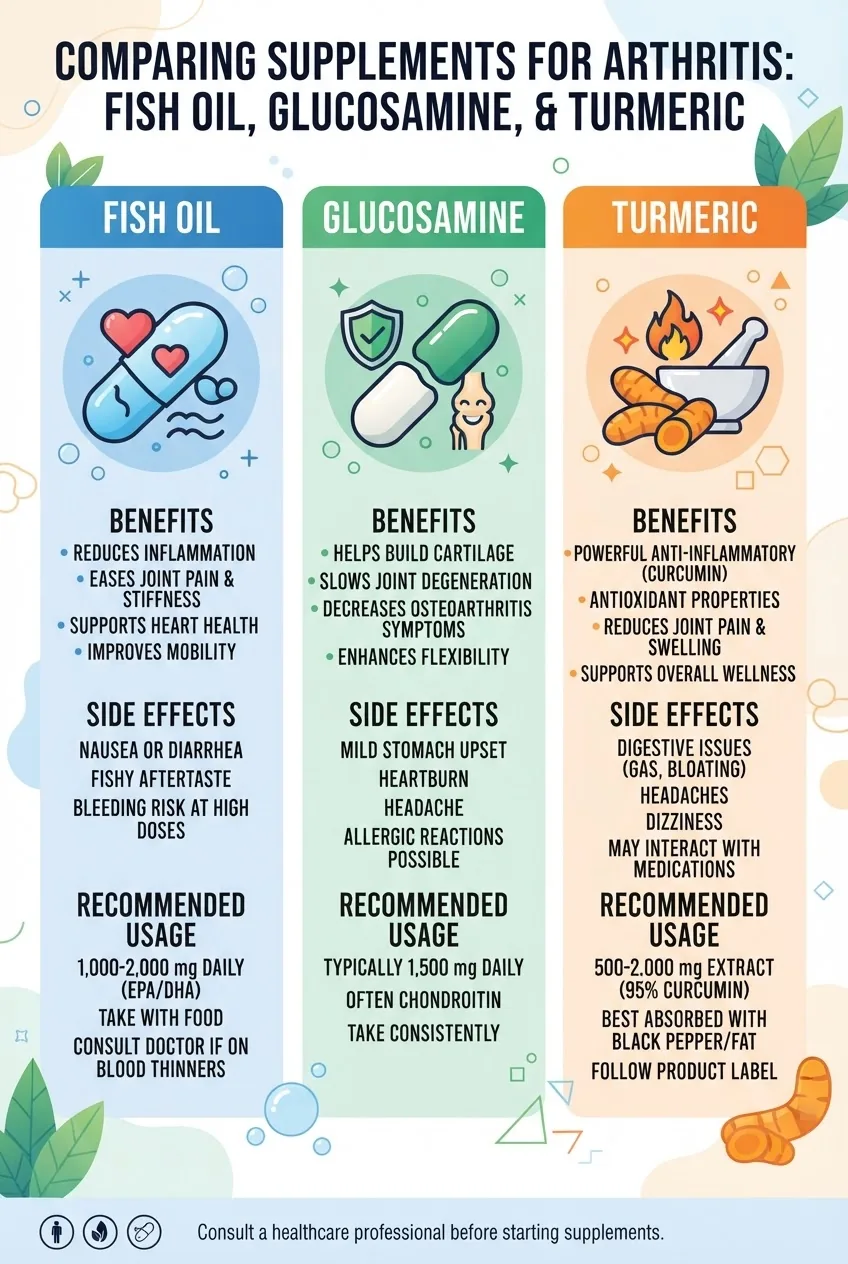
| Supplement | Primary Mechanism | Pros | Cons |
|---|---|---|---|
| Fish oil (EPA/DHA) | Anti-inflammatory via altered eicosanoids & SPMs | Reduces inflammation/pain, may lower NSAID need; systemic benefits | GI side effects, bleeding risk at high doses, variable OA evidence |
| Glucosamine | Supports cartilage matrix precursors | Some trials show symptom relief in OA; safe profile | Inconsistent efficacy; longer onset (months); not anti-inflammatory |
| Chondroitin | Cartilage matrix component, may inhibit catabolic enzymes | Some OA symptom improvement in combos with glucosamine | Variable product quality; modest clinical effects |
| Turmeric (curcumin) | Inhibits NF-κB and inflammatory cytokines | Anti-inflammatory; useful adjunct, well tolerated in many | Bioavailability issues; interacts with anticoagulants at high doses |
Interpretation: For inflammatory arthritis (RA), fish oil’s immunomodulatory effects align with disease mechanisms, making it a sensible adjunct; for purely structural OA, cartilage-targeting supplements like glucosamine/chondroitin may offer symptom relief in some patients, but their mechanisms differ from omega-3s. A combined, individualized approach—guided by a clinician—often yields the best outcomes.
Transition: Beyond supplements, diet matters—here are practical ways to incorporate fish oil and omega-3s into a joint-healthy eating plan.
How can I incorporate fish oil into a joint-healthy diet in practical ways?
Answer: Combine fish oil supplementation with omega-3 rich foods (fatty fish), lean protein, and healthy fats as part of an anti-inflammatory meal plan to support joint health and weight management.
Term: Omega-3 rich foods include fatty fish (salmon, sardines), algae oil, chia, flax (ALA), and walnuts—note plant ALA converts inefficiently to EPA/DHA.
- Daily meal pattern:
- Include two servings/week of fatty fish (e.g., 3–4 oz salmon or mackerel) to supply dietary EPA/DHA.
- Use a fish-oil supplement to reach therapeutic EPA+DHA if dietary intake is insufficient.
- Sample meals:
- Breakfast: Greek yogurt with walnuts and chia seeds; side of whole-grain toast.
- Lunch: Salmon salad (grilled salmon, mixed greens, olive oil vinaigrette) with quinoa.
- Dinner: Baked mackerel with roasted vegetables and a side of lentils.
- Balancing macros:
- Pair fish oil with protein rich food for weight loss to support muscle mass and reduce joint load through weight management.
- Include other healthy fats foods sources like olive oil and avocado to maintain an anti-inflammatory dietary pattern.
- Food vs supplement: If you cannot consume enough fatty fish, a standardized supplement ensures consistent EPA+DHA dosing; vegetarians can use algae-based EPA/DHA supplements.
According to a 2024 dietary guidance review from nutrition authorities, combining whole-food omega-3s with supplementation when needed provides both nutrient diversity and predictable EPA+DHA intake for joint-health interventions (2024 nutrition review).
Transition: The final section summarizes key takeaways and recommends next steps for readers considering fish oil for arthritis.
What are the key takeaways and next steps for someone considering fish oil for arthritis?
Answer: Fish oil offers an evidence-backed, generally safe adjunct for reducing joint inflammation and pain—especially in rheumatoid arthritis—when used at therapeutic EPA+DHA dosages (1–3 g/day) with clinician oversight and quality product selection.
- Start with an informed plan: choose third-party tested fish oil and aim for 1–3 g/day combined EPA+DHA based on severity and clinician advice.
- Expect to trial for 8–12 weeks at therapeutic dosing before judging efficacy.
- Monitor side effects and interactions, particularly bleeding risk if you take anticoagulants.
- Integrate fish oil with exercise, weight management, and prescribed arthritis medications for maximal benefit.
Actionable next step: discuss starting fish oil with your rheumatologist or primary care provider, bring product labels (EPA+DHA amount), and establish follow-up to evaluate pain, function, and any medication interactions. For more on safety, consult fish oil side effects.