
Saturated fats are saturated with hydrogen atoms: each carbon in their fatty acid chains holds the maximum number of hydrogen atoms and all carbon-carbon bonds are single bonds, producing straight chains that pack tightly. This molecular saturation affects melting point, digestion, and how the body handles cholesterol and energy storage.
What Are Saturated Fats Saturated With?
Answer: Saturated fats are saturated with hydrogen atoms attached to the carbon atoms of their fatty acid chains; all available carbon bonds in the chain are single (no double bonds), making the chain “fully hydrogenated” and chemically saturated.
Term: saturated fats — fats whose fatty acid chains have only single carbon–carbon bonds and are filled (saturated) with hydrogen atoms.

The simplest way to picture a saturated fatty acid is a row of carbon atoms (a carbon backbone) where every carbon that can bind to hydrogen has done so. Without any carbon–carbon double bonds, the chain becomes a straight rod-like molecule that packs closely with other rods. This packing increases melting temperature — which is why most saturated fats are solid at room temperature (butter, coconut oil at cooler temps).
Term: fatty acid chains — linear molecules made of carbon atoms bonded together with hydrogen atoms attached; they form the tail part of triglycerides, the storage form of dietary fats.
Chemically, a saturated fatty acid like palmitic acid contains no C=C double bonds: every carbon holds the maximum number of hydrogen atoms. By contrast, unsaturated fatty acids have one or more double bonds where two carbons share additional bonding, reducing hydrogen count at that position. When manufacturers hydrogenate oils, they add hydrogen atoms to unsaturated bonds to make oils more solid; that process can produce trans fats if partial hydrogenation occurs.
Term: hydrogenation — a chemical process that adds hydrogen atoms to carbon–carbon double bonds, converting unsaturated fats toward more saturated forms; partial hydrogenation can create trans fatty acids.
At the biochemical level, saturation changes how enzymes recognize and metabolize fats, influences blood lipid profiles, and affects physical properties of cell membranes. For deeper technical detail, see the saturated fatty acid guide.
Transition: Now that you know the molecular answer to “saturated with what,” we’ll define fat and explain how different types function in the body.
Defining Fat: Types and Functions in the Body
Answer: Fat (a lipid) is an energy-dense nutrient made of fatty acids attached to glycerol; it exists as saturated, monounsaturated, polyunsaturated, and trans fats, and serves energy storage, insulation, cell structure, vitamin transport, and hormone production roles.
Term: fat — a class of lipids made principally of triglycerides: three fatty acid chains attached to a glycerol molecule; fuels metabolism and builds structures.
Fats are broadly grouped by the chemical structure of their fatty acid chains:
- Saturated fats: no double bonds, saturated with hydrogen.
- Monounsaturated fats (MUFA): one double bond.
- Polyunsaturated fats (PUFA): two or more double bonds (includes omega-3 and omega-6 essential fatty acids).
- Trans fats: unsaturated fats with a trans double-bond configuration, usually industrially produced.
Primary functions of fat in the body include:
- Energy storage: one gram of fat yields ~9 kcal, making fats the body’s dense long-term energy store.
- Insulation and protection: subcutaneous and visceral fat cushion organs and help regulate body temperature.
- Cell structure: lipid membranes require specific fatty acids for fluidity and signaling.
- Transport of fat-soluble vitamins (A, D, E, K).
- Hormone precursors: e.g., cholesterol-derived steroid hormones.
Term: lipid metabolism — the biochemical processes by which fats are broken down for energy, reassembled into storage forms, or used to build cellular components.
How fat works in energy metabolism: triglycerides stored in adipose tissue are hydrolyzed to glycerol and fatty acids, which enter the bloodstream and are taken up by tissues for beta-oxidation in mitochondria. This pathway is central for exercise endurance and fasting states.
Transition: With types and roles clear, compare saturated fats with trans fats to understand key differences in structure and risk.
Saturated vs Trans Fats: Similarities and Differences
Answer: Saturated fats have only single carbon–carbon bonds and are fully hydrogenated; trans fats contain at least one trans-configured double bond, usually formed by industrial partial hydrogenation — trans fats raise heart disease risk more than naturally occurring saturated fats.
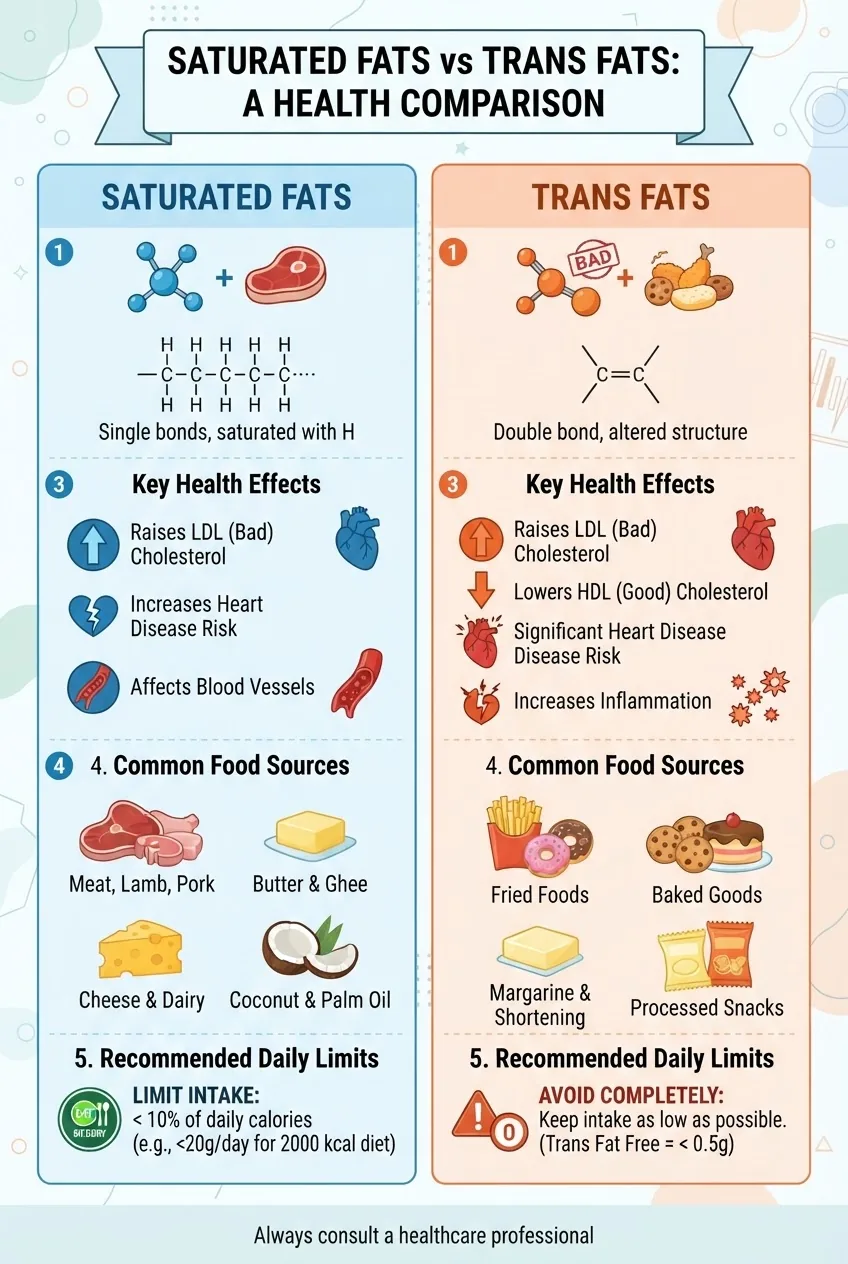
| Feature | Saturated Fats | Trans Fats |
|---|---|---|
| Chemical structure | Only single C–C bonds; fully hydrogenated chains | Contains at least one trans-configured C=C double bond |
| Common sources | Butter, cheese, fatty cuts of meat, coconut oil | Partially hydrogenated vegetable oils, some baked/fried processed foods |
| Physical state | Often solid at room temperature | Solid/semisolid due to industrial processing |
| Health impact | Can raise LDL cholesterol; link to CVD debated in nuance | Strongly raises LDL and lowers HDL; clear link to heart disease |
| Regulatory status | Recommended limited intake by health authorities | Banned/removed from many food supplies; advised ~0 intake |
Both fat types can make foods shelf-stable and change texture, but trans fats produced by partial hydrogenation have been linked to higher cardiovascular risk than saturated fats. For an at-a-glance visual comparison, consult the infographic above. The chemical difference — saturated = no double bonds, trans = specific double-bond geometry — explains their distinct effects on blood lipids and cell membranes.
Transition: Next, identify specific good fats and bad fats and examples to guide everyday choices.
Good Fats vs Bad Fats: What You Need to Know
Answer: “Good” fats (primarily monounsaturated and polyunsaturated fats, including omega-3s) support heart and brain health; “bad” fats (industrial trans fats and excess saturated fats) raise LDL cholesterol and cardiovascular risk when consumed in large amounts.
Term: good fats vs bad fats — a practical classification: good fats improve lipid profiles and metabolic health; bad fats worsen them when overconsumed.
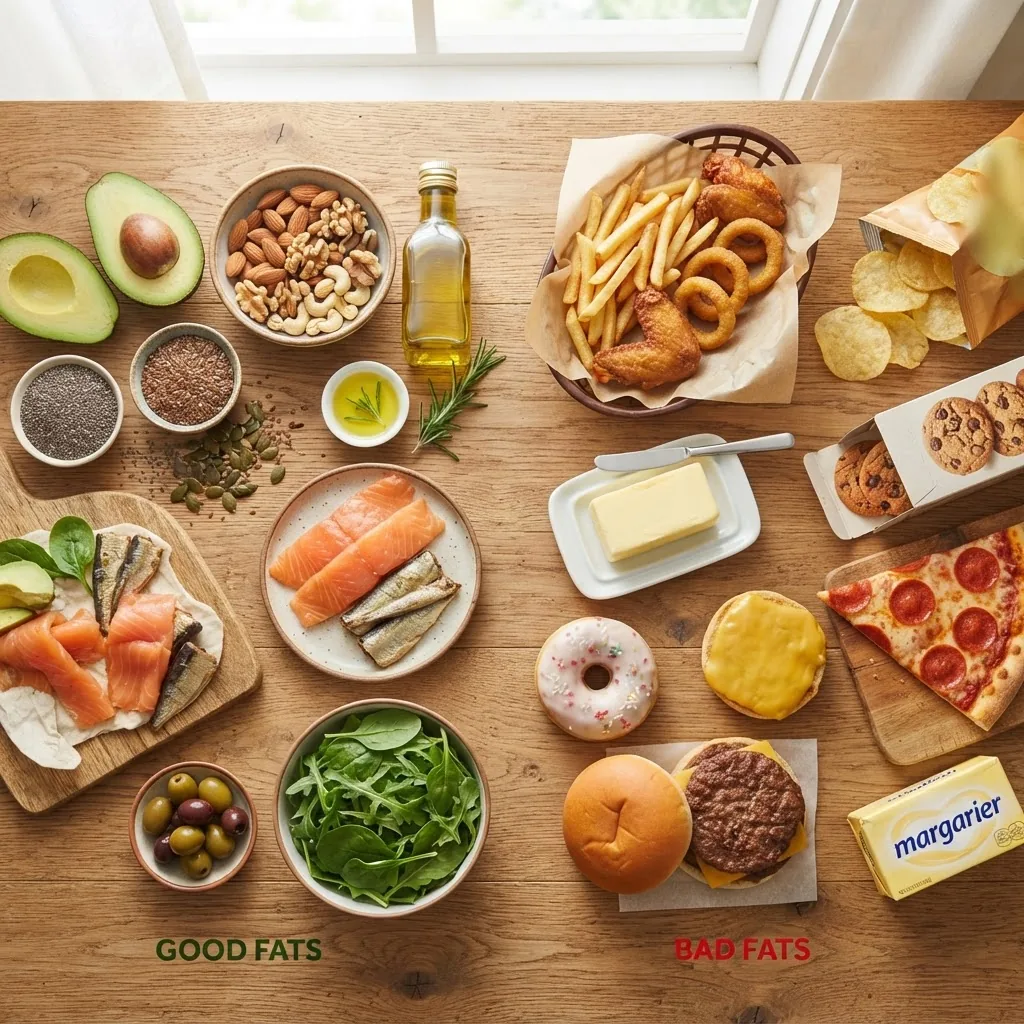
Below are numbered examples with brief health impacts to make shopping and cooking decisions easier:
-
Monounsaturated fats (Good):
- Examples: olive oil, avocados, almonds, macadamia nuts.
- Health impact: often associated with lower LDL cholesterol and improved insulin sensitivity; recommended as primary cooking and salad oils by many guidelines.
-
Polyunsaturated fats (Good):
- Examples: fatty fish (salmon, mackerel) for omega-3s; walnuts, flaxseed, soybean oil for omega-3/6 PUFAs.
- Health impact: omega-3s reduce triglycerides and may lower cardiovascular events in high-risk groups, according to peer-reviewed trials.
-
Saturated fats (Caution):
- Examples: butter, cheese, fatty beef, palm and coconut oil.
- Health impact: can raise LDL cholesterol; moderation is advised, replacing some saturated fat with MUFA/PUFA tends to lower cardiovascular risk in trials and guidelines.
-
Trans fats (Bad):
- Examples: partially hydrogenated oils in some processed baked goods, some fried fast foods (largely removed in many markets).
- Health impact: increases LDL, lowers HDL, and substantially raises heart disease risk; aim for zero intake.
-
Refined/processed fats (Contextual):
- Examples: hydrogenated spreads, many packaged snacks high in saturated and trans fats.
- Health impact: associated with weight gain and metabolic harms when a major part of the diet.
Authority guidance: USDA Dietary Guidelines and the American Heart Association recommend prioritizing unsaturated fats and minimizing trans fats; check those sources for specific percent-of-calories recommendations and updates.
Transition: The next section examines scientific evidence on health impacts of saturated fat and how experts balance the data and caveats.
Health Impacts of Saturated Fat: What Science Says
Answer: Saturated fat tends to raise LDL (“bad”) cholesterol and is linked to higher cardiovascular disease (CVD) risk in many studies; replacing saturated fat with unsaturated fats (MUFA/PUFA) reduces CVD risk, though nuance and ongoing debate remain in recent reviews.
According to the 2023 American Heart Association guidelines, limiting saturated fat and replacing it with unsaturated fats is recommended to lower CVD risk; those guidelines synthesize randomized trials and cohort studies. According to a 2024 peer-reviewed meta-analysis of cohort studies, higher saturated fat intake was associated with increased LDL but associations with clinical outcomes varied by what replaced saturated fat (PUFA/MUFA vs carbohydrate).
Term: LDL and HDL — LDL (low-density lipoprotein) carries cholesterol to tissues and is associated with atherosclerosis at high levels; HDL (high-density lipoprotein) helps remove cholesterol from arteries.
Key findings summarized:
- Mechanism: saturated fats increase LDL particle concentration by influencing hepatic lipid metabolism and LDL receptor activity.
- Replacement matters: Replacing saturated fat calories with polyunsaturated fats reduces CVD events in trials; replacing with refined carbohydrates does not show the same benefit.
- Heterogeneity: not all saturated fatty acids have identical metabolic effects — chain length matters (lauric, myristic, palmitic differ biologically).
On blood sugar and metabolic risk: for most people, saturated fat has weaker direct effects on glycemia than carbohydrate quality, but diets high in saturated fat and excess calories can worsen insulin resistance. For people tracking diabetes or blood sugar, consider the link between saturated fat and glucose control; see our blood sugar and fat intake relationship for context.
For the interaction of sugar and fat in the diet and how both affect heart and metabolic health, review the natural vs added sugar guide.
Regulatory and public-health actions reflect evidence strength: many countries and manufacturers eliminated industrial trans fats; health bodies like the USDA Dietary Guidelines recommend limiting saturated fat to under 10% of calories for general populations (check latest edition for updates).
Caveats and nuance:
- Observational studies can show associations but not causation; randomized trials with hard endpoints remain critical for policy.
- Food matrix matters: saturated fat from whole dairy has different observational signals versus isolated saturated fat in processed foods.
- Individual response varies: genetics, baseline diet, and metabolic health change lipid responses.
Practical clinical guidance: For patients with high LDL or existing CVD, the AHA and many clinicians advise reducing saturated fat and increasing PUFAs/MUFAs. For personalized advice, consult your clinician or registered dietitian.
Transition: With the evidence context set, here are hands-on strategies for eating fat healthily, including Texas-specific tips and a label-reading walkthrough.
How to Eat Fat: Practical Tips for a Healthy Diet
Answer: Eat fats that favor MUFA and PUFA, limit saturated fat, avoid trans fats, control portions, and replace high-saturated-fat foods with plant oils, nuts, fish, and whole-food swaps; practice label reading and simple cooking swaps for sustainable change.
Texas lifestyle tip: swap cooking fats in classic Texan dishes — use olive or canola oil for sautéing, and favor leaner cuts or grilled fish in place of heavily charred fatty meats. Many Texas farmers’ markets offer fresh avocado and pecans as local good-fat options.
Label-reading walkthrough: Look at the Nutrition Facts panel: first check serving size, then find “Saturated Fat (g)” and “Trans Fat (g).” Aim for low saturated fat grams per serving and zero trans fat (or “partially hydrogenated oil” in ingredients indicates hidden trans fats). Replace items where saturated fat is a leading contributor of calories.
- Do: Use olive oil, avocado oil, and canola oil for cooking and dressings; aim for fatty fish 2× weekly for omega-3s.
- Do: Choose nuts, seeds, and nut butters as snacks instead of chips and pastries.
- Don’t: Rely on processed fried foods and packaged snacks high in saturated and trans fats.
- Swap: Replace butter on toast with mashed avocado or olive oil drizzle; swap heavy cream sauces for yogurt-based or nut-based creamy options.
- Portion control: remember fat is calorie-dense — a tablespoon of oil is ~120 kcal; measure when cooking to avoid excess calories.
Complementary resources: pair fat-quality changes with daily sugar intake guidelines to optimize metabolic outcomes, and consider lifestyle supports such as natural remedies for diabetes only as adjuncts to evidence-based care. For body-shape goals, include foods from our foods that help reduce belly fat.
Recipe and cooking swaps practical examples (Texas-friendly):
- Grill lean flank steak with lime and serve with avocado salsa instead of deep-fried chimichangas.
- Make a pecan-olive oil crumb topping for fish in place of butter-based crusts.
Transition: Below are common myths about saturated fats alongside concise facts to cut through confusion.
Common Myths About Saturated Fats Debunked
Answer: Many claims oversimplify: saturated fat is not uniformly harmless nor universally deadly; its health impact depends on amount, replacement nutrient, and food source — trans fats are clearly harmful and should be avoided.
Myth:
Myth: “All saturated fats are healthy.” Fact: No — some saturated fats may be neutral in some studies, but overall evidence and guidelines recommend limiting saturated fat and replacing it with unsaturated fats to reduce heart disease risk.
Myth:
Myth: “Butter is as dangerous as trans fats.” Fact: Trans fats have a stronger, more consistent link to heart disease; butter raises LDL but does not have the same epidemiologic weight as industrial trans fats.
Myth:
Myth: “You must avoid all fats to be healthy.” Fact: Dietary fats are essential for nutrients, hormones, and vitamin absorption; focus on quality and portion control rather than abolishing fat entirely.
Myth:
Myth: “Saturated fat only matters for people with heart disease.” Fact: Saturated fat affects LDL in most people; population-level guidance targets everyone to reduce long-term cardiovascular risk.
Each fact is grounded in systematic reviews, randomized trial data, and guideline syntheses; for personalized medical advice, consult a clinician before making major dietary changes.
Transition: Finally, a concise summary of the most actionable takeaways and a clear next step.
Summary and Key Takeaways on Saturated Fats
Answer: Saturated fats are saturated with hydrogen atoms; they raise LDL cholesterol relative to unsaturated fats and should be limited, replaced where possible by MUFA/PUFA, and always considered within whole-food contexts and personal health goals.
- Saturated fats = fully hydrogenated carbon chains (no double bonds).
- Replace saturated fat calories with polyunsaturated or monounsaturated fats to reduce cardiovascular risk.
- Avoid industrial trans fats entirely; they have the clearest harmful effects.
- Read labels: prioritize foods low in saturated and zero in trans fats; watch serving sizes.
- For personalized guidance—especially if you live in Texas and eat local cuisines—talk to a registered dietitian or your healthcare provider about swaps that fit your lifestyle.
Conclusion and next step: Now you know what saturated fats are saturated with and how to manage fat intake practically. Start by swapping one high-saturated-fat item in your weekly menu for a MUFA/PUFA option and track the change. For more on sugar interactions and diet planning, explore other guides in our collection.