
What you will have achieved, how long it takes, and skill level
By the end of this guide you will have a concrete, step-by-step plan to perform a water-only fast of 24–72 hours with safe hydration practices: exact water volumes by weight and activity, low-risk monitoring thresholds (blood pressure, heart rate, urine color, blood glucose), and a tested 3-day refeed protocol to minimize complications. This is a practical do-it-yourself protocol aimed at short water fasts (1–3 days). Expect to spend 2–3 hours preparing across two days, then active daily monitoring of 5–15 minutes while fasting. Skill level: intermediate — you should be comfortable measuring liquids, taking basic vitals (pulse, blood pressure), and following numeric thresholds; medical training is not required but comfort contacting a clinician is essential.
Before you start
- Medical prerequisites: no pregnancy, no type 1 diabetes, no active eating disorder, no advanced kidney disease, and no recent bariatric surgery.
- Tools and materials:
- Digital scale (for body weight) and kitchen scale (optional) — to calculate water per kg.
- Reusable water bottle or jugs totaling at least 3 liters capacity.
- Blood pressure monitor (automatic cuff) and a stopwatch or smartphone timer.
- Pulse oximeter (optional) and a reliable thermometer.
- Urine color chart (printable) or camera to take photos for tracking.
- Electrolyte solution packets (sodium 300–500 mg per liter or generic oral rehydration salts), oral glucose gel (for hypoglycemia), and contact info for a local clinic or urgent care.
- Supplies to have nearby:
- One 1-liter bottle of water chilled and one at room temperature (for palatability).
- 30 mL measuring cup or syringe for oral electrolyte dosing.
- A logbook (paper or digital) to write weight, blood pressure, pulse, urine color, and symptoms twice daily.
- Knowledge checklist:
- Know your baseline weight and blood pressure within 7 days before starting.
- Have a plan to stop if systolic blood pressure drops >20 mmHg from baseline or pulse rises >25 bpm above baseline with symptoms.
Core water fasting rules: step-by-step guide
Below are step-by-step actions. Each numbered step begins with the action first in bold and then detailed, measurable guidance. Read every step before beginning the fast.
-
Confirm medical safety: screen for exclusions
Before starting any water fast, confirm you do not have any of these exclusion criteria: pregnancy or breastfeeding, type 1 diabetes, uncontrolled type 2 diabetes on insulin or sulfonylureas, active infection, advanced kidney disease (eGFR <45 mL/min/1.73 m2), symptomatic heart disease (unstable angina, recent MI in last 6 months), active eating disorder, or recent major surgery. If you are aged >75, or taking >3 prescription medications daily, consult a clinician first.
Actionable: call your primary care office and ask one question: “Given my plan to do a water-only fast for up to X hours, do you advise against it because of my medical history or medications?”
-
Set a clear duration and goal
Decide the exact fasting window: typical safe targets for beginners are 24 hours, intermediate 36–48 hours, and experienced practitioners 72 hours. Do not exceed 72 hours without medical supervision. Record the target start and end time in your logbook and set alarms 12 hours before and at the end time.
Worked example: If you plan a 48-hour fast starting 8:00 AM Monday, set start=8:00 AM Monday, projected end=8:00 AM Wednesday. Put a reminder to check vitals at 8:00 AM and 8:00 PM each day.
-
Reduce stimulant and salt intake 48 hours before
48 hours prior, cut caffeine by 50% and avoid alcohol entirely. Sodium intake should be moderate: aim for 2,300 mg/day for the two days before starting, avoiding extreme low-sodium days that will magnify electrolyte shifts. This reduces early withdrawal symptoms and blood-pressure swings.
Actionable checklist for 48 hours pre-fast:
- Day -2: caffeine ≤150 mg (one 8-oz brewed coffee ≈95 mg), salt ≈2,300 mg, hydrate with 2–2.5 L water.
- Day -1: caffeine ≤100 mg, salt ≈2,300 mg, eat balanced meals including 20–30 g protein per meal.
-
Weigh and baseline vitals the morning before
On the morning of the fast (or within 24 hours before), measure and record:
- Body weight to nearest 0.1 kg (or 0.2 lb).
- Blood pressure and pulse (sitting, after 5 minutes rest). Take two readings one minute apart and record the average systolic and diastolic values and pulse.
- Random blood glucose if you are diabetic or prediabetic (fingerstick).
- Urine color (compare to chart) and approximate cups of urine passed in prior 12 hours.
Thresholds that should stop a fast before starting: baseline systolic <90 mmHg, baseline pulse >110 bpm, or fasting glucose <70 mg/dL if diabetic. If any threshold is present, postpone and contact a clinician.
-
Calculate your target daily water volume
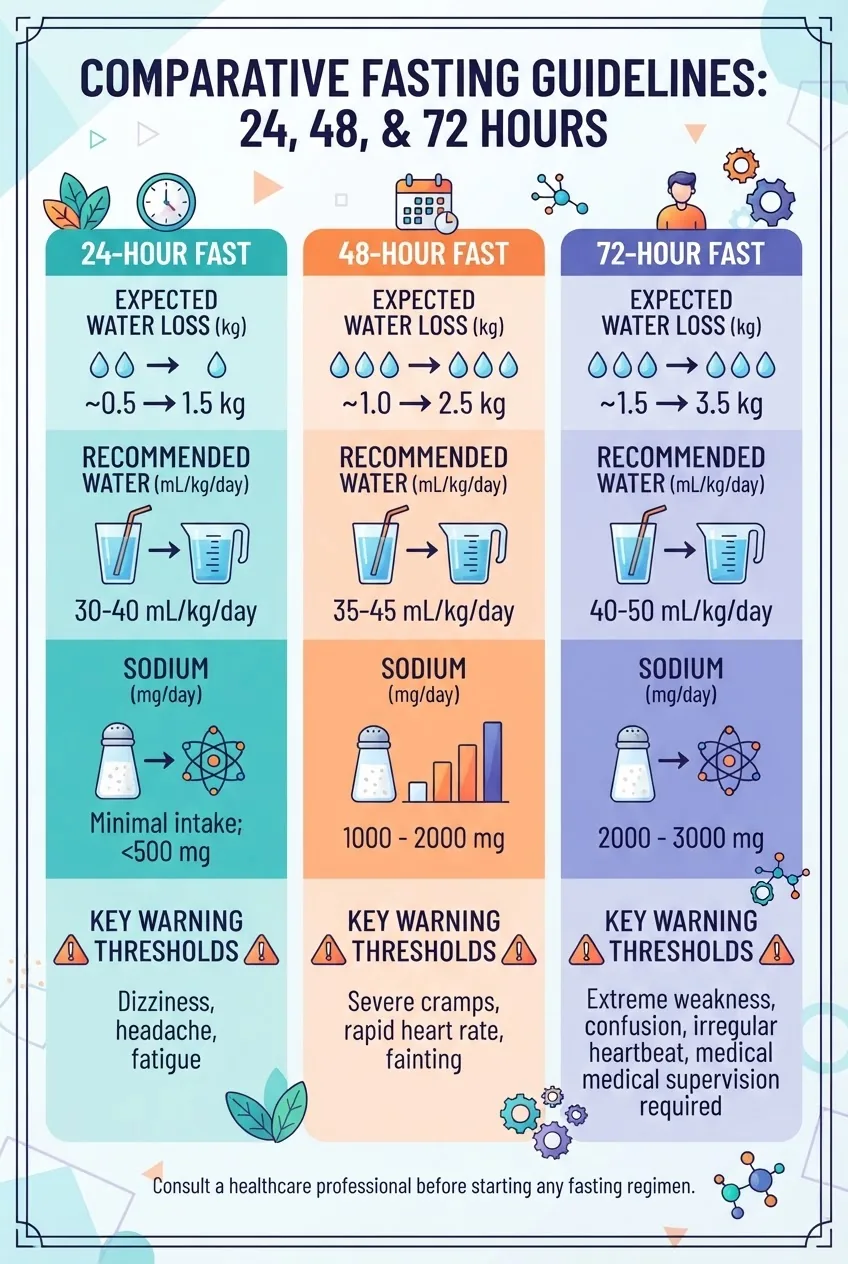
Use body weight to calculate minimum and upper-range volumes. Standard recommendation for fasting (no exercise) is 30–40 mL/kg/day. For low activity (walking <60 minutes/day) use 30 mL/kg; for light activity (walking 60–120 minutes/day) use 35 mL/kg; for moderate activity (>120 minutes/day) use 40 mL/kg. Do not exceed 60 mL/kg/day without medical supervision.
Worked examples:
- 70 kg (154 lb), sedentary: 70 × 30 = 2,100 mL/day (2.1 L).
- 85 kg (187 lb), light activity: 85 × 35 = 2,975 mL/day (≈3 L).
- 100 kg (220 lb), moderate activity: 100 × 40 = 4,000 mL/day (4 L).
Divide total by waking hours. If you are awake 16 hours, a 2 L/day plan is 125 mL every hour or 250 mL every 2 hours. Use scheduled drinking to avoid large boluses that may trigger hyponatremia symptoms.

-
Add measured electrolytes if fasting >24 hours or if you sweat heavily
Pure water fasting still allows electrolytes for safety: if your planned fast exceeds 24 hours, take 200–500 mg sodium per liter of water (preferably 300 mg/L) and 100–200 mg potassium per liter if available. Use oral rehydration salts or electrolyte packets with clear label dosing. Limit potassium to 2,000 mg total per day unless cleared by a clinician.
Practical dosing:
- For a 3 L/day plan: add ~900 mg sodium/day (3 × 300 mg packets) and ~300–600 mg potassium/day (3 × 100–200 mg packets).
- If you only have table salt (NaCl ≈ 40% sodium): 1/4 teaspoon ≈ 575 mg sodium. So one 1/8 tsp per liter ≈ 287 mg sodium per liter.
Do not use high-dose salt; keep to the ranges above. If you have high blood pressure on medication, consult a clinician about electrolyte dosing as sodium increases may interact with diuretics.
-
Establish a twice-daily monitoring routine
Monitor at least twice daily: once in the morning and once in the evening, plus any time you feel faint, dizzy, or unusually symptomatic. At each check record:
- Weight (morning only), blood pressure and pulse (sitting and standing if dizzy), urine color, and symptoms (nausea, lightheadedness, palpitations).
- If diabetic, measure blood glucose twice daily and any time you feel hypoglycemic.
Standing orthostatic test: if you feel lightheaded when standing, measure BP and pulse supine after 5 minutes rest and then at 1 and 3 minutes after standing. Stop the fast if systolic BP falls ≥20 mmHg or pulse increases ≥25 bpm with symptoms.
-
Manage activity and temperature
Do light activity only: walking 15–45 minutes twice daily is fine. Avoid vigorous exercise, heavy lifting, sauna, or hot tubs, which increase fluid and electrolyte loss. Keep ambient temperature 20–24°C (68–75°F). If you sweat extensively, add 200–400 mg extra sodium to the day for every 500 mL of sweat estimated.
Estimate sweat loss: moderate sweat ≈ 0.5 L/hour. If you sweat 1 hour of moderate activity, add 400–800 mL water and 200–300 mg sodium extra that day.
-
Recognize critical warning signs and stop thresholds
Immediately stop the fast and seek care if you experience any of the following:
- Systolic BP <90 mmHg for two consecutive readings or a drop ≥20 mmHg from baseline with symptoms.
- Pulse >110 bpm at rest or an increase ≥25 bpm from baseline with dizziness.
- Confusion, fainting, severe nausea/vomiting, visual disturbances, muscle cramps with weakness, or chest pain.
- Blood glucose <70 mg/dL if diabetic or symptomatic hypoglycemia (sweating, tremor, confusion).
If these occur, sip 120–240 mL of a 6–8% carbohydrate solution (juice or glucose gel diluted into water) and recheck glucose in 10–15 minutes. If symptoms persist, call emergency services. Keep emergency contacts written and accessible.
-
Plan and execute a controlled refeed
Refeeding is as clinically important as the fast. For fasts of 24–72 hours, follow a conservative 3-day refeed plan to avoid refeeding syndrome or GI distress:
- Day 1 (first 12 hours): start with 250–300 mL clear broth (200–300 kcal), or 150–200 mL bone broth every 2–3 hours, plus water as calculated. Keep total calories ≤600 for the remainder of the day.
- Day 2: progress to soft, low-fat meals totaling 800–1,200 kcal: 2–3 small meals of 200–400 kcal each, including 10–20 g protein per meal and 1–2 servings of easily digested carbs (cooked rice, potatoes). Add 300–600 mg potassium through fruit (banana 400 mg K) or electrolyte supplement.
- Day 3: return to normal intake gradually, aiming for 1,500–2,000 kcal with balanced macros, but avoid heavy, greasy, or high-fiber meals suddenly.
Actionable thresholds: if you feel palpitations, edema, or confusion during refeed, measure blood pressure and pulse and reduce sodium/carbohydrate intake immediately; seek medical care if edema or breathing difficulty occurs.
-
Record objective outcomes and subjective responses
At the end of the fast and after 72 hours of refeeding, record:
- Ending body weight, average blood pressure and pulse over the fast, urine color trends, and any medications changed.
- Subjective energy scores (scale 1–10) and hunger levels each 6 hours during the fast for pattern recognition.
Worked example log entry (48-hour fast):
- Day 0 baseline: weight 82.3 kg, BP 120/78, pulse 68, urine pale yellow.
- Day 1 08:00: water intake 1.5 L (target 2.5 L), BP 112/72, pulse 74, mild headache, energy 6/10.
- Day 2 08:05 end-fast: weight 80.7 kg, BP 110/70, pulse 70, urine slightly darker; refeed: 250 mL broth, 100 g cooked rice 2 hours later.
-
Adjust medications safely with clinician input
If you take prescription medications, particularly antihypertensives, diuretics, insulin, or sulfonylureas, consult your prescriber before starting. Practical considerations:
- Diuretics (thiazide, loop): consider pausing during a multi-day fast after clinician approval because of hypovolemia risk.
- Insulin and sulfonylureas: dosing adjustments required; patients with diabetes should not start unsupervised water fasts.
- ACE inhibitors/ARBs: monitor blood pressure closely; do not stop without clinician advice.
Always document medication changes and the clinician you consulted, with date and time.
-
Use safety padding: have a support person and an exit plan
Tell a trusted person your plan, check in twice daily, and agree on a code phrase if you need immediate help. Keep a pre-packed bag with a carbohydrate snack (juice box, glucose gel), your BP cuff, phone, identification, and medical records in case you need urgent care.
-
Evaluate outcomes and iterate your process
After the refeed period, review your log. Evaluate hydration strategy by comparing expected weight loss (water weight ~0.5–1.5% per 24 hours) and symptoms. If you experienced hypotension, dizziness, or muscle cramping, increase sodium dose by 50–100 mg per liter on your next attempt or shorten the next fast by 12–24 hours. Keep a simple scorecard of success/failure and adjust.
Understanding the physiology behind these water fasting rules
Short water fasts primarily use glycogen stores and shift the body to increased fat oxidation. Glycogen depletion (approx. 400–600 g stored with bound water) leads to rapid water loss — about 1–2 kg in the first 24–48 hours. Electrolyte shifts occur because insulin falls and kidney handling of sodium and potassium changes. This is why sodium supplementation of 200–500 mg/L helps maintain intravascular volume and reduces orthostatic hypotension and dizziness during prolonged fasts.
Why sodium, not extra plain water
Consuming large plain-water volumes without sodium can dilute serum sodium, increasing hyponatremia risk, especially if you use excessive water (>60 mL/kg/day) or sweat heavily. Adding modest sodium (300 mg/L) maintains osmolality and reduces symptomatic hypotension. Clinical threshold: serum sodium <135 mmol/L is hyponatremia; if you suspect hyponatremia (nausea, headache, confusion, seizures), stop the fast and seek emergency care. At-home glucose and sodium checks are not reliable — use symptoms and vitals as your primary guide.
Electrolytes and refeeding syndrome risk
Refeeding syndrome is most often associated with rapid reintroduction of carbohydrates after prolonged starvation (>5–7 days). For short fasts (≤72 hours) the risk is low, but sudden high-carbohydrate loads can cause transient hypophosphatemia and edema in vulnerable individuals. The 3-day refeed plan minimizes carbohydrate surges and distributes calories to avoid insulin spikes, reducing risk.
Worked examples and templates
Below are two full, timed templates you can copy-paste into your log. Tailor water and electrolyte doses by weight and activity using the formulas above.
24-hour fast template (beginner)
Start: 8:00 AM day 0; End: 8:00 AM day 1.
- Pre-fast (day -1): hydrate 2 L, meals with 20–30 g protein per meal, sodium ~2,300 mg.
- Target water: 35 mL/kg/day (moderate recommendation). Example 70 kg = 2.45 L → aim 2.5 L over 16 waking hours = ~156 mL every 1 hour.
- Day-of schedule: 08:00 start (log baseline); water 250 mL at 09:00, 11:00, 13:00, 15:00, 17:00, 19:00, 21:00; last sip before midnight allowed; final morning weigh and end-fast at 08:00.
- No electrolyte supplementation for a single 24-hour fast unless symptoms or heavy sweat; have 1 packet of electrolyte on hand.
48-hour fast template (intermediate)
Start: 8:00 AM day 0; End: 8:00 AM day 2.
- Pre-fast: reduce caffeine, sodium ~2,300 mg day -2 and day -1, hydrate 2–2.5 L/day.
- Target water: 30–35 mL/kg/day. For 80 kg aim 2.4–2.8 L/day; set timer every 1.5 hours for 200–300 mL sips.
- Electrolytes: add 300 mg sodium per liter and 100 mg potassium per liter (if not on K-altering meds). For 3 L/day: sodium total ~900 mg; potassium total ~300 mg.
- Twice-daily vitals at 08:00 and 20:00 each day; orthostatic checks if dizzy.
- Refeed: day 2 broth → small rice meal at 2–3 hours; day 3 soft meals with measured macros.
Special populations and adjustments (Texas, USA considerations)
Texas summers can amplify sweat losses; adjust sodium and water upward when ambient temperatures exceed 27°C (80°F) or when active outdoors. For those working outside (construction, agriculture), add 500–1,000 mL water and 300–500 mg sodium per hour of moderate work. If you live at altitude (>1,500 m), baseline fluid needs increase by ~200–400 mL/day and electrolyte needs remain similar.
Older adults (>65 years)
Older adults have blunted thirst response and a higher risk of orthostatic hypotension. Limit fasts to 24 hours unless cleared by a clinician. Target water 25–30 mL/kg/day and monitor twice daily plus standing orthostatics. Avoid diuretic dose changes without medical supervision.
People with hypertension
If you take antihypertensives, talk to your prescribing clinician: diuretics and ACE inhibitors can cause exaggerated drops in blood pressure during fasting. Consider measuring BP hourly for first 6 hours after starting; if systolic falls ≥15 mmHg from baseline, pause the fast and contact your clinician.
Troubleshooting common symptoms
Below are specific symptoms you might encounter and precise first-aid steps.
Headache
Likely from caffeine withdrawal, mild dehydration, or low sodium. Immediate actions:
- Sip 150–250 mL water with 150–300 mg sodium (half-teaspoon table salt sprinkled into ~250 mL water if needed).
- Rest in a cool, dark room for 20–30 minutes and retake pulse and BP. If BP <90 systolic or pulse >110, stop fast.
Lightheadedness or orthostatic symptoms
Action plan:
- Lie supine for 5 minutes, measure BP and pulse. If systolic <90 or drop ≥20 mmHg from baseline, sip 200 mL electrolyte water (≈300 mg sodium) and recheck in 10 minutes.
- If symptoms persist after two sips and rechecks, break the fast with 120–240 mL of carbohydrate solution and contact urgent care.
Muscle cramps
Usually due to low sodium or potassium. Take 250–500 mg extra sodium and 100–200 mg potassium (if allowed). Gentle stretching and magnesium supplement 200–300 mg may help; if cramps progress to weakness, seek medical evaluation.
Nausea or vomiting
Stop the fast. Sip small amounts (20–30 mL) of clear electrolyte solution every 10 minutes. If vomiting is continuous or you cannot retain fluids, call emergency services.
Common mistakes and how to avoid them
From my practitioner experience I have seen the following failures repeatedly. I write these in first person as real observed mistakes so you recognize them when you do them.
1) I once skipped baseline vitals and learned the hard way that my blood pressure was already low; during the fast I became lightheaded and had to stop early. Always record baseline BP and pulse.
2) I assumed “more water is safer” and recommended 6 L/day to someone who then developed nausea and hyponatremia symptoms—never exceed 60 mL/kg/day without medical oversight and add sodium if fasting >24 hours.
3) I forgot to recommend a refeed plan; a participant ate a large, greasy meal and experienced severe cramping and diarrhea. Always plan the 3-day controlled refeed with gradual carbohydrate reintroduction.
4) I advised an older adult to fast 48 hours without adjusting for age: she had orthostatic hypotension. For adults over 65 limit to 24 hours unless cleared by a physician.
Compact checklist to verify your work
- Medical exclusions checked and documented (pregnancy, diabetes type 1, kidney disease, etc.).
- Start and end times recorded; alarms set 12 hours before and at end time.
- Baseline vitals logged: weight, BP (two readings averaged), pulse, urine color.
- Calculated water volume using 30–40 mL/kg/day and scheduled sipping intervals.
- Electrolyte plan for >24-hour fast: sodium 200–500 mg/L and potassium 100–200 mg/L if appropriate.
- Twice-daily monitoring checklist created and support person notified.
- 3-day refeed plan printed and grocery items purchased (broth, rice, lean protein).
- Emergency exit plan and contact info accessible; glucose gel or juice available if hypoglycemia occurs.
When to call a professional
Call your clinician or urgent care immediately if any of the following occur while fasting or during early refeed:
- Persistent vomiting or inability to keep fluids down for >4 hours.
- Chest pain, shortness of breath, fainting, or loss of consciousness.
- Confusion, severe weakness, seizure, or signs of stroke.
- Hypoglycemia (blood glucose <70 mg/dL) in people with diabetes that does not respond to 15–20 g fast-acting carbohydrate.
- New significant swelling, especially around the ankles or face during refeed.
For non-urgent clinical questions (medication adjustments, chronic disease concerns) schedule a telehealth appointment with your primary care clinician and bring your logbook entries. If you cannot reach your clinician and you meet any stop thresholds in the guide, go to your nearest urgent care or emergency department. For local resource information, trusted public health pages like the CDC provide hydration and heat guidance: https://www.cdc.gov/.
Additional resources and internal links
To deepen your understanding of hydration and related risks, read our pillar overview on hydration: Essential Guide with 5 Tips to Stay Hydrated and Healthy. For symptoms to watch for when hydration is inadequate, see Guide to 16 Alarming Side Effects of Not Drinking Enough Water. If you want help measuring everyday intake references, consult Understanding 32 Oz of Water and Hydration Requirements Guide.
Practical notes for Texas summers and outdoor workers
If you plan a fast during hot months in Texas, add 500–1,000 mL water and 300–500 mg sodium per hour of outdoor work in high heat. Example: a 75 kg roofer performing 3 hours moderate labor in 33°C heat should add an extra 1.5–3.0 L and 900–1,500 mg sodium distributed throughout the day. Re-evaluate whether a fast is sensible during multi-day heatwaves; postponing to a cooler period is often the safest choice.
Data-driven expectations: what measurable changes to expect
Typical physiologic changes during a 48-hour fast in a healthy adult:
- Weight loss: 0.7–2.0 kg in first 48 hours (mostly water from glycogen depletion and natriuresis).
- Blood pressure: small average decline in systolic BP 5–15 mmHg in healthy adults; larger drops indicate volume depletion or medication interaction.
- Heart rate: may transiently increase 5–20 bpm with orthostatic stress; sustained high heart rate suggests inadequate volume or other illness.
- Urine output: may fall by 10–30% over the first 24 hours as kidneys conserve fluid; urine will darken slightly but should not be tea-colored.
Ethical and safety considerations for self-directed fasting
Self-administered fasting carries risks. Always prioritize safety: honest pre-screening, conservative electrolyte dosing, and having an exit plan reduce harm. Never coerce others to fast or use fasting as a primary treatment for serious conditions without clinician oversight. Document your process and consider sharing your logbook with your clinician if you have chronic disease.
Final practical tips
- Carry a pocket reference card listing stop thresholds (systolic <90 mmHg, pulse >110 bpm, confusion, repeated vomiting).
- Prefer multiple small fluid sips at regular intervals rather than large boluses to reduce nausea and rapid sodium dilution.
- Keep electrolyte packets in labeled zip-lock bags corresponding to the number of liters per day to avoid dosing errors.
- If you experience persistent hunger-related headaches, chew sugar-free gum or sip warm water; short-term distraction strategies help most people until 24 hours pass.
Frequently Asked Questions
What are the essential water fasting rules for a safe 48-hour fast?
For a safe 48-hour fast: calculate water at 30–40 mL/kg/day, add 300 mg sodium per liter, monitor BP and pulse twice daily, stop if systolic BP <90 mmHg or pulse >110 bpm, and follow a 3-day refeed with broth then soft meals.
Is water fasting healthy for weight loss and how fast will I lose weight?
Short water-only fasts can produce 0.7–2.0 kg weight loss in 48 hours, mostly water and glycogen. Healthiness depends on individual medical status; for many people a short fast is low-risk, but those with medical conditions should consult a clinician before attempting fasting.
How much water should I drink per hour during a fast?
Divide your daily target by waking hours. Example: a 2.4 L/day target over 16 waking hours equals 150 mL every hour or 300 mL every two hours. Avoid boluses larger than 500 mL at once to reduce hyponatremia risk.
What are the signs of dehydration versus low sodium during a fast?
Dehydration signs: concentrated urine, very low urine output, dry mouth, low BP with high pulse. Hyponatremia signs: headache, nausea, confusion, seizures. If confused or severe symptoms occur, stop fasting and seek emergency care immediately.
When should I call a clinician instead of continuing at home?
Call a clinician if you have persistent vomiting, chest pain, fainting, blood glucose <70 mg/dL that doesn’t respond to carbs, or new severe swelling or breathing difficulty during refeed; any of these warrant urgent medical evaluation.