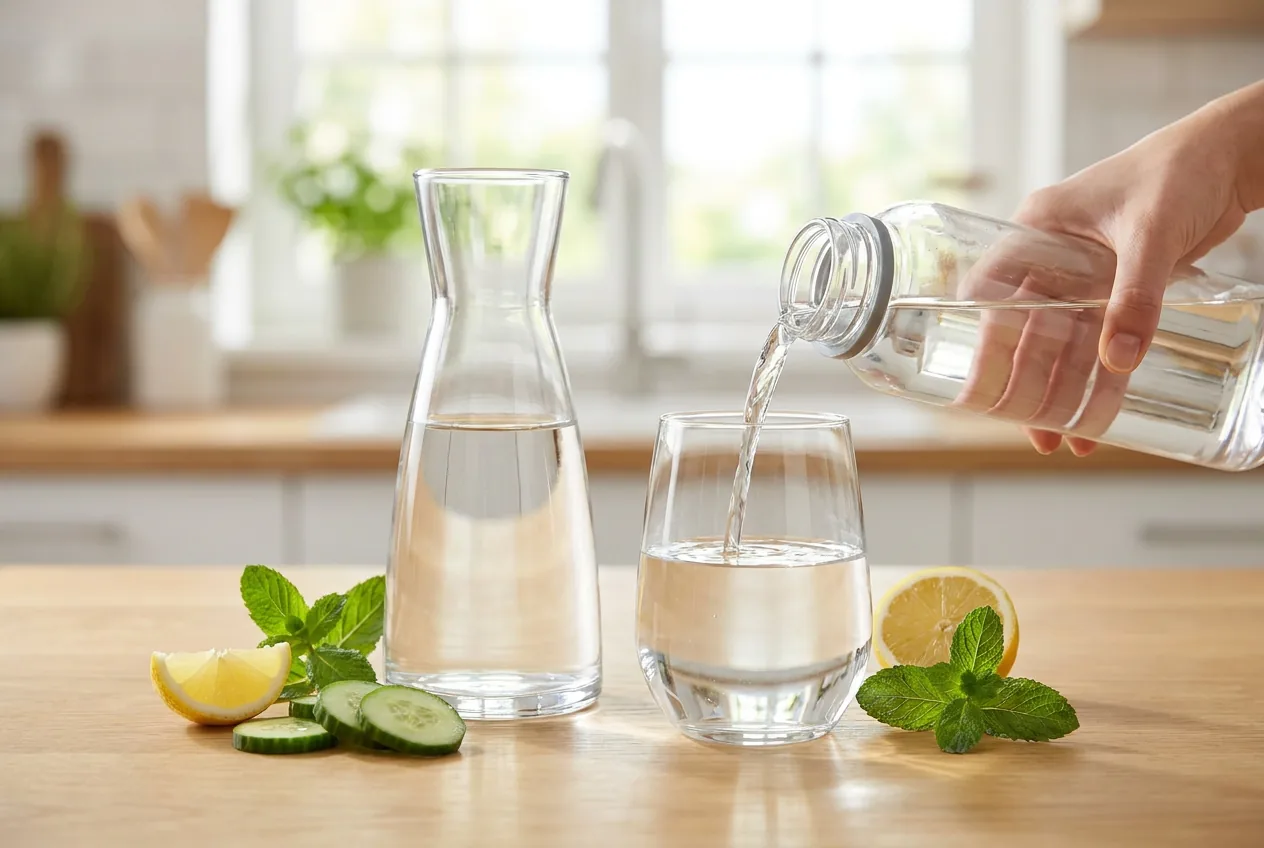
32 oz of water equals approximately 946 milliliters — just under one liter — which can represent one large serving or roughly half of a common daily target; how useful 32 oz is depends on body size, activity, climate, and total daily fluid recommendations, not on the volume alone.
Ounce: a fluid ounce (fl oz) is a U.S. customary volume unit equal to approximately 29.5735 milliliters.
What exactly is 32 oz of water in metric units?
Answer: 32 U.S. fluid ounces equals about 946 milliliters (0.946 liters), which is just under one liter of water.
Conversion uses the U.S. fluid ounce value: 1 fl oz = 29.5735 mL, so 32 × 29.5735 = 946.352 mL.
Milliliter: a milliliter (mL) is one-thousandth of a liter, the metric unit for volume.
| Measure | Value |
|---|---|
| 32 U.S. fluid ounces | 946.35 mL (0.946 L) |
| Imperial fluid ounces (for comparison) | 32 imp fl oz ≈ 1.092 L |
How many cups, glasses, or common containers is 32 oz of water?
Answer: 32 oz equals four U.S. cups, two typical 16-oz reusable bottles, or about three standard restaurant glasses (8–12 oz each) depending on glass size.
Common equivalents:
- 4 U.S. cups (1 cup = 8 fl oz).
- 2 typical 16-oz water bottles (popular reusable bottles are 16 oz or 20 oz).
- Approximately 3 restaurant-style glasses if each glass is 10–12 oz.
Cup: a U.S. cup is a volume unit equal to 8 U.S. fluid ounces (≈236.588 mL).
How long does it take to drink 32 oz of water safely?
Answer: Drinking 32 oz safely depends on pace and individual tolerance; spread over 30–90 minutes is generally comfortable for most adults, while drinking it in under 10–15 minutes can cause stomach discomfort and rarely raises hyponatremia risk in low-sodium conditions.
Factors influencing safe pace:
- Stomach capacity and recent food intake — a full stomach reduces immediate tolerance.
- Kidney function — healthy kidneys can excrete about 0.8–1.0 L per hour under normal conditions.
- Electrolyte balance — rapid large-volume intake with low sodium raises hyponatremia risk in extreme cases.
Hyponatremia: a condition where blood sodium falls too low, often from excess water relative to sodium, causing cellular swelling and symptoms from headache to seizures.
How much does 32 oz of water contribute to daily hydration needs?
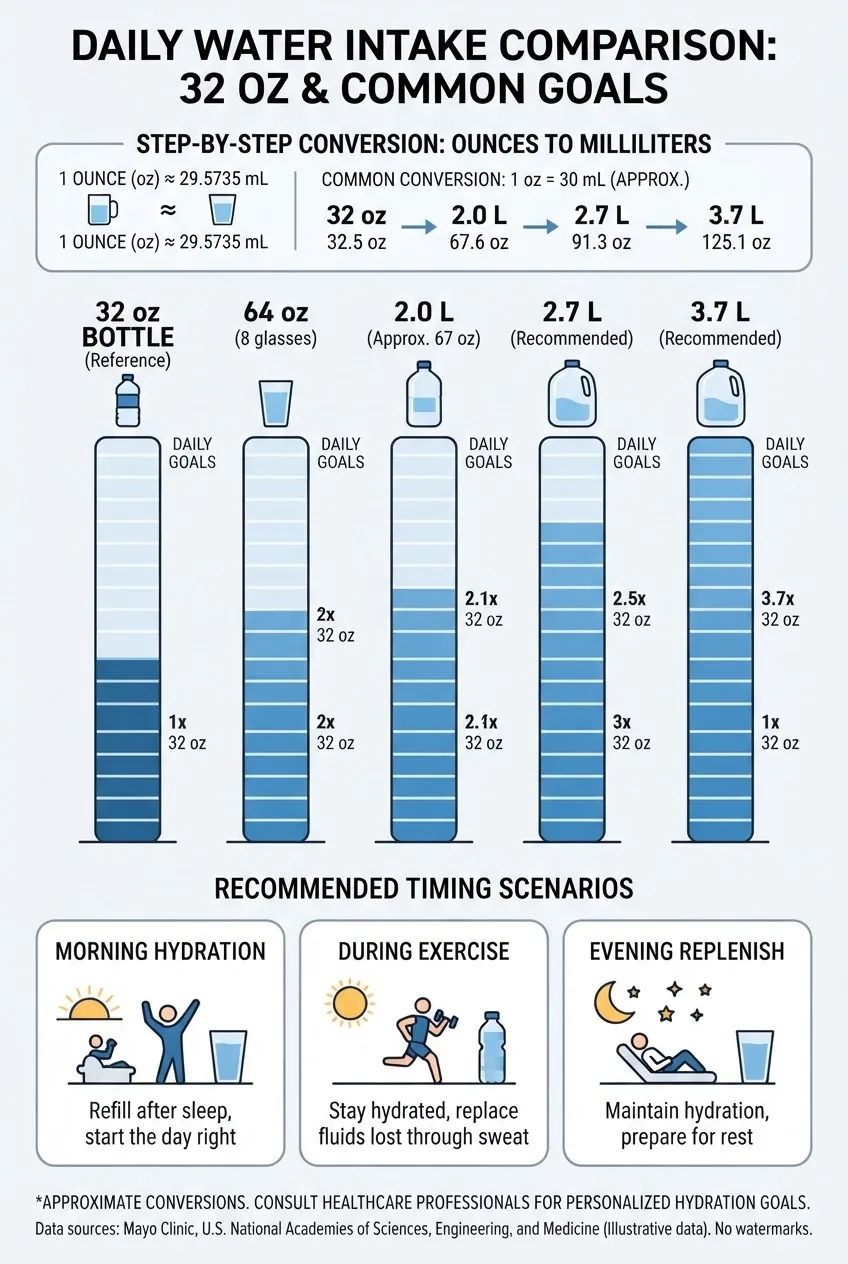
Answer: 32 oz provides about 40–50% of a common 2-liter daily target, 25% of an 8-cup (64 oz) conventional recommendation, and a variable share of individualized targets based on weight, activity, and climate.
Common daily recommendations and how 32 oz fits:
| Recommendation | Daily volume | 32 oz relative |
|---|---|---|
| Common guideline (2 liters) | ~67.6 oz (2000 mL) | ≈47% |
| 8×8 rule | 64 oz (about 1.9 L) | 50% |
| Institute of Medicine approximate (men) | 3.7 L (≈125 oz) | ≈25% |
| Institute of Medicine approximate (women) | 2.7 L (≈91 oz) | ≈35% |
Use these steps to calculate personal share of daily water represented by 32 oz:
- Pick your recommended daily volume (e.g., 2.7 L for many women, 3.7 L for many men).
- Convert to ounces if needed (1 L ≈ 33.814 oz).
- Divide 32 by that daily total to get the percentage contribution.
Can drinking 32 oz at once be harmful?
Answer: For healthy adults, a single 32 oz bolus is rarely harmful, but drinking large volumes very quickly can cause stomach pain, nausea, and — in extreme repeated excess with low sodium — raise the risk of hyponatremia.
When 32 oz may be unsafe or problematic:
- In people with reduced kidney function who cannot excrete excess water efficiently.
- When combined with endurance exercise and inadequate sodium replacement.
- For infants, small children, or older adults with heart or renal issues — adjust volumes and timing.
Practical safe-drinking guidelines:
- Adults: spreading 32 oz across 30–120 minutes lowers discomfort and is well tolerated.
- Athletes: add electrolytes if replacing sweat losses exceeding 1 L/hour.
- Medical conditions: follow clinician advice; certain heart or kidney conditions require fluid limits.
When is 32 oz of water the right single serving to drink?
Answer: Choose 32 oz as a single serving when you need a large replenishment after moderate exercise, travel in hot weather, or to carry a practical daily portion if you plan measured intake—otherwise smaller, frequent sips are preferable.
Common scenarios where 32 oz fits well:
- Post-workout rehydration after moderate, nonendurance workouts (30–60 minutes) with minimal sodium loss.
- Day-hike or commute where one large reusable bottle simplifies carry and tracking.
- To supply a planned half-day hydration schedule (e.g., morning or afternoon block).
How should you distribute 32 oz across the day for optimal hydration?
Answer: Distribute 32 oz into timed portions tailored to activity: e.g., 8 oz on waking, 8–12 oz before/after meals, and remaining 8–16 oz during or after activity; spacing every 1–3 hours maintains steady absorption and avoids gastric overload.
Three practical distribution examples:
- Basic schedule (sedentary): 8 oz upon waking, 8 oz mid-morning, 8 oz mid-afternoon, 8 oz evening.
- Active short workout: 12 oz pre-workout, 12–16 oz post-workout, smaller sips rest of day.
- Hiking day: 16 oz morning block, 16 oz afternoon block, with electrolyte snack if sweating heavily.
Rules of thumb:
- Drink 200–300 mL (≈7–10 oz) 15–30 minutes before exercise for baseline hydration.
- During long workouts, aim for 200–300 mL every 10–20 minutes depending on sweat rate.
How can you measure 32 oz when you don’t have measuring tools?
Answer: Use common household references: two standard 16-oz bottles, four US cups, or roughly three medium restaurant glasses; alternatively, weigh water—32 oz by volume equals about 946 g by mass at typical room temperature.
Practical measuring shortcuts:
- Two standard 16-oz reusable bottles or one typical “32 oz” wide-mouth bottle equals the volume.
- Four coffee mugs labelled as 8 oz each usually approximate 32 oz total.
- Kitchen scale: fill a container on scale to 946 g (subtract container tare) for high precision.
Density: the mass per unit volume of water; at 4°C density ≈1.0 g/mL, which simplifies mass-volume conversions near room temperature.
Does 32 oz of other beverages count the same as plain water for hydration?
Answer: Most non-alcoholic beverages count toward hydration; coffee and tea contribute fluids despite mild diuretic effects, while alcohol does not count equivalently because it increases urine loss and can dehydrate.
How common beverages compare:
- Coffee/tea: count as fluid; normal consumption does not cause net fluid loss for habitual drinkers.
- Milk and juice: contribute fluid plus calories and electrolytes.
- Alcoholic drinks: do not reliably count because ethanol increases urine output; compensate with water.
- Sports drinks: count as fluid and add electrolytes, helpful during heavy sweating.
Practical rule: if a beverage has <10% alcohol by volume, treat cautiously and add extra plain water; for nonalcoholic drinks, include them in daily fluid tally.
How do body size, climate, and activity change whether 32 oz is enough?
Answer: Bigger body mass, hotter/drier climate, and higher activity increase fluid needs, so 32 oz may be insufficient for heavy exercisers or hot-weather workers but adequate for a short sedentary day.
Quantitative examples:
- 30-minute light walk in mild climate: 32 oz extra may be more than enough to remain hydrated across the day.
- 90-minute high-intensity exercise in heat: sweat losses can exceed 1–2 L/hour, making 32 oz a partial replacement requiring electrolyte strategy.
- Occupations with continuous exposure (e.g., outdoor labor in Texas summer): daily needs commonly exceed 3–4 L; 32 oz is a modest fraction.
How to use 32 oz bottles to build a hydration habit or support weight loss?
Answer: Use a 32 oz bottle as a measurable unit to track intake—finish it by mid-morning and refilling twice daily gives an easy two-bottle target that supports mindful eating and can increase satiety for weight-loss goals.
Habit-building plan using 32 oz bottle:
- Set two or three 32 oz bottle goals per day based on your target volume.
- Schedule fill-and-finish checkpoints (e.g., finish first bottle by 11:00, second by 4:00, third if needed by bedtime).
- Pair drinking cues with behaviors (drink 8 oz before each meal) to reduce snacking and improve satiety.
Weight-loss mechanism: increased water intake can reduce meal energy intake when consumed before meals and supports metabolic processes; combine with diet and exercise for best results.
What are common mistakes when relying on 32 oz for daily hydration?
Answer: Common mistakes include over-relying on a single 32 oz bottle as the whole day’s plan, ignoring electrolyte needs during heavy sweating, and drinking large volumes too quickly.
List of mistakes and corrections:
- Mistake: assuming one 32 oz bottle equals “enough” without checking urine color or thirst; Correction: monitor urine and symptoms.
- Mistake: not replacing sodium after sweat-heavy activity; Correction: include electrolyte beverages or salty snacks.
- Mistake: gulping 32 oz quickly; Correction: spread intake for absorption and to avoid stomach upset.
How does 32 oz compare cost-wise and environmentally across bottle types?
Answer: A reusable 32 oz bottle has higher upfront cost but lower long-term cost and environmental impact than single-use plastic; insulated stainless bottles cost more but save on waste and keep water palatable longer.
| Bottle Type | Typical cost (USD) | Pros | Cons |
|---|---|---|---|
| Reusable plastic 32 oz | $8–$20 | Lightweight, cheap | Can retain odors; less durable than stainless |
| Stainless insulated 32 oz | $25–$60 | Keeps temperature; durable | Heavier, higher upfront cost |
| Single-use plastic 32 oz | $1–$3 per bottle | Convenient, available | High waste and cost over time |
Environmental and cost tip: a $25 reusable bottle used daily pays back its cost compared to buying bottled water within weeks to months depending on purchase frequency.
How do you adjust 32 oz intake for specific groups: children, pregnant people, older adults?
Answer: Adjust 32 oz recommendations: children need much less and must be given age-appropriate volumes, pregnant people require modestly increased fluids (plus 300 mL/day), and older adults may need scheduled small intakes to avoid underhydration.
Specific adjustments:
- Children: base on age and size—32 oz can be excessive for toddlers; follow pediatric guidance (e.g., older children may safely consume 32 oz across a day, divided into small portions).
- Pregnancy: aim for an extra ~300 mL/day due to increased blood volume and amniotic fluid; 32 oz can be one useful portion within a larger target.
- Older adults: kidneys concentrate less efficiently; recommend smaller, regular amounts and use reminders to avoid forgetting fluids.
What objective signs tell you whether 32 oz was enough for the day?
Answer: Clear to pale-yellow urine, minimal thirst, stable body weight across the day, and normal cognitive function indicate adequate hydration; dark urine, headache, dizziness, or dry mouth indicate insufficiency.
Quick objective checks:
- Urine color scale: aim for pale straw to light yellow.
- Body weight: small intra-day weight loss after sweating indicates fluid loss to replace.
- Thirst: consistent thirst means intake needs increase despite finishing 32 oz.
How do you factor electrolytes when replacing fluids with 32 oz?
Answer: For routine daily hydration, plain water is fine; when sweat losses are large (long exercise, heavy labor), include sodium and potassium via sports drinks or salted snacks to maintain electrolyte balance when drinking 32 oz.
Guidance for electrolyte use:
- Short workouts (<60 min, moderate intensity): plain water with small snacks usually suffices.
- Endurance or long heavy sweating (>60–90 min): use fluids with ~300–700 mg sodium per liter or include electrolyte tablets.
- Severe heat exposure with continuous sweating: higher sodium replacement and regular small-fluid intake are advised.
Osmolarity: the concentration of solutes per liter of a solution; electrolyte drinks are formulated to balance osmolarity for absorption and to replace lost salts.
How to log and track 32 oz portions for accurate daily intake?
Answer: Track by counting bottle fills, using a marked 32 oz bottle with time targets, or logging in hydration apps that allow custom bottle sizes; weigh bottles for precision if needed.
Tracking methods:
- Use a bottle with volume markings: mark the 32 oz fill line and note times.
- Phone apps: set a 32 oz bottle size and log each fill or finish.
- Manual log: paper or notes—record each 32 oz consumed and calculate cumulative total.
What are worked examples showing how 32 oz fits different daily plans?
Answer: Examples show usage as a single block or part of several-bottle plans adjusted to targets: sedentary adult (2 L target) uses 32 oz plus other fluids; endurance athlete needs multiple liters beyond 32 oz with electrolytes.
Example 1 — Sedentary 2 L target (example adult):
- Morning: 8 oz on waking.
- Mid-morning: 16 oz (half of 32 oz bottle).
- Afternoon: refill and drink 16 oz (finish 32 oz bottle by 3 PM).
- Evening: 8–10 oz with dinner to reach ≈2 L total.
Example 2 — Active day with 3 L target (athlete or outdoor worker):
- Morning: 16 oz with breakfast.
- Pre-work: 8 oz 30 minutes before activity.
- Post-work: 32 oz with electrolytes to rapidly begin replacement.
- Evening: additional fluids and salty snacks to complete 3 L target.
How do you reconcile conflicting daily water rules with 32 oz planning?
Answer: Treat rules (2 L/day, 8×8, per-weight formulas) as starting points and use personal metrics (urine color, activity, climate) to scale; use 32 oz as a measurable building block rather than a rigid target.
How to adapt common formulas to a 32 oz strategy:
- 8×8 (64 oz): two 32 oz bottles = daily target.
- Weight-based estimate (30–35 mL/kg): compute total, then divide into 32 oz units to plan bottle count.
- Activity-climate adjustments: add 500–1500 mL per heavy sweat session, measured as additional 32 oz servings.
How to store and maintain a 32 oz water bottle safely?
Answer: Clean reusable bottles daily with warm soapy water or dishwasher-safe cycles, avoid prolonged sunlight exposure for plastic bottles, and replace bottles showing cracks or persistent odors to keep water safe and palatable.
Maintenance checklist:
- Daily rinse and weekly deep clean (warm water, mild detergent, and a bottle brush).
- Sanitize periodically with a dilute vinegar solution or boiling for heat-safe materials.
- Inspect seals and lids to avoid leaks and bacterial buildup; replace worn parts as needed.
How does drinking 32 oz before or after meals impact digestion and appetite?
Answer: Drinking about 8–16 oz before meals can increase satiety and reduce calorie intake; consuming a full 32 oz immediately before a meal may cause fullness and discomfort for some people.
Meal timing recommendations:
- Drink 8–12 oz 20–30 minutes before meals to aid appetite control.
- Avoid gulping large volumes (32 oz) directly at mealtime to prevent bloating or reflux in sensitive individuals.
What practical tips help Texans use 32 oz effectively in hot climates?
Answer: In hot Texas climates, use 32 oz as a portable baseline but increase intake based on heat index and activity, add electrolytes for heavy sweating, and keep a chilled or insulated 32 oz bottle to encourage frequent sipping.
Practical Texas-specific actions:
- Carry an insulated 32 oz bottle to keep water cool during outdoor work or summer activities.
- Schedule refill checkpoints during midday heat—aim to finish at least one 32 oz bottle before noon if active outside.
- Replace sodium lost to sweat with salty snacks or electrolyte solutions when working outdoors for multiple hours.
Internal resources for broader hydration planning: review the Essential Guide with 5 Tips to Stay Hydrated and Healthy and the calculator in How Much Water to Drink a Day Calculator for customized targets.
How do you decide whether to call a clinician about hydration after consuming 32 oz?
Answer: Seek medical advice if you experience persistent dizziness, confusion, severe headache, swelling, very frequent urination, or symptoms after consuming large volumes indicating possible hyponatremia or fluid imbalance; otherwise, monitor signs and self-correct.
When to contact emergency services or a clinician:
- Confusion, seizures, or severe headache after rapid large-volume drinking—possible hyponatremia emergency.
- Reduced urine output despite drinking, significant breathlessness, or edema—could indicate heart or kidney issues.
- Persistent vomiting or diarrhea preventing retention of fluids—seek care for IV rehydration if oral intake fails.
Where can you find reliable external guidance about safe fluid intake?
Answer: Consult national health authorities and medical organizations for population-level guidelines, and follow personalized medical advice for conditions affecting fluid needs.
Suggested types of external sources:
- Government health agencies and national nutrition bodies for general recommendations.
- Medical clinics or registered dietitians for individualized plans when medical conditions are present.
For complementary reading within this site, see the practical bottle sizing guide at Guide on How Many Ounces a Water Bottle Holds and Intake and the daily intake overview at How Much Water Should You Drink a Day: Recommended Guide.
Frequently Asked Questions
How many milliliters is 32 oz of water?
32 U.S. fluid ounces equals approximately 946.35 milliliters (0.946 liters), calculated using 1 fl oz = 29.5735 mL; this is slightly less than one full liter.
Is drinking 32 oz of water a day enough?
It can be sufficient for a light-activity person when combined with other fluids and food moisture, but most adults need more—use body size, activity, climate, and urine color to judge; many adults aim for 64–125 oz total per day depending on circumstances.
Can I drink 32 oz of water at once before a workout?
Drinking 8–16 oz 15–30 minutes before exercise is recommended; 32 oz at once right before activity can cause sloshing or discomfort—split intake into pre-exercise and peri-exercise sips for best performance.
How many 32 oz bottles equal the 8×8 rule?
The 8×8 rule (64 oz) equals two 32 oz bottles; finishing two full 32 oz bottles gives the conventional eight-cups target of 64 oz.
Does drinking 32 oz of water help with weight loss?
Drinking water, including a 32 oz portion split across the day and timed before meals, can help reduce meal energy intake and support weight-loss efforts when combined with calorie control and exercise.
How can I tell if 32 oz made me overhydrated?
Early signs of overhydration include persistent nausea, headache, bloating, and unusually clear urine with frequent urination; if neurological symptoms like confusion appear after drinking large volumes, seek emergency care for possible hyponatremia.
Is 32 oz too much for an older adult?
Not necessarily, but older adults should sip smaller amounts throughout the day and follow clinician guidance if they have heart or kidney conditions; scheduled small intakes reduce the risk of fluid overload or nocturia.
How should I adjust 32 oz intake in hot Texas weather?
Increase fluid volume and include electrolytes during heat exposure; a 32 oz bottle is a good portable unit but likely insufficient alone—carry multiple bottles, finish one early, and refill to match sweat losses and activity level.