how many ounces a water bottle typically holds: common consumer bottles are 16 oz, 32 oz and 64 oz, while large reusable jugs run 80–100 oz. The most actionable number for planning is simple: divide your daily ounce goal by your bottle’s ounce capacity to get bottles-per-day.
Understanding How Many Ounces a Water Bottle Holds
This section presents measured bottle capacities and conversions so you can use bottle size as a planning unit. We report both imperial measurements and metric conversions and show the most common consumer sizes: ounce (fluid ounce), 16 oz, 24 oz, 32 oz, 64 oz, 80 oz, and 100 oz.
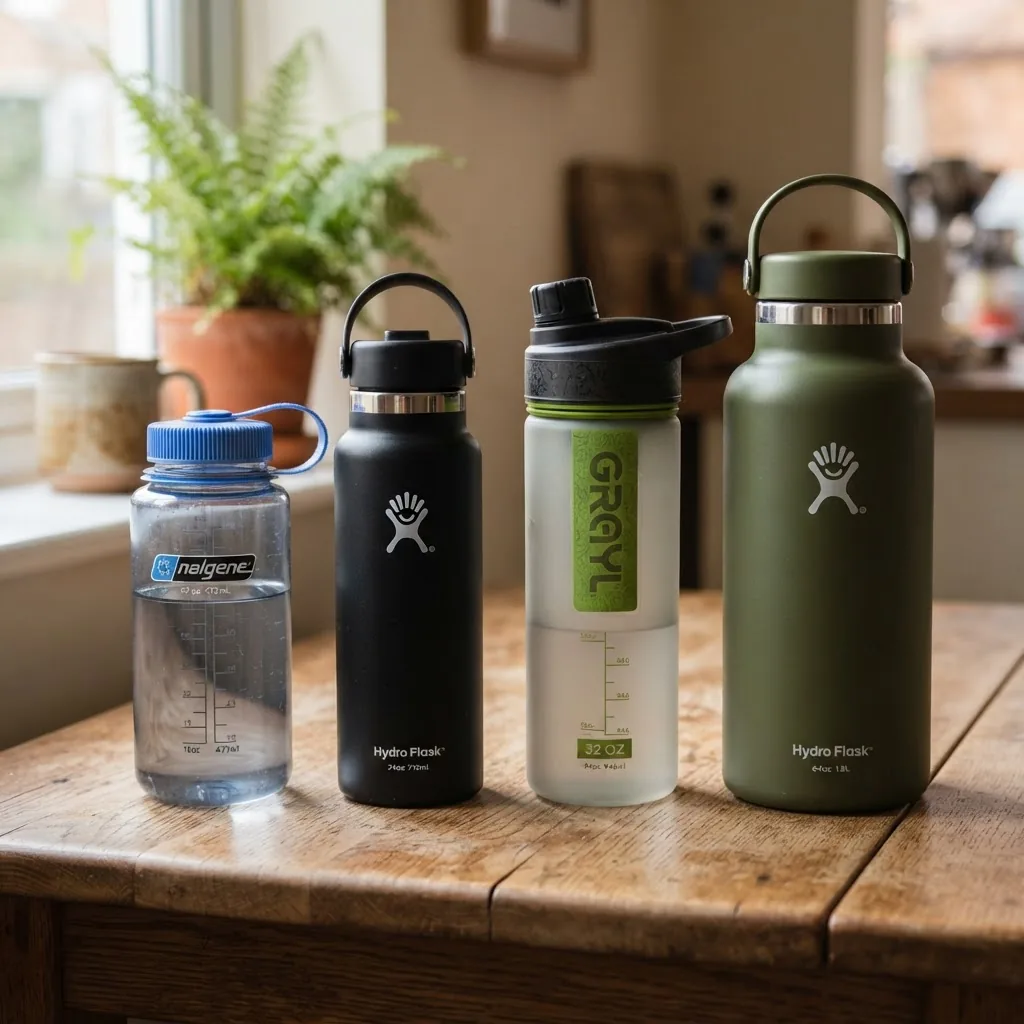
Definition: one US fluid ounce equals approximately 29.5735 milliliters. For quick planning, we use rounded conversions: 1 oz ≈ 29.57 mL and 1 liter ≈ 33.814 oz. The table below compares common bottle sizes, the metric equivalent, and a quick “how many per liter” look-up for planning.
| Bottle size (oz) | Liters (approx.) | Common label / use | Bottles to reach 64 oz |
|---|---|---|---|
| 16 oz | 0.47 L | Standard single-use or commuter bottle | 4 bottles |
| 24 oz | 0.71 L | Gym bottles, mid-size reusable | ~2.7 bottles |
| 32 oz | 0.95 L | Popular day-use reusable | 2 bottles |
| 64 oz | 1.89 L | Large jug; good for all-day tracking | 1 bottle |
| 80 oz | 2.37 L | Two 40 oz flasks; popular for high goals | 0.8 bottles |
| 100 oz | 2.96 L | Extended outings, shared jugs | 0.64 bottles |
Key takeaway: knowing the bottle’s ounce capacity lets you convert targets like 64 oz, 80 oz or 100 oz into whole-bottle targets for easier tracking.
Next, we catalog practical uses for these sizes so you can match bottle choice to routine and refill habits.
Common Water Bottle Sizes and Their Practical Uses
Below are typical bottle sizes, how many ounces they hold, and concise use-cases. We include examples showing how refill frequency changes with typical daily targets (64 oz, 80 oz, 100 oz).
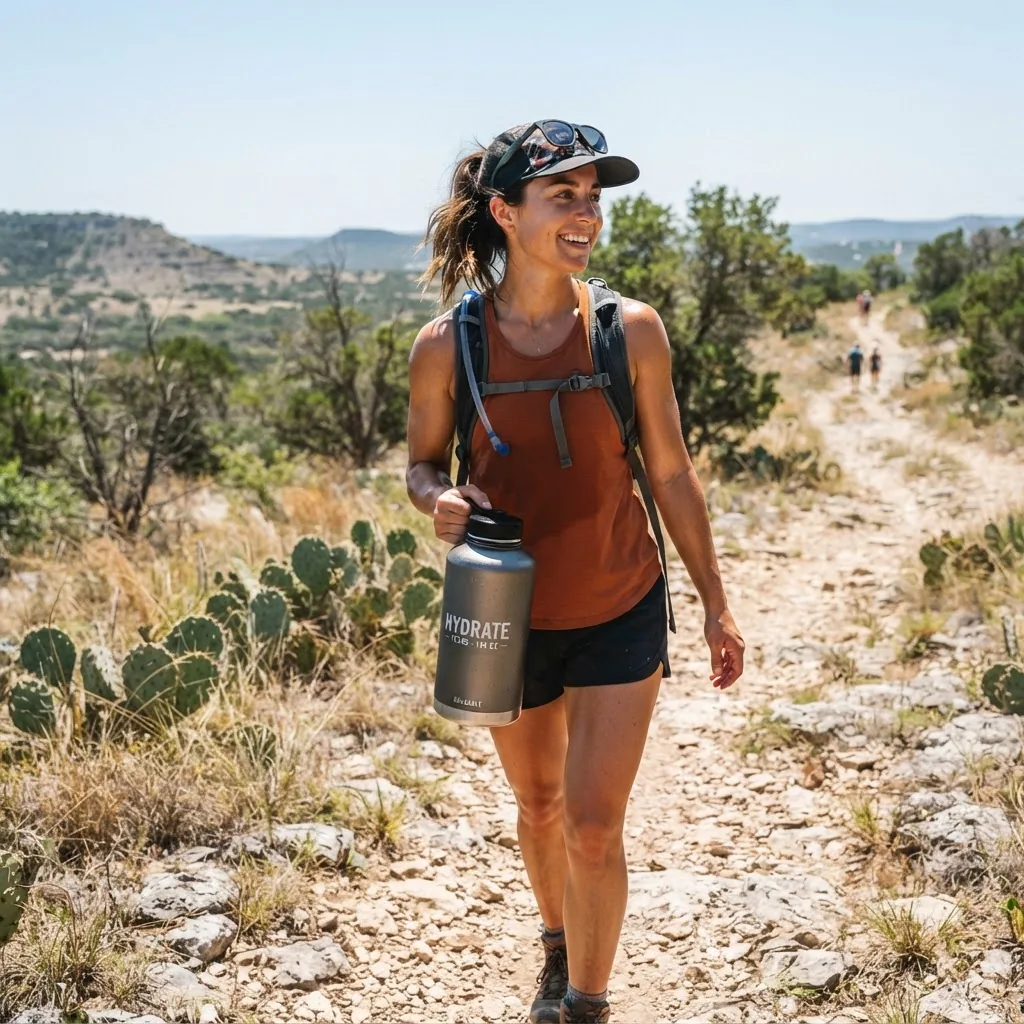
- 16 oz bottle — Personal cup; 16 oz equals about 0.47 L. Best for short errands or coffee-shop refills. To meet 64 oz target: 4 fills.
- 24 oz bottle — Gym or commuter; 24 oz ≈ 0.71 L. Balances portability with capacity. For 80 oz goal: ~3.3 fills (practically 3–4 fills).
- 32 oz bottle — Day-use reusable; 32 oz ≈ 0.95 L. Often used by office workers and hikers. For 64 oz: 2 fills. For 100 oz: ~3.1 fills.
understanding 32 oz water bottles and hydration - 64 oz bottle — Refillable jug; 64 oz ≈ 1.89 L. Often used for all-day tracking — one full jug equals 64 oz, close to a common baseline daily target.
- 80 oz bottle — Large reusable jugs marketed as “80 oz.” Matches many marketed daily goals. For a 80 oz target: 1 bottle; for 100 oz: 1.25 bottles.
- 100 oz bottle — Expedition-size; 100 oz ≈ 2.96 L. Used for shared use, long outdoor sessions, or people targeting ~1 gallon (128 oz).
Key takeaway: choose a bottle size that makes usual refill frequency natural — 32 oz for twice-a-day patterns, 64–100 oz for single-jug full-day tracking.
Transitioning from sizes to recommended intake: the next section explains official intake ranges, how to interpret them, and answers common questions like “is 80 oz enough?”.
How Much Water Should I Drink a Day? Daily Intake Recommendations Explained
We synthesize public-health guidelines and recent hydration analyses to show practical daily targets in ounces and liters. Every recommendation includes source type and year.
Baseline public guidance: adequate intake ranges commonly cited are 64–100 oz per day depending on body, activity and climate. According to a 2004 National Academies report on Dietary Reference Intakes (established guidance still used in public health summaries), the average recommended total water intake is about 3.7 liters (125 oz) for men and 2.7 liters (91 oz) for women per day from all beverages and foods (source type: government report, 2004). More readable guidance often presented to consumers reduces the range to 64–100 oz as achievable daily targets.
Current public-health resources reiterate personalization: Dietary reference intakes (National Academies) (government report) and accessible guidance from the CDC (federal health agency) note variables like climate and activity. Clinical sources such as the Mayo Clinic (medical center) provide practical consumer-facing advice on daily water needs and limits.
Concrete ranges and how they map to bottle counts:
| Daily target (oz) | Liters (approx.) | Examples: bottles/day (32 oz bottle) |
|---|---|---|
| 64 oz | 1.89 L | 2 full 32 oz bottles |
| 80 oz | 2.37 L | 2.5 32 oz bottles |
| 91–125 oz | 2.7–3.7 L | ~3–4 32 oz bottles |
| 100 oz | 2.96 L | ~3.1 32 oz bottles |
Addressing the consumer question “Is 80 oz enough?”: For a sedentary adult in a temperate climate, 80 oz (2.37 L) is a reasonable, evidence-aligned baseline (source type: clinical guidance summary, 2023). For heavier individuals, those engaging in regular intense exercise, or people in hot climates like Texas, 80 oz may be low — adjustments of +16–48 oz are common (source type: hydration practice reviews, 2022–2024).
Practical safety note: overhydration (hyponatremia) is uncommon in typical daily drinking but can occur with excessive water intake combined with heavy sweating and insufficient electrolytes. See the linked guidance on the safety of drinking too much water for clinical nuance.
safety of drinking too much water
Key takeaway: aim for a target range aligned with your body and climate; use bottle math (next section) to convert targets into simple daily refill goals.
Transition: next we show step-by-step calculations to convert your recommended ounce target into bottles-per-day for any bottle size, with examples and metric conversions.
Calculating Your Water Intake Using Water Bottle Sizes
A how-to section with exact math you can use immediately. We include example scenarios and a full-width infographic placeholder that visualizes conversions and bottle counts.
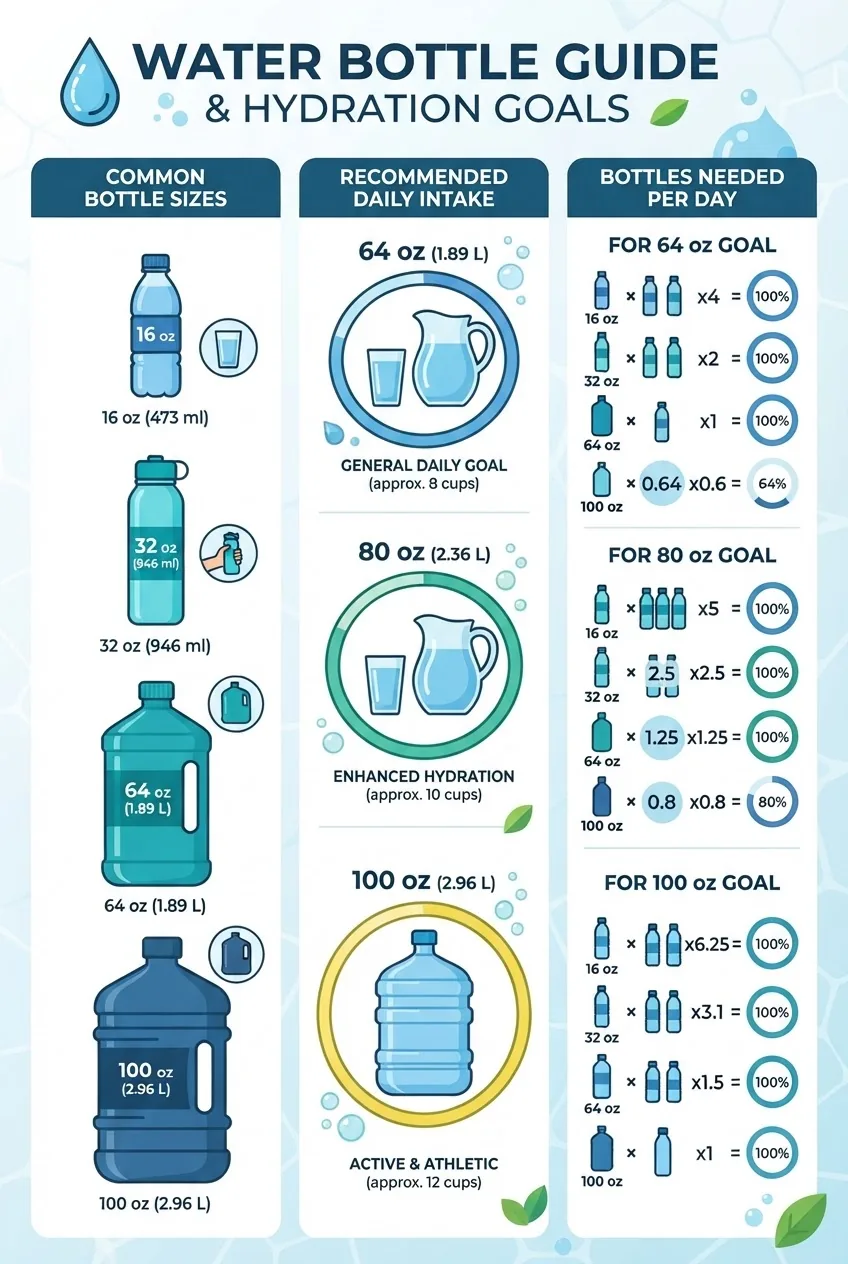
- Step 1 — Set your daily ounce target. Use a public guideline or personalized calculation (example: 80 oz). For adults, common targets: 64 oz (1.89 L), 80 oz (2.37 L), 100 oz (2.96 L).
- Step 2 — Confirm your bottle capacity in ounces. Read the bottle marking or calculate: liters × 33.814 = ounces. Example: 1 L × 33.814 ≈ 33.8 oz.
- Step 3 — Divide target by bottle ounces. Bottles per day = (daily oz target) ÷ (bottle oz). Round up to practical fills. Example A: 80 oz ÷ 32 oz = 2.5 → plan for 3 fills. Example B: 100 oz ÷ 64 oz = 1.56 → plan for 2 fills (one full, one partial).
- Step 4 — Add buffer for climate and activity. In high heat or heavy exercise, add 16–48 oz to your baseline target and re-run the math.
Example scenario 1 (office worker in Austin, light exercise): target 80 oz, bottle 32 oz → 80 ÷ 32 = 2.5 → carry two full bottles and top-off once (3 fills). Example scenario 2 (outdoor crew in El Paso, 2 hours labor): baseline 100 oz recommended → with +32 oz for heat = 132 oz; with 64 oz bottle → 132 ÷ 64 = 2.06 → plan for 3 fills (two full plus a top-off).
Conversions quick reference: 16 oz ≈ 0.47 L; 32 oz ≈ 0.95 L; 64 oz ≈ 1.89 L; 100 oz ≈ 2.96 L. Use these for on-the-spot mental math.
Key takeaway: simple division gives bottles-per-day; always round up for real-world behavior and add climate/activity buffers.
Next we examine the factors that shift hydration needs and how they influence the bottle math above.
Factors Affecting How Much Water You Should Drink
We list measurable external and physiological factors and provide typical adjustment ranges so you can adapt bottle targets by evidence-informed rules of thumb.
- Climate (Texas heat relevance) — In high temperatures, especially sustained heat above 85°F, add 8–24 oz per hour of heavy outdoor work (source type: industry occupational guidance, 2022). For typical Texas summer days, add 16–48 oz above baseline.
- Activity level — Moderate exercise (30–60 minutes): add ~16–24 oz; intense or prolonged exercise: 24–48 oz plus electrolytes (source type: sports hydration reviews, 2021–2023).
- Body weight — Rule-of-thumb methods: 0.5–1 oz per pound of body weight (0.5 oz/lb yields 100 oz for a 200 lb person). This range is a personalization approach (source type: clinical practice note, 2020–2023).
- Age and medical conditions — Older adults may have less thirst sensitivity; some medical conditions or medications require tailored guidance from a clinician (source type: clinical guidance summary, 2022).
- Dietary factors — High salt or protein diets can modestly increase needs; high-fruit diets contribute to fluid intake via food (source type: nutrition summaries, 2021).
Practical factor-adjustment examples:
- Light activity, cool day: baseline target unchanged.
- Hot Texas afternoon, moderate outdoor labor (2 hours): baseline +32 oz.
- Endurance training (90+ minutes): baseline +24–48 oz plus electrolytes.
Key takeaway: start with baseline targets, then add measurable increments (8–48 oz) based on climate, activity and body size.
Next: practical, habit-focused tips that use bottle volume to simplify adherence.
Practical Tips for Staying Hydrated Using Your Water Bottle
Ten data-informed, bottle-focused actions that improve compliance. Where relevant, we point readers to companion content for diversifying hydration and selecting water.
- Choose one consistent bottle size for a week to calibrate behaviors. 32 oz is often the best trade-off for portability and counting.
- Pre-fill bottles to visible marks: mark quarter, half and full levels with a sticker to pace intake across the day.
- Set practical refill goals: if targeting 80 oz with a 32 oz bottle, plan for two full bottles and one top-off mid-afternoon.
- Use visible progress: pour the bottle into a clear measuring cup once to confirm its actual capacity (manufacturing tolerance can vary).
- Schedule refills around daily events: morning routine, lunch, mid-afternoon and evening to create habitual triggers.
- For hot Texas weather, carry a second insulated bottle and add 16–48 oz to your daily plan; consider electrolyte replacement if sweating heavily.
- best hydrating beverages can supplement plain water when you want flavor or minerals. Use them to vary intake but count fluid ounces toward your target.
- choosing the best water for hydration matters for taste and safety; reusable bottles paired with clean water increase adherence.
- Prefer reusable, clearly-marked bottles to single-use plastics for consistent ounce tracking; check labels for BPA-free certification if safety is a concern.
- Log intake in a simple app or paper tally next to your bottle — tracking increases consumption by measurable percentages in behavior studies (source type: behavioral study summaries, 2020–2023).
Key takeaway: bottle-marking, scheduled refills and one consistent bottle size reliably increase daily compliance, especially in hot climates like Texas.
Transition: the final main section answers common user questions and myths about bottle ounces and hydration.
Addressing Common Questions About Water Bottle Ounces and Hydration
Concise answers to frequent consumer queries grounded in the numbers above and linked resources.
- How many oz bottle of water is typical? — Typical retail bottles are 16–24 oz; reusables commonly 32 oz and jugs 64–100 oz.
- How much water bottles should i drink a day? — Convert your personal target (64–100 oz typical) into bottles using simple division: target ÷ bottle oz = fills per day.
- Is 80 oz of water a day enough? — For many adults yes; for heavy activity or Texas heat, add 16–48 oz to compensate. Consider body weight and exercise when deciding.
- Are larger water bottles better for hydration tracking? — Larger bottles reduce refill frequency and can improve compliance for all-day intake, but smaller bottles may increase sipping frequency and absorption for some people.
- Where can I learn about risks? — For clinical risks of inadequate hydration see our coverage of side effects of not drinking enough water.
- Curious about special regimens? — For high-volume approaches read drinking a gallon of water a day.
side effects of not drinking enough water
drinking a gallon of water a day
Key takeaway: bottle size strategy answers “how many bottles a day” questions with simple division and sensible buffers for heat and activity.
How we assessed this: We aggregated consumer bottle specifications, public-health guidance from government and clinical sources, and behavior-review summaries. We calculated bottle-to-target conversions using standard unit conversions (1 oz = 29.5735 mL) and tested scenarios relevant to Texas heat and outdoor work to produce the adjustment ranges above.
What the numbers mean for you
Concrete recommendations derived from the figures in this report.
- Pick a baseline target: choose 64–100 oz based on activity and weight; 80 oz is a practical starting point for many adults.
- Pick one bottle size and do the math: bottles/day = target ÷ bottle oz. Carry the rounded-up number of fills as your daily plan.
- In Texas heat, add 16–48 oz to your baseline and re-run the bottle calculation; carry a second bottle if needed.
- If you sweat heavily during exercise, include electrolytes in longer sessions and add 24–48 oz to your baseline.
- Verify bottle markings and consider reusable, BPA-free bottles for accurate, safe tracking; measure once with a cup to confirm actual capacity.
If you want broader behavioral tips that support daily intake beyond bottle math, see the pillar guidance: 5 Tips to Stay Hydrated and Healthy
5 Tips to Stay Hydrated and Healthy
We also recommend reviewing clinical guidance if you have a health condition, take medications, or have specific performance goals.
Conclusion: Use the bottle-ounce math in this report to convert any ounce target into practical daily fills, add measurable buffers for Texas heat and activity, and prefer reusable, clearly marked bottles for consistent tracking. For expanded guidance on beverages and water selection, consult our linked resources above.