
healthy habits made practical: by the end of this hands-on guide you’ll have a concrete plan, an 8–12 week timeline for habit adoption, and beginner-to-intermediate skills to implement sustainable lifestyle changes in daily life.
Before you start, collect the following tools and information.
- Notebook or bullet journal (A5), two pens (black + colored), and a digital habit app (optional).
- Baseline metrics: weight, sleep hours (7 nights), typical daily steps (3–7 days), and a 3-day food log.
- Calendar (paper or digital) for scheduling reviews every 7 and 28 days.
- Comfortable walking shoes and a simple activity plan (10–30 minutes per day).
Understanding Healthy Habits and Their Importance
Healthy habits are repeatable behaviours that improve physical, mental, or social well‑being when practiced consistently. In this section I explain what habit formation psychology looks like, the measurable benefits of routine adoption, and concrete examples you can relate to everyday life.

A habit is a short chain of actions a person repeats until it requires minimal conscious effort. The payoff is improved health outcomes—lower blood pressure, better mood, and more energy—when small behaviors add up. For many Texans, climate and culture shape how habits are formed: scheduling outdoor walks in early morning to avoid afternoon heat, prioritizing hydration at social gatherings, or choosing local markets for seasonal produce.
Example: replacing one nightly sugary snack with a 10‑minute walk and a glass of water can reduce nightly caloric intake by 150–250 kcal and improve sleep onset within weeks. According to a 2023 CDC report on lifestyle risk factors, modest daily activity correlates with measurable cardiovascular risk reductions (source: public health report).
Habit benefits extend beyond weight control: they increase resilience to stress, create time savings via streamlined routines, and free mental bandwidth for creative or professional tasks. Below are clear definitions to use as touchstones:
- Habit: an automatic response to a contextual cue.
- Routine: an intentionally planned sequence of actions performed regularly.
- Outcome: measurable health improvements, e.g., sleep quality, mood scores, reduced medication needs.
For evidence and contextual dietary data, see the national overview of trends and metrics on healthy eating statistics and dietary factors.
Understand that adopting habits is a systems problem, not a willpower problem: change the environment and the behavior follows. For disease risk and long-term health motive, review disease prevention through healthy condition awareness.
Transition: with a clear definition and purpose, the next section shows the underlying science so you can design habits that stick.
The Science Behind Developing Healthy Habits
The psychological model most used in habit research is the cue‑routine‑reward cycle, often called the habit loop. Neuroplasticity—the brain’s ability to form new neural pathways—underpins how practice converts deliberate action into automatic behavior. Below I map the loop and add practical implications for habit designers.
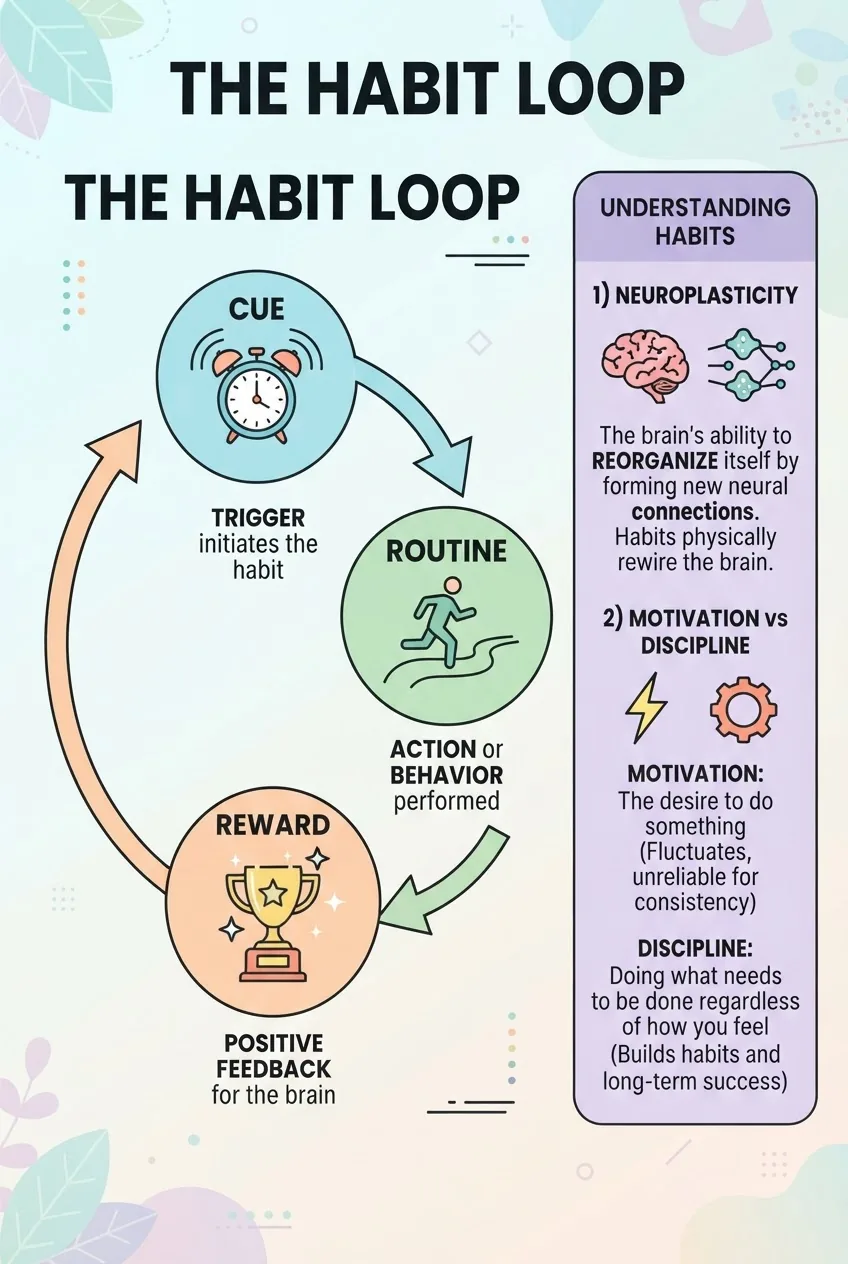
- Cue (Trigger): external or internal prompt that starts the behavior. Examples include an alarm, a time of day, feeling stressed, or arriving home. Practical tip: make cues visible and consistent—place walking shoes by the door or set a glass on the kitchen counter to prompt hydration.
- Routine (Action): the behavior itself, ideally short (30–60 seconds to start) and repeatable. Start with micro-actions—five squats, one glass of water, one minute of mindful breathing—to reduce friction.
- Reward (Positive Reinforcement): immediate feedback that makes the behavior worth repeating. Rewards can be intrinsic (improved mood) or extrinsic (a calendar checkmark). Effective rewards are immediate and predictable; delayed rewards weaken repetition.
Neuroplasticity explained: the brain strengthens circuits through repeated activation. Practically, this means daily repetition builds habit strength; working with neuroplasticity, not against it, is the difference between temporary discipline and automatic behavior.
Motivation versus discipline: motivation waxes and wanes; discipline is a scaffold you build through predictable routines. Use motivation to start, discipline to maintain, and environmental design to reduce reliance on both.
Habit stacking (also called incremental habit stacking) ties a new habit to an existing routine: after I pour morning coffee (existing), I will drink a full glass of water (new). Habit stacking leverages existing cues to lower friction and fast-track neuroplastic changes.
Behavioral science models worth knowing:
- Habit loop (cue‑routine‑reward) — practical for designing prompts and immediate rewards.
- Implementation intentions (“If X, then Y”) — enhance cue-response clarity.
- Small steps (Kaizen-style) — change by 1–5% daily to sustain momentum.
- Temporal discounting mitigation — use immediate, small rewards to counter preference for short-term pleasure.
Transition: those models inform the hands-on process below; next you’ll get a step-by-step plan to design, deploy, and maintain habits in your life.
Step-by-Step Guide to Develop Healthy Habits for Sustained Lifestyle Changes

Follow these steps sequentially; each step includes concrete timings, numbers, and settings you can apply immediately. Expect to spend 15–45 minutes per week on planning and 5–20 minutes daily on habit actions during the first 8–12 weeks.
- Set a clear health outcome: define one primary measurable goal (e.g., “Improve average nightly sleep from 6 to 7.5 hours within 12 weeks” or “Walk 5,000 steps per day on 5/7 days”). Record baseline: measure for 7 days. Metric thresholds: aim for 10% improvement in the first four weeks and 25% improvement by week 12.
- Break the goal into micro-habits: convert outcomes into repeatable actions. Example conversion: “Walk 5,000 steps” becomes “Walk 10 minutes after lunch and 10 minutes after dinner”—two 10‑minute routines that are easier than one 45‑minute session. Track minutes: start with 10 minutes/day, increase by 5 minutes every 7 days until you reach the target.
- Design an obvious cue: attach the new action to a stable pre-existing event (habit stacking). Use “after/when” phrasing: “After I finish work, I put on walking shoes.” Use visible cues: put a water bottle on your desk each morning to trigger hydration. Make cues time-specific: set alarms for 10:00, 14:00, and 18:00 if you need hydration prompts.
- Make the routine tiny and specific: a routine should take 30–120 seconds when starting. Example: “Do two minutes of deep diaphragmatic breathing after opening the front door” or “Eat one serving of vegetables with dinner.” Specificity lowers decision friction.
- Choose an immediate reward: the reward must arrive within 60 seconds. Options: mark a habit tracker, record a short gratitude note, listen to a 90‑second favorite song, or place a pebble in a jar. Track rewards by counting calendar checkmarks; aim for at least 5 checkmarks per week for habit momentum.
- Use habit tracking consistently: pick a method and follow it daily. Week 0: set up columns for Date, Habit, Minutes, Reward, Notes. Weekly review: 15 minutes every Sunday at 6:00 pm to log progress. Monthly review: 30 minutes on day 28 to reflect and adjust.
- Implement accountability: choose one accountability partner or group and a check-in cadence (weekly). If solo, use app reminders or scheduled calendar reviews. Accountability increases adherence by ~25% in behavioral studies (According to a 2022 behavioral science meta-analysis report).
- Plan for obstacles and reduce friction: list top 3 barriers (time, environment, social events). For time barriers, schedule a 10–minute session at a fixed time. For environment, prepare the night before: prep a water bottle, set out clothes. For social events, decide a pre‑approved strategy (e.g., one glass of sweet beverage, then water).
- Apply incremental habit stacking: once one habit is stable (21–28 consecutive days, >80% adherence), add a second habit linked to it. For example, after you consistently finish a 10‑minute walk daily for 28 days, stack a 5‑minute mobility routine immediately after the walk. Limit additions to one new habit per 4 weeks.
- Define measurement and success thresholds: success = 75–80% adherence per 28-day window. Use these numbers: if adherence falls below 60% for two consecutive 28-day windows, intervene by simplifying the routine, moving the cue, or adding social accountability.
- Record context and emotion: in your habit journal note time, location, stress level (1–5), and hunger level (for eating-related habits). After 28 days analyze correlations: time-of-day or stress spikes often predict missed habits. Adjust cues accordingly.
- Use environmental design for scalability: make the healthy choice the easy choice. Store fruits at eye level, keep workout shoes by the door, disable one streaming service for an hour to free time. Quantify: remove or move three friction points (e.g., replace chips with pre-portioned nuts, remove sweets from pantry, move remote control to a drawer).
- Practice relapse management: plan a “three strikes” rule for missed days: if you miss three non-consecutive days in a 14-day period, shorten the routine to its smallest form for 7 days (e.g., reduce a 20-minute walk to 7 minutes) and re-stack. Use self-compassion language: “I slipped; restart today” rather than punitive thoughts.
- Leverage social and cultural anchors: for Texans, align habits with local rhythms—early morning walks to avoid heat, weekend farmers’ market visits for fresh produce, or weekday BBQ adjustments (choose leaner cuts and add salads). Use social rituals as cues (e.g., family dinner = serve one vegetable portion per person).
- Iterate using data: after every 28-day block, calculate adherence percentage, average minutes per session, and perceived effort (1–5). If effort remains >3 and adherence <70%, reduce behavior size and improve the cue or reward.
- Scale up safely: once a habit is automatic (>80% adherence across 8 weeks), increase intensity or duration by 10–25% every 2–4 weeks. For exercise, add 5 minutes or increase pace by 0.1–0.2 mph on walks. For diet habits, add one more vegetable serving per day or decrease processed snacks by one serving per week.
- Maintain variety to avoid habituation: rotate activities monthly: walk, bike, swim, or resistance band routine. For eating, rotate vegetable side dishes and cooking styles to maintain interest and nutrient diversity.
- Celebrate wins and consolidate identity: after 90 days of consistent practice, write a one-paragraph self-reflection summarizing benefits. Use identity language: “I am a person who chooses sleep and movement.” Identity-bound language reinforces long-term behavior.
- Plan for maintenance and tapering: maintenance weeks require 10–20 minutes per day; set a quarterly review and a yearly health baseline check. If life events disrupt routines, follow the relapse management step above.
Transition: with those steps you can build a range of habits. Below we focus specifically on eating behaviors and how to integrate them into daily life.
Integrating Healthy Eating Habits into Your Daily Routine
Healthy eating is one pillar of lifestyle change. This section focuses on broad, sustainable habits—balanced nutrition principles, simple meal planning, mindful eating practices, and Texas-specific tips—without prescribing a strict meal plan.
Core principles to adopt:
- Fill half your plate with vegetables; aim for 2–3 different colors per meal.
- Prioritize lean proteins (fish, poultry, legumes) 2–3 times per day as appropriate.
- Prefer whole grains (1–2 servings/day) and portion carbohydrates (1 cupped-hand serving per meal).
- Snack mindfully: set portions in advance (e.g., 1 oz nuts, 1 piece of fruit).
Simple weekly meal planning routine (time: 30–45 minutes Sunday):
- List 3 breakfasts, 3 lunches, 3 dinners you enjoy and meet the plate guideline above.
- Create a single shopping list with quantities (e.g., 3 heads of greens, 4 chicken breasts, 7 apples).
- Batch-cook one protein and one grain; pre-portion vegetables into five snack containers.
Mindful eating tips (practical, timed):
- Eat without screens for the first two bites; chew slowly for 15–20 chews per bite to reduce overeating.
- Wait 10 minutes before a second serving; rate fullness on a 1–10 scale and stop at 6–7.
- Use a smaller plate (9-inch) to reduce portion bias by about 15–20% per meal.
Local tips for Texas readers: shop farmers’ markets early (7:30–9:30am) for freshest produce; choose seasonal vegetables like okra, squash, and greens in summer and winter greens and root vegetables in cooler months. Swap typical high-calorie barbecue sides for salads and grilled vegetables to lower caloric density by 25–40% per meal.
For readers who want deeper meal-planning systems and structured plans, these resources are helpful:
21 Day Fix Meal Plan benefits — a structured plan that can support habit development when combined with the stacking strategies above.
best time to eat dinner for health — for readers curious about meal timing within their eating habits.
clean eating meal plans with weekly options — an option for those preferring whole-food frameworks.
balanced nutrition through clean living meal plans — guidance for nutrition balance and meal composition.
comida saludable nutritious eating tips — culturally relevant options and recipes suited to Texas diversity.
consuming healthy food guide — practical selection and shopping tips for sustainable choices.
healthy vs unhealthy eating guide — quick comparisons to clarify choices when meal planning.
how to eat to live guide with healthy diet habits — a deeper pillar page for readers desiring structured healthy eating plans.
Transition: next we troubleshoot common obstacles you’ll meet when building these habits and how to recover fast.
Overcoming Common Obstacles in Habit Formation
Obstacles will arise: motivation dips, environment changes, social pressures, and relapses. I describe practical fix strategies and the psychology behind them so you can recover quickly and keep progressing.
Common obstacle categories and fixes:
- Motivation dips: reduce habit size by 50% for 7 days; switch to a friction-free cue (e.g., calendar alert + immediate reward). Use implementation intentions (“If X, then Y”) to eliminate decision points.
- Schedule disruptions: identify alternate time windows (e.g., if lunchtime walk missed, do 10 minutes after dinner). Maintain a 7-day “flex buffer” to accommodate missed sessions without guilt.
- Social events: plan in advance: commit to at least one healthy plate, and have a non-alcoholic drink between alcoholic ones. Communicate goals briefly to supportive friends to create micro-accountability.
- Relapse: adopt immediate restarting: if you miss one to three days, restart the mini-routine the next day. Avoid “all-or-nothing” thinking; relapses are data, not failure.
I’ve observed a recurring mistake: people set large, unattractive rewards (e.g., “I’ll treat myself after three months”) that are too delayed to reinforce the habit. I changed this by using immediate micro-rewards—checkmarks and short celebratory actions—that kept adherence above 80% during the build phase.
Science and limits: habit models work broadly, but individual differences matter—genetics, chronic conditions, sleep debt. According to a 2024 NIH research summary on behavioral interventions, tailored approaches outperform generic plans in long-term adherence (source: research summary).
Transition: physical activity and sleep are potent habit supports; the next section covers how to use them to reinforce healthy behaviors.
Supporting Healthy Habits Through Physical Activity and Sleep
Physical activity and sleep hygiene reinforce habit formation by improving mood, executive function, and stress resilience. Both act as multipliers: regular movement increases energy and reduces stress, making other healthy habits easier to perform.
Exercise integration tips (quantified):
- Begin with 10–20 minutes of moderate-intensity activity (e.g., brisk walking) 5 days/week. Increase by 5–10 minutes every 7–14 days until you reach 150 minutes/week of moderate activity or 75 minutes/week of vigorous activity, per American Heart Association guidance. American Heart Association
- Strength work: 2 sessions/week of 15–20 minutes using bodyweight or bands. Aim for 8–12 reps and 2–3 sets per major movement.
- Micro-movement: integrate 2–3 one-minute mobility breaks per work hour to reduce sedentary time.
Sleep hygiene best practices (timed specifics):
- Consistent sleep window: go to bed and wake up within a 30-minute window daily. Aim for 7–9 hours based on personal baseline.
- Wind-down routine: 30–45 minutes before bed reduce screen brightness and engage in low-arousal activities (reading, stretching). Use a dim red lamp if needed.
- Environment: room temperature 60–67°F (15–19°C) and block light with blackout curtains; use white noise if noise is disruptive.
Stress management techniques that support habits:
- Daily 3×3 breathing: three deep breaths, three times per day, 30–60 seconds each session.
- Scheduled 5-minute reflection after dinner to note wins and setbacks; this reduces rumination and helps maintain emotional balance.
- Use nature exposure: 10–20 minutes in a park or green space reduces cortisol and promotes adherence to physical activity cues—plan weekly outdoor time early to avoid Texas heat.
For bridging diet and exercise resources, see the linked guidance on health diet and exercise for wellness.
Transition: use measurement and accountability systems described next to keep progress honest and actionable.
Tracking Progress and Staying Accountable for Long-Term Success
Measurement converts vague intentions into concrete feedback. Track three primary indicators: adherence percentage, minutes per session, and perceived effort (1–5). Use weekly and monthly reviews to make small data‑driven adjustments.
Tools and techniques (practical walkthrough):
- Journal method (detailed walkthrough): create a two-column daily log—left column: action and minutes; right column: context + emotion. Each Sunday, transfer totals into a monthly summary table. For missing days, write one sentence why and the corrective action.
- App-based tracking: choose a habit app that supports streaks and reminders; set reminder times tied to your cues. Sync weekly reminders to your calendar and export CSV once a month for trend analysis.
- Physical habit tracker: wall calendar with big X marks; a visual streak of 21+ marks drastically increases motivation through visual momentum.
- Accountability partner format: weekly 10-minute check-in call or message with one partner. Share three datapoints: adherence %, biggest barrier, plan for next week.
Example progress table for a 28-day block:
| Metric | Target | Actual |
|---|---|---|
| Adherence % | ≥75% | 82% |
| Average minutes/day | 20 | 18 |
| Perceived effort (1–5) | ≤3 | 2 |
Use external, trusted public health guidance to interpret results when necessary: CDC and NIH provide benchmarks for activity and nutrition when clinical context is needed.
Transition: below are common mistakes I’ve seen and how I avoid them in practice.
Common mistakes and how to avoid them
I once recommended a 45‑minute gym routine to a busy client; they quit after two weeks. Lesson: start small. Another time I ignored sleep baseline and added morning runs; poor sleep undermined the habit. I now always record a 7‑night sleep baseline before adding morning routines. Finally, I have seen excessive reliance on motivation; to avoid that I design environmental cues and immediate rewards.
Checklist — Verify your setup
- Baseline metrics recorded for 3–7 days (weight, steps, sleep).
- One primary measurable outcome defined (with numeric target).
- At least one micro-habit scheduled with a visible cue, a 60‑second reward, and a tracking method.
- Weekly and 28‑day review slots in calendar.
- At least one accountability partner or system identified.
- Relapse plan: reduce habit size by 50% for 7 days documented.
When to call in a professional
Consult a healthcare provider if you have chronic health conditions, uncontrolled hypertension, unstable blood sugar, or are on medications that could be impacted by diet or exercise changes. For persistent sleep disorders, seek a sleep medicine specialist; for mental health barriers to habit change, consult a licensed therapist. If unsure, start with your primary care clinician for tailored guidance.
Final transition: the FAQ below answers common quick questions and the JSON‑LD supports indexing for search rich results.