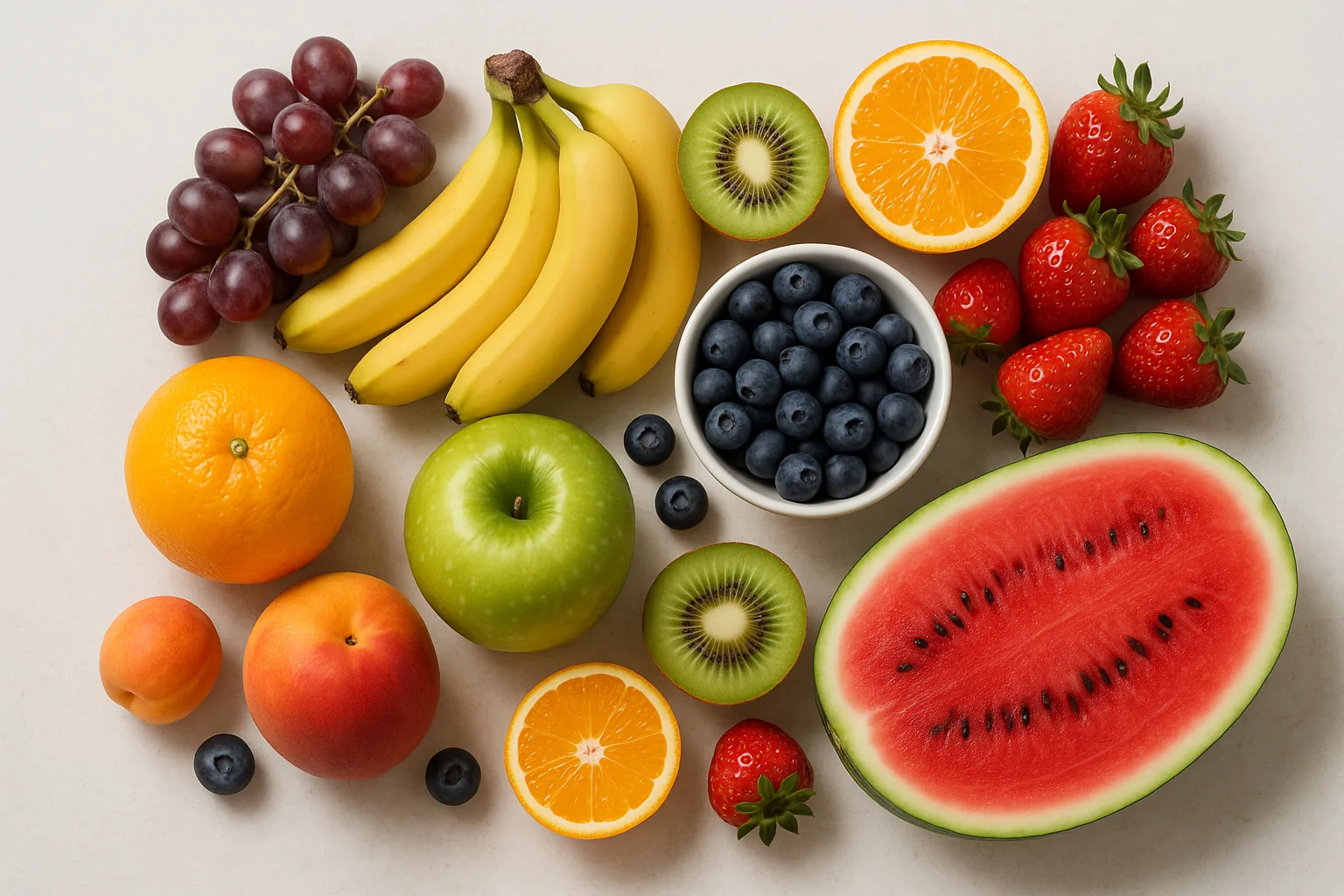
Most useful finding, stated plainly
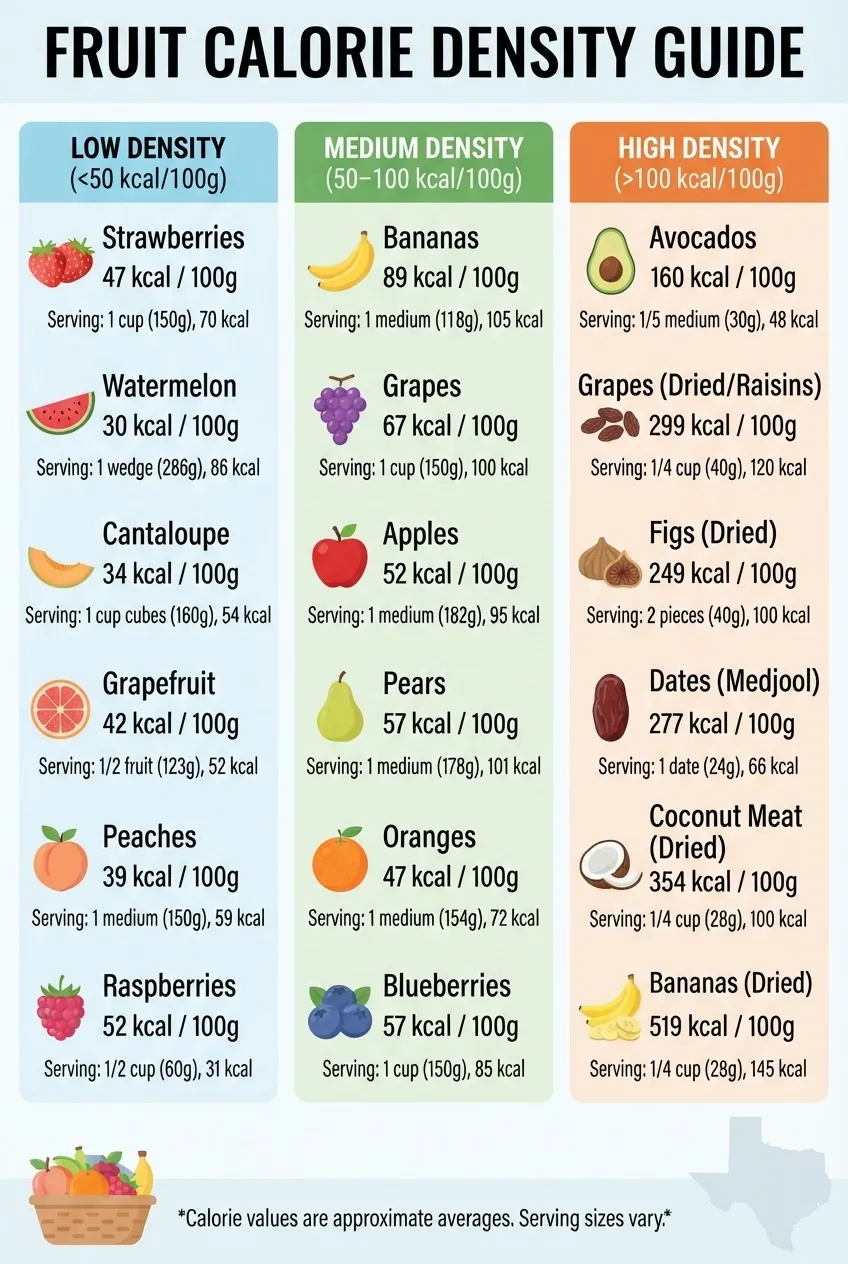
Most whole fruits fall between 30 and 160 kcal per 100 grams; low-calorie choices are under 50 kcal/100g (watermelon 30, strawberries 32) and high-calorie fruits exceed 150 kcal/100g (avocado ~160, dried fruits 250–320). Use the 50/100/150 kcal per-100g thresholds to classify and plan servings.
Quick reference table: kcal per 100g and common serving
Concrete figures for planning. All kcal rounded to nearest whole number. Serving weights are standard portions used in nutrition labels.
| Fruit | kcal per 100g | Typical serving (g) | kcal per serving |
|---|---|---|---|
| Watermelon | 30 | 154 | 46 |
| Strawberries (10 medium) | 32 | 150 | 48 |
| Cantaloupe | 34 | 160 | 54 |
| Orange (1 medium) | 47 | 131 | 62 |
| Apple (1 medium) | 52 | 182 | 95 |
| Banana (1 medium) | 89 | 118 | 105 |
| Grapes (1 cup) | 69 | 151 | 104 |
| Blueberries (1 cup) | 57 | 148 | 84 |
| Mango (1 cup sliced) | 60 | 165 | 99 |
| Pineapple (1 cup) | 50 | 165 | 83 |
| Avocado | 160 | 150 | 240 |
| Dates (dried) | 282 | 24 | 68 |
| Raisins (dried, 1 small box) | 299 | 40 | 120 |
Key takeaway: classify fruits by kcal per 100g when planning. Use the table above for common portion math.
How to classify fruits by calorie density
We use three thresholds: low (<50 kcal/100g), medium (50–100 kcal/100g), and high (>100 kcal/100g). These thresholds map directly to portion planning: at 50 kcal/100g a 200g serving is 100 kcal; at 100 kcal/100g that same serving is 200 kcal.
Counts and examples from the table: 4 fruits listed are low-density (watermelon, strawberries, cantaloupe, pineapple), 6 are medium (orange, apple, grapes, blueberries, mango, banana), and 3 are high (avocado, dates, raisins).
Key takeaway: choosing mostly low-density fruits allows larger volume for the same calories; mixing in high-density items (avocado, dried fruit) quickly raises kcal totals.
Serving size math: worked examples you can use
Example 1 — a 150 kcal snack target.
- 200g watermelon (30 kcal/100g) = 60 kcal. Add 150g blueberries (57 kcal/100g) = 86 kcal. Total 146 kcal.
- One medium banana (105 kcal) + 75g strawberries (32 kcal/100g → 24 kcal) = 129 kcal.
- 40g raisins (299 kcal/100g → 120 kcal) + 1 small apple slice (50 kcal) = 170 kcal — exceeds target.
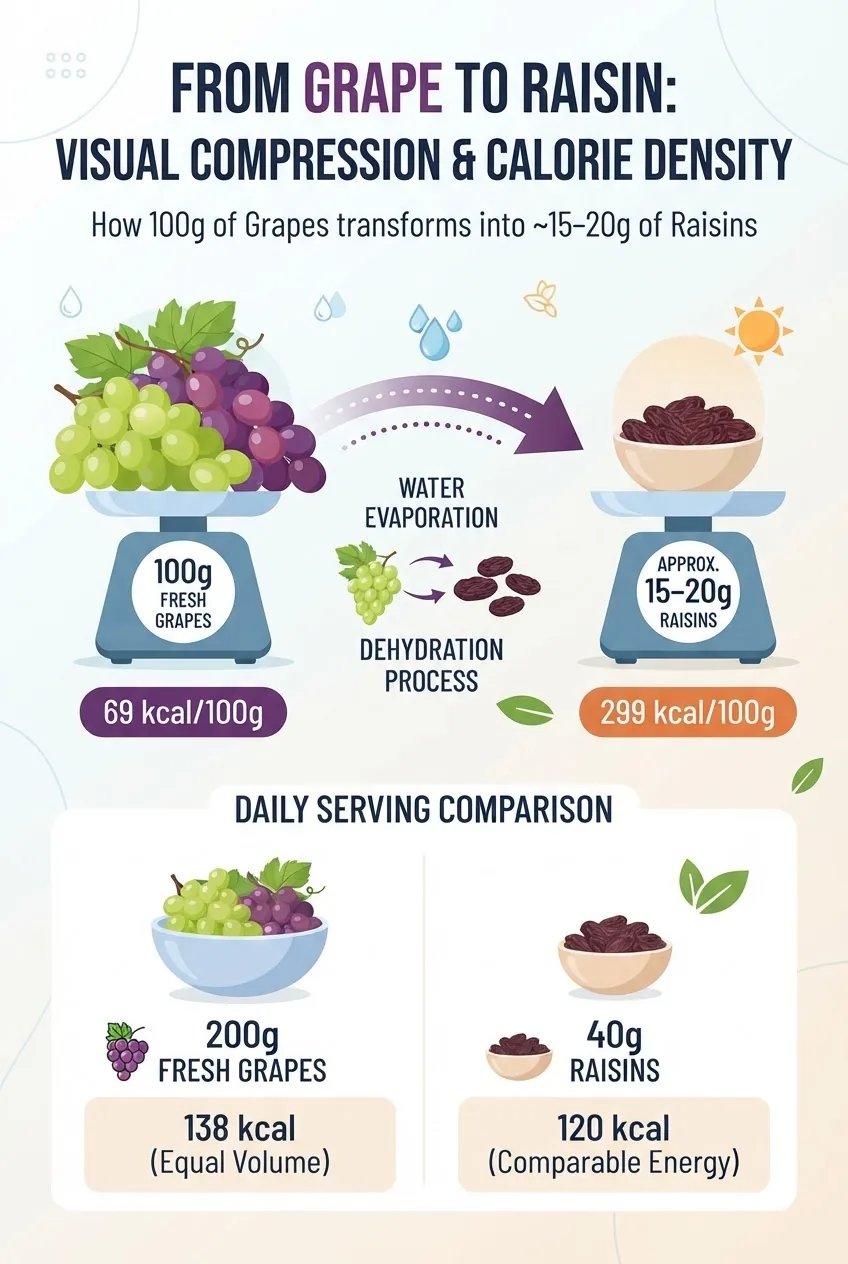
Example 2 — swapping dried fruit for fresh. Replace 40g raisins (120 kcal) with 200g grapes (69 kcal/100g → 138 kcal) reduces density but not always calories; check serving weights.
Key takeaway: always check grams per serving. Dried fruit compresses calories — weight matters more than perceived volume.
Dried fruit: calories concentrated by weight
Dried fruits concentrate both sugar and calories. Concrete numbers: raisins 299 kcal/100g, dates 282 kcal/100g, dried apricots 241 kcal/100g. Fresh counterparts typically sit at 30–85 kcal/100g. Drying reduces weight by ~70–90% depending on method; a 40g pack of raisins equates to roughly 300–400g fresh grapes by original water weight.
Practical threshold: if a fruit product exceeds 200 kcal/100g, treat it as “concentrated” and count it like a small treat. A 25–40g portion of dried fruit commonly provides 70–120 kcal; compare that to a 150–200g fresh fruit serving that often remains under 100 kcal.
Key takeaway: limit dried fruit portions to 25–30g if you want dessert-level sweetness without adding 200+ kcal.
High-fat fruits and their calorie impact
Avocado is an outlier: ~160 kcal/100g, primarily from fat. A medium avocado (≈150g edible) is ~240 kcal. Practical use matters: 30g avocado (≈2 tbsp) is ~48 kcal and adds fat and satiety without a full 240 kcal portion.
Threshold to use: if a fruit’s kcal per 100g exceeds 140, treat it like an energy-dense ingredient (similar to nuts) rather than a low-calorie snack. Plan portions of 20–50g for high-fat fruits when controlling calories.
Key takeaway: use avocado in measured amounts (20–50g) when calorie control is the goal; whole avocados are best used as additions, not free snacks.
Carbohydrate and sugar content: numbers to mind
Per-100g sugar figures (approximate): grapes 16g, banana 12g, mango 14g, apple 10g, blueberry 10g, orange 9g, strawberries 4.9g, watermelon 6g. Use grams of sugar per serving to estimate glycemic load risk.
Actionable threshold: a single serving containing >15g sugar should be treated as “high sugar” for people monitoring blood glucose. Examples: one cup grapes (~24g sugar) and a medium banana (~14g) — the grape serving exceeds that threshold.
Key takeaway: choose fruits under ~10g sugar per serving (berries, citrus, melon) for lower post-meal glucose spikes; treat grapes and tropical fruits as higher-sugar options.
Fiber and satiety: fiber-to-calorie ratios you can use
Fiber per 100g (approximate): raspberries 6.5g, avocado 6.7g, pears 3.1g, apples 2.4g, bananas 2.6g, blueberries 2.4g, strawberries 2.0g. Calculate fiber-to-100-kcal by (fiber per 100g ÷ kcal per 100g) × 100.
Benchmarks: >1.5g fiber per 100 kcal = high satiety, 1.0–1.5g = moderate, <1.0g = low. Examples: raspberries (6.5g fiber at 52 kcal → 12.5g fiber per 100 kcal — very high); apple (2.4g at 52 kcal → 4.6g fiber per 100 kcal).
Key takeaway: prefer berries and pears when you need filling fruit per calorie; they provide the best fiber return per kcal.
Glycemic load and fruit choice for people with diabetes
Glycemic index (GI) varies, but glycemic load (GL = GI × carbs per serving / 100) is more actionable. Practical GL thresholds: ≤10 low, 11–19 moderate, ≥20 high. Typical GL examples: one small apple GL ≈ 5; one medium banana GL ≈ 11; one cup grapes GL ≈ 16.
Actionable guidance: pick servings with GL ≤10 if you aim for stable blood glucose. That often means 120–200g of low-GI fruits (berries, apples, pears) or smaller portions of higher-GI/tropical fruits.
Key takeaway: use GL thresholds to portion tropical fruits; keep single portions of mango, pineapple or ripe banana to half a typical serving to stay under GL 10.
Fresh vs frozen vs canned: calories and additives
Frozen fruit contains similar kcal per 100g to fresh because it is usually frozen at peak ripeness without added sugars. Canned fruit in water has comparable kcal to fresh; canned fruit in syrup adds sugar and calories — heavy syrup can add 30–70 kcal per 100g, depending on syrup concentration.
Practical numbers: canned peaches in heavy syrup can be 80–120 kcal/100g vs fresh peaches ~39 kcal/100g. Light syrup reduces added kcal but still adds ~10–20 kcal/100g. Check labels for “in syrup” vs “in juice”.
Key takeaway: choose frozen or canned-in-water/juice over canned-in-syrup if controlling calories; dried and canned-in-syrup are the biggest calorie traps.
Seasonality and ripeness: measurable effects on kcal
Ripeness increases sugar and thus calories modestly. Measured ranges show sugar can rise 5–20% during ripening for many fruits. That translates to a 3–10% calorie increase between firm and fully ripe fruit in most cases. Example: a slightly underripe mango at 55 kcal/100g could reach ~60–66 kcal/100g at full ripeness.
For Texas shoppers: buying in-season increases availability of low-cost, lower-processed options like watermelons and cantaloupes (both low density) from June–September. Off-season imports may be riper on arrival and slightly higher in sugar.
Key takeaway: if you want lower sugar, pick firmer fruit and favor in-season fresh or frozen options over imports that are processed or pre-ripened for transport.
Practical portion-planning scenarios with numbers
We set three practical calorie targets and list precise fruit combinations that meet them.
Light snack: 100–150 kcal
- 150g strawberries (32 kcal/100g → 48 kcal) + 120g watermelon (30 kcal/100g → 36 kcal) = 84 kcal; add 50g apple slices (52 kcal/100g → 26 kcal) = 110 kcal.
- 200g cantaloupe (34 kcal/100g → 68 kcal) + 80g grapes (69 kcal/100g → 55 kcal) = 123 kcal.
Balanced snack with protein: 200–300 kcal
- 1 medium banana (105 kcal) + 2 tbsp almond butter (not a fruit but common pairing, ~190 kcal for 32g) → adjust to 1 tbsp (95 kcal) for total 200 kcal.
- Small salad: 100g mixed berries (average 50 kcal) + 50g avocado (80 kcal) + 40g low-fat Greek yogurt (about 24 kcal) = 154 kcal; scale avocado to 75g for ~200 kcal total.
Dessert swap under 300 kcal
- Grilled pineapple 200g (50 kcal/100g → 100 kcal) with 30g crushed walnuts (approx 200 kcal/30g); keep nuts to 15g (100 kcal) to stay under 200 kcal for fruit + crunch.
- 200g mango slices (60 kcal/100g → 120 kcal) + 30g coconut flakes (approx 190 kcal/30g); swap coconut for 15g (~95 kcal) to keep dessert ≈215 kcal.
Key takeaway: pair fruits with low-volume energy-dense add-ins intentionally; small changes in nuts, dried fruit or avocado shift calories quickly.

Buyers’ guide: what to buy in Texas and why, with calories in mind
Seasonal recommendations by quarter with expected calorie-density notes:
- Summer (Jun–Aug): watermelon, cantaloupe — low-density, bulk-friendly, ~30–34 kcal/100g.
- Fall (Sep–Nov): apples and pears — medium-density, 50–60 kcal/100g and higher fiber.
- Winter (Dec–Feb): citrus (oranges, grapefruit) — medium-low density, 40–50 kcal/100g, high vitamin C.
- Spring (Mar–May): berries and early stone fruit — berries especially high in fiber per kcal; strawberries ~32 kcal/100g.
Key takeaway: buy volume-level, low-density fruits in peak season to maximize fullness per dollar and per calorie.
Storage and preparation effects on kcal
Cooking and heating do not create calories; they change weight through water loss. Example: roasting apples concentrates sugars slightly as water evaporates; 100g roasted apple after dehydration could register 10–15% higher kcal/100g than raw. Frying or coating fruits in sugar or syrups adds calories directly — a pancake topping of caramelized apples can add 50–150 kcal per 100g compared with raw fruit.
Key takeaway: prefer raw or lightly cooked fruits without added sugar when counting calories; if cooking concentrates water, reweigh portion sizes.
Comparing fruits to other snack categories
Per-100g comparisons: fruit averages 30–160 kcal; nuts average 550–650 kcal/100g; full-fat cheese 350–450 kcal/100g. Use fruit when you want lower-calorie volume; use small measured portions of nuts or avocado when you want energy density and fat-based satiety.
Measured equivalence: 30g almonds (~174 kcal) ≈ 120g grapes (~83 kcal) + 100g strawberries (~32 kcal) = 115 kcal — nuts give more than 1.5× the calories in much smaller weight.
Key takeaway: choose whole fruit for volume; choose nuts or avocado for concentrated energy and fat — quantify portions to avoid unintended calorie increases.
When fruit could hinder weight goals: objective thresholds
Fruit alone rarely causes weight gain. The measurable risk arises when concentrated forms or added sugars exceed portions. Threshold rules we use:
- Treat portions >200 kcal as significant additions to a meal.
- Limit dried fruit to 25–40g per sitting (70–120 kcal).
- Avoid canned-in-syrup servings unless counted; these can add 100+ kcal per small portion compared to fresh.
Key takeaway: track portions where fruit’s kcal/100g is >150 or where serving weight is >150–200g; otherwise, whole fruit is typically a low-risk calorie choice.
Special cases: fruit juice and smoothies
Juicing removes fiber and concentrates sugar by weight. Typical 250ml glass of orange juice contains ~110 kcal and 21g sugar; this equals roughly two medium oranges but removes fiber that slows absorption. Smoothies keep fiber but often increase serving size: a 500ml fruit-only smoothie can be 250–350 kcal depending on fruit choices and whether dairy or sweeteners are added.
Key takeaway: prefer whole fruit; if using juice or smoothies, measure portions and avoid adding honey/syrup. Aim for smoothies that stay under 200–250 kcal for snack-size portions.
Worked example: building a 1,800 kcal day including fruit
We assign fruit kcal targets for three daily roles: breakfast fruit (100–200 kcal), snack fruit (100–150 kcal), dessert or meal addition (50–150 kcal). Example day:
- Breakfast: 200g mixed berries (avg 50 kcal/100g → 100 kcal) + 200g low-fat yogurt (not fruit) = fruit 100 kcal.
- Snack: 1 medium banana (105 kcal) + 15g almonds (87 kcal) = fruit 105 kcal.
- Lunch sides/dessert: 100g sliced apple (52 kcal) = 52 kcal.
- Total fruit calories = 257 kcal, leaving 1,543 kcal for other meals — roughly consistent with balanced macros for a 1,800 kcal day.
Key takeaway: allocate 250–350 kcal to fruit in a 1,800 kcal day for volume and micronutrients without crowding calorie budget; adjust by activity level.
Cost, storage and waste considerations in Texas
Price per edible calorie varies. Low-density fruits (watermelon, cantaloupe) provide large edible weight at low cost per kcal during summer. Dried fruit and out-of-season tropicals cost more per kcal. To reduce waste, freeze surplus ripe fruit: frozen fruit retains kcal and most nutrients and keeps serving math consistent.
Key takeaway: buy seasonally for best kcal-per-dollar; freeze surplus to convert to consistent, measured servings for smoothies or cooking.
Internal resources and further reading
For context on fruit types and benefits see our pillar resource Fruit Types Guide with Benefits and Nutritional Information. For focused pages on dried fruit and weight-loss choices see Is Dried Fruit Good for You? and Best Fruits for Weight Loss.
How we assessed this
We compiled nutrient-by-weight values from standard nutrition-label conventions and multiple food-composition tables. We converted serving sizes to grams to compute kcal per serving and cross-checked sugar and fiber values per 100g. We ran practical portion scenarios and GL/fiber benchmarks to produce thresholds and meal plans. We prioritized whole-food comparisons, noted processing effects (drying, canning, syrup), and used seasonal availability data to tailor recommendations for Texas shoppers.
What the numbers mean for you
- Use the 50/100/150 kcal per-100g thresholds to plan portions: favor fruits <50 kcal/100g for large-volume snacks; restrict fruits >150 kcal/100g to measured additions.
- Limit dried fruit to 25–30g portions when tracking calories; a small box of raisins (40g) is roughly 120 kcal and can replace a larger fresh portion.
- Include berries and pears for high fiber per calorie; aim for >1.5g fiber per 100 kcal to improve satiety in snacks.
- Measure avocado and nuts: treat avocado as an ingredient (20–50g servings) rather than a free snack to avoid rapid calorie increases.
- Prefer whole or frozen fruit over juice and canned-in-syrup options; check labels and serving weights to avoid hidden sugar and extra calories.
Frequently Asked Questions
How many calories are in common fruits per 100g?
Most whole fruits fall between 30 and 160 kcal per 100g. Low-density examples: watermelon 30, strawberries 32, cantaloupe 34. High-density examples: avocado ~160 and dried fruits 240–320 kcal/100g. Use per-100g values for consistent portion math.
Is dried fruit higher in calories than fresh fruit?
Yes. Drying removes water and concentrates sugar. Typical dried fruit is 240–320 kcal/100g versus 30–100 kcal/100g for fresh varieties. A 25–40g portion of dried fruit often equals 70–120 kcal and should be measured like a treat.
Can I eat fruit on a low-calorie diet?
Yes. Choose low-density fruits (berries, melons, citrus) and portion higher-density items. Aim to keep individual fruit servings under 150–200 kcal if you want fruit without exceeding a daily calorie target.
How does ripeness change fruit calories?
Ripening increases sugar and calories modestly—commonly a 3–10% kcal increase from underripe to fully ripe. The change depends on variety and storage; firmer fruit generally contains less available sugar than fully ripened fruit.
Are fruit juices and smoothies better or worse for calories?
Juices are worse when counting calories because they remove fiber and concentrate carbohydrates; a 250ml juice can be ~100–120 kcal. Smoothies keep fiber but often increase serving size and calories; measure portions and avoid added sweeteners to control kcal.
How much fruit should someone with diabetes eat?
Aim for fruit servings with glycemic load ≤10 per portion. That typically means 120–200g of low-GI fruits (berries, apples, pears) or reduced portions of high-GI fruits. Monitor blood glucose and adjust portions and pairing with protein or fat accordingly.