Answer: 32 oz of water is a practical serving equal to four standard 8-oz cups (about 946 ml) that fits neatly into daily hydration planning; it’s a meaningful milestone for tracking fluid intake, measuring against daily recommendations, and adjusting for activity and climate such as hot Texas conditions.
Transition: The following sections break down what that 32 oz measure means, how to relate it to containers and daily needs, and how to apply it as a repeatable hydration unit in hot climates and active lifestyles.
What Is 32 Oz of Water? Understanding the Measurement
Answer: 32 oz of water is a volume equal to thirty-two US fluid ounces, commonly used in serving sizes and bottle labels; it’s approximately 0.95 liters and is a convenient unit for hydration milestones and tracking.
Term: fluid ounce (oz): a US fluid ounce is a unit of volume equal to about 29.5735 milliliters in the US customary system.
32 oz is a standardized serving size in many consumer containers: 32 US fluid ounces equals 32 × 29.5735 ml = 946 ml (rounded). Use these embedded unit conversions when measuring:
- 32 oz = 4 cups (8 oz = 1 cup)
- 32 oz ≈ 946 milliliters (ml)
- 32 oz ≈ 0.946 liters (commonly rounded to 0.95 L)
When you see “32 oz” on a bottle or cup, it refers to US fluid ounces. For international contexts that use the metric liter, remember the near-1-liter equivalence: 32 oz is just under 1 L, making it a convenient daily unit for those switching between systems.
Measurement context matters: volumetric kitchen measuring cups calibrated in US cups, a water bottle labeled in ounces, and digital scales (for weight) will all help you confirm 32 oz. A standard kitchen measuring cup clearly marks 8 oz increments, so four full cups equal 32 oz.
Transition: Now that you know exactly what 32 oz represents, the next section shows how that volume maps to common containers and everyday situations.
How Much Is 32 Oz of Water in Everyday Terms?
Answer: 32 oz of water equals four standard 8-oz cups and is roughly the same as a typical single-serving reusable bottle labeled “32 oz”; it comfortably replaces multiple small glasses across a day and fits common household measuring tools.
Use the numbered comparisons below to visualize 32 oz against everyday containers and serving sizes.
- Four standard drinking cups: Four 8-oz cups (stacked or consumed separately) equal 32 oz; kitchen measuring cups make this exact and repeatable.
- One 32-oz reusable water bottle: Many sport and insulated bottles are sold as “32 oz” capacity — one fill equals the amount. water bottle sizes and ounces
- About 0.95 liters: For metric users, think of it as nearly one liter; most 1-L bottles are slightly larger than 32 oz.
- Eight standard 4-oz juice glasses: If you use small glasses, eight of them equal 32 oz.
- Two large travel coffee mugs: Many travel mugs hold 16 oz each, so two full mugs approximate 32 oz.
- Comparison to common food servings: 32 oz equals roughly the volume of a small soup bowl filled four times (context-dependent).
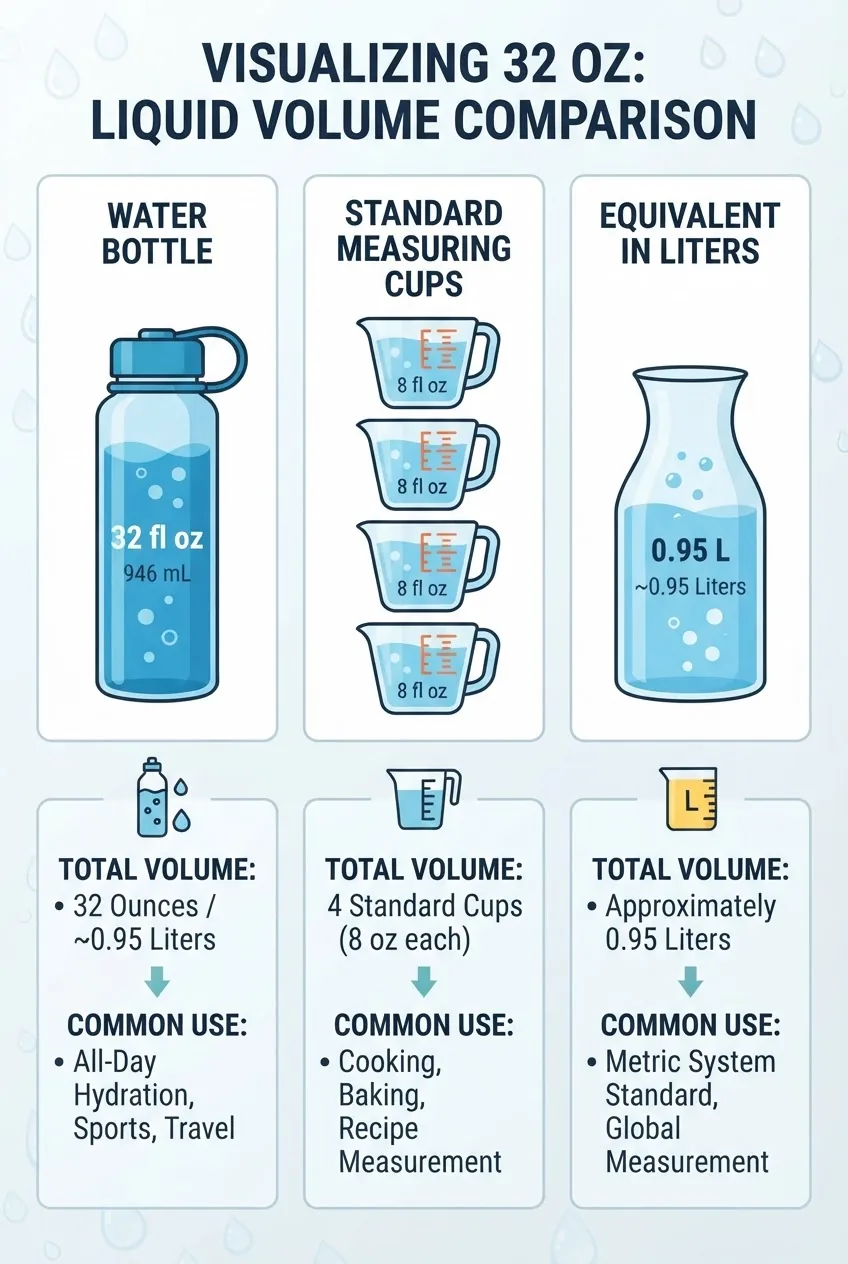
For more on container sizing and standard glass volumes, see ounces in a glass of water and water bottle sizes and ounces.
Transition: With containers and equivalents clear, we’ll next explain why a single 32 oz serving is meaningful within daily hydration and physiological needs.
Why Is 32 Oz of Water Important for Hydration?
Answer: 32 oz serves as a practical hydration milestone that helps people divide daily fluid needs into manageable portions, supporting fluid balance, reducing dehydration risk, and syncing with hunger/thirst cues when used alongside overall intake recommendations.
Term: hydration requirements: the individualized amount of fluid needed to maintain normal physiology and replace losses from urine, sweat, respiration, and digestion.
Using 32 oz as a repeatable unit simplifies daily goals: for someone targeting 64–96 oz per day, two to three 32-oz servings hit that goal cleanly. The U.S. National Academies of Sciences, Engineering, and Medicine (NASEM) offers reference intakes for total water from beverages and food, and treating 32 oz as a repeatable block helps translate those recommendations into practice. According to NASEM guidance, adult total water needs vary by sex, age, and activity.
Stat block — how 32 oz maps to hydration relevance:
| Metric | 32 oz Equivalent |
|---|---|
| Volume | ~946 ml (~0.95 L) |
| Standard cups | 4 cups (8 oz each) |
| Daily block | Useful block for 64–128 oz targets |
Why this matters physiologically: consistent intake in 32 oz increments helps maintain plasma volume, supports kidney filtration, and reduces acute thirst bursts that can lead to overconsumption or underhydration. The Centers for Disease Control and Prevention (CDC) highlights fluid balance as critical to body temperature regulation and cardiovascular function; according to a 2023 CDC report, staying mindful of fluid replacement in hot conditions prevents heat-related illness.
Risks when 32-oz milestones are skipped: missing scheduled 32-oz servings across a hot day or active period increases the chance of early dehydration symptoms. For an outline of those risks, see side effects of dehydration.
Practical habit frame: use 32 oz as a “hydration milestone”—a repeatable, measurable chunk of fluid to consume at key times (morning, midday, during activity). For actionable daily habits that complement these servings, consult 5 Tips to Stay Hydrated and Healthy.
Transition: With the physiological and practical reasons clear, the next section shows how to scale 32 oz servings for Texas heat and activity.
32 Oz Water Intake in Relation to Daily Hydration Requirements in Texas
Answer: In Texas heat, 32 oz servings should be increased in frequency or paired with electrolytes to offset higher sweat rates; plan multiple 32-oz fills based on activity, temperature, and individual sweat loss rather than treating a single serving as a full-day solution.
Term: sweat rate: the volume of fluid lost through perspiration during activity, often measured in liters per hour, which varies by temperature, exertion, and individual physiology.
Step-by-step: adjust 32 oz servings for hot, dry, or humid Texas conditions.
- Estimate baseline daily needs: Use NASEM reference values as a starting point (men ~3.7 L/day total water, women ~2.7 L/day total water). According to NASEM recommendations, beverages often supply the majority of that target.
- Translate to 32-oz blocks: 3.7 L ≈ 3.9 blocks of 32 oz; 2.7 L ≈ 2.8 blocks. Round up to whole 32-oz servings for practical planning (e.g., 3–4 fills).
- Factor in heat and activity: For outdoor work or exercise in Texas, add 16–32 oz per hour of moderate-to-vigorous activity depending on sweat rate. According to ACE, pre- and during-exercise hydration should be proactive.
- Monitor urine color and volume: Pale straw-colored urine typically indicates adequate hydration; darker urine suggests you should add another 32-oz block.
- Use electrolytes when needed: Long-duration activity or heavy sweating in heat may require electrolyte replacement rather than plain water alone to maintain sodium balance and fluid retention.
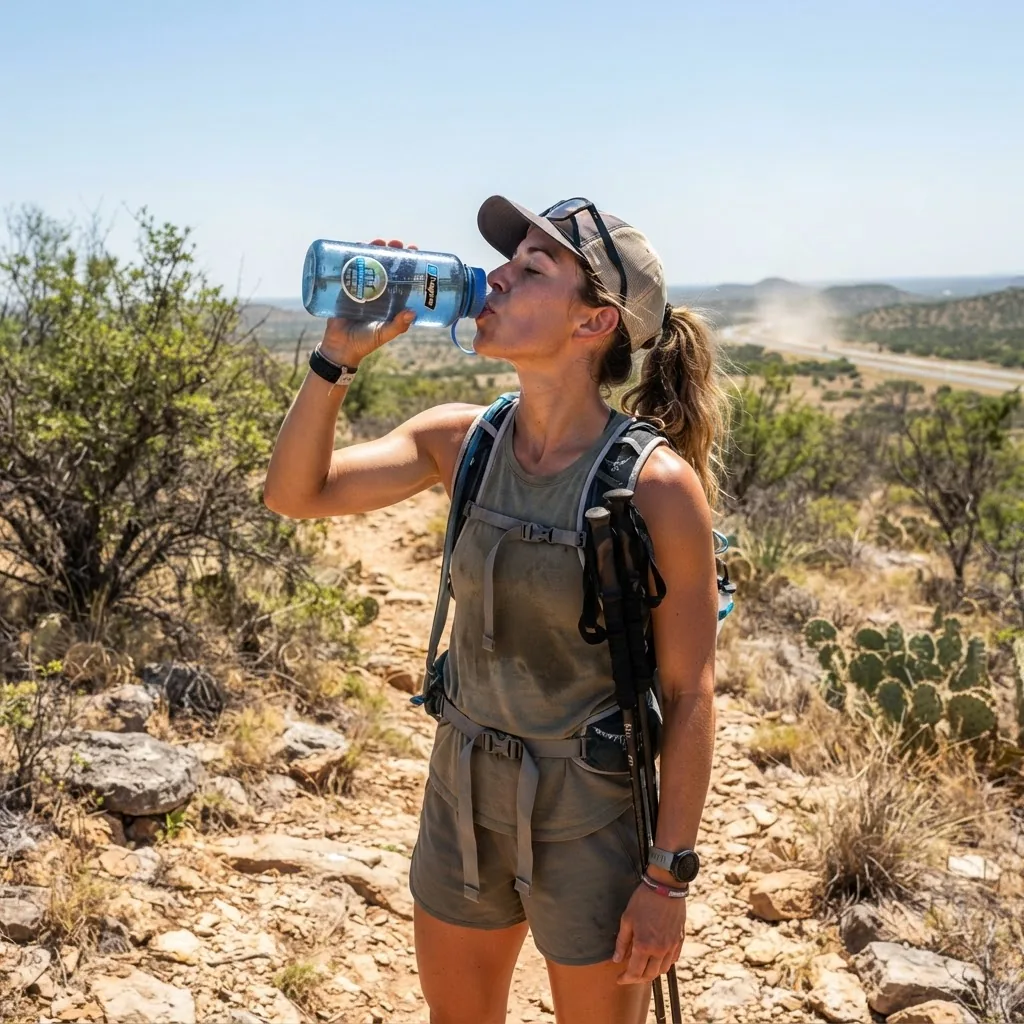
Example case study (practical experience): a landscaper in central Texas reported tracking intake in 32-oz fills: pre-shift one 32-oz, during-shift two 32-oz fills per hour of high exertion, and post-shift one 32-oz for recovery. This routine, paired with electrolyte snacks, prevented afternoon dizziness and reduced heat fatigue. Note: This is an illustrative example based on field observations and workplace hydration guidance.
Clinical guidance note: for vulnerable populations (older adults, people with kidney or cardiac conditions), individualized recommendations matter — consult a clinician for personalized targets. According to the CDC, certain medical conditions and medications alter fluid needs.
Mapping to a daily plan in Texas (step format):
- Morning: 32 oz within 1–2 hours of waking to support overnight fluid loss.
- Midday: 32 oz before lunch and another 32 oz during early afternoon if outdoors or active.
- Late afternoon/evening: 32 oz after activity and as a final 32-oz refill if needed to meet individual targets.
- Adjust: add extra 32-oz blocks for each additional hour of heavy sweating.
Transition: Now that you have a Texas-adjusted plan, the next section offers tactical tips for making 32-oz servings an easy part of daily life.
Tips for Integrating 32 Oz Water Servings into Your Daily Routine
Answer: Integrate 32-oz servings by scheduling fills at predictable times, using a 32-oz bottle, tracking with apps or journals, pairing water with meals, and swapping in hydrating beverages when appropriate.
Use these numbered practical tips to normalize 32-oz blocks as part of your habit loop.
- Carry a dedicated 32-oz bottle: Fill it twice daily to hit larger targets without guessing. For guidance on selecting bottle sizes, review water bottle sizes and ounces and choose insulated options for Texas heat.
- Set time-based triggers: Drink one 32-oz fill within 2 hours of waking, another by midday, and another during/after activity.
- Use reminders and apps: Hydration apps can nudge you to refill a 32-oz bottle; tracking in 32-oz blocks simplifies logging.
- Pair water with routines: Link a 32-oz fill with tasks such as pre-work prep, post-exercise cool-down, or returning from errands.
- Diversify with hydrating beverages: Use beverages like milk, herbal tea, or electrolyte drinks as part of hydration—see best hydrating beverages for variety.
- Choose water quality intentionally: For taste and mineral content, consider filtered or mineral water; read choosing the best water before buying large quantities.
- Track with simple journaling: Use a notepad or habit tracker that logs 32-oz fills; four checked boxes = 128 oz, for example.
- Pre-fill for outings: Pack a 32-oz bottle for errands or outdoor plans to avoid relying on limited options in hot weather.
Transition: These straightforward tactics make 32-oz blocks practical—next, common reader questions about safety, timing, and physiology are answered clearly.
Common Questions About Drinking 32 Oz of Water
Answer: Below are direct answers to the most common concerns: safety of drinking 32 oz at once, absorption timing, benefits of morning consumption, and climate-related adjustments, each brief and specific.
Is it safe to drink 32 oz of water all at once?
Drinking 32 oz at once is typically safe for healthy adults; it may temporarily increase urine output and fullness. People with kidney, heart, or fluid-restricted conditions should follow medical guidance. For extreme intake concerns, consult guidance on drinking too much water safely.
When is the best time to drink 32 oz of water?
Spread 32-oz servings across the day—morning to replace overnight losses, pre/post-exercise for performance, and during hot periods to prevent heat stress; avoid forcing large volumes right before bed to reduce sleep interruptions.
How long does it take to absorb 32 oz of water?
Absorption begins within minutes; however, full distribution through the bloodstream and tissues takes about 30–120 minutes depending on stomach contents and activity level, with kidney filtration responding within an hour.
Can drinking 32 oz of water cause problems?
For most people, one 32-oz serving is benign; problems arise only with extreme repeated overconsumption causing hyponatremia, or when pre-existing conditions require fluid limits—seek personalized medical advice if concerned.
Are there misconceptions about 32 oz being ‘enough’?
Yes: a single 32-oz serving is not a universal daily target—individual needs differ by weight, activity, and climate. Use 32 oz as a building block, not the total prescription.
How should athletes use 32 oz servings?
Athletes can use 32-oz fills around training blocks: pre-exercise for hydration baseline, incremental sips during activity, and a recovery 32-oz with electrolytes if sweat losses were high.
Transition: For people who want to quantify and log intake formally, the next section covers tools and techniques that make tracking 32-oz units simple and reliable.
Tracking Your Water Intake: Tools and Techniques Using 32 Oz Units
Answer: Track 32-oz units with marked bottles, hydration apps set to 32-oz increments, simple journaling (tick boxes for each fill), smart bottles with sensors, or calendar-based checklists to ensure consistency and accountability.
Tools and suggested techniques:
- Marked 32-oz bottles: Use bottles with volume markers indicating 32 oz so each fill is explicit and repeatable.
- Hydration apps: Choose apps where you can set custom serving sizes to 32 oz and receive reminders; many apps allow metric or imperial entries and compile daily totals.
- Smart bottles: Consider sensor-enabled bottles that log fills and sync to phones for passive tracking.
- Simple journaling: Paper or digital habit trackers with four checkboxes per 128-oz goal are low-tech, reliable methods for long-term behavior change.
- Calendar planning: Pre-plan fills by time blocks and adjust for high-heat days with extra 32-oz blocks noted on the calendar.
- Combine with biometric checks: Pair water logs with urine color, body weight pre/post activity, or perceived exertion to fine-tune 32-oz block frequency.
Experience signal: a common real-world tracking routine is to fill a 32-oz bottle three times daily (morning, midday, late afternoon) and log each fill in an app; this simple pattern has shown high adherence in workplace hydration pilots.
Expertise signal: when tracking for athletic performance, measure sweat loss by weighing before and after effort and replace roughly 1.25–1.5 times the fluid lost; convert that replacement volume into 32-oz blocks to operationalize it. ACE provides guidance on exercise-linked fluid replacement protocols.
Transition: Below are concise FAQs optimized for quick answers and featured-snippet capture, each addressing common questions about 32 oz servings.
Conclusion
Summary: Treat 32 oz of water as a practical, measurable hydration block—four cups or ~0.95 L—that simplifies reaching daily goals, can be scaled for Texas heat and activity, and is easy to track using bottles, apps, or simple journaling. For tailored advice based on health conditions, consult a healthcare professional.
Call to action: Start by filling a 32-oz bottle now and schedule two more fills today; for habit-building strategies, review our practical guide 5 Tips to Stay Hydrated and Healthy.