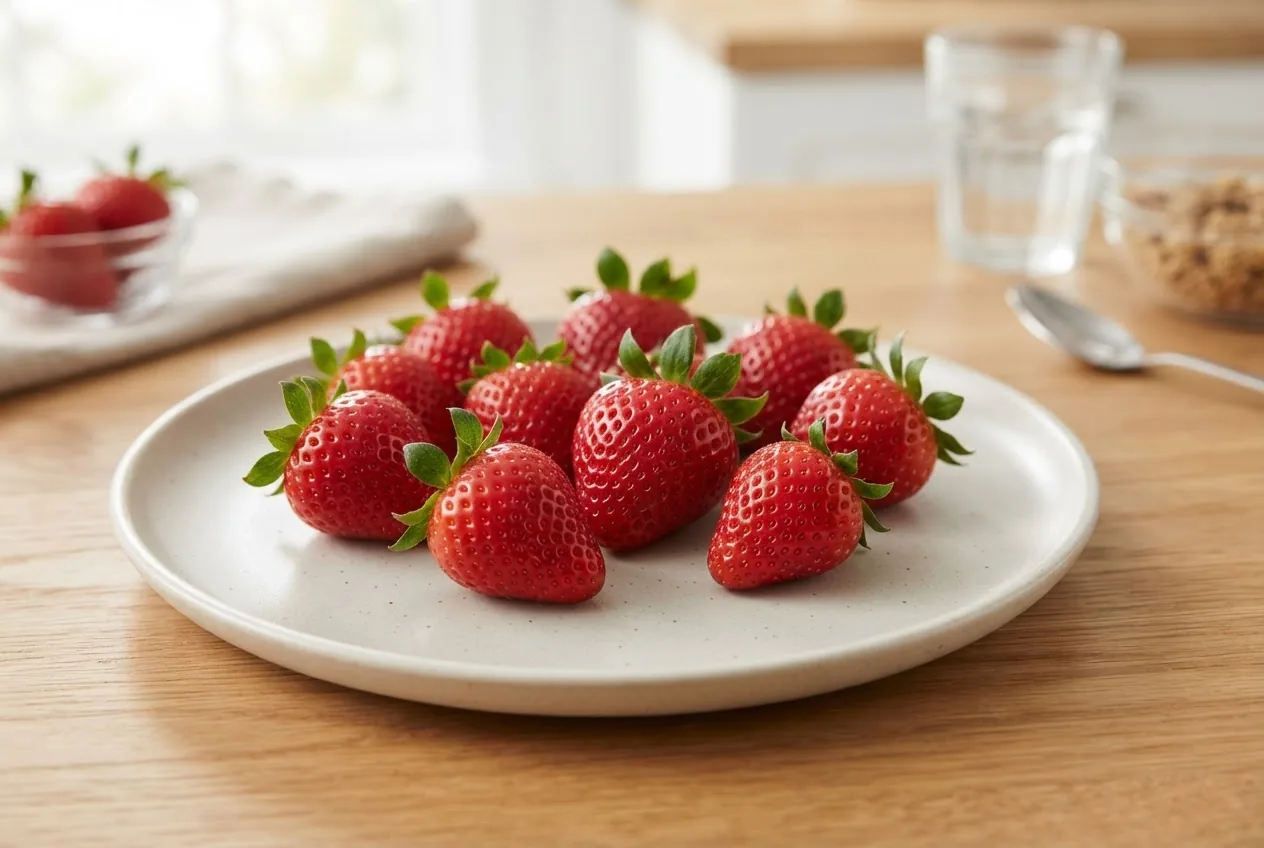
Calories in 10 strawberries equals roughly 38 kcal when using a medium-strawberry assumption (about 12 g each); this includes ~9.2 g total carbs, ~5.9 g natural sugar and ~2.4 g fiber — useful for precise calorie budgeting and meal planning.
This guide breaks down calories and macros for 1, 2, 5, 6 and 10 strawberries, explains serving sizes, compares preparation methods, and gives practical portion-control steps for weight-loss-friendly eating.
Calories in 10 Strawberries — Exact Nutritional Breakdown
Answer: Ten medium strawberries (~120 g total using a 12 g average per berry) contain about 38 calories, ~9.2 g carbohydrates, ~5.9 g sugar and ~2.4 g fiber; values scale directly from USDA per-100g nutrient data.
Term: macros are the three main nutrient groups—carbohydrates, protein and fat—that provide calories and fuel the body.
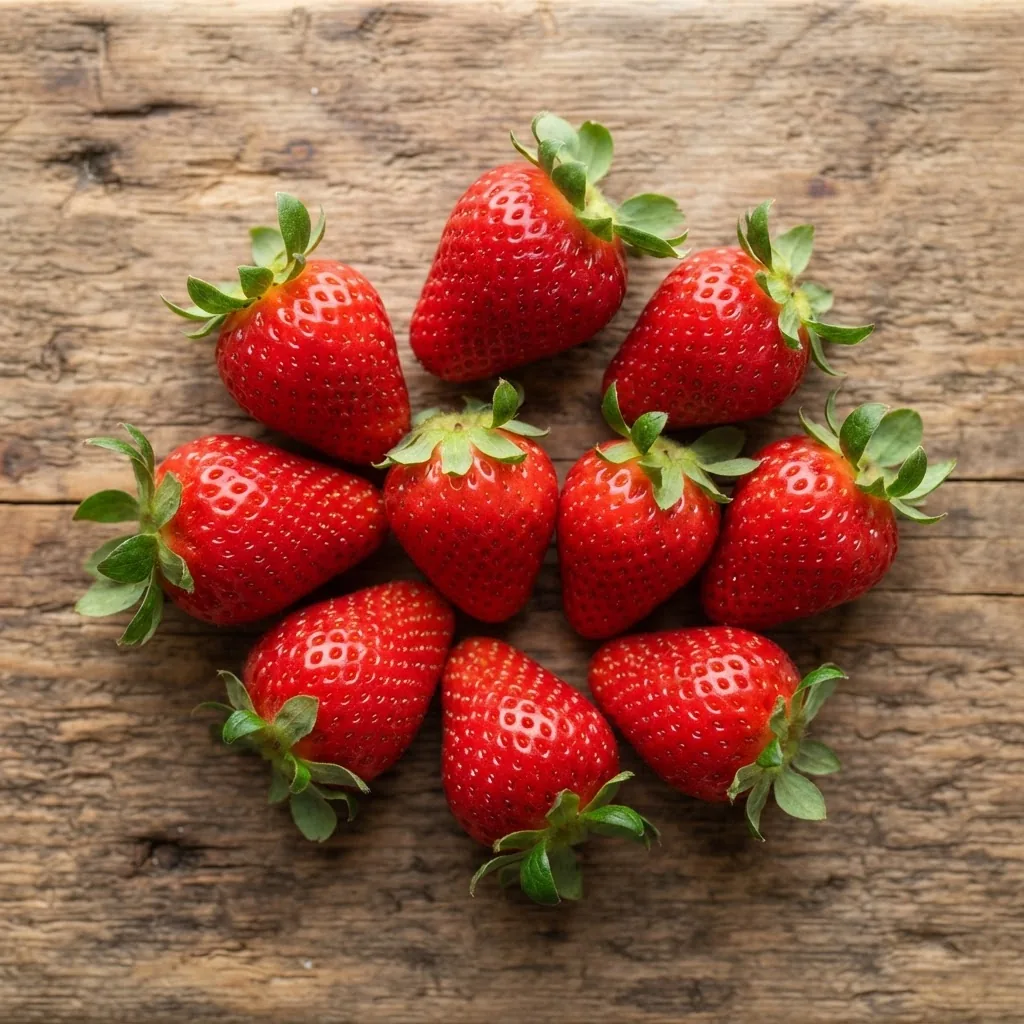
Calculations below use a consistent, transparent basis so you can adapt them to your berries’ actual size. According to a 2024 USDA report, raw strawberries provide 32 kcal per 100 g along with 7.7 g total carbs, 2.0 g fiber, 4.9 g sugar, 0.67 g protein and 0.30 g fat per 100 g (USDA National Nutrient Database).
| Measure | Weight (g) | Calories (kcal) | Carbs (g) | Sugar (g) | Fiber (g) | Protein (g) |
|---|---|---|---|---|---|---|
| Per 100 g (USDA baseline) | 100 | 32 | 7.7 | 4.9 | 2.0 | 0.7 |
| Assumed 1 medium strawberry (≈12 g) | 12 | 3.8 | 0.9 | 0.6 | 0.24 | 0.08 |
| 10 medium strawberries | 120 | 38 | 9.2 | 5.9 | 2.4 | 0.8 |
Notes on the table: numbers are rounded; actual calories vary by berry size and variety. For cross-references to broader fruit calorie totals see the calories in fruit guide with kcal and nutritional insights.
Practical example for daily calorie budgets: if your daily target is 2,000 kcal, 10 strawberries (~38 kcal) use ~1.9% of that target; adding them to a breakfast of 300 kcal raises the meal to ~338 kcal.
Preparation impact: fresh and frozen strawberries (without added sugar) have nearly identical calories; dried or sweetened forms concentrate sugar and calories dramatically (see section below).
Calories in Smaller Strawberry Portions: 1, 2, 5, and 6 Strawberries
Answer: Using a 12 g medium-strawberry basis, one strawberry ≈ 3.8 kcal, two ≈ 7.6 kcal, five ≈ 19 kcal and six ≈ 23 kcal — with proportional macro and sugar content for each count.
- 1 strawberry — ~3.8 kcal. Macros: ~0.9 g carbs, ~0.6 g sugar, ~0.24 g fiber, negligible fat and protein. Small enough to be a micro-snack or garnish.
- 2 strawberries — ~7.6 kcal. Macros double from one berry: ~1.8 g carbs, ~1.2 g sugar, ~0.48 g fiber. Handy when tracking tiny increments or adding to yogurt.
- 5 strawberries — ~19 kcal. Macros: ~4.6 g carbs, ~2.9 g sugar, ~1.2 g fiber. A reasonable mid-meal fruit portion when combined with protein or fat for balance.
- 6 strawberries — ~23 kcal. Macros: ~5.5 g carbs, ~3.5 g sugar, ~1.4 g fiber. Useful portion for recipes calling for 6 whole berries or a small side serving.
These small-count calculations let you track fruit precisely in calorie-counting apps or food journals. Because strawberries vary by cultivar and harvest, weigh them if exactness matters.
Preparation notes: frozen strawberries without syrup match fresh calorie counts; dried strawberries can be 3–5x denser in calories and sugar per serving because water is removed.
Strawberry Serving Size Explained — How Much is One Serving?
Answer: A standard serving of strawberries is typically 1 cup of whole berries (about 150 g), which provides roughly 48 kcal using USDA per-100g data scaled to 150 g; serving guidance changes by dietary goals and country-specific recommendations.
Term: serving size is the standardized amount of food used to report nutrition information, not necessarily the recommended intake for every individual.
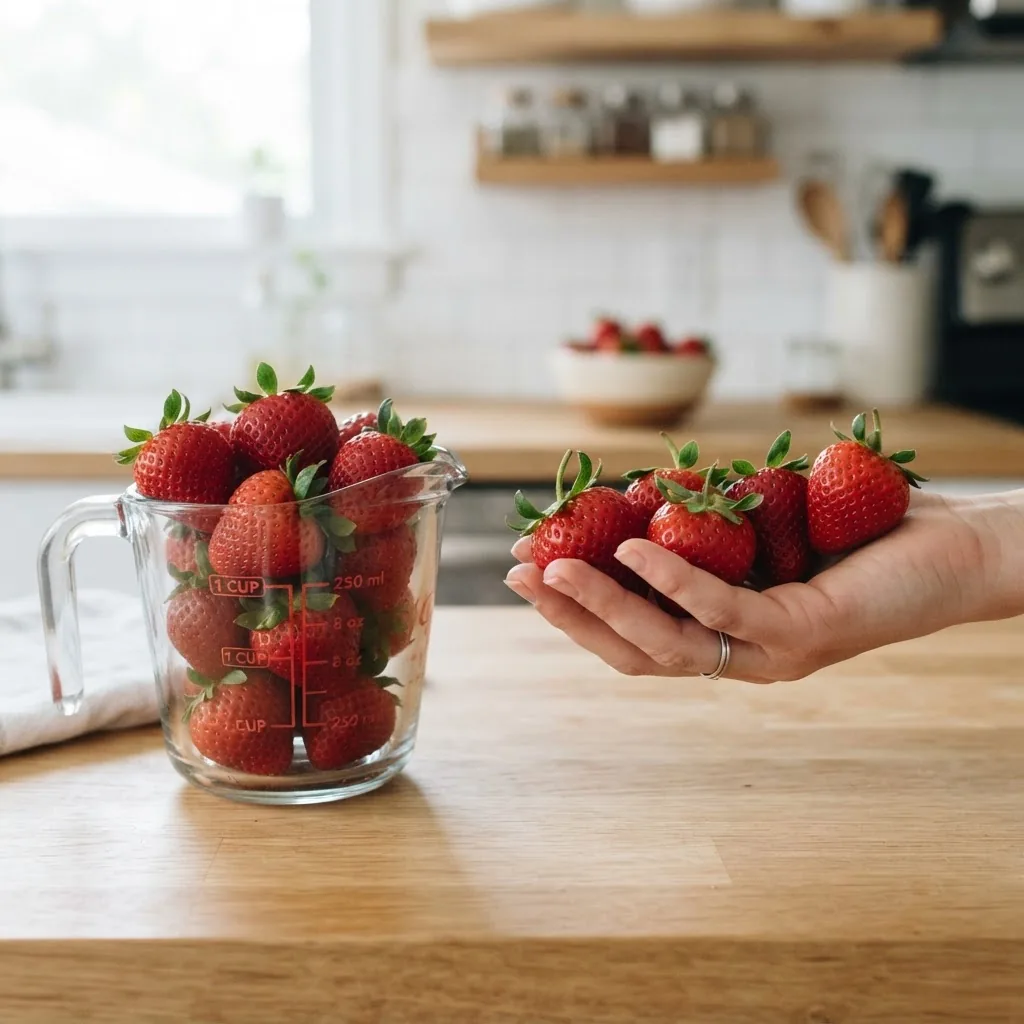
Examples: one cup (≈150 g) is commonly listed on nutrition labels and equals about 12–15 medium strawberries depending on size. According to a 2024 USDA report, 1 cup (150 g) of strawberries contains roughly 48 kcal and 3.0 g fiber when scaled from the 100 g baseline.
Practical serving-size recommendations:
- US-style guidance: aim for 1–2 cup-equivalents of fruit daily depending on age, sex and activity — strawberries count toward that total.
- For snacking: 5–8 medium strawberries (≈19–30 kcal) make a low-calorie, high-water snack paired with protein for satiety.
Kitchen measurement steps (experience signal):
- Use a digital kitchen scale: weigh 150 g to get one cup equivalent of whole strawberries.
- If no scale: fill a standard US measuring cup to the brim with whole berries to approximate a 1-cup serving.
- Count method: expect roughly 12 medium strawberries per 1-cup serving — adjust if your berries are unusually large or small.
For comparison of serving logic between fruits and vegetables, see the fruit types guide with benefits and nutritional information and the are green beans fruit or vegetable guide to understand classification impacts on portions.
fruit types guide with benefits and nutritional information
are green beans fruit or vegetable guide
Serving limits and special populations: people with diabetes should monitor carbohydrate equivalents; speak to a clinician for individualized carbohydrate targets.
Strawberry Nutritional Profile — Macros, Fiber, and Sugar Content
Answer: Strawberries are low-calorie fruits with carbohydrates as the primary macro, modest protein, minimal fat, about 2.0 g fiber per 100 g and roughly 4.9 g natural sugar per 100 g; fiber moderates sugar absorption and adds fullness.
Term: glycemic index (GI) is a scale that ranks carbohydrate-containing foods by their effect on blood glucose; low-GI foods raise blood sugar more slowly than high-GI foods.
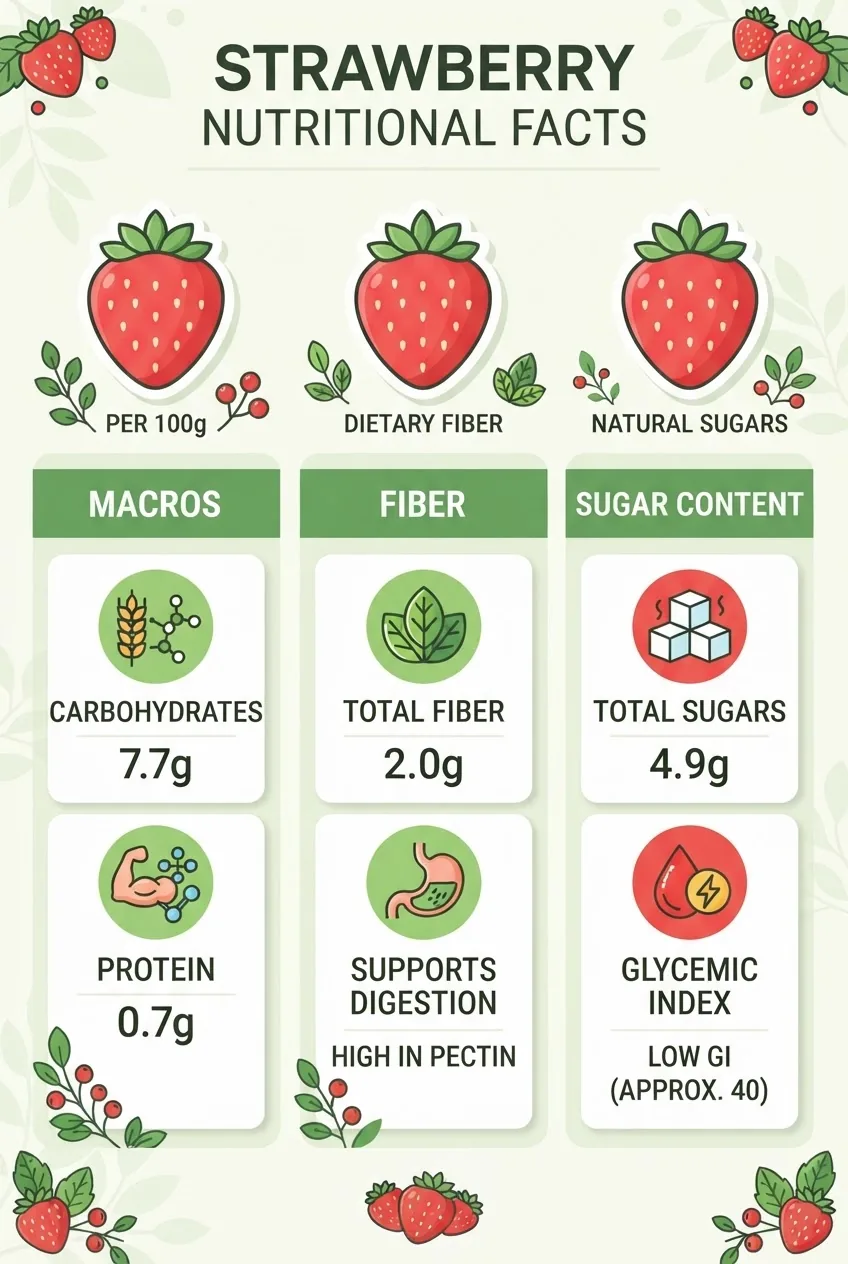
Stat block (based on 2024 USDA per-100g):
- Calories: 32 kcal per 100 g (USDA 2024 baseline).
- Carbohydrates: 7.7 g per 100 g; this includes natural sugars and fiber.
- Natural sugars: 4.9 g per 100 g; intrinsic fruit sugar primarily fructose, glucose and sucrose.
- Fiber: 2.0 g per 100 g; soluble and insoluble fibers that support gut health and slow glucose uptake.
- Protein: 0.7 g per 100 g; not a major protein source.
- Fat: 0.3 g per 100 g; negligible for most diets.
Fiber role: dietary fiber slows digestion and blunts blood sugar spikes; the American Heart Association emphasizes fiber-rich foods as part of heart-healthy eating (American Heart Association).
Sugar context: the sugar in strawberries is intrinsic (naturally occurring) rather than added sugar; intrinsic sugar consumed with fiber and water has a different metabolic profile than sugary drinks. According to a peer-reviewed review on fruit intake and weight outcomes, whole-fruit consumption is generally linked to neutral or beneficial weight outcomes when added sugars and fruit juices are limited (peer-reviewed study).
For fiber and calorie comparisons with vegetables like carrots, consult the calories in carrots and fiber content resource.
calories in carrots and fiber content
Glycemic behavior: strawberries are low on the glycemic index scale due to their fiber and water content, which lowers glycemic load per serving; this makes them a favorable choice for blood-sugar-aware diets compared with high-GI sweets.
Health Benefits and Dietary Considerations when Eating Strawberries
Answer: Strawberries offer antioxidants, vitamin C, and fiber while being low in calories; they support cardiovascular health and satiety, but portion context and preparation (fresh vs. sweetened) determine metabolic effects.
Antioxidants: strawberries contain polyphenols and vitamin C that act as antioxidants; several peer-reviewed studies associate regular berry intake with improved markers of heart health and inflammation (peer-reviewed study).
Fiber and heart health: fiber supports cholesterol management and bowel regularity; the American Heart Association recommends fiber-rich whole foods for cardiovascular benefit (American Heart Association).
Portion caveat for sugar-sensitive conditions: although strawberry sugars are natural, people with diabetes should count carbs; individual responses vary and clinical guidance should be followed.
avocado fruit guide and nutritional benefits
Preparation impact: fresh and plain frozen strawberries maintain their nutritional strengths; sweetened preserves, syrups or dried forms add concentrated sugar and calories and should be limited for weight management or glycemic control.
Tips to Incorporate Strawberries into Your Diet Smartly — Portion Control and Weight Loss
Answer: Use strawberries as low-calorie, high-volume snacks, pair with protein/fat for satiety, measure portions with a scale or cup, and substitute them for higher-calorie desserts to support weight loss while staying within daily calorie goals.
Step-by-step portion-control tips:
- Weigh once to know size: Place 150 g on a kitchen scale to see a 1-cup serving. Track that weight in your app for repeatability.
- Measure by count: If you don’t weigh, learn your common berry count per cup (often 12 medium strawberries) and use counts for quick tracking.
- Pair for satisfaction: Combine 5–8 strawberries with 100 g Greek yogurt, 1 tbsp nut butter or 10–12 almonds to add protein and fat, reducing post-snack hunger.
- Swap desserts: Use a bowl of strawberries instead of a 200 kcal packaged dessert to save calories while enjoying sweetness.
- Mind preparation: Avoid dried, candied or sugar-syrup preparations which concentrate calories; choose fresh or plain-frozen.
Calorie budgeting example (experience signal): if your daily target is 1,500 kcal and you want a 300 kcal breakfast, 10 strawberries (~38 kcal) can be added with 2 scrambled eggs (~140 kcal) and a slice of whole-grain toast (~120 kcal) staying close to 300 kcal total.
Real-life one-day meal plan example incorporating strawberries (experience signal):
- Breakfast: 2 scrambled eggs (140 kcal) + 10 strawberries (38 kcal) = 178 kcal.
- Snack: 5 strawberries (19 kcal) + 1 string cheese (80 kcal) = 99 kcal.
- Lunch/dinner: balance remaining calories with lean protein, vegetables and whole grains.
For broader weight-loss fruit strategies and fruit choices that support fat-loss goals, consult the best fruits for weight loss guide. For tips on selecting fresh produce, see the fresh fruits and veggies guide with produce selection tips.
best fruits for weight loss guide
fresh fruits and veggies guide with produce selection tips
Practical portion-control tools: small bowls, measuring cups and a kitchen scale are the fastest ways to standardize strawberry servings; if tracking on an app, enter grams for the most accurate nutrient totals.
FAQ About Strawberries Calories and Nutrition
Answer: Below are common, concise answers to frequently asked calorie and nutrition questions about strawberries, useful for quick decision-making and meal planning.
- How many calories are in 10 strawberries? → About 38 kcal using a 12 g medium-berry assumption (see USDA-based calculations above).
- What is the recommended serving size? → 1 cup (≈150 g) is a common serving, roughly 12 medium strawberries.
- Do strawberries have a lot of sugar? → They contain natural sugar (~4.9 g/100 g) but also fiber which moderates absorption.
- How does preparation affect calories? → Dried and sweetened forms concentrate sugar and calories significantly compared to fresh or plain-frozen berries.
Closing summary: Strawberries are a low-calorie, fiber-containing fruit that fit well into balanced diets; use the portion and measurement techniques above to control calories accurately and pair berries with protein for better satiety.
CTA: Track a cup or weigh your next serving—try replacing one sweet snack today with a cup of strawberries and note the calorie savings in your daily log.