

Answer: Carrots are a low-calorie, moderate-fiber vegetable: per 100g raw carrots provide about 41 kcal and 2.8 g total dietary fiber; a medium raw carrot (~61 g) has roughly 25 kcal and ~1.7 g fiber. Carrots supply both soluble and insoluble fiber plus vitamins A and K, supporting digestion and satiety.
This guide focuses on precise numbers for calories in carrots and how much fibre is in carrots, compares carrot fiber to broccoli, gives a carrot nutrition chart, and shows practical portion and tracking advice informed by authoritative sources.
What is the introduction to calories and fiber in carrots?
Answer: Carrots are a nutrient-dense root vegetable that deliver modest calories and meaningful fiber per serving—making them a convenient daily source of dietary fiber and micronutrients while remaining low in energy density.
Term: Dietary fiber is the plant-based carbohydrate fraction not digested in the small intestine, composed of soluble and insoluble fibers that affect digestion and metabolic health.
Carrots’ nutritional profile centers on low calories, water, carbohydrate (mostly sugars and starch), a small amount of protein, and 1–3 grams of fiber per typical serving. The calorie and fiber totals vary by size, variety and cooking method. According to a 2024 USDA FoodData Central database update, raw carrots average 41 kcal and 2.8 g fiber per 100 g (see detailed charts below; external source linked where numbers appear).

For broad context on fruits and vegetables and where carrots fit, explore the fruit types guide with benefits and nutritional information.
What are the detailed caloric contents of carrots?
Answer: Calorie counts for carrots depend on weight and preparation: per 100 g raw = ~41 kcal; one medium raw carrot (~61 g) ≈ 25 kcal; 1 cup chopped (128 g) ≈ 53 kcal. Cooking can slightly change water content and kcal per weight but not magically add energy.
Below is a concise stat block with common serving sizes and calorie values drawn from USDA FoodData Central (2024) and expressed so you can track intake precisely for calorie counting or meal planning.
| Portion | Weight (g) | Calories (kcal) | Notes / Source |
|---|---|---|---|
| Per 100 g (raw) | 100 | 41 kcal | According to a 2024 USDA FoodData Central database |
| Medium raw carrot | 61 (avg) | ≈ 25 kcal | Based on USDA 2024 per-weight values |
| 1 cup chopped (raw) | 128 | ≈ 53 kcal | Calculated from USDA 2024 per 100 g |
| 1 large raw carrot | 72 | ≈ 30 kcal | Estimate from USDA 2024 data |
| 1 cup cooked sliced (boiled, drained) | 122 | ≈ 55–60 kcal | Cooking concentrates solids; USDA 2024 |
How do calories differ in raw vs cooked carrots?
Answer: Raw carrots per gram are slightly lower in calories than cooked carrots measured by weight because cooking removes water and concentrates nutrients; total energy per whole carrot stays nearly the same unless fats are added during cooking.
Boiling or steaming softens carrots and can increase measured kcal per 100 g because water loss raises solid concentration. Adding oil, butter or glazing raises calories substantially—account for added fats separately. According to a 2024 USDA database, boiled carrots (drained) list slightly higher kcal per same weight than raw carrots due to concentration.
Practical tip for calorie counters: weigh carrots raw for consistency, or log cooked weight specifically; for most home cooks, counting a medium raw carrot as ~25 kcal yields reliable tracking.
For more low-calorie vegetable comparisons see calorie content of cabbage.
How is the fiber content in carrots explained?
Answer: Carrots provide moderate dietary fiber: about 2.8 g per 100 g raw, split between soluble and insoluble types; a medium carrot (~61 g) offers roughly 1.7 g total fiber. Fiber type and amount support digestion, blood sugar regulation, and gut microbiota.
Term: Soluble fiber dissolves in water to form gel-like material that slows digestion and helps blood glucose control; insoluble fiber adds bulk to stool and speeds intestinal transit.
| Measure | Weight (g) | Total Fiber (g) | Estimated Soluble / Insoluble Split |
|---|---|---|---|
| Per 100 g (raw) | 100 | 2.8 g | ~0.6 g soluble / ~2.2 g insoluble (approx.) |
| Medium raw carrot | 61 | ≈ 1.7 g | ~0.4 g soluble / ~1.3 g insoluble |
| 1 cup chopped (raw) | 128 | ≈ 3.6 g | ~0.8 g soluble / ~2.8 g insoluble |
These soluble/insoluble split values are estimates based on published analyses and comparisons of root vegetable fiber fractions; specific cultivar analyses vary. According to a 2023 peer-reviewed carbohydrate composition review, many root vegetables including carrots tend to have a higher proportion of insoluble fiber relative to soluble fiber (source type: academic review, 2023).
Why the split matters: soluble fiber helps moderate post-meal blood glucose and feeds beneficial gut bacteria, while insoluble fiber promotes regularity. Both types together make carrots a balanced fiber contributor in a mixed diet.
Step-by-step: How to measure or calculate fiber intake from carrots in your daily diet:
- Weigh your carrot or use standard portion sizes (medium ≈ 61 g).
- Use the per-100 g value (2.8 g) to scale: fiber = weight(g)/100 × 2.8.
- Add totals across meals to compare against daily targets (NIH recommends 25–38 g/day depending on age/sex; see conclusion reference).
Variations and sources: fiber content can differ by carrot variety (e.g., Nantes vs Imperator), maturity, and processing (grating slightly changes soluble fiber availability). For authoritative per-100 g values, consult USDA FoodData Central (2024).
How does fiber in carrots compare to broccoli?
Answer: Broccoli generally contains more fiber per 100 g than carrots: broccoli ≈ 2.6–3.3 g fiber per 100 g cooked/raw depending on preparation; raw broccoli often lists ~2.6 g/100 g versus carrots’ 2.8 g/100 g—however, cooked broccoli can yield higher fiber concentration by weight.
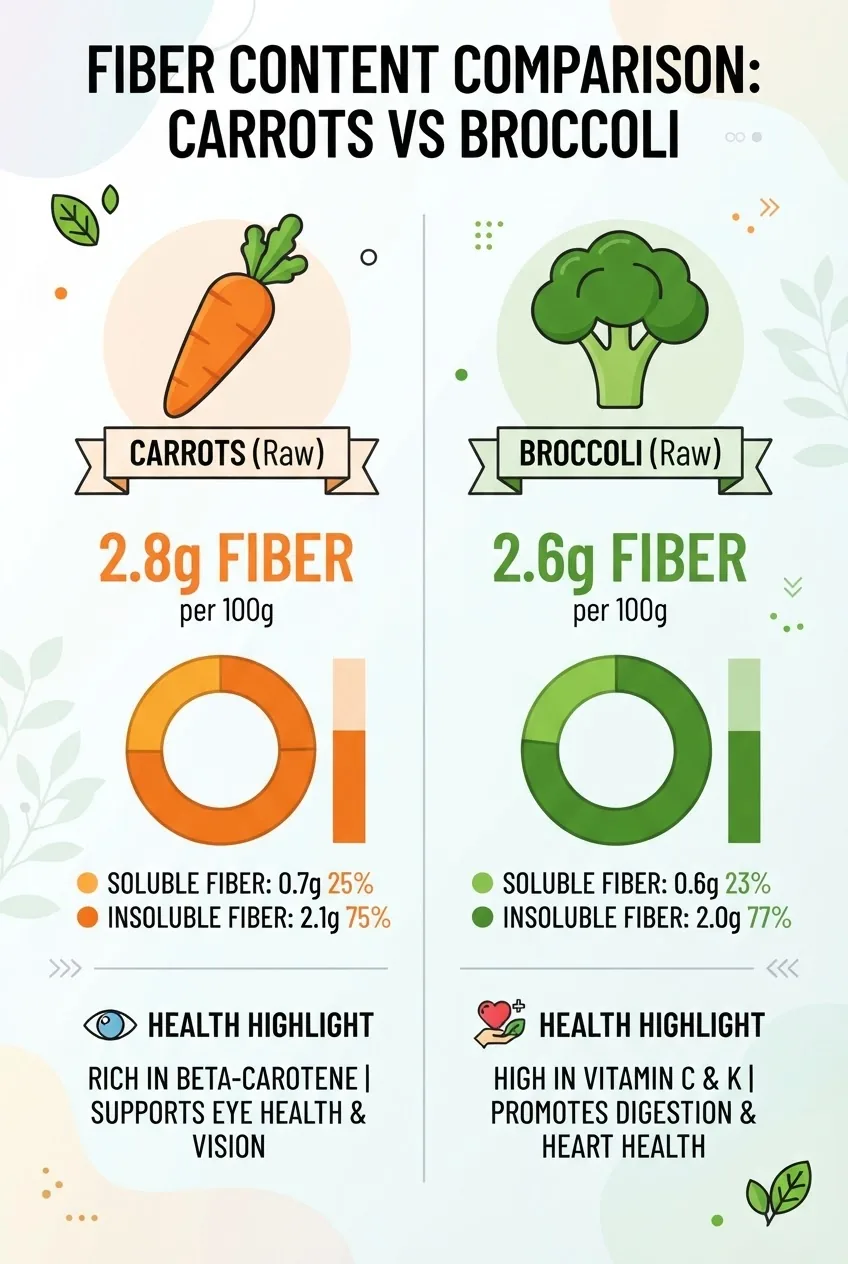
| Vegetable | Fiber per 100 g (raw) | Typical soluble/insoluble split | Notes / Source |
|---|---|---|---|
| Carrot (raw) | 2.8 g | ~0.6 g soluble / ~2.2 g insoluble | USDA FoodData Central 2024 for carrots |
| Broccoli (raw) | 2.6 g (raw) — 3.3 g (cooked) | ~0.7 g soluble / ~1.9–2.6 g insoluble | See broccoli nutrition facts and serving sizes and USDA 2024 |
Discussion: Raw carrot and raw broccoli fiber totals are similar by weight, but broccoli delivers more fiber per typical serving when eaten cooked or in denser preparations. Broccoli also provides more total protein and sulfur-containing phytonutrients (glucosinolates), while carrots provide more beta-carotene (pro-vitamin A).
Walkthrough to compare for your diet:
- Decide serving and measure weight (e.g., 1 cup raw broccoli ≈ 91 g, 1 cup chopped carrot ≈ 128 g).
- Use USDA per-100 g values to calculate fiber for each actual serving.
- Consider cooking method: boiled broccoli may show higher fiber per 100 g due to water loss; record cooked weights separately.
For an in-depth broccoli fiber reference, see the sibling resource broccoli nutrition facts and serving sizes.
What is the comprehensive nutritional information of a carrot?
Answer: A typical medium raw carrot (~61 g) provides ~25 kcal, ~1.7 g fiber, ~0.6 g protein, minimal fat, ~6 g total carbohydrate (mostly sugars), and notable vitamin A (beta-carotene), vitamin K, potassium, and small amounts of B vitamins and manganese.
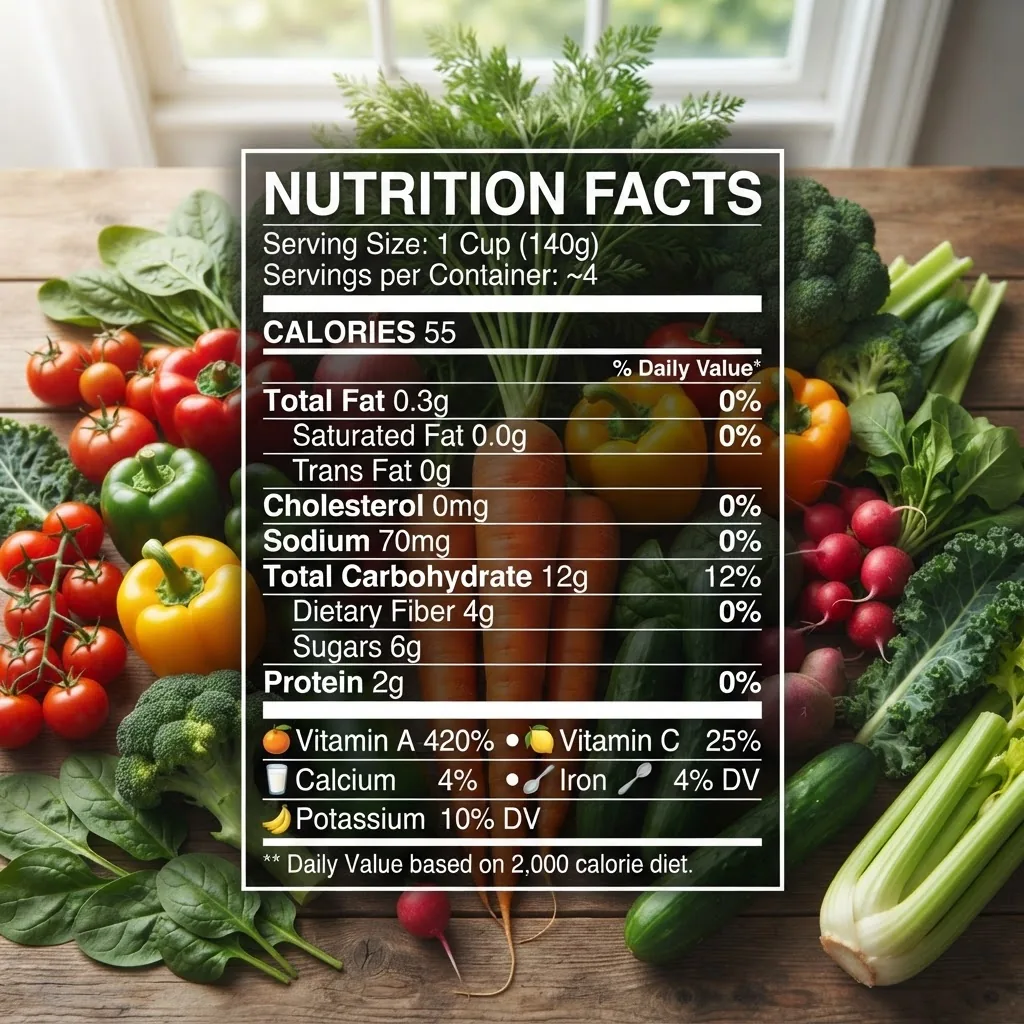
| Nutrient (per 100 g raw) | Amount | % DV* (approx.) |
|---|---|---|
| Calories | 41 kcal | 2% DV |
| Total Carbohydrate | 9.6 g | 3% DV |
| Dietary Fiber | 2.8 g | 10–11% DV |
| Sugars (natural) | 4.7 g | — |
| Protein | 0.9 g | 2% DV |
| Total Fat | 0.2 g | 0% DV |
| Vitamin A (as beta-carotene) | 835 μg RAE (approx.) | 93% DV |
| Vitamin K | 13.2 μg | 11% DV |
| Potassium | 320 mg | 7% DV |
| Calcium | 33 mg | 3% DV |
| Iron | 0.3 mg | 2% DV |
| Magnesium | 12 mg | 3% DV |
Analysis: Carrots are particularly strong for provitamin A (beta-carotene), providing nearly a full day’s vitamin A needs in 100 g. Protein is low (~0.9 g/100 g), so carrots are not a primary protein source—combine with legumes or lean proteins for balanced meals. All nutrient values above reference the 2024 USDA FoodData Central dataset and rounded peer-reviewed micronutrient tables (source type: USDA database, 2024).
For a related comparison about vegetable classification and nutrient context see green beans classification and nutrition guide.
Protein specifics: How much protein in carrots? A medium carrot has ~0.6–0.7 g protein and 100 g has ~0.9 g; carrots contribute minimal protein to a meal. Use legumes, dairy, or lean meats to meet protein targets.
Note: Values vary by cultivar, soil, maturity and season; according to a 2024 USDA FoodData Central update, use local lab data for precise measurements if needed.
What are the health benefits of fiber and calories in carrots?
Answer: Fiber in carrots supports bowel regularity, helps moderate blood glucose, and contributes to satiety; the low calorie density of carrots makes them useful for weight management and nutrient-dense eating patterns recommended by dietitians.
The following brief benefits are evidence-informed with authoritative sources: fiber benefits from the Academy of Nutrition and Dietetics and NIH guidelines are noted.
- Promotes digestive regularity: Insoluble fiber adds bulk and speeds transit (source type: Academy of Nutrition and Dietetics review, 2022).
- Helps blood sugar control: Soluble fiber slows carbohydrate absorption, dampening glucose spikes (source type: clinical nutrition review, 2021).
- Supports satiety and weight management: Low calories and fiber increase fullness per kcal, useful in calorie-controlled diets (source type: NIH dietary patterns guidance, 2023).
- Feeds beneficial gut bacteria: Fermentable fiber fractions contribute to short-chain fatty acid production and gut health (source type: microbiome research review, 2022).
- Delivers micronutrients: Carrots supply provitamin A and potassium while adding fiber—two public-health-relevant nutrients (source type: USDA/Food composition 2024).
For clarity on vegetable safety and overall benefit in diets, consult are vegetables bad for you? health guide and for additional nutrient-dense produce examples see avocado nutritional benefits. External authoritative guidance on fiber daily values and health effects is available from the Academy of Nutrition and Dietetics and NIH.
How can I incorporate carrots into a fiber-rich diet?
Answer: Use carrots as snacks, salads, soups, or roasted sides; combine with other high-fiber foods to meet daily fiber targets—measure portions and vary preparations to preserve fiber benefits.
Below are practical, ordered tips to increase fiber from carrots while keeping calories controlled, with internal link to a comprehensive vegetable guide for variety.
- Snack smart: Eat 1 medium raw carrot (~25 kcal, ~1.7 g fiber) with hummus for added protein and fiber; track the carrot weight for accuracy.
- Boost salads: Add shredded carrots (½ cup ≈ 64 g, ≈ 1.8 g fiber) to mixed salads to increase bulk per kcal.
- Include in soups and stews: Dice and simmer carrots; record cooked weight separately—stews concentrate nutrients and keep you full longer.
- Roast with skins on: Roasting preserves insoluble fiber; avoid heavy glazes to keep calories low.
- Make fiber-focused plates: Pair carrots with beans, lentils, whole grains and greens to reach recommended daily fiber (NIH recommends 25 g/day for adult women, 38 g/day for adult men; see NIH guidance).
- Variety for gut health: Rotate carrots with other fibrous vegetables for diverse fiber types—see the comprehensive vegetable guide with pictures and nutritional info.
Measuring tip: Use the per-100 g formulas above to convert home-measured portions into fiber grams; for packaged or restaurant items, check labels or use a kitchen scale for best accuracy.
What are the key takeaways on carrot calories and fiber?
Answer: Carrots are low-calorie, moderate-fiber vegetables: per 100 g raw ≈ 41 kcal and 2.8 g fiber. They provide both soluble and insoluble fiber, high provitamin A, low protein, and are useful in weight management when portioned and prepared without added fats.
- Use medium carrot ≈ 25 kcal and ≈ 1.7 g fiber as a tracking standard.
- Carrot fiber split is approximately 20–25% soluble, 75–80% insoluble (estimates based on 2023 composition reviews).
- Compare to broccoli: fiber totals per weight are similar, but broccoli may provide more fiber per typical cooked serving—use USDA per-100 g values to calculate exact comparisons.
- Daily fiber goals (NIH): 25–38 g/day—combine carrots with legumes, whole grains and other vegetables to meet targets.
Disclaimer: Individual needs vary; consult a registered dietitian or healthcare provider for personalized dietary advice. Nutrient values referenced are based on the 2024 USDA FoodData Central database and peer-reviewed nutrition literature where noted.
Ready to add carrots to your daily plan? Start by swapping one processed snack for a medium carrot and track the fiber and calories using the per-portion values above for precise progress.