
Does sugar make you fat? Short answer: sugar can contribute to fat gain mainly when it helps create a caloric surplus, triggers insulin-driven fat storage, or increases liver-derived fat via excess fructose — but context (total calories, activity, sugar type) determines the outcome.
Understanding Sugar and Its Types
Question: What kinds of sugar exist and why do they matter for weight and metabolism?
Answer: Sugars include naturally occurring sugars in whole foods (fruit, milk) and added sugars (table sugar, syrups); chemically they are monosaccharides like glucose and fructose, or disaccharides such as sucrose, and each type is metabolized differently, affecting appetite and storage.
Term: Sugar — small carbohydrates that taste sweet; common forms include glucose, fructose, and sucrose.
Glucose is the primary circulating sugar cells use for energy; fructose is processed mainly in the liver; and sucrose (table sugar) is a disaccharide that splits into glucose and fructose after ingestion. Natural sugar appears inside a food matrix (fiber, water, micronutrients), while added sugar is introduced during processing or cooking and often lacks satiety-promoting components.
Natural vs added sugars matter because added sugars—common in sodas, desserts, sweetened cereals and many Texas convenience foods—deliver concentrated calories with low satiety, raising risk of excess intake. For a full foundational comparison, see Natural vs Added Sugar Guide with Health and Nutrition Facts.
Key distinctions summarized:
- Monosaccharides — single sugars: glucose, fructose, galactose.
- Disaccharides — two sugars bonded: sucrose (glucose+fructose), lactose (glucose+galactose).
- Natural sugars — within whole foods; slower absorption due to fiber and lower glycemic load.
- Added sugars — increase calorie density and fast absorption, often elevating glycemic index and blunting satiety.
Practical context for Texans: sweetened iced teas, convenience-store pastries, and restaurant sauces are frequent sources of added sugar. Reducing added sugars reduces empty calories and often lowers overall energy intake without sacrificing nutrient density.
Transition: With sugar types clear, next we examine precisely how sugars interact with metabolism and hormones to influence energy use and storage.
How Sugar Consumption Affects Your Body’s Metabolism
Question: How does sugar change blood glucose, hormones, and pathways that determine whether calories are burned or stored?
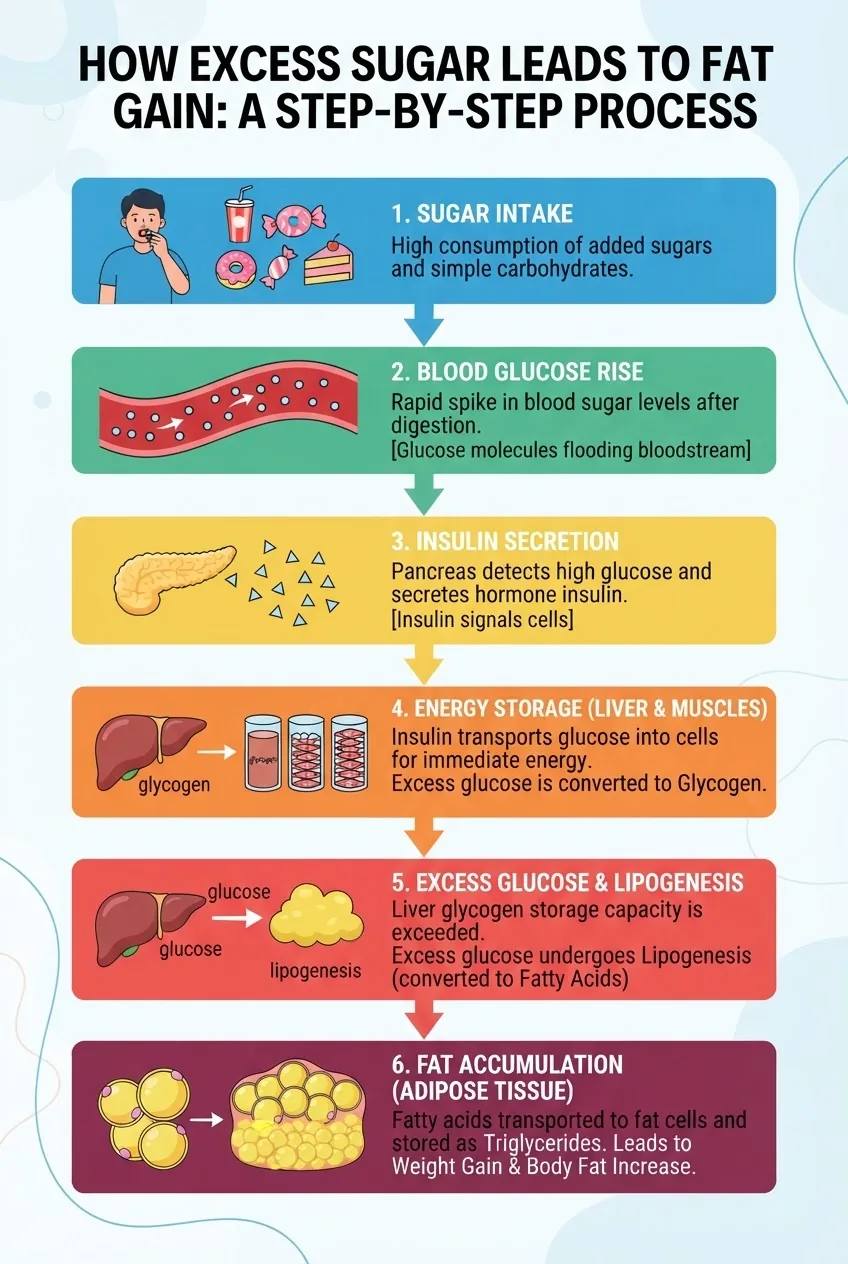
Answer: Dietary sugar rapidly raises blood glucose (especially glucose-containing carbs), prompting insulin secretion; insulin directs cells to take up glucose and promotes fat storage (lipogenesis) when energy is surplus, while fructose preferentially drives hepatic lipid synthesis when consumed in excess.
Term: Insulin resistance — reduced cellular responsiveness to insulin, raising blood glucose and altering fat storage patterns.
Mechanisms, step-by-step:
- Absorption and blood glucose rise: Ingested sugars enter the bloodstream—glucose raises blood glucose directly, while sucrose and starches are broken into glucose/fructose during digestion. The glycemic index/load influence how fast and how high.
- Insulin response: Beta cells in the pancreas secrete insulin in proportion to blood glucose; insulin facilitates cellular glucose uptake and suppresses lipolysis (fat breakdown), shifting metabolism toward storage.
- Glycogen vs fat allocation: Short-term incoming glucose first replenishes glycogen; persistent energy excess causes conversion of carbohydrates to fat (de novo lipogenesis) in liver and adipose tissue.
- Fructose handling: Fructose is metabolized primarily in the liver; high fructose flux increases triglyceride production and may raise liver fat without proportionally stimulating insulin or satiety.
- Satiety signals and appetite: Foods with added sugar often lack protein and fiber, produce weaker satiety signals, and can lead to higher subsequent energy intake.
Data context: simple sugars deliver about 4 kcal per gram, so their contribution to daily calories can be substantial—see the authoritative breakdown on calories contained in sugar in the guide calories in sugar.
Physiological nuance:
- Insulin also encourages lipogenesis — the biochemical pathway converting excess glucose into fatty acids for storage.
- Repeated high sugar intake can foster metabolic inflexibility and contribute to insulin resistance, part of the pathway toward metabolic syndrome.
- Energy expenditure and metabolic rate adjust slowly; a single sugary meal has limited long-term effect unless it sustains a caloric surplus over days and weeks.
Relevant resources explaining broader effects of sugar on metabolism and health are compiled in the guide effects of sugar on the body.
Transition: Understanding these metabolic steps clarifies why researchers ask whether sugar itself causes fat gain or whether it’s the calories and patterns that matter — explored next with the evidence.
Does Sugar Make You Fat? Scientific Evidence and Mechanisms
Question: Is there direct scientific proof that sugar uniquely causes fat gain independent of calories?
Answer: Evidence shows sugar contributes to fat gain primarily by increasing calorie intake and promoting hepatic lipogenesis (especially with high fructose loads); controlled-calorie studies indicate sugar per se is not uniquely fattening, but real-world patterns of high added-sugar consumption reliably raise obesity risk.
Term: Caloric surplus and deficit — a surplus means consuming more calories than expended, causing weight gain; a deficit causes weight loss.
Key study types and what they show:
- Randomized controlled trials (isocaloric swaps): When researchers replace other carbs with sugar but keep total calories constant, weight change is minimal, implying sugar is not inherently more fattening than other carbohydrates under equal calories. A 2019 systematic review in peer-reviewed literature summarized multiple such trials showing small effects when energy is matched (According to a 2019 systematic review in a peer-reviewed journal).
- Ad libitum (free-eating) trials and observational cohorts: Studies where people eat freely show sugary foods and sugar-sweetened beverages are associated with higher total energy intake and body weight over time; prospective cohort analyses repeatedly link higher added-sugar intake to weight gain and obesity risk (According to a 2021 cohort meta-analysis in a peer-reviewed journal).
- Metabolic tracer and hepatic studies: Controlled metabolic studies demonstrate that excess fructose increases de novo lipogenesis and liver triglycerides, contributing to visceral fat and fatty liver independent of moderate energy surplus (According to a 2020 metabolic study in a peer-reviewed journal).
Practical interpretation of mechanisms:
- Calorie mediation: Sugar raises the chance of a caloric surplus because it’s energy-dense, palatable, and poorly satiating when consumed alone (liquids amplify this effect).
- Fructose-specific pathway: High-fructose loads shift hepatic metabolism toward triglyceride synthesis and VLDL export, increasing circulating lipids and liver fat.
- Insulin and adipose tissue: Elevated insulin after carbohydrate intake reduces fat oxidation and favors storage; chronic exposure can promote adipocyte hypertrophy and obesity risk.
- Behavioral drivers: Sweet palatability can alter food choice patterns and reward circuits, promoting repeated overconsumption of calorie-dense foods.
Representative evidence and authoritative guidance:
- Longitudinal cohorts link sugar-sweetened beverage intake to weight gain and obesity across populations (According to a 2021 cohort meta-analysis in a peer-reviewed journal).
- Clinical trials show lowering added sugars reduces body weight when it lowers total energy intake (According to randomized controlled trials summarized in a 2020 review in a peer-reviewed journal).
- Guidelines from the CDC and American Heart Association recommend limiting added sugars to reduce obesity and cardiovascular risk (see external guidance below).
Evidence limitations and variability:
- Many trials are short-term (weeks to months) and cannot capture lifetime patterns.
- Individual metabolic responses vary: genetics, baseline insulin sensitivity, gut microbiome, and activity level influence outcomes.
- Most population studies rely on self-reported diet, which introduces measurement error but consistent associations across designs strengthen inference.
For readers focused on fat loss, the most actionable concept is energy balance: adopting a sustainable calorie deficit for fat loss combined with lowering added sugars generally produces better adherence and improved body composition than focusing purely on sugar elimination.
Transition: Sugar’s role must be compared to other weight drivers—next we place sugar in context alongside fats, inactivity, and genetics.
Comparing Sugar’s Role to Other Factors in Weight Gain
Question: How does sugar compare to other causes of weight gain like fats, inactivity, and overall calories?
Answer: Sugar often raises weight indirectly by increasing total calories and lowering satiety; physical inactivity, overall calorie intake, and genetics are equally or more important determinants of obesity risk depending on individual context.
| Factor | Mechanism | Relative effect on weight |
|---|---|---|
| Added sugar intake | Increases calorie density, lowers satiety, fructose promotes liver fat | Medium — often indirect via excess calories |
| Saturated fats | High energy density; can cluster in processed foods that are calorically dense | Medium — depends on food patterns |
| Overall calorie intake | Energy balance determines fat gain/loss regardless of macronutrient source | High — primary determinant |
| Physical inactivity | Reduces energy expenditure; favors storage | High — significant contributor |
| Genetic and hormonal factors | Affect appetite, fat distribution, metabolic rate | Variable — can be major in individuals |
Explanation: The table shows sugar is an important modifiable factor, but not always the dominant one. For example, two diets with equal calories—one high in sugar, one lower in sugar but higher in fat—can produce similar weight outcomes if the energy balance is the same. However, sugar-rich diets often promote overeating and metabolic changes that increase obesity risk.
Public health perspective: reducing sugar-sweetened beverage consumption is a cost-effective population strategy because beverages add calories without satiety; this is why many public health campaigns prioritize added sugar reduction.
Transition: With that comparative context, here are practical steps Texans and others can take to reduce sugar-related weight risk while sustaining a healthy lifestyle.
Will Cutting Sugar Help You Lose Weight? Practical Diet Strategies
Question: Will removing or reducing sugar help with weight loss, and what practical steps work?
Answer: Cutting added sugar helps most people lose weight if it lowers total calories and improves diet quality; combine sugar reduction with a sustainable calorie deficit, protein and fiber increases, and behavior changes to manage cravings and adherence.

Actionable numbered plan:
- Create a modest calorie deficit — reduce daily intake by 250–500 kcal to lose ~0.5–1.0 lb/week; for guidance see daily sugar intake recommendations and calorie strategies.
- Target added sugars first — eliminate sugar-sweetened beverages and obvious sources (candies, desserts) to quickly reduce empty calories.
- Swap smartly — use lower-calorie, nutrient-dense options and safe substitutes when appropriate; compare artificial sweetener safety and options in sugar substitutes like aspartame and review the best alternatives in best sugar substitutes for diabetics.
- Prioritize protein and fiber at meals — increases satiety and reduces post-meal cravings; pair fruit (natural sugar) with nuts, yogurt, or whole grains.
- Plan meals and snacks — meal prep reduces impulse purchases of high-sugar convenience items; combine with foods from the foods that help burn belly fat resource to target abdominal adiposity.
- Manage cravings behaviorally — delay, distract, hydrate, and substitute; techniques detailed in stopping sugar cravings.
- Monitor progress and adjust — track weight, waist, and dietary intake; if plateaued, reassess calories and activity.
Daily sugar limits and practical context: refer to the recommended values in the daily sugar intake recommendations to set individualized targets and portion control.
Substitution notes and safety:
- Non-nutritive sweeteners can help reduce calories when used thoughtfully; examine health implications in Aspartame vs Sugar Comparison Guide and Health Insights.
- Whole-food swaps (fruit, yogurt, cinnamon) deliver flavor plus nutrients and stabilize blood sugar better than refined sugars.
- For diabetics or those with blood sugar concerns, consult guidance and consider options from Best Sugar Substitute for Diabetics Guide and Options.
Behavioral toolkit for cravings: see practical step-by-step methods in the guide How to Stop Craving Sugar Guide with Practical Tips and combine them with portion-controlled meal prep and increased protein to improve adherence.
Transition: Beyond weight, excess sugar intake has other health consequences that strengthen the case for moderation.
Health Risks of Excess Sugar Beyond Weight Gain
Question: What health risks does too much sugar create besides increasing body fat?
Answer: Excess sugar increases risk for type 2 diabetes, cardiovascular disease, nonalcoholic fatty liver disease, chronic inflammation, and worsened blood sugar regulation; population studies and clinical data link high added-sugar diets to these conditions.
Term: Metabolic syndrome — a cluster of conditions (high waist circumference, elevated triglycerides, low HDL, high blood pressure, insulin resistance) that increases cardiovascular and diabetes risk.
Selected evidence and statistics:
- Type 2 diabetes risk: High intake of sugary drinks correlates with higher incidence of type 2 diabetes in large cohort studies (According to a 2021 cohort meta-analysis in a peer-reviewed journal).
- Cardiovascular risk: The American Heart Association links excess added sugar to greater risk of heart disease (According to an AHA guidance statement, 2020).
- Liver fat: Controlled metabolic studies show high fructose raises liver fat and triglycerides (According to a 2020 metabolic study in a peer-reviewed journal).
- Inflammation and markers: High added sugar diets associate with elevated inflammatory markers and adverse lipid profiles (According to a 2022 systematic review in a peer-reviewed journal).
For practical thresholds and clinical blood sugar ranges, refer to the clinical overview in blood sugar level guidelines. For readers focused on prevention and complementary approaches, consider reviewing natural remedies for diabetes as part of a broader prevention plan.
Authoritative public guidance: The CDC recommends limiting added sugars and provides resources on how added sugars affect public health (According to the CDC, 2024). See the CDC’s guidance for population-level recommendations: CDC on added sugars.
Transition: Next we dispel common misunderstandings about sugar, using straightforward myth-versus-fact clarity.
Myths and Facts: What You Need to Know About Sugar and Fat Gain
Question: Which widely held beliefs about sugar and fat gain are true, and which are false?
Answer: Some claims (e.g., “sugar is uniquely fattening regardless of calories”) overstate the case; others (sugar-sweetened beverages promote weight gain) are supported. Myth-busting clarifies evidence-based steps.
- Myth: Sugar alone makes you fat no matter what. Fact: Weight gain requires a caloric surplus; sugar often causes surplus via low satiety and caloric density.
- Myth: Fruit will make you fat because of natural sugar. Fact: Whole fruit contains fiber and water that slow absorption and promote satiety; typical fruit consumption rarely causes weight gain unless consumed in extreme excess.
- Myth: “Sugar-free” always equals weight loss. Fact: Sugar-free products can still be caloric and may encourage overconsumption; focus on whole foods and energy balance.
- Myth: Artificial sweeteners are universally harmful. Fact: Evidence is mixed; some non-nutritive sweeteners can reduce calorie intake short-term, but long-term metabolic effects require more study (According to a 2022 review in a peer-reviewed journal).
- Myth: Carbs are the sole driver of obesity. Fact: All macronutrients contribute calories; obesity is multifactorial—diet quality, activity, and environment matter.
Contextual nuance: A pragmatic approach treats sugar as a modifiable risk factor: reduce added sugars, prioritize whole foods, and use calorie-aware substitutions rather than demonizing single nutrients.
Transition: To finish, practical final takeaways summarize how to balance sugar for sustainable health and weight management.
Conclusion: Balanced Approach to Sugar for Healthy Weight Management
Question: What are the key takeaways about sugar and fat gain for a practical, balanced plan?
Answer: Limit added sugars to reduce empty calories and risk of fat gain, emphasize whole-food carbohydrate sources, maintain a modest calorie deficit for weight loss, and prioritize behavioral strategies that fit your lifestyle for lasting change.
Key final takeaways:
- Calories drive weight; sugar typically increases the risk of a caloric surplus.
- Fructose-heavy intakes can increase liver fat and metabolic risk even without large weight changes.
- Reduce sugar-sweetened beverages and processed sweets first for rapid improvements.
- Use sustainable swaps, monitor portions, and combine diet change with activity to improve outcomes.
If you want step-by-step meal plans, portion guidance, and Texas-relevant recipe swaps to lower added sugars while keeping familiar flavors, consult our guides and start with a simple rule: replace one sugary drink per day with water or unsweetened alternatives — small changes compound into lasting results.