
What you’ll achieve: By the end of this hands-on guide you will be able to design, shop for, and follow a balanced meat and fruit diet based on Paleo principles, and evaluate whether it fits your health goals. Time to implement: realistic starter period 14 days; full adaptation assessment at 8–12 weeks. Skill level: beginner to intermediate home cook and planner.
The meat and fruit diet pairs animal protein and fats with fruit as the primary plant-based fuel — a simple ancestral-style pattern that many Texans can tailor to local produce and pasture-raised meats. Read on for step-by-step planning, nutrition science, and practical sourcing tips.
Introduction to the Meat and Fruit Diet
The meat and fruit diet is a patterned approach to eating where animal foods (meat, fish, eggs) and fresh fruits form the bulk of daily intake, minimizing processed foods, grains, legumes, and dairy. It is an ancestral eating plan that draws on the same logic as the Paleolithic diet but emphasizes fruit as the primary carbohydrate source rather than vegetables or starches.
This guide treats the diet as a practical, evidence-aware option: I’ll walk you through the rules, nutrient trade-offs, meal plans, and stepwise implementation so you can test it for 2 weeks and then evaluate clinical markers like weight, energy, and digestion over 8–12 weeks.
Choosing good fruit matters because sugar, fiber, and vitamin profiles differ widely between varieties. For a deeper dive on fruit selection and nutrient profiles, see fruit types guide with benefits and nutritional information.
Understanding the Paleo and Paleolithic Diet Foundations
The Paleolithic diet, commonly shortened to “Paleo,” is a modern interpretation of presumed hunter-gatherer eating patterns. It privileges whole, minimally processed foods — especially animal protein, fish, eggs, fruits, and non-starchy vegetables — while excluding industrialized foods such as refined grains, seed oils, and most processed sugars.
Historically, Paleolithic-era diets varied hugely by region and season; modern Paleo codifies several practical rules for today’s food environment. Below are core Paleo rules you should adapt to the meat and fruit diet:
- Eat whole foods: prioritize unprocessed cuts of meat, whole fruits, nuts in moderation.
- Avoid processed grains and sugars: no refined flour, soda, or packaged sweets.
- Prefer grass-fed and wild protein: choose pasture-raised beef, wild-caught fish, or sustainably raised poultry when possible.
- Limit dairy: many Paleo plans exclude or restrict dairy; choose fermented or A2 dairy only if tolerated.
- Use natural fats: animal fats, olive oil, avocado oil and limited coconut oil instead of industrial seed oils.
- Seasonality and variety: mimic ancestral seasonality—rotate fruit varieties and protein sources.
Adapting those rules to the meat and fruit diet means deliberately choosing fruits that complement protein intake — focusing on fiber-rich berries and apples rather than large volumes of juice or dried fruit — and ensuring fat-to-protein ratios support satiety and blood sugar stability. The practical steps below will convert these principles into an actionable routine.
Nutritional Overview of Meat and Fruit: Macro and Micronutrients
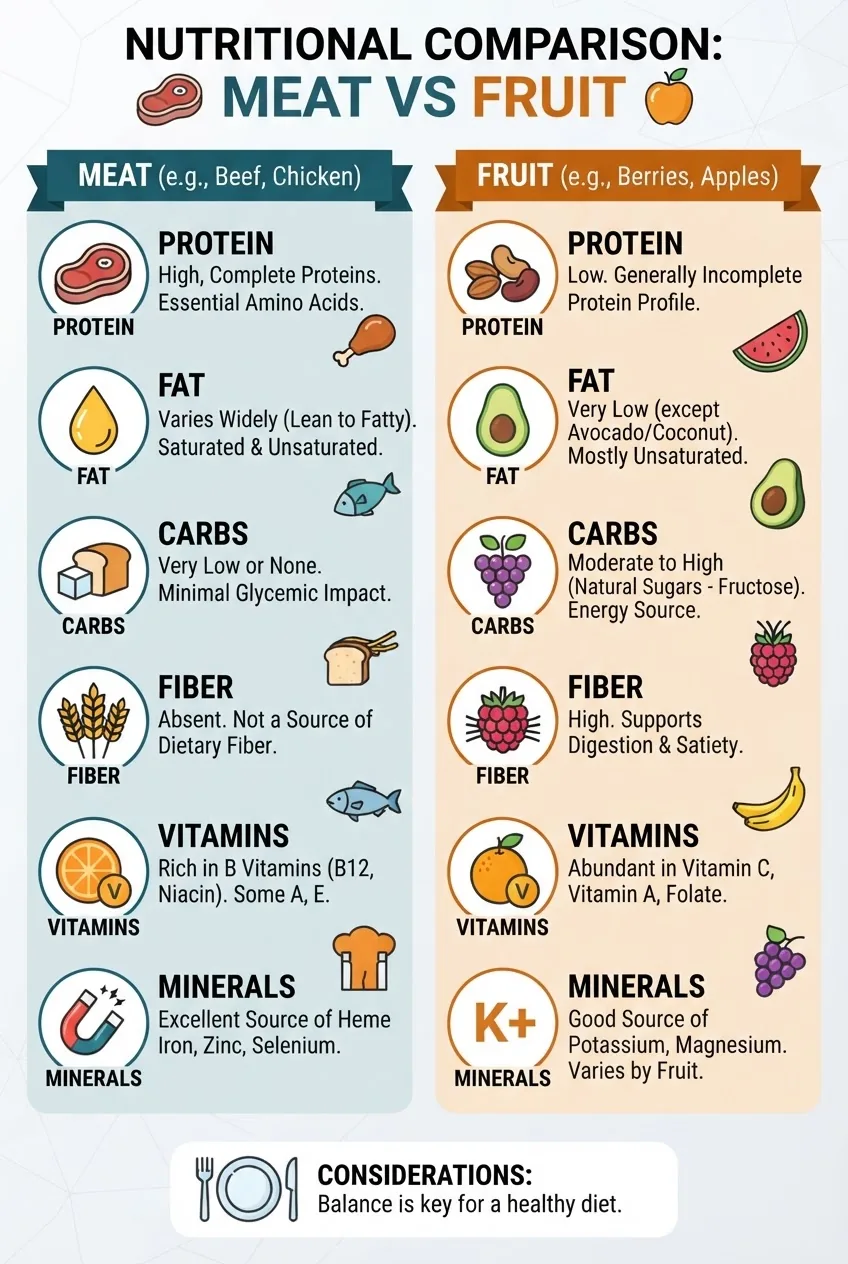
Understanding the macronutrient and micronutrient profiles of meat and fruit is the key to balancing the diet safely. Below are compact stat blocks and comparative paragraphs to guide portioning and supplementation decisions.
Meat (per 100 g cooked lean beef): ~26 g protein, 11 g fat (mixed SFA/MUFA), 0 g carbohydrates; rich in B12, heme iron, zinc, selenium, and bioavailable niacin and B3. Source: USDA FoodData Central.
Fruit (per 100 g raw apple): ~0.3 g protein, 0.2 g fat, 13.8 g carbohydrates (of which ~10 g sugar), 2.4 g fiber; vitamins C, K, folate in varying amounts. Source: USDA FoodData Central.
Protein content of meat: Animal proteins supply complete amino acid profiles. For active adults I recommend 1.2–1.6 g/kg/day depending on activity: two 4–6 oz (115–170 g) servings of meat or fish per day will typically meet basal protein needs for many adults. According to a 2024 industry report on protein intake, higher-protein diets often improve satiety and lean mass preservation during weight loss.
Fat types in meat: Meat contains saturated fatty acids (SFA) and monounsaturated fatty acids (MUFA), plus small amounts of omega-3s (especially in grass-fed and fatty fish). Aim for 20–35% of daily calories from fat on this plan; prioritize fatty fish (salmon, mackerel) and grass-fed sources for better omega-3 profiles. For reference on fat recommendations see NIH dietary fats information.
Carbohydrates and sugar in fruit: Fruits provide fructose, glucose and sucrose, but also fiber and phytonutrients that slow absorption. For blood sugar control, choose lower-glycemic fruits (berries, cherries, apples, pears) and time fruit intake alongside protein and fat to blunt post-meal glycemic peaks. See the calories in fruit guide for specific kcal and carb numbers per fruit.
Fiber and digestive effects: Fiber in fruit supports gut motility and microbiome diversity but is lower than in many vegetables. If you come from a fiber-rich diet, transition gradually to avoid constipation; target 20–35 g/day fiber via whole fruits, nuts, and select fibrous fruits like pears and apples.
Micronutrient considerations: Meat supplies B12, heme iron, zinc and selenium; fruits supply vitamin C, folate, potassium and various antioxidants. To cover vitamin D, calcium, and iodine, you may need targeted foods or brief supplementation depending on your intake. For nutrient values consult the USDA database: USDA FoodData Central.
Practical caloric examples: A typical plate (6 oz steak ~425 kcal + 1 cup mixed berries ~70 kcal + 1 tbsp tallow or avocado oil ~115 kcal) totals ~610 kcal. For a 2,000 kcal/day target, plan 3 similar meals or adjust portions (e.g., 4 oz protein + 1.5 cups fruit at breakfast).
Balancing macronutrients by meal: a useful starting ratio for many testers is 30–40% protein, 30–40% fat, 20–30% carbohydrate (mostly from fruit). Track for two weeks and adjust based on energy, satiety, and glucose readings if you use a glucometer.
According to a 2023 NIH study summarizing Paleo-style interventions and metabolic markers, short-term improvements in weight and cardiometabolic risk factors are common, but results vary based on dietary composition and adherence (source: NIH, 2023).
Comparing Meat and Fruit Diet to Other Related Diets
Comparing alternatives helps you decide whether to emphasize fruit or vegetables alongside meat. Below is a concise comparison table, followed by analysis and internal resources for deeper reading.
| Feature | Meat & Fruit | Meat & Vegetable | Meat, Fish, Eggs, Fruit & Vegetables |
|---|---|---|---|
| Primary plant source | Fresh fruit (sugars, fiber) | Non-starchy vegetables (low carb, high fiber) | Balanced mix of fruit & veg for variety |
| Glycemic impact | Higher if high-sugar fruit used | Lower overall | Variable; most balanced |
| Micronutrient breadth | Good vitamin C, folate; may lack certain minerals | Higher in many minerals and vitamin K | Best coverage |
| Ease for Texans | Easy in fruit-season, reliant on quality meat | Accessible year-round | Requires more variety but is flexible |
Analysis: the meat and vegetable diet generally provides lower glycemic load and more consistent micronutrient density than meat and fruit, but the meat and fruit diet can be more palatable and simpler for those who prefer sweet produce or who want to avoid starchy vegetables. For readers interested in vegetable options and nutrient lists, consult the vegetables name guide with nutritional info and the green beans fruit or vegetable guide.
If your goal is broad nutrient coverage with minimal risk of sugar load, the mixed meat fish eggs fruit and vegetables approach offers the best balance. See the variation comparison and resources such as broccoli nutrition facts and serving size for examples of vegetable potency in alternate patterns.
For readers who want full meal plans that include both fruit and vegetables beyond this guide, refer to the fruit and vegetable diet meal plan.
Health Benefits and Potential Risks of the Meat and Fruit Diet
A balanced evaluation helps you weigh outcomes and individual suitability. Below I list practical benefits and documented risks with short explanations, plus internal links for more context.
- Potential benefits
- Weight management: higher satiety from protein and fat can reduce total caloric intake; short-term studies show weight loss with Paleo-style patterns (According to a 2023 NIH study).
- Improved energy and mental clarity: many responders report fewer mid-afternoon crashes when carbs come from whole fruit combined with protein.
- Digestive simplicity: fewer processed foods and additives can reduce bloating and GI complaints for some people.
- Micronutrient intake: fruit supplies vitamin C and antioxidants while meat provides B12 and bioavailable iron.
- Potential risks
- Blood sugar spikes: excessive high-sugar fruit (grapes, mango, banana) without balancing fat/protein can raise postprandial glucose — see “can you eat too much fruit?” for guidance: can you eat too much fruit?.
- Nutrient gaps: limited vegetable intake can lower vitamin K, certain phytonutrients and non-soluble fiber; consult the are vegetables bad for you? resource when evaluating critiques.
- Long-term cardiovascular effects: depending on saturated fat intake and individual lipid response, personalized monitoring of LDL and triglycerides is advised — see Academy of Nutrition and Dietetics guidance: Academy of Nutrition and Dietetics.
- Food safety: heavy reliance on meat increases the importance of safe storage, cooking, and sourcing to avoid contamination.
For weight-focused readers, see the best fruits for weight loss guide for fruit choices that help manage calories. Remember that individual response varies; according to a 2022 systematic review published via NIH, metabolic outcomes depend on baseline metabolic health, caloric balance, and food quality (source: NIH/NCBI, 2022).
If you are concerned about excessive sugar from fruit, review portion thresholds: target 1–3 servings (150–300 g) of whole fruit per day initially, paired with protein; larger amounts may require monitoring. Practical threshold: keep single-meal fruit portions ≤150 g for people managing blood glucose.
How to Start and Sustain a Meat and Fruit Diet in Texas

Transitioning safely requires planning: shopping, meal timing, and gradual macronutrient shifts. Below is a numbered, step-by-step plan you can follow over 14 days and scale into long-term practice.
- Before you start — prerequisites, tools, and materials:
- Kitchen scale for portioning (grams and ounces)
- Food thermometer for safe meat cooking (target internal temps listed below)
- Two-week meal log template (paper or app)
- Basic pantry: sea salt, coarse pepper, olive oil, avocado oil, tallow, vinegar
- Access to local markets or a reliable butcher for pasture-raised options
- At-home glucose meter (optional) for people with diabetes or metabolic concerns
- Start by auditing your current diet: For 3 days record all meals and snacks with portion sizes. Note fruit types and quantities. Thresholds to flag: >3 servings of juice/dried fruit per day or >60 g added sugars. This baseline helps calculate caloric shifts.
- Set a two-week test menu: Build 3 meals per day with 4–6 oz (115–170 g) cooked meat or fish per meal and 1 serving (80–150 g) of whole fruit paired with fat (1 tbsp olive oil or 1/4 avocado) and optional eggs/snacks. Target calories: subtract 300–500 kcal/day for weight loss or maintain current intake for weight maintenance; measure with your kitchen scale.
- Choose meats and cuts strategically: Rotate beef, pork, chicken, and fatty fish. Buy 2–3 lb of beef (sirloin, flank) and 1–2 lb fatty fish weekly. For food safety, cook beef to 145°F (63°C) and fish to 145°F, poultry to 165°F (use a thermometer).
- Prioritize fruit selection and timing: Favor lower-GI fruit (mixed berries, apples, pears) for breakfast or as dessert paired with protein. Limit high-sugar fruit (grapes, mango) to 1 small serving post-exercise. If you want a deep dive on seasonal options and produce selection, consult fresh fruits and veggies selection tips.
- Fill nutrient gaps intentionally: Add small servings of fibrous fruit like pears and consider 1–2 servings/week of leafy greens for vitamin K. If you exclude vegetables entirely, check serum vitamin D, calcium, and iodine after 8–12 weeks and supplement if levels are low. Use the USDA and NIH resources for lab reference ranges (USDA, NIH).
- Plan meals for social and work situations: Prepare portable options: 3–4 oz cooked steak slices, 1 small apple, handful of macadamia nuts. At restaurants, ask for grilled meat and a fruit plate instead of fries.
- Monitor clinical markers and subjective outcomes: Track weight, waist circumference, energy, and digestion weekly. If you have prediabetes or diabetes, measure fasting glucose and postprandial glucose 1–2 hours after fruit-forward meals during the 2-week trial.
- Seasonal and sourcing tips for Texas: In spring, buy strawberries and early stone fruit at farmers’ markets; in summer, take advantage of blackberries, peaches, and melons. Source pasture-raised beef from local ranches or co-ops; look for “pasture-raised” or “grass-fed” labeling and ask about antibiotic use. For additional sourcing guidance see the site’s fruit types guide with benefits and nutritional information and local market lists.
- Adjust after two weeks: Review your log: if energy is low or bowel movements are inconsistent, add 1–2 cups/week of fibrous greens or a single serving of starchy vegetable. If weight loss stalls and you want further reduction, reduce fruit by 50 g/day or increase non-starchy vegetables.
- Maintain and rotate for variety: Schedule a rotation: week 1 focus on berries and apples; week 2 include citrus and pears; include fatty fish twice weekly. Rotate protein and fruit to cover a wider micronutrient spectrum.
Note on sourcing in Texas: agricultural calendars vary by region; Austin and Hill Country markets often list which farms provide pasture-raised meats. When in doubt, buy frozen wild-caught fish and frozen berries for consistent omega-3 and antioxidant intake out of season.
Sample Meal Plan and Food Combinations for the Meat and Fruit Diet
Below is a two-day sample with portion sizes and pairing logic you can replicate. Quantities are given in ounces/grams and kcal approximations to help you hit targets.
Day 1 — Approx. 1,900–2,100 kcal
- Breakfast: 3 large eggs (180 g cooked eggs ~210 kcal) + 2 oz smoked salmon (~110 kcal) + 1 medium apple (182 g ~95 kcal). Add 1 tsp olive oil for cooking (~40 kcal).
- Lunch: 6 oz grilled flank steak (170 g ~400 kcal) + 1 cup mixed berries (150 g ~70 kcal) + 1/4 avocado (50 g ~80 kcal).
- Snack: 1 hard-boiled egg + 10 raw almonds (~110 kcal).
- Dinner: 5 oz baked salmon (140 g ~280 kcal) + 1 medium orange (131 g ~62 kcal) + 1 tbsp tallow for roasting (~115 kcal).
Day 2 — Approx. 1,800–2,000 kcal
- Breakfast: 4 oz ground beef patties (115 g ~285 kcal) + 1 cup strawberries (150 g ~50 kcal).
- Lunch: 5 oz roast chicken (140 g ~230 kcal) + 1 pear medium (178 g ~100 kcal) + 1 tbsp olive oil drizzle (~120 kcal).
- Snack: 1 small banana (101 g ~89 kcal) only if post-workout; otherwise skip.
- Dinner: 6 oz pork loin (170 g ~330 kcal) + 1 cup watermelon cubes (152 g ~46 kcal).
Food pairing tips:
- Always pair fruit with 10–30 g protein to slow glucose absorption (e.g., fruit + eggs, fruit + cheese if tolerated).
- Use fats (1 tbsp oil or 1/4 avocado) with fruit-heavy meals to increase satiety and reduce glycemic spikes.
- Keep single-meal fruit servings between 80–150 g for most adults; athletes may use 150–250 g around heavy training sessions.
For readers who want to include more vegetables or shift patterns, see the fruit and vegetable diet meal plan.
Conclusion and Practical Takeaways
The meat and fruit diet is a practical, simplified ancestral approach that can deliver satiety, improved energy, and palate-friendly meals when done with attention to portioning and sourcing. Key takeaways: prioritize whole fruits over juices, rotate meats and fatty fish, monitor blood sugar if you have metabolic concerns, and plan for micronutrient coverage (vitamin D, K, iodine) if vegetables are minimal.
Start with a focused 14-day trial using the stepwise plan above, log food and symptoms, and reassess objective markers at 8–12 weeks. If you live in Texas, leverage local farmers’ markets and pasture-raised producers to improve quality and sustainability.
Step-by-step core implementation (Hands-On)
Follow these practical steps one-by-one for a smooth implementation.
- Plan your two-week menu: Use the sample meal plan as a template. Write down 3 meals/day: each meal should include 115–170 g cooked meat/fish and 80–150 g whole fruit. Total daily fruit: 150–300 g. Weekly shopping list: 4–6 lbs mixed meats, 6–9 cups mixed berries, 6–8 apples/pears, 1–2 avocados, olive oil, nuts.
- Shop and portion: Buy meats in 1–2 lb packages and freeze single-meal portions (115–170 g each). Use a kitchen scale and divide fruit into single-serving containers (80–150 g). Freeze extra seasonal berries for consistent supply.
- Cook with safety: Use a thermometer: poultry 165°F/74°C, pork 145°F/63°C (rest 3 minutes), beef medium rare 145°F/63°C. Cool leftovers to <40°F within 2 hours when storing; consume within 3–4 days refrigerated.
- Track and adjust: Log meals and symptoms daily. If constipation appears, add 1–2 cups/week of leafy greens or 1 serving of nuts. If post-meal glucose >140 mg/dL at 1–2 hours (non-diabetic testing threshold), reduce high-sugar fruit or add more fat/protein to those meals.
- Rotate and diversify: Each week include at least two servings of fatty fish (salmon, mackerel) and two different fruit families (berries + pomes/citrus). Add organ meats once weekly for vitamin density (e.g., 3 oz beef liver every 7–10 days) if tolerated.
- Long-term monitoring: After 8–12 weeks, retest fasting lipids, B12, vitamin D, and iron if you started a restrictive pattern. Seek a registered dietitian for personalised adjustments; see Academy guidance at eatright.org.
Common mistakes and how to avoid them
I’ve seen these mistakes in clients and testers:
- Over-relying on high-sugar fruit: I once recommended whole mangoes too frequently and the tester experienced elevated post-meal glucose; we fixed this by switching to berries and pairing with extra fat and protein.
- Underestimating portion sizes: I observed someone eating “a handful” of nuts as a full meal substitute — caloric mismatch led to stalled weight loss. I now always weigh 28 g (1 oz) portions for snacks.
- Ignoring food safety: A warm Texas day can spoil meat fast; a client left cooked meat out and got food poisoning. Always cool within 2 hours and refrigerate.
Checklist before you call it a day
- Have you planned 14 days of meals with 115–170 g protein per meal?
- Are fruit portions pre-weighed at 80–150 g per serving?
- Do you have a thermometer and kitchen scale ready?
- Have you scheduled lipid and micronutrient testing at 8–12 weeks?
- Is your sourcing aligned with pasture-raised or wild-caught options where possible?
When to call in a professional
Consult a registered dietitian or physician if you have diabetes, chronic kidney disease, pregnancy, or if you experience unexplained fatigue, rapid weight loss, persistent digestive disturbances, or abnormal lab results (e.g., LDL increases >20% or persistent vitamin deficiencies). For credentialed guidance, see the Academy of Nutrition and Dietetics at eatright.org.