

Can you drink too much water? Yes — drinking far more water than your body can clear can cause overhydration and hyponatremia, a dangerous electrolyte imbalance; safe intake depends on activity, kidney function, and climate, and most healthy adults rarely hit water toxicity with ordinary drinking.
Understanding “Can You Drink Too Much Water?”
Answer: Yes — it is possible to overhydrate, but whether drinking too much water is harmful depends on the amount consumed relative to your kidneys filtration capacity, your electrolyte balance, and risk factors such as intense exercise or kidney disease.
Hyponatremia: hyponatremia is a low blood sodium concentration caused by excess free water diluting sodium, which disrupts cellular function.
Overhydration: overhydration describes excess total body water that overwhelms the body’s ability to maintain water homeostasis and electrolyte balance.
This section explains how excess fluid affects the body, clarifies common hydration myths and facts, and uses Texas climate and lifestyle examples to show practical nuance. Many people ask “is it possible to drink too much water?” — the short answer is yes, although the typical daily water advice (like 2 L/day) is safe for most adults unless special conditions apply.
Overhydration and water intoxication are often used interchangeably; water intoxication: refers to the acute, severe end of overhydration where rapid fluid intake causes dangerous cerebral swelling and organ dysfunction.
Example: a recreational runner in Austin who drinks continuously after a long hot run without replacing sodium can dilute blood sodium and develop hyponatremia over hours. That real-world athlete scenario will be outlined later as a timeline example.
For contrast with the risks of too little fluid, see the side effects of insufficient hydration.
Transition: Now that we know overhydration is possible, the next section sets clear thresholds—how much water is too much for different people.
How Much Water Is Too Much? Safe Intake Thresholds and Limits
Answer: Safe daily water intake varies; for most adults 2–3 liters is adequate, while acute toxicity tends to occur with very rapid consumption (several liters within hours) exceeding kidneys filtration capacity; special groups and athletes have different safe ranges.
Term: Kidneys filtration capacity: the kidneys filtration capacity is the maximum rate at which kidneys can excrete free water and maintain electrolyte balance, typically around 0.8–1.0 liters per hour in healthy adults under normal conditions.
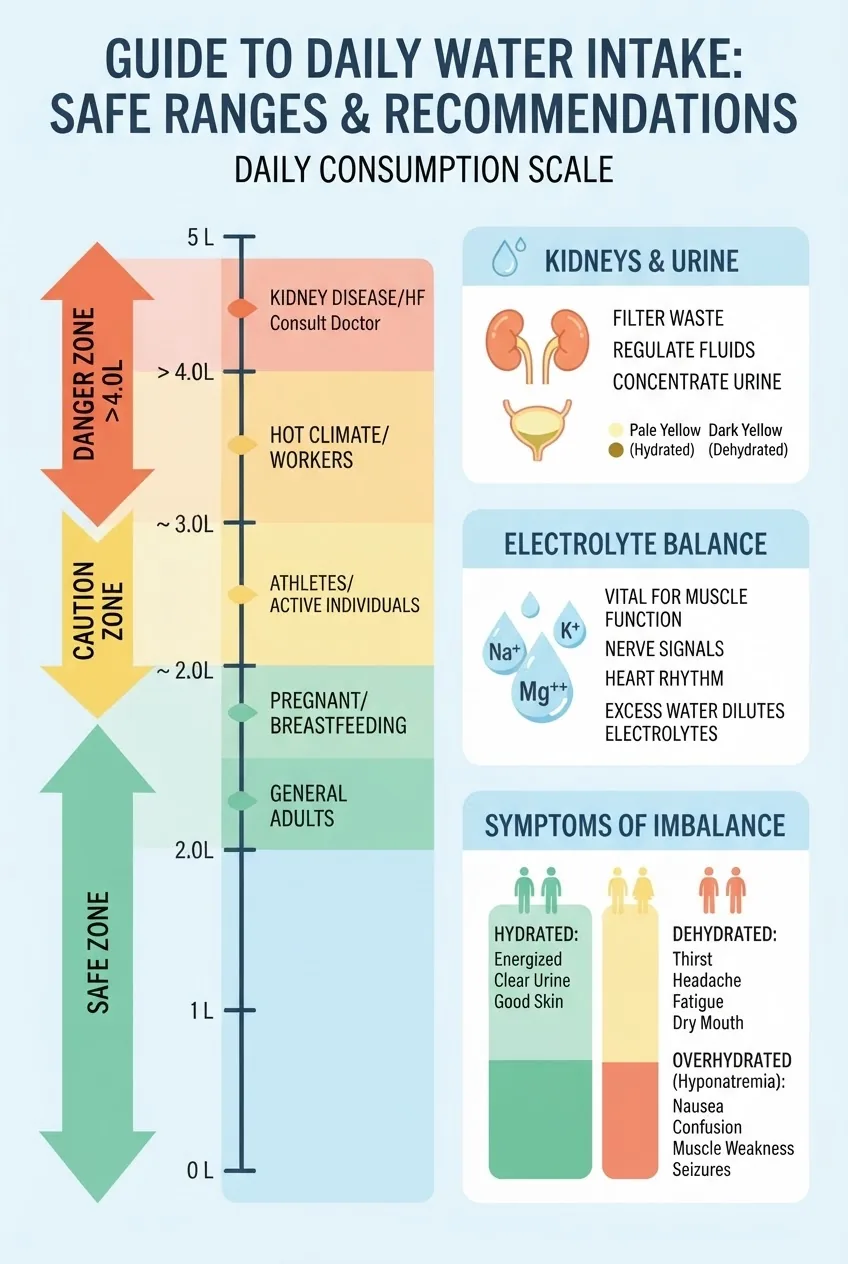
The table below gives recommended ranges and limits rooted in physiology and public-health guidance; numbers are ranges, not strict targets. For tailored intake calculators, see hydration requirements guides and the linked resources.
| Group | Typical safe daily intake | Key limit/notes |
|---|---|---|
| Average healthy adult | 2–3 liters (≈8–12 cups) | Rarely toxic at this range; monitor thirst and urine. |
| Endurance athletes (high sweat loss) | Intake varies: replace sweat losses; ~0.4–0.8 L/hr typical | Avoid >1 L/hr continuous drinking unless electrolytes replaced; see ACSM guidance. |
| People with kidney disease | Individualized—often lower than normal | Consult clinician; kidneys filtration capacity may be reduced. |
| Acute water toxicity threshold | Several liters consumed rapidly (e.g., >3–4 L in <1–3 hours) | Can overwhelm kidneys and cause hyponatremia—medical emergency. |
Key physiology: the kidneys can excrete about 0.8–1.0 L of free water per hour in a healthy adult; exceeding that repeatedly raises risk of fluid overload and electrolyte imbalance. Fluid overload: fluid overload conditions describe excess intravascular and interstitial water that leads to edema and organ stress.
According to a 2023 NIH report, hyponatremia is clinically defined when serum sodium falls below 135 mmol/L, with moderate to severe effects often appearing below 125 mmol/L (source: government health guidance).
Quick guidelines for safety:
- Do not force large volumes of plain water rapidly—pace drinking to thirst and activity.
- Aim for urine that is pale straw colored; use hydration color indicators to monitor status.
- Athletes replacing large sweat losses should include electrolyte-containing fluids per ACSM advice: ACSM.
choosing the best water can matter for taste and contaminants, but it doesn’t change safe physiological intake limits significantly.
Transition: Knowing safe ranges helps anticipate symptoms; next we explain exactly what happens physiologically when you exceed them.
What Happens When You Drink Too Much Water? Symptoms and Physiological Effects
Answer: Drinking too much water can cause hyponatremia, water intoxication, and fluid overload; symptoms progress from mild (nausea, headache) to severe (seizures, coma) as electrolyte imbalance and cellular swelling worsen.
Term: Electrolyte imbalance: electrolyte imbalance is a disruption in minerals like sodium and potassium that are critical for nerve, muscle, and cellular fluid regulation.

- Mild symptoms — early warning (nausea, headache, bloating)
Explanation: early overhydration dilutes plasma sodium slightly, causing brain and gastrointestinal discomfort; many people report nausea, headache, a sense of fullness or bloating within hours of rapid excess intake.
- Moderate symptoms — confusion, muscle weakness, cramps
Explanation: as sodium concentration drops, neurons lose osmotic balance and cellular swelling interferes with nerve conduction; muscle cramps and confusion reflect electrolyte imbalance and impaired neuromuscular function.
- Severe hyponatremia — seizures, respiratory arrest, coma
Explanation: when serum sodium falls dramatically (often <125 mmol/L), cerebral edema can raise intracranial pressure and lead to seizures or coma; water intoxication can be fatal without rapid medical correction. According to a 2022 clinical review, severe hyponatremia requires emergency care (peer-reviewed clinical source).
- Fluid overload signs — peripheral edema, shortness of breath
Explanation: excess intravascular volume can lead to pulmonary edema and heart strain, especially in those with heart or kidney disease; watch for swollen ankles, difficulty breathing, or rapid weight gain.
- Kidneys strain and reduced clearance
Explanation: kidneys filtration capacity limits how fast water is excreted; if intake exceeds excretion capacity, plasma becomes diluted. Kidneys filtration capacity: healthy kidneys usually excrete 0.8–1.0 L/hr; chronic overdrinking may stress renal handling of electrolytes.
- Altered thirst mechanism regulation
Explanation: the thirst mechanism regulation can be suppressed if plasma osmolality drops, which may paradoxically reduce thirst while water distribution shifts into cells—this confuses intuitive drinking cues.
- Cardiovascular effects — blood pressure changes
Explanation: acute volume expansion can transiently raise blood pressure and cardiac workload; in heart failure, even small increases in fluid may precipitate decompensation. For comparative cardiovascular context, see blood pressure and hydration.
- Timeline example — athlete overhydration case
Case: A 30-year-old male marathoner in humid Houston drinks 2 L of water over two hours after finishing without sodium replacement. Within 3–6 hours he develops nausea, dizziness, then confusion; by hour 8 he is admitted with serum sodium 122 mmol/L and mild cerebral edema. This illustrates how rapid rehydration without electrolytes plus high sweat losses can produce acute hyponatremia.
- Metabolic and cellular consequences
Explanation: intracellular swelling due to hypo-osmolar plasma impedes mitochondrial and membrane function, contributing to systemic symptoms beyond the nervous system.
Clinical definitions and thresholds: according to a 2023 NIH report, hyponatremia severity is categorized as mild (130–134 mmol/L), moderate (125–129 mmol/L), and severe (<125 mmol/L); management depends on acuity and symptoms (government health guidance).
When to seek emergency care: any severe neurological sign (seizure, severe confusion, loss of consciousness), severe shortness of breath, or rapid swelling requires immediate medical attention.
Transition: a common concern is whether excess water causes diarrhea — the next section debunks that and explores digestive effects.
Can Drinking Too Much Water Cause Diarrhea? Debunking Myths and Explaining Facts
Answer: Drinking too much plain water alone does not typically cause true diarrhoea; however, rapid ingestion of large volumes, electrolyte-poor fluids, or consuming water with laxative substances can influence bowel habits and cause loose stools in some people.
Term: Diarrhea: diarrhea is defined as three or more loose or liquid stools per day or an increase in stool frequency and liquidity from baseline.
Myth vs fact:
| Myth | Fact |
|---|---|
| Drinking a lot of water will directly give you diarrhea. | Not usually; plain water is absorbed in the gut—diarrhea usually stems from infection, osmotic loads, or irritants. |
| Overhydration always affects digestion negatively. | Excess fluid can change stool consistency only if it disrupts electrolyte balance or is consumed with osmotic agents (e.g., high-sugar drinks, some supplements). |
Mechanisms where water intake interacts with bowel function:
- Osmotic effects: Consuming large volumes of hypotonic fluid during or after meals can slightly affect intestinal absorption in sensitive individuals, but this seldom produces frank diarrhoea.
- Fluid transit: Extremely rapid ingestion may transiently speed gastric emptying, but the small intestine efficiently absorbs water unless overwhelmed by osmotic substances.
- Associated ingredients: caffeinated or sugar-heavy beverages, magnesium supplements, or certain herbal laxatives in water can cause diarrhea — it’s not the water itself but what it contains.
Practical guidance: if you experience new-onset diarrhea after increasing fluid, evaluate what else changed: beverage type (see hydrating beverages), supplements, or recent infections.
For prevention and management of diarrhoea linked to hydration, consult diarrhoea-specific guidance such as diarrhea and hydration.
Transition: now we identify who is most at risk when drinking too much water so you can spot vulnerable people quickly.
Who Is at Risk of Overhydration? Special Populations and Warning Signs
Answer: Risk factors include endurance athletes, people with impaired kidney function, older adults, infants, those on certain medications, and people with psychiatric conditions that cause polydipsia; each group’s monitoring needs differ.
Term: Fluid overload conditions: fluid overload conditions refer to pathologies where the body cannot properly handle or excrete excess fluid, leading to edema, congestion, and organ stress.
Athletes and endurance exercisers
Why at risk: prolonged sweating causes sodium loss; if athletes replace losses with large quantities of plain water without electrolytes, free water clearance can fall behind losses and intake, producing hyponatremia.
Practical note: sports guidelines recommend balancing fluid replacement with electrolyte drinks during long events; see the American College of Sports Medicine guidance: ACSM.
People with kidney disease or reduced renal function
Why at risk: reduced kidneys filtration capacity lowers the hourly excretion limit for free water, increasing susceptibility to fluid overload and hyponatremia even at moderate intakes; clinicians set individualized fluid plans.
Older adults
Why at risk: age-related changes in water homeostasis, altered thirst mechanism regulation, and common medications (diuretics, SSRIs) raise hyponatremia risk; monitor intake and urine color closely.
Infants and young children
Why at risk: smaller body size means a given fluid volume represents a larger proportion of total body water; accidental over-dilution of formula or excessive water intake can quickly cause electrolyte imbalance.
Psychiatric conditions and psychogenic polydipsia
Why at risk: compulsive water drinking in some psychiatric disorders can lead to dangerous water intoxication requiring psychiatric and medical intervention.
Medication-related risks
Why at risk: medications that alter sodium handling or ADH (antidiuretic hormone) such as SSRIs, thiazide diuretics, and some anticonvulsants can precipitate hyponatremia when combined with high fluid intake.
Warning signs common to multiple risk groups:
- Rapid weight gain (over a day)
- Swelling of hands/feet or sudden shortness of breath
- Persistent nausea or vomiting alongside fluid intake
- Confusion, severe headache, seizures — emergency signs
For athletes and exercise-specific guidance, refer to ACSM and sports-medicine resources; for kidney disease consult nephrology specialists and official guidelines. Monitoring free water clearance and individualized plans are essential in these groups.
Transition: the next section gives step-by-step, practical tips you can use right now to manage water intake safely.
How to Safely Manage Your Water Intake: Tips to Avoid Drinking Too Much
Answer: Use thirst signals, urine color, and activity-based adjustments to pace drinking; include electrolytes during heavy sweat losses, avoid forced large-volume drinking, and follow medical guidance if you have risk factors.
5 Tips to Stay Hydrated and Healthy is a foundational companion resource to these practical steps.
Term: Water homeostasis: water homeostasis is the body’s regulation of fluid intake and excretion to keep internal water and electrolyte levels stable.
- Rely on thirst as your primary guide
Practical step: drink when you feel thirsty and avoid “forced” drinking regimens unless directed by a clinician; thirst is a reliable signal for most healthy adults because of intact thirst mechanism regulation.
- Monitor urine color and volume
Practical step: use hydration color indicators — aim for pale straw colored urine; very clear urine plus low thirst may indicate overdrinking.
- Pace fluids during and after exercise
Practical step: during prolonged exercise in hot Texas conditions, sip fluids and include electrolyte replacements rather than drinking large volumes quickly; replace sweat sodium appropriately per ACSM/athlete guidance (ACSM).
- Include electrolytes for heavy sweating
Practical step: sports drinks or electrolyte tablets can prevent dilutional hyponatremia when sweat losses are high. Balance the amount: match fluid replacement to sweat rate, not to arbitrary cup counts.
- Know your medical risk profile
Practical step: if you have kidney disease, heart failure, or take medications impacting sodium/fluid balance, follow clinician-directed limits; avoid self-imposed high-volume drinking.
- Avoid chugging large volumes quickly
Practical step: spreading intake over time lets the kidneys excrete excess water; remember kidneys filtration capacity is limited to roughly 0.8–1.0 L/hr in many people.
- Use practical monitoring in hot Texas climates
Practical step: in high heat, check body weight pre/post long workouts to estimate sweat loss and fluid needs; replace about 75% of weight lost in fluids over the next few hours, with electrolytes as needed.
- Track symptoms and set stop rules
Practical step: set personal stop rules—if you experience persistent nausea, swelling, confusion, or headache after drinking, stop additional fluids and seek medical advice.
- Consider beverage composition
Practical step: beverages with moderate sodium and carbohydrate can be superior during endurance events; for everyday hydration, plain water is fine unless sweat losses are large. For guidance on other fluids, see hydration from beverages and hydrating beverages.
- Use weight and urine checks as routine monitoring
Practical step: weigh yourself before and after long activity; check urine color multiple times daily. This personal monitoring method helps maintain water homeostasis without overreliance on cup counts.
For additional practical hydration guidance, consider these sibling resources: hydration tips, and for tracking specific ounce targets see hydration requirements guides.
Transition: the final section summarizes how to balance hydration without overdoing it and offers a practical call to action.
Conclusion: Balancing Hydration Without Overdoing It
Answer: Balance hydration by listening to thirst, monitoring urine color and symptoms, and adjusting for activity and health status; most people will not reach water toxicity with sensible drinking, but certain groups must use tighter controls and medical advice.
Key takeaways:
- Can you drink too much water? Yes—overhydration, water intoxication, and hyponatremia are real but usually preventable.
- Safe daily water intake varies; kidneys filtration capacity and electrolyte balance are the physiological limits to pace drinking against.
- Watch for symptoms of too much water (nausea, headache, confusion, seizures) and know emergency signs.
- Special populations (athletes, kidney disease, older adults) need tailored plans; consult clinicians when in doubt.
Final practical advice: use thirst signals, urine color, and measured post-exercise weighing to guide intake; include electrolytes during heavy sweating; and if you suspect severe overhydration or hyponatremia seek emergency care. For a short set of practical steps you can apply daily, see the pillar resource 5 Tips to Stay Hydrated and Healthy.