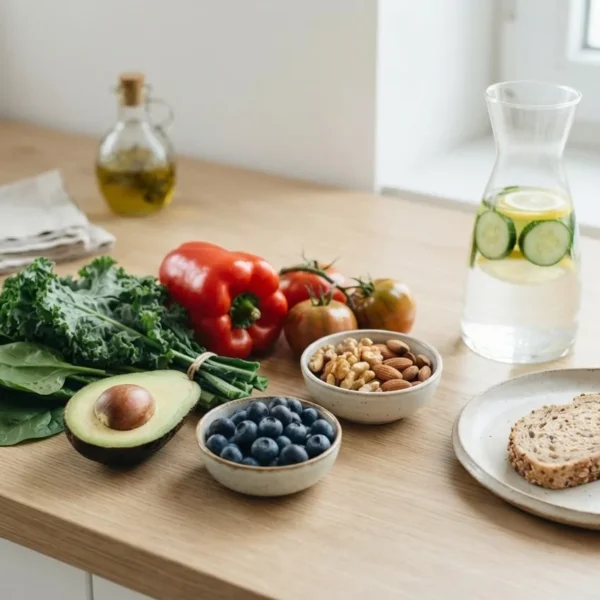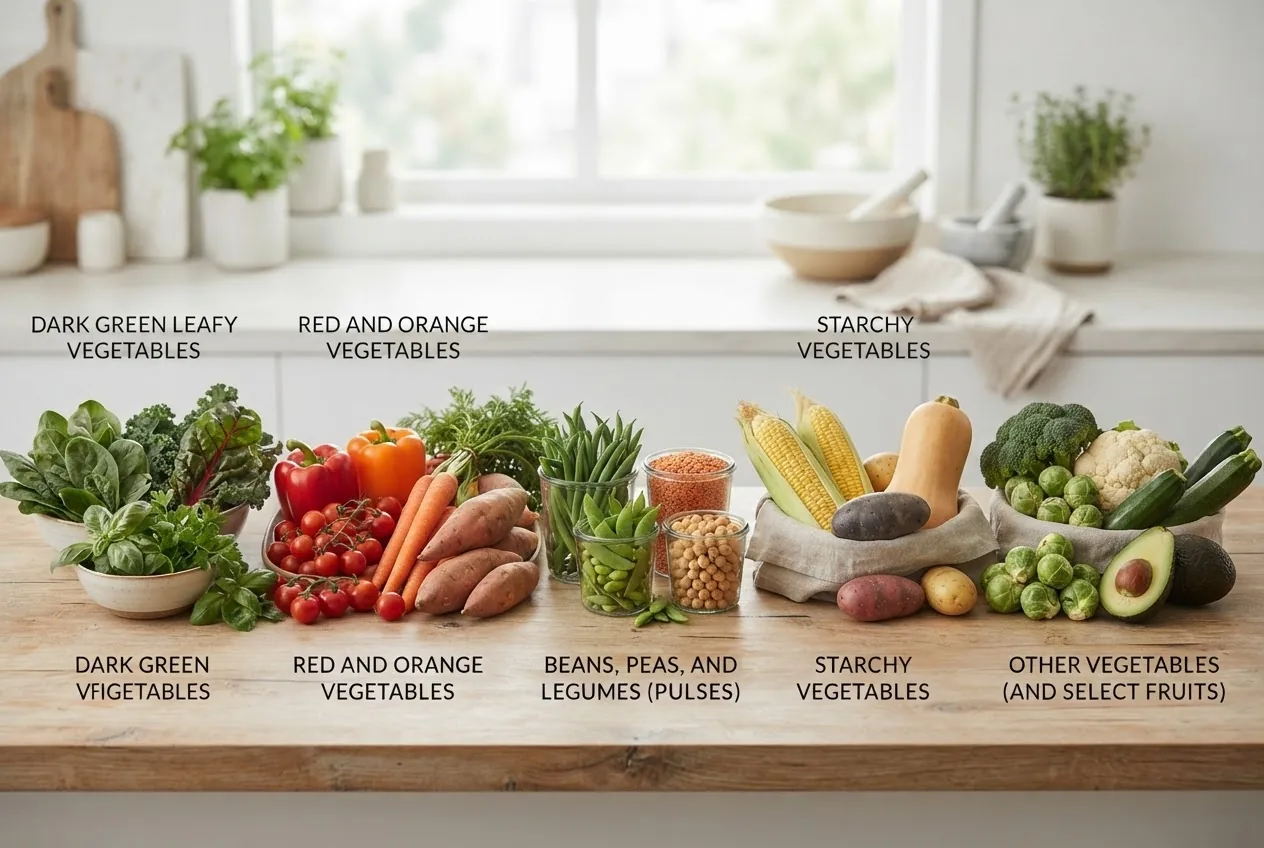
Vegetable group: The vegetable group is the food category composed of edible plant parts—leaves, stems, roots, tubers, bulbs, seeds, and flowers—organized into five USDA subgroups (dark green, red & orange, legumes, starchy, other) that guide portioning and healthy meal planning.
Below you’ll find a clear, expert guide to classification by subgroup, examples, practical uses in Texas cuisine, and how these categories map to botanical and culinary definitions.
What Is the Vegetable Group? An Overview
Answer: The vegetable group is the MyPlate food group that includes edible plant parts grouped by nutrient profiles into five subgroups used for dietary guidance and meal planning.
Term: vegetable group — a dietary classification that organizes edible plants by nutrient contribution (e.g., leafy greens, legumes, starchy roots) for public-health guidance.
The vegetable food group is defined by nutrition frameworks such as the USDA MyPlate system to help people meet daily nutrient needs. According to USDA 2023 guidelines, vegetables are classified into subgroups that reflect similar vitamin, mineral and fiber profiles for clearer serving recommendations. These groupings guide portion targets, meal balance, and public-health messaging.
Vegetables are consumed across cultures for flavor, texture and nutrients: dark green leafy vegetables often supply vitamin K and folate, red and orange vegetables are vitamin A–rich, legumes deliver protein and fiber, starchy vegetables provide energy-dense carbohydrates, and the “other” bucket increases variety and micronutrient coverage.
For a broader look at produce across fruits and vegetables, see fruit types and vegetable groups.
Transition: The USDA organizes vegetables into five distinct subgroups—each with specific examples and nutritional roles—explained next.
The Five Vegetable Subgroups Explained
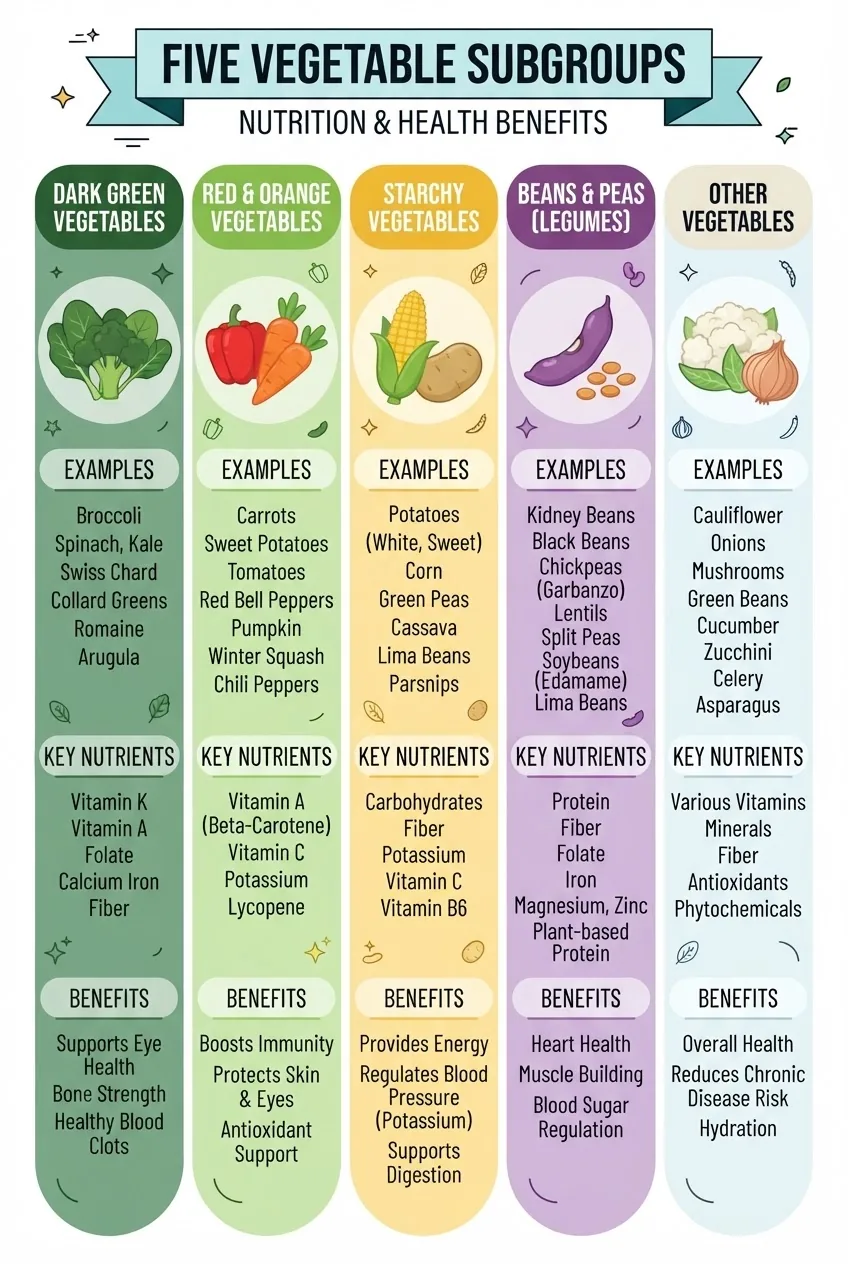
Answer: The five vegetable subgroups are dark green, red & orange, legumes (beans and peas), starchy vegetables, and other vegetables—each defined by typical nutrient contributions and culinary uses.
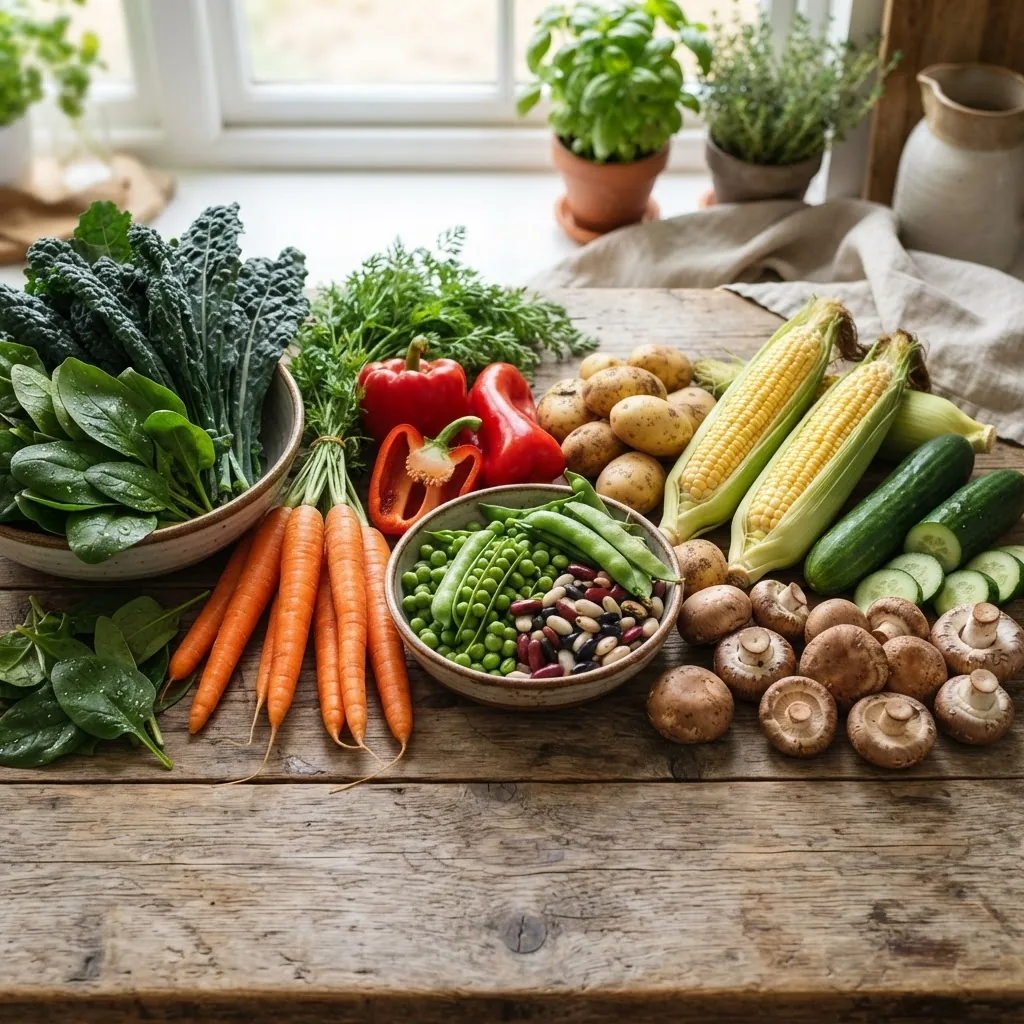
The USDA’s subgroup framework groups vegetables to simplify meeting recommended daily amounts and to highlight which vegetables provide key nutrients. According to USDA 2023 guidelines, these five subgroups are used in food-based dietary guidance to ensure variety and adequate intake of vitamins, minerals and fiber.
-
1. Dark Green Vegetables
Answer: Dark green vegetables are leafy or green stalk vegetables high in vitamins K, A (as carotenoids), folate and minerals like calcium and iron.
Term: dark green vegetables — vegetables with deep green color indicating higher levels of chlorophyll and often concentrated micronutrients such as vitamin K and folate.
Dark green vegetables are emphasized because they deliver nutrients that support blood clotting, bone health and fetal development. According to a 2024 industry report summarizing nutrient density studies, dark greens consistently rank among the most nutrient-dense vegetable foods.
- Examples: spinach, kale, collard greens, Swiss chard, romaine lettuce, arugula, bok choy, broccoli, and turnip greens.
- Learn more: broccoli nutrition details
Nutritional role: high in vitamin K, vitamin A precursors, folate, fiber and often calcium; beneficial for bone health, blood coagulation and supporting low-calorie nutrient density.
-
2. Red and Orange Vegetables
Answer: Red and orange vegetables are rich in provitamin A carotenoids (beta-carotene) and antioxidants that promote vision health and immune function.
Term: red and orange vegetables — vegetables whose pigments (carotenoids) convert to vitamin A in the body and provide antioxidants.
These vegetables are singled out in dietary guidance because of their vitamin A contribution; adequate vitamin A supports vision, epithelial tissue health and immunity. A 2023 review of carotenoid intake linked higher consumption with improved visual function in at-risk populations.
- Examples: carrots, sweet potatoes, red bell peppers, butternut squash, pumpkin, red tomatoes, and cantaloupe (botanically a fruit but often grouped culinarily).
Practical note: cooking orange vegetables (like sweet potatoes) often increases carotenoid bioavailability; pair with a small amount of fat to aid absorption.
-
3. Legumes (Beans and Peas)
Answer: Legumes are seed-bearing plants—beans, peas and lentils—valued for plant-based protein, soluble fiber and micronutrients like iron and folate.
Term: legumes — plants in the family Fabaceae whose seeds (beans, peas, lentils, chickpeas) are nutrient-dense sources of protein and fiber.
Legumes are treated as a vegetable subgroup by USDA but can also count as a protein source because of their higher protein content; they are recommended for both their fiber and plant-protein benefits. According to a 2022 meta-analysis in a peer-reviewed nutrition journal, regular legume intake is associated with lower LDL cholesterol and improved glycemic control.
- Examples: black beans, pinto beans, navy beans, kidney beans, chickpeas (garbanzo beans), lentils, green peas, and edamame.
- Ambiguous cases: green beans classification explained
- Extra: canned and dried legumes are both valid pantry staples that vary in cooking time and sodium content.
Nutritional role: high in soluble and insoluble fiber, plant protein, iron and folate; legumes support satiety, digestive health, and heart-healthful cholesterol profiles.
-
4. Starchy Vegetables
Answer: Starchy vegetables are higher in digestible carbohydrates (starch) and provide concentrated energy, B vitamins and minerals; portion control matters for caloric balance.
Term: starchy vegetables — root and tuber vegetables (and some seeds like corn) with higher starch content and calorie density compared to non-starchy types.
Starchy vegetables include potatoes and corn, which provide fuel and micronutrients like potassium and B vitamins. The USDA includes them as a separate subgroup because frequent intake can substantially increase total carbohydrate and calorie intake if portion sizes are large. According to a 2023 dietary survey report, starchy vegetables are often the most overconsumed vegetable subgroup in Western diets.
- Examples: white potatoes (baked, mashed), sweet potatoes, corn, plantains, yams, and cassava (in global contexts).
Usage tip: when tracking energy intake, consider portioning starchy vegetables alongside non-starchy vegetables to balance macronutrients.
-
5. Other Vegetables
Answer: The “other vegetables” subgroup contains diverse vegetables that don’t fit the other four categories, providing variety and additional micronutrients and textures.
Term: other vegetables — a catch-all USDA subgroup including all vegetables not classified as dark green, red & orange, legumes, or starchy.
This subgroup preserves dietary variety and includes many commonly used vegetables for flavor and bulk without high starch or concentrated carotenoids. According to a 2021 food-survey analysis, increasing “other” vegetable variety correlates with improved meal satisfaction and micronutrient coverage.
- Examples: cucumbers, onions, garlic, mushrooms (fungi, culinarily treated as vegetables), zucchini, eggplant, celery, and cabbage.
- Reference: cabbage calories and nutrition
Note: some items like tomatoes and avocados are botanically fruits but culinarily treated as vegetables; classification depends on context.
Transition: With subgroup definitions and examples covered, the next section maps how culinary and botanical categories align with these food categories.
Categories of Vegetables Within the Vegetable Group
Answer: Vegetable categories can be described botanically (plant parts) and culinarily (how they’re used in cooking); the USDA subgroups primarily reflect nutrient profiles rather than strict botanical definitions.
Term: botanical vs culinary vegetable classifications — botanical: based on plant anatomy (root, stem, leaf, flower, fruit, seed); culinary: based on flavor, preparation and meal use.
Botanical classification divides plant foods into roots (carrots), tubers (potatoes), bulbs (onions), leaves (lettuce), stems (asparagus), flowers (broccoli), seeds (peas) and fruits (tomatoes, cucumbers). Culinary categories group by use—salad greens, roasting vegetables, pickles, and so on. The USDA vegetable subgroups overlay this by grouping foods with similar nutrient contributions to simplify serving guidance.
| Comparison | Botanical | Culinary / USDA Subgroup Alignment |
|---|---|---|
| Basis | Plant anatomy (root, stem, leaf, flower, seed, fruit) | Nutrient profile and typical consumption (dark green, red & orange, legumes, starchy, other) |
| Example: tomato | Botanical fruit (contains seeds) | Culinary vegetable; often categorized in red & orange vegetables |
| Example: pea | Botanical seed | Culinary vegetable; USDA places many peas in legumes subgroup |
| Example: potato | Botanical tuber (stem tissue) | Culinary starchy vegetable subgroup |
Practical implication: when planning meals, use culinary grouping for recipes and USDA subgrouping for nutrition goals; both views are useful. For botanical-vs-culinary clarity using an example, see an avocado case study.
Compare classifications: fruit vs vegetable classification.
Transition: Understanding categories is helpful, but the next section lays out targeted nutritional benefits and serving guidance for each subgroup aligned with CDC and USDA recommendations.
Nutritional Benefits and Serving Recommendations for Each Vegetable Subgroup
Answer: Each subgroup supplies characteristic nutrients—dark greens (vitamin K, folate), red & orange (vitamin A carotenoids), legumes (protein, fiber), starchy (energy, potassium), and other (varied micronutrients)—and USDA/CDC recommend daily servings distributed across subgroups for balance.
As reported in 2023 CDC recommendations, adults should aim for 2–3 cups of vegetables per day depending on age, sex and activity level; the USDA MyPlate framework offers subgroup-based advice to reach those cups with variety. Below are practical serving recommendations and key nutrients for each subgroup.
-
Dark Green Vegetables — Serving & Key Nutrients
- Suggested serving: at least 1–2 cups per week as part of a balanced intake; aim for several servings across the week to meet vitamin K and folate needs.
- Key nutrients: vitamin K, folate, vitamin A precursors, vitamin C, calcium, iron, fiber.
- Health benefits: bone health, reduced neural-tube defect risk in pregnancy, improved nutrient density of meals.
- Source note: According to USDA 2023 guidelines, including dark greens weekly supports recommended folate intake.
-
Red & Orange Vegetables — Serving & Key Nutrients
- Suggested serving: include several cups per week; aim for a serving with meals 3–5 times weekly to boost vitamin A precursors.
- Key nutrients: beta-carotene (vitamin A precursor), vitamin C, potassium, antioxidants.
- Health benefits: supports eye health, epithelial tissue maintenance, and immune function.
-
Legumes — Serving & Key Nutrients
- Suggested serving: 1–3 cups equivalent per week within the vegetable group; can also count toward weekly protein needs.
- Key nutrients: plant-based protein, soluble fiber, iron, folate, magnesium.
- Health benefits: lowers LDL cholesterol, improves glycemic control and increases satiety (according to a 2022 meta-analysis of legume interventions).
-
Starchy Vegetables — Serving & Key Nutrients
- Suggested serving: moderate intake; USDA suggests balancing starchy vegetables with non-starchy types to manage total caloric intake.
- Key nutrients: digestible carbohydrates, potassium, vitamin C (for some tubers), B vitamins.
- Health benefits and cautions: provide energy and important minerals but may increase calorie and carb load—important to portion consciously for weight or glycemic goals.
- Context: see potato guidance for classification and serving notes.
-
Other Vegetables — Serving & Key Nutrients
- Suggested serving: fill remaining vegetable cups with “other” vegetables to broaden phytonutrient intake and meal variety.
- Key nutrients: variable—vitamins C and K, various minerals, fiber, and phytochemicals depending on the item.
- Health benefits: promotes microbiome diversity through fiber variety and provides flavor and texture to meet overall vegetable cup targets.
Serving-size clarity: USDA defines one cup raw leafy vegetables as 1 cup, but 2 cups raw leafy greens count as a single cup-equivalent for MyPlate calculations in some contexts; check specific serving rules for leafy greens. For individualized guidance, consult a registered dietitian because needs vary by age, sex and activity level.
For trade-offs and common concerns, see health effects of vegetables.
Transition: Below are common vegetables used in Texas cooking and how they map to these subgroups and uses.
Vegetables Commonly Found and Used in Texas Cuisine
Answer: Texas cuisine commonly uses jalapeños, sweet corn, tomatoes, onions, okra, black beans, and sweet potatoes—covering dark green, red & orange, legumes, starchy, and other subgroups in regional dishes.
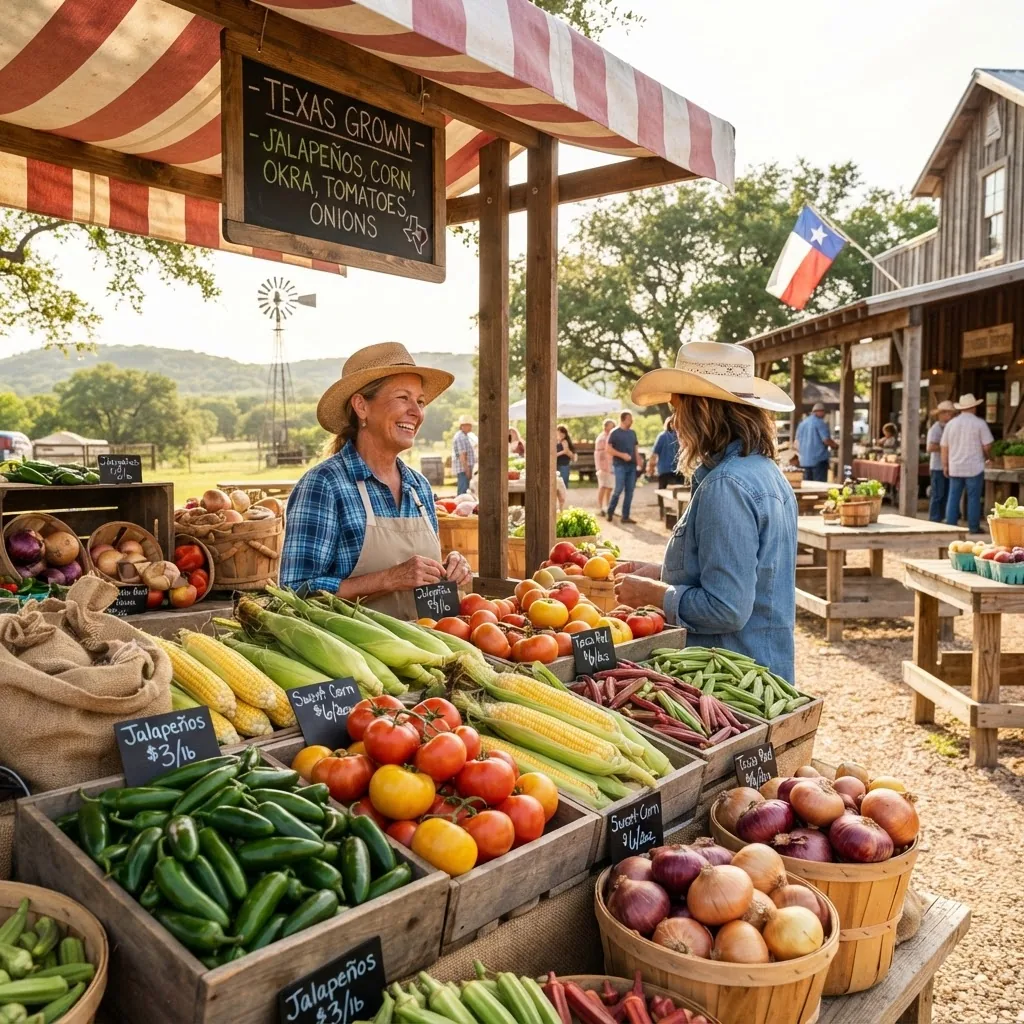
Texas cooking blends Southern, Mexican, and Southwestern influences, favoring bold flavors and produce that grows well in the state’s climate. Below are common Texas vegetables with subgroup classification and typical uses:
- Jalapeños — culinary vegetable used for heat; subgroup: other vegetables (capsaicin-rich, antioxidant benefits).
- Sweet corn — subgroup: starchy vegetable; used grilled, boiled, or in salads and salsas.
- Tomatoes — subgroup: red & orange (culinary vegetable though botanically a fruit); essential in salsas, stews and salads.
- Onions and garlic — subgroup: other vegetables; flavor bases in virtually every savory Texas dish.
- Okra — subgroup: other vegetables; used in gumbo, fried preparations and stews for texture.
- Black beans and pinto beans — subgroup: legumes; foundational protein and fiber sources in Tex-Mex and southern plates.
- Sweet potatoes — subgroup: starchy vegetables; used in sides, casseroles and desserts.
- Leafy greens (collards, kale) — subgroup: dark green; commonly braised or served as side dishes.
Experience signal: local produce availability shifts seasonally across Texas; summer farmers markets highlight tomatoes, corn and jalapeños, while fall sees sweet potatoes and collards. Including these regional staples helps meet subgroup targets while keeping recipes culturally relevant.
Usage notes: Many Texas recipes pair legumes and starchy vegetables (beans with corn) to create balanced protein and energy combinations—use portioning strategies described later to keep meals nutritious.
Transition: Next, practical steps to incorporate all vegetable subgroups into daily meals with easy swaps, prep tips and meal examples.
How to Incorporate Vegetable Subgroups Into Your Daily Diet
Answer: Build daily meals by aiming for variety—include at least one item from three different subgroups per major meal, use legume-based sides, swap starchy portions with non-starchy vegetables, and prep vegetables for grab-and-go use.
Practical, experience-based steps below help translate subgroup targets to a realistic meal plan for busy households, with Texas-friendly examples.
-
Plan meals around color and subgroup balance
Step: Aim for at least 3 vegetable subgroup appearances across breakfast, lunch and dinner. Example: breakfast with sautéed spinach (dark green), lunch salad with tomatoes (red & orange) and chickpeas (legumes), dinner with roasted sweet potato (starchy) and sautéed onions (other).
-
Use legumes as protein and vegetable
Step: Replace half the meat in a taco or chili with black beans to boost fiber and meet a legume serving; this lowers saturated fat and adds volume. Canned beans are convenient—rinse to reduce sodium.
Tip: For weight-focused plans, try pairing fruits and vegetables for weight loss strategies—combine high-fiber vegetables with low-calorie fruit snacks to increase satiety.
-
Prep and store vegetables for convenience
Step: Roast batches of mixed “other” vegetables, wash and chop dark greens, and portion starchy vegetables for reheating. According to a 2023 consumer-behavior report, meal prepping increases vegetable intake by up to 25% among busy adults.
Learn safe cooking methods: vegetable preparation and cooking tips.
-
Swap and combine for balance
Step: When a recipe calls for a starchy vegetable side, halve the portion and add a dark green side salad to increase nutrient density without adding many calories.
-
Use simple seasoning to boost appeal
Step: Grill vegetables with a squeeze of citrus and chili for Texas-style flavor; use herbs, chiles and citrus to highlight natural tastes instead of heavy sauces.
-
Track servings the easy way
Step: Use hand portions—one cupped hand=about 1 cup of cooked vegetables; two cupped hands for leafy greens—and aim to fill half your plate with vegetables at lunch and dinner per MyPlate guidance (as echoed by CDC recommendations in 2023).
Meal example for a day (Texas-inspired): breakfast: scrambled eggs with spinach (dark green) and sautéed onions (other); lunch: grilled chicken salad with tomatoes (red & orange), corn (starchy), black beans (legumes); dinner: roasted sweet potato (starchy), braised collards (dark green) and grilled jalapeño salsa (other).
Transition: Final section summarizes the practical health takeaways and encourages actionable next steps.
Summary and Key Takeaways on the Vegetable Group and Its Subgroups
Answer: The vegetable group is organized into five USDA subgroups—dark green, red & orange, legumes, starchy, and other—to guide balanced intake; aim for variety across subgroups to maximize nutrient coverage and use Texas produce to make it culturally relevant.
Key takeaways:
- Follow USDA subgroup guidance to ensure a range of vitamins, minerals and fiber.
- Include dark green and red/orange vegetables regularly for vitamin K and provitamin A.
- Use legumes for plant protein and fiber; treat starchy vegetables as energy sources to portion deliberately.
- Balance culinary norms (botanical vs culinary) with nutrient-driven subgroup goals; consult CDC and USDA recommendations when setting daily targets.
Final call to action: Start your week by selecting one local Texas vegetable from each subgroup to add to meals—small, consistent changes produce measurable benefits. For deeper lists and images, check the comprehensive vegetable list with pictures.